

Organizations need to identify security weaknesses before attackers can exploit them. Faster development cycles, cloud adoption, APIs, and interconnected systems have made penetration testing an important part of security validation. Providers differ in their testing expertise, methodologies, coverage, reporting, and support for remediation and retesting.
When evaluating a penetration testing partner in 2026, organizations should consider tester expertise, testing scope, manual testing capabilities, methodology, evidence quality, reporting, compliance experience, scalability, remediation support, and retesting. The right criteria depend on the organization’s technology environment, security objectives, and risk requirements.
Why Choosing the Right Partner Matters
The quality of a penetration test affects how effectively an organization can identify and address security risks. A limited scope, shallow testing, or insufficient evidence can leave vulnerabilities undiscovered and make remediation more difficult. A well-planned assessment provides security teams with useful details about affected assets, exploitability, potential impact, and issues that require attention.
The provider also influences how well penetration testing fits into the broader security program. Testing frequency, communication throughout the engagement, compliance requirements, reporting quality, remediation support, and retesting can all affect the value of the assessment.
Growing Application, API, Cloud, and AI Attack Surfaces
Modern attack surfaces span web applications, APIs, cloud infrastructure, mobile platforms, networks, and AI-enabled systems. Testing expertise should match the technologies and integrations present in the organization’s environment.
Testing may need to examine:
- Authentication and session controls
- Authorization and privilege boundaries
- Business logic
- API access controls
- Cloud identity and permissions
- Infrastructure exposure
API security testing helps identify weaknesses in authentication, authorization, and API access controls. API penetration testing can complement broader application security assessments.
What Does a Penetration Testing Partner Do?
A penetration testing partner manages the security testing engagement from planning and scoping through testing, reporting, remediation, and retesting. The provider defines testing boundaries, identifies attack surfaces, validates vulnerabilities, documents evidence, and explains the potential business impact of significant findings.
Depending on the engagement, the provider can assess web applications, APIs, mobile applications, cloud environments, networks, infrastructure, and emerging technologies. The final report should provide security teams with clear findings, supporting evidence, risk context, and practical remediation recommendations. The penetration testing process typically covers reconnaissance, vulnerability identification, exploitation, reporting, and remediation.
Penetration Testing vs Vulnerability Scanning
Both approaches identify security weaknesses; they serve different purposes:
| Factor | Vulnerability Scanning | Penetration Testing |
| Primary Goal | Identify known vulnerabilities | Validate exploitability and security impact |
| Approach | Primarily automated | Manual and automated |
| Testing Depth | Broad vulnerability coverage | In-depth security assessment |
| Business Logic | Limited | Evaluated through manual testing |
| Attack Paths | Limited visibility | Identifies and validates attack paths |
| Output | Vulnerability findings and risk ratings | Validated vulnerabilities, evidence, impact, and remediation guidance |
If you’d like to explore this in more depth, check out our complete guide on Penetration Testing vs Vulnerability Scanning.
Human-Led Testing vs Automated Security Testing
Automation improves testing speed, repeatability, and coverage. Human expertise provides context, creativity, and the ability to investigate complex security behavior.
Experienced penetration testers can:
- Analyze application and system behavior.
- Test authentication and authorization controls.
- Identify business logic vulnerabilities.
- Validate high-risk vulnerabilities through controlled exploitation.
- Chain multiple weaknesses into realistic attack paths.
- Assess the effectiveness of security controls.
How Penetration Testing Supports Risk Reduction and Compliance
Penetration testing helps organizations identify security weaknesses that pose the greatest risk and understand how they could affect critical assets. The findings provide technical evidence that security teams can use to prioritize remediation based on exploitability, potential business impact, and the affected systems.
Penetration testing can also support compliance and security assurance programs by documenting the assessment scope, identified vulnerabilities, remediation activities, and retesting results. When selecting a provider, organizations should verify that its testing scope, methodology, reporting practices, and tester credentials align with the requirements of relevant regulatory or compliance frameworks.
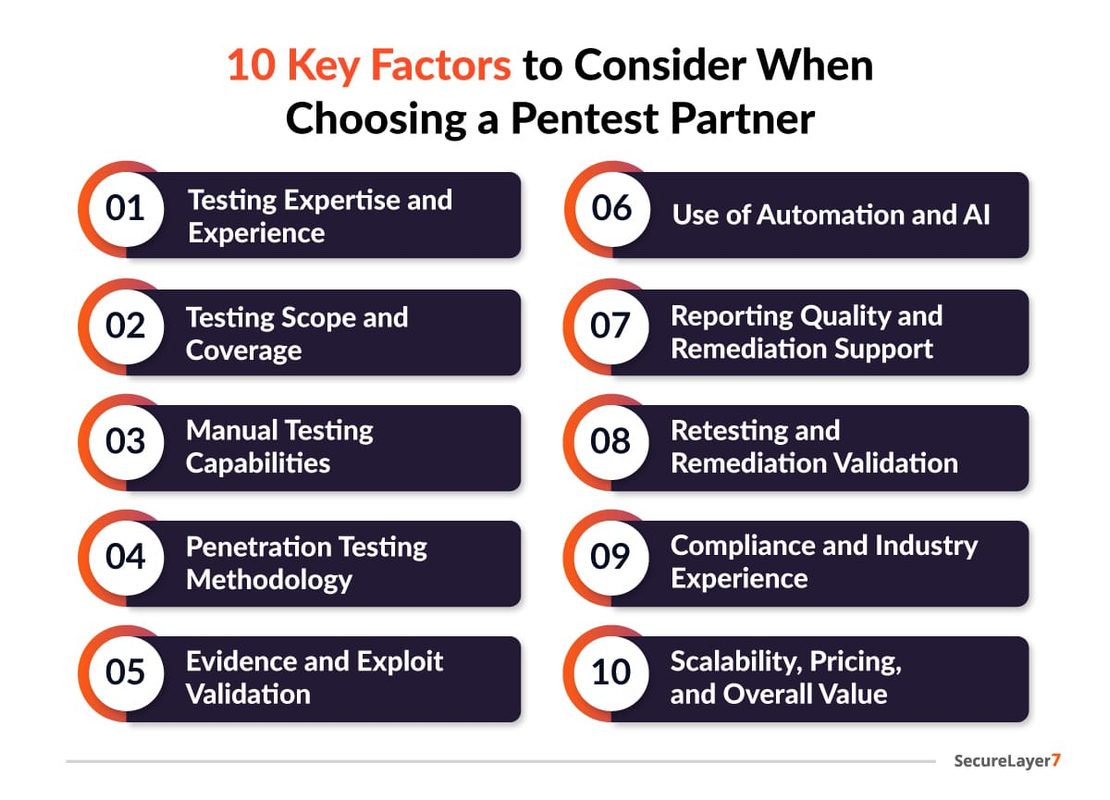
10 Key Factors to Consider When Choosing a Pentest Partner
Choosing the right penetration testing partner requires more than comparing service prices. Organizations should evaluate technical expertise, testing depth, security coverage, reporting quality, compliance experience, and the provider’s ability to support changing technology environments.
1. Testing Expertise and Experience
The quality of a penetration test depends heavily on the people conducting the assessment.
Evaluate the testing team has practical experience with:
- Your technology stack
- Your application architecture
- Cloud environments
- APIs
- Mobile applications
- Network infrastructure
- Security controls
- Relevant attack techniques
Mobile application assessments require specialized testing techniques covering application binaries, authentication, data storage, APIs, and application behavior, which are addressed through mobile application penetration testing.
2. Testing Scope and Coverage
Choose a provider that can assess your key attack surfaces, including:
- Web applications
- APIs
- Mobile applications
- Cloud environments
- Networks and infrastructure
- AI and LLM applications, where applicable
3. Manual Testing Capabilities
Automated scanning provides useful vulnerability coverage, but manual testing is essential for deeper security validation. Confirm that the provider performs:
- Manual vulnerability validation
- Exploit verification
- Attack-path analysis
- Business logic testing
4. Penetration Testing Methodology
Review the provider’s methodology from initial assessment through remediation. For web applications, web application penetration testing combines reconnaissance, vulnerability assessment, manual testing, exploitation, and security validation to identify weaknesses that automated scanning can overlook.
A structured process should cover:
- Reconnaissance and attack-surface discovery
- Vulnerability identification
- Controlled exploitation and validation
- Risk and impact assessment
- Reporting and remediation guidance
- Retesting after remediation
5. Evidence and Exploit Validation
A useful penetration testing report should demonstrate why a vulnerability is important.
Look for findings supported by evidence such as:
- Reproduction details
- Technical screenshots
- Request and response information
- Proof-of-concept evidence
- Exploitation results
- Affected assets
- Attack paths
- Business impact
6. Use of Automation and AI
Automation and AI can improve penetration testing efficiency when used appropriately.
Providers may use these technologies for:
- Attack-surface discovery
- Vulnerability identification
- Pattern analysis
- Testing assistance
- Large-scale enumeration
- Risk prioritization
- Reporting support
7. Reporting Quality and Remediation Support
The value of a penetration test depends partly on whether teams can understand and remediate the findings.
A useful penetration testing report should include:
- Clear vulnerability descriptions
- Severity
- Technical impact
- Business impact
- Evidence
- Affected systems
- Reproduction information
- Remediation recommendations
- Executive-level summaries where required
8. Retesting and Remediation Validation
Penetration testing should not necessarily end when the initial report is delivered.
Retesting helps confirm whether vulnerabilities have been successfully remediated.
Evaluate:
- Whether retesting is included
- How long the retesting window remains available
- Whether partial fixes are reviewed
- How reopened findings are handled
- Updated reports are provided
- Remediation questions can be discussed with testers
9. Compliance and Industry Experience
Organizations operating in regulated industries should evaluate whether the provider understands the security requirements relevant to their environment.
These may include:
- PCI DSS
- SOC 2
- ISO 27001
- Financial-sector security requirements
- Healthcare security requirements
- Government security requirements
- Customer security-assurance requirements
10. Scalability, Pricing, and Overall Value
Price is important, but it should not be evaluated independently from testing quality.
Compare providers based on:
- Testing depth
- Tester expertise
- Number of assets
- Complexity of the environment
- Engagement duration
- Reporting quality
- Remediation support
- Retesting
- Delivery timelines
- Scalability
Penetration Testing Partner Evaluation Checklist
Use the following checklist when comparing penetration testing providers.
- Relevant testing expertise: Experience with the organization’s technology stack, architecture, industry, and security requirements.
- Qualified testing team: Experienced testers with relevant technical credentials and specialization.
- Required testing coverage: Support for web, API, mobile, cloud, network, infrastructure, container, AI, or other required environments.
- Manual testing capabilities: Human-led vulnerability analysis, business logic testing, controlled exploitation, and attack-path analysis.
- Proven methodology: A documented testing process covering scoping, discovery, validation, exploitation, reporting, remediation, and retesting.
- Evidence quality: Clear proof demonstrating exploitability, technical impact, and affected systems.
- Automation and AI capabilities: Effective technology use that improves testing efficiency without replacing essential human analysis.
- Quality reporting: Clear findings with severity, evidence, impact, and actionable remediation guidance.
- Remediation support: Access to testers or security specialists for clarification and remediation discussions.
- Scalability and value: Ability to support changing scopes, multiple assets, business growth, and appropriate testing frequency at a sustainable cost.
How to Choose the Right Partner for Your Organization
Selecting a penetration testing partner begins with understanding the organization’s own requirements. Instead of asking which company is universally the best, security leaders should ask which provider best matches their environment, risk profile, technology stack, testing objectives, and security maturity.
Define the Asset Landscape
Identify the systems that require testing.
- Customer-facing applications
- APIs
- Mobile applications
- Cloud workloads
- Internal networks
- External infrastructure
Evaluate Testing Depth
Ask whether the assessment includes:
- Business logic testing
- Authorization testing
- Exploit validation
- Attack-path analysis
- Vulnerability chaining
- Manual verification
Evaluate Evidence Quality
High-quality security findings should provide enough evidence for technical teams to understand and reproduce the issue.
Look for:
- Clear technical proof
- Exploitation evidence
- Business impact
- Attack scenarios
- Affected assets
- Remediation recommendations
Consider Regulatory and Compliance Requirements
Determine which security frameworks or regulatory requirements apply to the organization.
Then confirm whether the provider has experience delivering assessments that support those requirements.
- Scope definition
- Testing methodology
- Required evidence
- Reporting format
- Retesting
- Documentation for audits
Review Sample Reports, Case Studies, and References
Request sample deliverables where available and check whether the reports provide enough technical detail for engineers and clear risk context for security leaders.
Relevant case studies, customer references, independent accreditation, security research, and publicly documented expertise can provide additional insight into the provider’s capabilities.
Compare Overall Value Rather Than Price Alone
The cheapest provider is not necessarily the best-value provider.
Evaluate:
- Testing quality
- Security expertise
- Methodology
- Evidence
- Reporting
- Communication
Why Consider SecureLayer7 as a Penetration Testing Partner?
Organizations evaluating SecureLayer7 should assess it against the same criteria used for any other penetration testing provider: testing methodology, tester expertise, coverage, evidence quality, reporting, remediation support, retesting, and overall fit.
SecureLayer7 provides penetration testing across application and infrastructure environments with an emphasis on expert-led security assessment and practical vulnerability validation.
Comprehensive Security Testing
SecureLayer7 provides penetration testing across applications and infrastructure, helping organizations assess security risks across critical attack surfaces.
Key testing areas include:
- Web application penetration testing
- API penetration testing
- Mobile application security testing
- Cloud security testing
- Network and infrastructure penetration testing
Expert-Led Manual Testing
SecureLayer7 combines security testing tools with manual penetration testing.
Manual analysis can help investigate:
- Authentication weaknesses
- Authorization issues
- Business logic flaws
- API abuse
- Privilege-escalation opportunities
- Vulnerability chains
Structured Testing Methodology
A structured methodology helps ensure assessments progress from reconnaissance and vulnerability discovery through validation, exploitation, reporting, remediation, and retesting.
Organizations evaluating SecureLayer7 should review the proposed methodology for the specific engagement and confirm how testing will be adapted to their technology stack and risk profile.
Actionable Reporting and Evidence
Security findings need to provide enough context for teams to understand the vulnerability and its potential impact.
SecureLayer7’s penetration testing engagements can provide technical findings, supporting evidence, risk context, and remediation recommendations to help security and development teams prioritize fixes.
Organizations should review sample deliverables during vendor evaluation to confirm that the reporting depth meets their internal requirements.
Conclusion
Choosing a penetration testing partner in 2026 requires looking beyond the number of services a provider offers. Organizations need to consider whether the provider can identify exploitable vulnerabilities, validate security controls, and assess risks across applications, APIs, cloud environments, networks, and AI systems.
Key evaluation factors include tester expertise, testing methodology, assessment depth, technology coverage, compliance experience, reporting quality, remediation guidance, retesting, scalability, and overall service fit. Reviewing these areas helps security teams compare providers based on their actual requirements rather than relying only on pricing or brand recognition.
SecureLayer7 provides penetration testing for web applications, APIs, mobile applications, cloud environments, networks, and infrastructure. Its testing approach combines manual assessment with security tools to investigate vulnerabilities, validate attack paths, and provide remediation guidance.
Contact SecureLayer7 to assess your security risks and strengthen your defenses.
Frequently Asked Questions (FAQs)
Start by defining the assets, technologies, business risks, compliance requirements, and testing objectives involved. Then compare providers based on tester expertise, methodology, testing depth, manual testing capabilities, evidence quality, reporting, remediation support, retesting, scalability, and overall value.
Look for experienced security professionals, relevant technical expertise, structured testing methodologies, broad attack-surface coverage, strong manual testing capabilities, clear reporting, exploit evidence, remediation guidance, retesting, and experience with environments similar to yours.
Penetration testing costs vary depending on the number of assets, application complexity, testing scope, environment type, testing depth, engagement duration, tester expertise, compliance requirements, and whether retesting is included. Organizations should compare the scope and quality of each proposal rather than evaluating price alone.
Relevant certifications depend on the type of testing required. Organizations can evaluate tester qualifications from recognized offensive security and penetration testing certification bodies alongside practical experience, research expertise, methodology, and previous engagement experience.
The two approaches serve different purposes. Automated scanning provides broad and repeatable vulnerability discovery, while manual penetration testing can identify business logic flaws, authorization weaknesses, attack chains, and vulnerabilities requiring contextual analysis.

