
Organizations face a growing range of cyber threats that can expose sensitive data, disrupt business operations, and affect customer trust. To manage these risks, businesses commonly use both risk assessments and vulnerability assessments as part of their cybersecurity programs. A risk assessment looks at potential threats, the likelihood of those threats occurring, and the impact they could have on business assets.
A vulnerability assessment takes a more technical approach. It identifies weaknesses in systems, applications, networks, and other IT assets that attackers could potentially exploit. The two assessments have different purposes, they work well together. Combining their findings helps organizations understand which vulnerabilities present the most significant risks, prioritize remediation, support compliance requirements, and improve their overall security.
Importance of Cybersecurity Assessments in Modern Organizations
Web applications, cloud services, and interconnected IT systems to deliver products and services efficiently. They also expose organizations to an ever-growing range of cybersecurity threats, including ransomware, phishing attacks, and insider breaches.
Cybersecurity assessments help organizations identify vulnerabilities, evaluate risks, and implement effective mitigation strategies before attackers can exploit weaknesses. They provide a structured approach to reviewing systems, networks, applications, and processes to ensure that security controls are working effectively.
Rising Need for Risk and Vulnerability Assessment
The need for risk and vulnerability assessments has become more urgent. Organizations face a landscape where attacks are not only frequent but increasingly sophisticated, often combining phishing, social engineering, zero-day exploits, and API-targeted attacks.
- Risk Assessment: Evaluates potential threats and their business impact, helping security leaders prioritize what matters most.
- Vulnerability Assessment: Identifies specific weaknesses in systems, applications, and networks that could be exploited.
What is Risk Assessment
Risk assessment is a structured process used to identify potential threats, understand their impact, and determine how to reduce the associated risks. It helps organizations protect critical assets, systems, and data supporting broader cybersecurity and enterprise risk management efforts.
The process considers both internal and external threats and examines how each one could affect business operations. By assessing the likelihood of a threat and the potential impact, security teams can determine which risks require more attention.
Learn how an effective information security risk management process helps organizations identify and prioritize security risks.
How Risk Assessment Identifies Potential Threats and Their Impact
Risk assessment involves evaluating the likelihood of various threats and the potential consequences if those threats materialize. It considers:
- Internal and External Threats: From insider errors and misconfigurations to external cyberattacks like phishing, malware, and ransomware.
- Asset Value: Assessing the importance of systems, data, and infrastructure in business operations.
- Impact Analysis: Estimating the financial, operational, reputational, and compliance consequences of potential threats.
Role in Prioritizing Mitigation Strategies
A critical function of risk assessment is to prioritize security efforts. Not all vulnerabilities or threats have the same impact, and resources are often limited. Risk assessment helps organizations:
- Focus on high-impact risks first, ensuring critical systems and data are protected.
- Allocate resources efficiently, avoiding unnecessary expenditure on low-priority risks.
- Guide decision-making for security policies, investments, and compliance initiatives.
- Establish a continuous risk management framework, allowing organizations to adapt to evolving threats.
Examples of Risk Assessment in IT and Cybersecurity
Risk assessment is widely applied in IT and cybersecurity environments to proactively manage threats:
- IT Infrastructure Risk Assessment: Evaluating servers, network devices, and cloud infrastructure to identify vulnerabilities, misconfigurations, or outdated software that could be exploited.
- Web Application Risk Assessment: Identifying risks associated with user authentication, input validation, session management, APIs, and third-party components.
- Third-Party Vendor Risk Assessment: Assessing external partners’ systems and processes to ensure they do not introduce vulnerabilities into the organization’s environment.
What is Vulnerability Assessment?
A vulnerability assessment is a systematic process for identifying weaknesses in systems, applications, and networks that attackers could exploit. It focuses on technical issues such as misconfigurations, outdated software, insecure APIs, and improper access controls. The findings help security teams understand where weaknesses exist and determine what needs to be fixed.
Which looks at potential threats and their impact on business operations, vulnerability assessment takes a more technical approach. It examines specific weaknesses and provides information that can guide remediation efforts.
Explore how a network vulnerability assessment helps identify security weaknesses across network infrastructure.
Focus on Identifying Weaknesses in Systems, Applications, Networks
Vulnerability assessment focuses on detecting technical weaknesses across an organization’s IT environment. Key areas of focus include:
- Systems: Servers, endpoints, and network devices that may have misconfigurations, outdated patches, insecure default settings.
- Applications: Web, mobile, and desktop applications, including APIs, third-party libraries, and custom code.
- Networks: Internal and external networks for open ports, weak firewall rules, or unsecured protocols.
Types of Vulnerabilities Commonly Detected
Vulnerability assessments uncover a wide range of security weaknesses. Understand the vulnerability management lifecycle from discovery and prioritization to remediation and continuous monitoring.
- Software Flaws: Unpatched applications or outdated software libraries.
- Configuration Weaknesses: Misconfigured servers, APIs, or cloud services.
- Authentication and Authorization Issues: Weak passwords, improper role assignments, or missing multi-factor authentication.
- Injection Vulnerabilities: SQL injection, NoSQL injection, command injection, and cross-site scripting (XSS).
- Network Weaknesses: Open ports, weak encryption, and unsecured network protocols.
Examples of Vulnerability Assessments in Practice
Vulnerability assessments are applied across multiple environments to enhance security:
- Web Application Vulnerability Scans: Using tools like OWASP ZAP, Burp Suite, or Acunetix, security teams identify common application flaws such as XSS, SQL injection, and broken authentication. See how web application penetration testing helps validate vulnerabilities through real-world attack scenarios.
- Network Vulnerability Assessment: Scanning internal and external networks with tools like Nessus or OpenVAS to detect misconfigured firewalls, open ports, and outdated network devices.
- Cloud Infrastructure Assessment: Evaluating cloud environments to uncover misconfigurations, weak IAM policies, or exposed storage buckets.
- Endpoint Security Assessment: Checking laptops, desktops, and mobile devices for missing patches, weak encryption, and insecure software configurations.
Risk Assessment vs Vulnerability Assessment
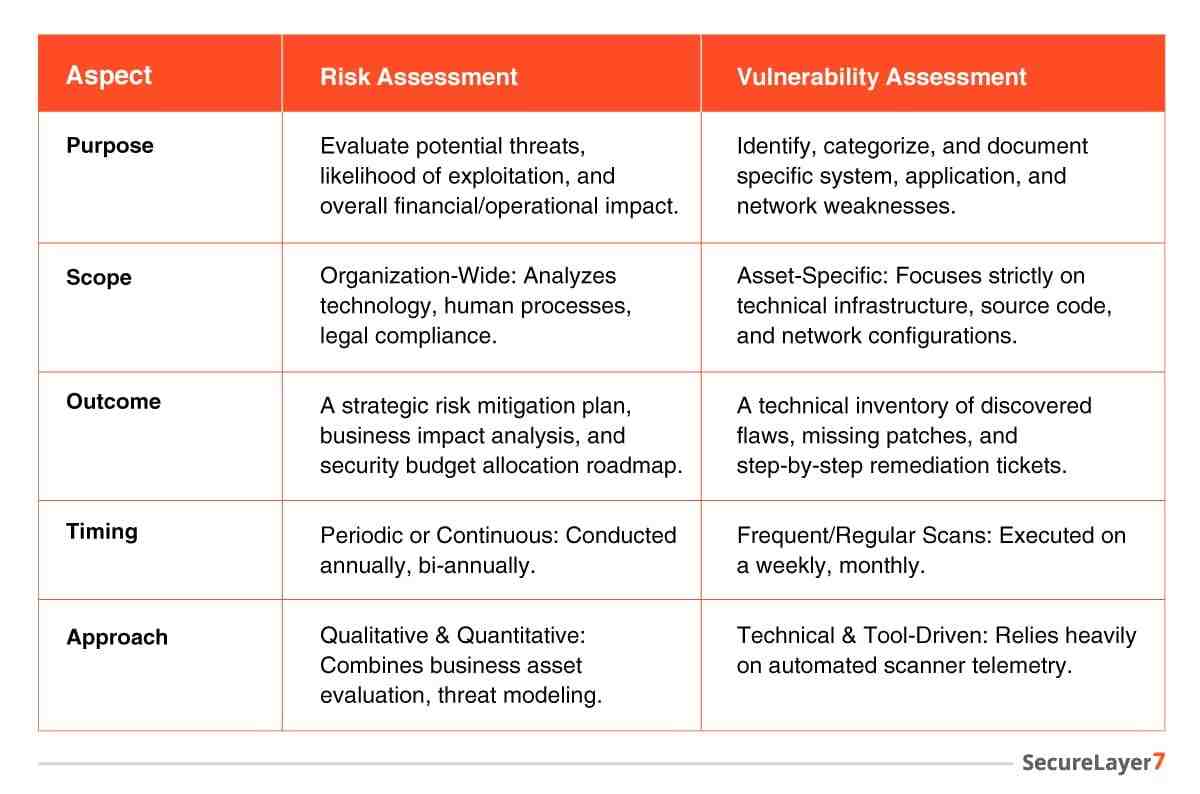
Building a strong cybersecurity program requires more than identifying technical weaknesses. Organizations also need to understand how those weaknesses could affect business operations. A risk assessment takes a broader view by considering the likelihood of a threat, its potential impact, and the business assets involved.
Key Differences Between Risk Assessment and Vulnerability Assessment
Key Distinctions and Overlaps
Distinctions:
- Focus: Risk assessment is strategic, analyzing threats and impact vulnerability assessment is technical, identifying exploitable weaknesses.
- Methodology: Risk uses qualitative/quantitative analysis; vulnerability relies on scanning tools and manual tests.
- Scope: Risk covers the entire organization; vulnerability targets specific systems and networks.
Overlaps:
- Both protect organizational assets and strengthen cybersecurity.
- Vulnerability findings inform risk assessments to gauge likelihood and impact.
- Both require continuous monitoring and remediation.
Risk vs Vulnerability vs Threat
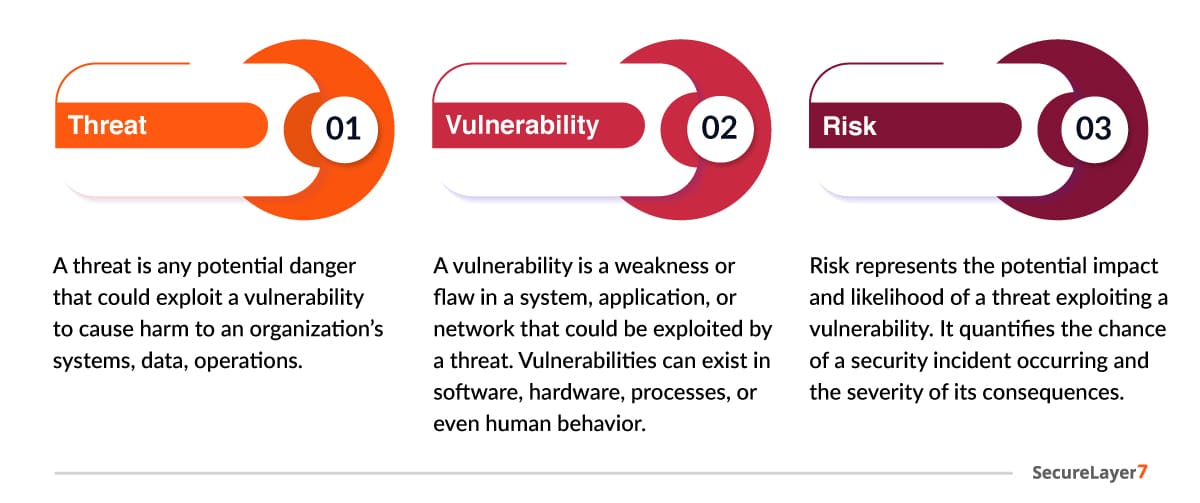
A threat is any potential danger that could exploit a weakness, a vulnerability is the weakness itself, and risk is the likelihood and impact if that threat exploits the vulnerability.
Understanding the relationship between these concepts helps organizations prioritize security efforts, remediate weaknesses, and maintain a strong cybersecurity posture.
Definition of Threat, Vulnerability, and Risk
How These Concepts Interrelate
The relationship between threat, vulnerability, and risk can be summarized as follows:
- A vulnerability is a weak spot in a system.
- A threat is a possible event or actor that could exploit that weakness.
- Risk is the likelihood and potential impact of that threat successfully exploiting the vulnerability.
Why Risk and Vulnerability Assessment Matters
Risk and vulnerability assessments are essential for organizations to identify security gaps, anticipate threats, and prioritize mitigation strategies. By systematically evaluating systems, applications, and networks, these assessments help prevent cyberattacks, protect sensitive data, and maintain operational continuity.
They also support regulatory compliance with standards like ISO 27001, NIST, PCI DSS, and HIPAA, improve incident response planning, and strengthen overall security posture.
For more information learn what a VAPT report includes and how its findings support remediation and security decision-making.
Early Identification of Security Gaps
Risk and vulnerability assessments is the early detection of weaknesses in systems, applications, and networks. By systematically evaluating security controls, organizations can:
- Detects misconfigurations, outdated software, and unpatched vulnerabilities.
- Identify gaps in access controls, authentication, and session management.
- Mitigate potential attack vectors before they are exploited by malicious actors.
Regulatory Compliance
Many industries require adherence to security standards and frameworks, including ISO 27001, NIST, PCI DSS, HIPAA, and GDPR. Risk and vulnerability assessments:
- Provide evidence that security policies and controls are effectively implemented.
- Highlight areas where controls need improvement to meet regulatory requirements.
- Support audits by demonstrating proactive risk management.
Improved Incident Response Planning
By identifying vulnerabilities and evaluating risks, organizations gain valuable insights to strengthen incident response plans:
- Understand potential attack scenarios and their impact on operations.
- Prioritize resources for monitoring, detection, and remediation.
- Develop playbooks for rapid response, minimizing downtime and data loss during incidents.
How to Perform Risk and Vulnerability Assessment
A risk and vulnerability assessment helps organizations identify threats, detect weaknesses, and prioritize remediation to protect critical systems and data.
By following a structured process, businesses can strengthen security, ensure compliance, and proactively mitigate cyber risks before they impact operations.
Define Scope and Objectives
The first step in any assessment is to clearly define the scope and objectives:
- Scope: Determine which systems, applications, networks, and processes will be assessed.
- Objectives: Establish the purpose of the assessment, such as identifying high-risk areas, ensuring regulatory compliance, or evaluating the effectiveness of existing security controls.
Identify Assets, Threats, and Vulnerabilities
The next step is to map assets, potential threats, and existing vulnerabilities:
- Identify Assets: Catalog critical data, systems, applications, and infrastructure components that need protection.
- Identify Threats: Consider both internal and external threats, including cyberattacks, insider errors, natural disasters, and operational failures.
- Identify Vulnerabilities: Detect technical weaknesses such as unpatched software, misconfigured servers, insecure APIs, and weak authentication.
Assess Likelihood and Impact of Risks
Threats, and vulnerabilities are identified, evaluate the likelihood and potential impact of each risk:
- Likelihood: Estimate how probable it is that a threat could exploit a vulnerability. Consider historical data, threat intelligence, and environmental factors.
- Impact: Assess the consequences if the risk materializes, including financial loss, operational disruption, reputational damage, and regulatory penalties.
- Prioritization: Use the likelihood and impact assessment to rank risks, ensuring that resources are focused on high-impact, high-probability threats first.
Common Tools for Risk and Vulnerability Assessment
Choosing the right cybersecurity tools depends on what an organization needs to assess and manage. Vulnerability scanners help identify technical weaknesses, while risk management platforms provide a broader view of how those issues could affect the business. Using the right combination of tools gives security teams better visibility and helps them prioritize remediation.
- Tenable Nessus: Identifies known vulnerabilities, missing patches, configuration issues, and other security weaknesses across servers, endpoints, and network devices. Its findings can help security teams assess risks and prioritize remediation.
- Qualys VMDR: Provides asset discovery, vulnerability detection, risk-based prioritization, and remediation tracking across IT environments. It helps security teams identify vulnerabilities and determine which issues need faster attention.
- Greenbone/OpenVAS: Provides vulnerability scanning capabilities to identify known vulnerabilities and configuration weaknesses across networked systems. It can support regular security assessments and vulnerability management.
- ServiceNow Integrated Risk Management (IRM): Helps organizations manage technology and enterprise risks, security controls, compliance requirements, risk assessments, and remediation activities. Vulnerability data can be combined with business context to support risk-based decisions.
- Archer: Supports risk management, compliance, control assessments, third-party risk, and risk reporting. Organizations can use it to document risks, assess their potential impact, and track mitigation activities.
Best Practices for Risk and Vulnerability Assessment
Organizations face sophisticated threats to systems and networks. Risk and vulnerability assessments, when performed using best practices, help proactively identify weaknesses, prioritize remediation, and strengthen security posture.
Following best practices strengthens security, ensures regulatory compliance, and improves incident response.
Conduct Regular Assessments and Audits
Security threats evolve constantly, making periodic and continuous assessments essential. Organizations should:
- Schedule regular risk assessments and vulnerability scans.
- Conduct formal security audits to verify compliance with standards like ISO 27001, PCI DSS, and NIST.
- Review assessments after major system updates, deployments, or architectural changes.
Integrate Assessments into DevSecOps Pipelines
Embedding security assessments into DevSecOps workflows ensures that vulnerabilities are detected early in the development lifecycle:
- Automate vulnerability scans within CI/CD pipelines.
- Conduct pre-deployment security testing to prevent insecure code from reaching production.
- Enable continuous monitoring and feedback loops for developers and security teams.
Maintain Updated Asset Inventory
A complete and up-to-date inventory of assets is critical for accurate risk evaluation:
- Catalog applications, servers, endpoints, databases, cloud resources, and third-party systems.
- Track versioning, configurations, and patch status.
- Identify critical assets that require priority protection.
Conclusion
Understanding the differences and interplay between risk assessment and vulnerability assessment is essential for organizations to proactively manage cyber threats, protect critical assets, and maintain regulatory compliance. By implementing regular assessments, leveraging the right tools, and following best practices, businesses can strengthen their security posture, prioritize remediation, and stay resilient against evolving threats.
SecureLayer7 provides expert guidance and comprehensive solutions to help organizations conduct thorough risk and vulnerability assessments, remediate weaknesses efficiently, and maintain robust, proactive cybersecurity defenses.
Contact SecureLayer7 today to secure your organization against cyber risks.
Frequently Asked Questions (FAQs)
Risk assessment evaluates the likelihood and potential impact of threats on organizational assets, providing a strategic view of security risks. Vulnerability assessment identifies technical weaknesses in systems, applications, and networks that attackers could exploit.
Understanding both concepts allows organizations to prioritize security measures effectively. Risk assessment guides strategic decisions on which threats are most critical, vulnerability assessment provides actionable insights for technical remediation.
A risk and vulnerability assessment is a structured process for identifying weaknesses in systems, applications, and networks, evaluating potential threats and their impact, and prioritizing mitigation measures to reduce overall organizational risk.
A threat is a potential event or actor that could cause harm. A vulnerability is a weakness in a system, application, network, or process that a threat could exploit. Risk represents the likelihood and potential impact of a threat successfully exploiting a vulnerability.
Risk assessment and vulnerability assessment serve complementary purposes. Risk assessment provides a business-oriented view of security risks, while vulnerability assessment identifies technical weaknesses that require remediation. Using both helps organizations understand their security exposure and make informed decisions about remediation priorities.

