
The Penetration Testing Execution Standard (PTES) is a widely recognized framework that defines a structured, consistent, and realistic approach to penetration testing. It provides clear guidance on how security assessments should be planned, executed, and reported, ensuring penetration tests deliver meaningful insights rather than isolated vulnerability lists.
As cyber threats continue to evolve, relying on ad-hoc or purely automated testing is no longer sufficient. PTES addresses this gap by outlining each phase of a penetration test – from pre-engagement planning and intelligence gathering to exploitation and reporting – so vulnerabilities are validated, prioritized, and clearly communicated.
Why Structured Penetration Testing is Important
Structured penetration testing is critical because unplanned or ad hoc testing often misses key vulnerabilities or fails to reflect how real attackers operate. Without a defined methodology, penetration tests may rely too heavily on automated tools, resulting in false positives, incomplete coverage, or inconsistent results.
Using a standardized structure also improves credibility and trust in penetration testing results. Stakeholders can clearly understand what was tested, how it was tested, and why certain risks are considered critical. This structure helps organizations prioritize remediation efforts, align findings with business risk, and make informed security decisions instead of reacting to fragmented or unclear test results.
Role of PTES in Delivering Consistent and Reliable Pen Tests
PTES plays a key role in delivering consistent and reliable penetration tests by providing a repeatable framework that testers can follow regardless of the target environment or testing scope. By defining clear phases and objectives for each stage of testing, PTES ensures that no critical steps are skipped and that testing depth remains consistent across different engagements.
PTES improves the quality of reporting and communication between security teams and business stakeholders. Because findings are mapped to a standardized testing process, reports are clearer, more actionable, and easier to compare over time.
What are Penetration Testing Execution Standard (PTES)
The Penetration Testing Execution Standard (PTES) is a widely adopted framework that defines a structured and consistent approach to conducting penetration testing engagements. It establishes a common methodology for how penetration tests are carried out, helping ensure assessments are thorough, repeatable, and aligned with realistic attack scenarios.
PTES emphasizes understanding how attackers think and operate by evaluating security weaknesses in context rather than in isolation. By covering the full penetration testing lifecycle – from preparation and reconnaissance to exploitation and reporting – PTES enables organizations to assess real security exposure, identify high-risk attack paths, and strengthen defenses based on practical, business-relevant outcomes.
How PTES Standardizes Penetration Testing Engagements
PTES standardizes penetration testing by defining distinct phases that every engagement should follow, such as pre-engagement interactions, intelligence gathering, threat modeling, vulnerability analysis, exploitation, post-exploitation, and reporting.
This structured approach ensures repeatability across engagements, testers, and environments. Whether the test is performed by different teams or at different times, PTES helps deliver consistent depth, scope, and quality – making results easier to compare and track over time.
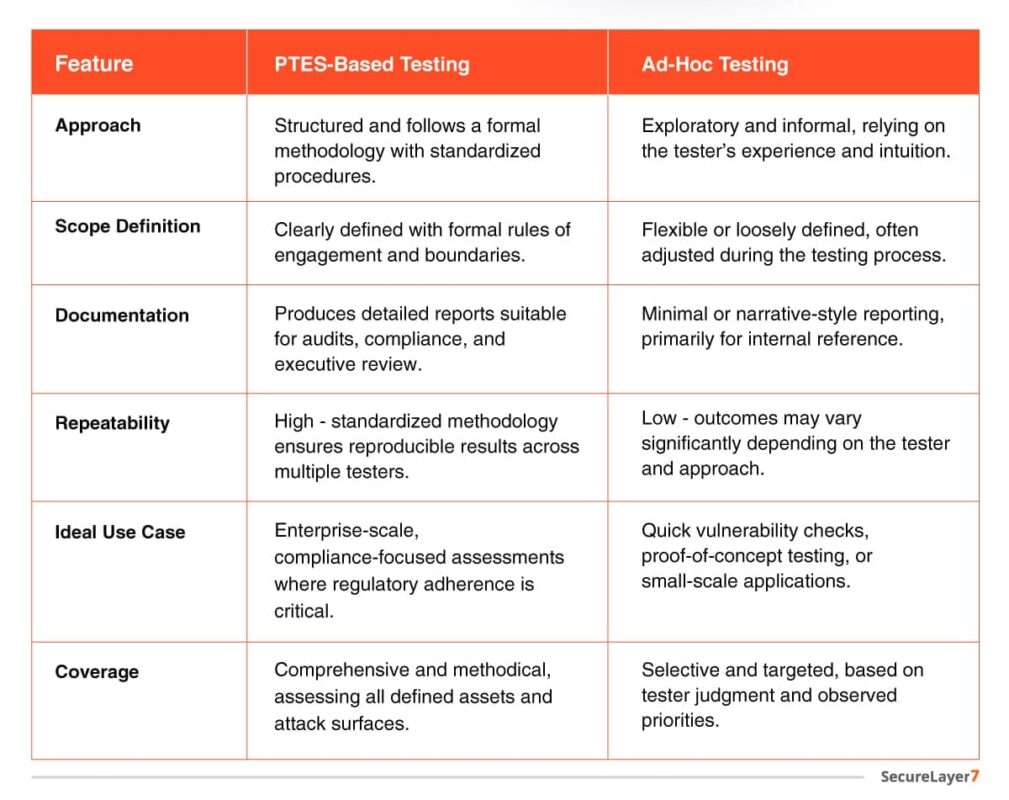
Difference Between PTES-based Testing and Ad-hoc Testing
Why the Penetration Testing Execution Standard Matters
Organizations need penetration testing that delivers consistent, realistic, and actionable results. The Penetration Testing Execution Standard (PTES) matters because it provides a structured, repeatable framework that ensures security assessments go beyond surface-level vulnerability discovery. PTES focuses on real-world attack scenarios, helping organizations understand not just what is vulnerable.
Challenges Caused by Inconsistent Testing Methodologies
Inconsistent penetration testing methodologies often lead to unpredictable results, incomplete coverage, and confusion among stakeholders. When different testers or vendors follow their own approaches, findings may vary significantly even when testing the same environment. This inconsistency makes it difficult to measure security improvements over time or compare results across assessments.
Unstructured testing can overlook critical attack paths, focus too heavily on automated scans, or fail to assess exploitability and business impact. These gaps leave organizations with a false sense of security and remediation efforts that are poorly prioritized
How PTES Improves Testing Quality and Repeatability
PTES improves testing quality by defining clear phases and objectives for every penetration test, from pre-engagement planning to exploitation and reporting. This ensures that each assessment follows a logical, comprehensive process rather than relying on ad-hoc decisions or automated scans alone.
The standardized approach also enhances repeatability. Whether testing is performed by different vendors, internal teams, or at different times, PTES ensures consistent depth and scope. This allows organizations to track progress, measure improvements, and validate remediation efforts with confidence.
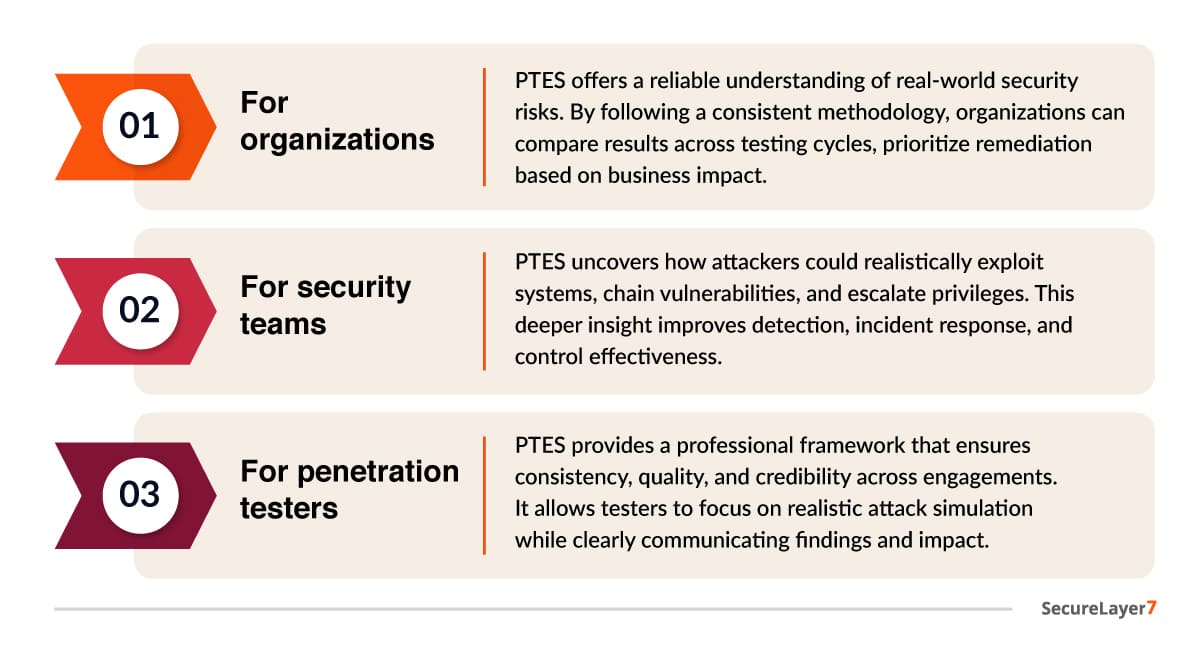
Benefits for Organizations, Security Teams, and Penetration Testers
The Penetration Testing Execution Standard (PTES) delivers clear value to all stakeholders involved in security testing by providing a structured, realistic, and repeatable approach.
Alignment with Real-World Attack Techniques
PTES is designed to reflect how real attackers operate. Instead of stopping at vulnerability discovery, it emphasizes exploitation, post-exploitation, privilege escalation, and lateral movement. This approach helps identify how attackers can chain multiple weaknesses together to achieve deeper compromise.
By aligning testing with real-world attack techniques, PTES enables organizations to identify the most dangerous attack paths and strengthen defenses where it matters most. This results in more practical security improvements and a stronger overall security posture.
Overview of the PTES Penetration Testing Framework
The Penetration Testing Execution Standard (PTES) provides a structured and practical framework for conducting penetration testing in a consistent and reliable manner. It defines a clear methodology that guides security professionals through each phase of a penetration test, ensuring that assessments are thorough, repeatable, and aligned with real-world attack scenarios.
Rather than focusing solely on tools or checklists, PTES emphasizes process, discipline, and attacker mindset. This makes it a trusted framework for organizations seeking penetration tests that deliver meaningful insights into security weaknesses and business risk.
High-Level View of the PTES Methodology
The PTES methodology is divided into distinct phases that represent the full flow of a penetration testing engagement. These phases include pre-engagement interactions, intelligence gathering, threat modeling, vulnerability analysis, exploitation, post-exploitation, and reporting.
Each phase has a specific objective and builds on the previous one. This phased approach ensures that testing progresses logically – from understanding the environment and threat landscape to actively exploiting vulnerabilities and documenting real-world impact.
How PTES Covers the Entire Engagement Lifecycle
The Penetration Testing Execution Standard (PTES) provides a complete, end-to-end framework for penetration testing. It starts with clear pre-engagement planning to define scope, objectives, and authorization, ensuring alignment between testers and stakeholders.
PTES then guides testers through intelligence gathering, threat modeling, exploitation, and post-exploitation to simulate real attacker behavior. The lifecycle concludes with structured reporting that delivers clear risk insights and remediation guidance, ensuring testing results lead to measurable security improvements.
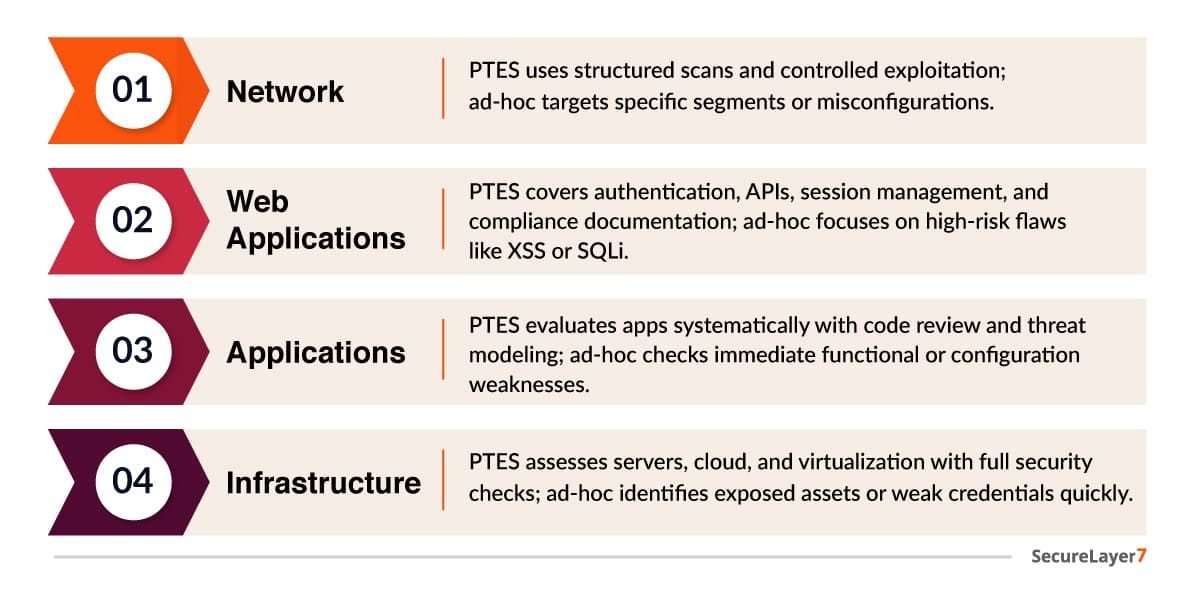
Applicability Across Network, Web, Application, and Infrastructure Testing
PTES-based and ad-hoc penetration testing serve different purposes across network, web, application, and infrastructure environments:
Seven Phases of the Penetration Testing Execution Standard
The Penetration Testing Execution Standard (PTES) defines a structured, end-to-end approach for conducting penetration tests that accurately reflect real-world attack scenarios. These seven phases ensure penetration testing is systematic, repeatable, and focused on business risk rather than isolated technical flaws.
Following PTES, organizations receive consistent, high-quality penetration testing outcomes that support risk prioritization, compliance efforts, and long-term security improvement.
Pre-Engagement Interactions
The pre-engagement phase establishes the foundation for the penetration testing engagement. During this phase, stakeholders and penetration testers clearly define the scope, objectives, timelines, and rules of engagement.
Legal authorization is a critical component of this phase. Formal approvals, contracts, and permissions ensure testing is conducted ethically and within legal boundaries. Organizations should also establish clear Penetration Testing Rules of Engagement to define testing boundaries, communication plans, and responsibilities before security assessments begin.
Intelligence Gathering
Intelligence gathering focuses on collecting detailed information about the target environment to understand its attack surface. Testers use passive techniques, such as open-source intelligence (OSINT), public records, and exposed metadata, alongside active techniques, including scanning and service enumeration.
This phase helps identify exposed systems, technologies, user accounts, network ranges, and potential entry points. A thorough intelligence-gathering process allows testers to simulate how real attackers identify weaknesses before launching an attack.
Threat Modeling
Threat modeling connects discovered assets to realistic threat scenarios. In this phase, testers evaluate which assets are most valuable, who potential attackers might be, and what motivations or attack methods they are likely to use.
By mapping assets to threat actors and attack paths, testers can prioritize testing efforts toward high-impact scenarios. This ensures the penetration test focuses on the most critical risks rather than treating all vulnerabilities with equal importance.
Vulnerability Analysis
Vulnerability analysis involves identifying technical, configuration, and logical weaknesses within the environment. This includes analyzing outdated software, misconfigurations, weak authentication, improper access controls, and insecure application logic.
Beyond identification, this phase validates which vulnerabilities are actually exploitable in the given environment. This reduces false positives and ensures the penetration test highlights weaknesses that pose genuine security threats.
Exploitation
The exploitation phase demonstrates how identified vulnerabilities can be abused in real-world conditions. Testers carefully exploit weaknesses to gain unauthorized access, escalate privileges, or bypass security controls without causing harm.
PTES emphasizes manual validation, many organizations are also evaluating Manual vs Autonomous Penetration Testing to understand where AI-driven automation can complement human expertise.
Post-Exploitation
Post-exploitation examines what an attacker could achieve after initial access. This phase includes privilege escalation, lateral movement, persistence testing, and data access evaluation.
By assessing how far an attacker can move within the environment, testers highlight potential business and operational impacts, such as access to sensitive data, critical systems, or administrative controls.
Reporting
Reporting translates technical findings into clear, actionable insights. Penetration testers document vulnerabilities with supporting evidence, risk ratings, attack paths, and prioritized remediation recommendations.
PTES reporting typically includes both executive summaries for leadership and technical reports for security teams. Clear, structured reporting ensures stakeholders can quickly understand risks, take corrective action, and strengthen their security posture effectively.
PTES vs Other Penetration Testing Standards
Multiple standards exist, each serves a different purpose and audience. Understanding how PTES compares with other approaches – such as the OWASP Testing Guide and NIST penetration testing frameworks – helps organizations choose the methodology that best fits their security objectives.
Organizations implementing PTES for web security can also refer to Web Application Penetration Testing Methodology, which aligns closely with PTES phases including planning, reconnaissance, exploitation, and reporting.
PTES vs OWASP Testing Guide
The OWASP Testing Guide is primarily focused on web application security. It provides detailed guidance on testing web applications against common vulnerabilities, particularly those OWASP Top 10. OWASP is highly effective for identifying application-layer weaknesses such as injection flaws, authentication issues, and insecure configurations.
PTES, on the other hand, offers a broader and more holistic framework. It covers the full penetration testing lifecycle across networks, applications, infrastructure, and environments. While OWASP excels at depth in web application testing, PTES focuses on realistic attack paths, exploitation, post-exploitation, and overall business impact.
PTES vs NIST Penetration Testing Approaches
The Penetration Testing Execution Standard (PTES) is execution-driven and focuses on simulating real-world attacker behavior through hands-on testing, exploitation, and impact analysis. It emphasizes consistency, realism, and business impact, making it suitable for organizations seeking practical validation of their security defenses.
NIST penetration testing approaches are more governance and compliance focused, offering high-level direction on planning, assessment, and risk management rather than execution depth. In practice, PTES is best for realistic penetration testing, while NIST is better suited for policy alignment and regulatory requirements.
When PTES is the Preferred Methodology
PTES is the preferred methodology when organizations need realistic, actionable penetration testing results rather than purely compliance-driven assessments. It is ideal for testing enterprise networks, cloud environments, critical infrastructure, and complex systems where attackers could chain multiple vulnerabilities together.
Organizations often choose PTES when they want to:
- Simulate real-world attack scenarios
- Validate the effectiveness of existing security controls
- Identify high-impact attack paths and business risk
- Obtain consistent and repeatable testing outcomes
Benefits of Using the PTES Penetration Testing Standard
The Penetration Testing Execution Standard (PTES) provides a structured and proven framework for conducting penetration tests in a consistent, realistic, and business-focused manner.
Unlike ad-hoc testing approaches, PTES ensures that every penetration test follows a defined methodology that reflects real-world attack behavior while delivering clear, actionable results. Following are the key benefits of using the PTES penetration testing standard.
Consistent and Repeatable Penetration Tests
PTES establishes a standardized lifecycle for penetration testing, covering everything from pre-engagement planning to final reporting. This consistency ensures that tests are executed using the same methodology regardless of the tester, team, or environment.
Organizations can reliably compare findings across different testing cycles, track security improvements over time, and avoid discrepancies caused by inconsistent testing techniques. Repeatable testing also strengthens audit readiness and long-term security planning.
Better Risk Prioritization and Clarity
Penetration Testing Execution Standard (PTES) is improved risk prioritization and clarity. Rather than presenting long lists of isolated vulnerabilities, PTES focuses on how weaknesses can be exploited in real-world attack scenarios and what impact they would have on the business.
By linking technical findings to exploitability, attack paths, and potential business consequences, PTES enables security teams and leadership to make informed remediation decisions. Clear risk context reduces confusion, prevents misallocation of resources, and ensures that critical vulnerabilities are addressed first – strengthening overall security posture in a measurable and strategic way.
Improved Communication with Stakeholders
PTES significantly improves communication between security teams, technical staff, and business stakeholders by translating complex technical findings into risk-based insights. Instead of focusing solely on vulnerabilities, PTES reporting explains how issues can be exploited, what assets are affected, and the potential business impact.
This approach enables executives, managers, and non-technical stakeholders to understand security risks without requiring deep technical knowledge. Impact-driven findings, and actionable remediation guidance support faster decision-making, better cross-team alignment, and stronger organizational buy-in for security initiatives.
Who Should Use PTES Penetration Testing?
The Penetration Testing Execution Standard (PTES) is designed for organizations and security professionals who require a structured, realistic, and repeatable approach to penetration testing. Unlike ad-hoc or tool-driven testing, PTES focuses on real-world attack scenarios, business impact, and clear remediation guidance. Following are the detailed breakdown of who benefits most from PTES penetration testing and why.
Enterprises and Mid-Size Organizations
Enterprises and mid-size organizations typically operate complex environments that include cloud platforms, internal networks, applications, APIs, and third-party integrations. PTES helps these organizations assess security risks across the entire engagement lifecycle from planning and threat modeling to exploitation and reporting.
By adopting PTES, organizations gain consistent testing outcomes across departments, regions, and vendors. This consistency allows leadership teams to compare results over time, track risk reduction, and align security testing with business priorities. PTES also helps identify high-impact vulnerabilities that could disrupt operations, damage reputation, or expose sensitive data.
Security Teams and Red Teams
The Penetration Testing Execution Standard (PTES) provides significant value to security teams and red teams by offering a structured yet realistic approach to penetration testing. By focusing on attacker behavior rather than isolated vulnerabilities, PTES helps teams understand how real threats could compromise systems, move laterally, and escalate privileges within the environment.
PTES delivers actionable insights that improve detection, response, and remediation efforts. Red teams benefit from a consistent methodology that supports advanced attack simulations while assuming a real adversary mindset.
Penetration Testing Service Providers
The Penetration Testing Execution Standard (PTES) enables penetration testing service providers to deliver consistent, high-quality, and credible security assessments. By following a structured methodology, providers can ensure uniform testing practices across different clients, environments, and engagement sizes.
PTES also improves transparency with clients by clearly defining scope, testing phases, and reporting expectations. This reduces misunderstandings, strengthens client trust, and helps service providers demonstrate professionalism, reliability, and real-world security expertise.
Common Challenges When Implementing PTES
Implementing the Penetration Testing Execution Standard (PTES) brings structure, consistency, and realism to penetration testing. Organizations often encounter practical challenges when applying PTES in live environments. These challenges typically arise from complexity in scope definition, limited resources, operational constraints, and coordination gaps between teams.
Following are the detailed look at the most common challenges faced during PTES implementation.
Scoping and Engagement Complexity
Defining the scope of a PTES engagement can be complex, especially in modern environments that include cloud platforms, on-prem infrastructure, APIs, third-party services, and legacy systems. PTES requires precise scoping to identify what will be tested, what is excluded, and how deep the testing should go.
Challenges arise when asset inventories are incomplete, ownership is unclear, or dependencies are poorly documented. Overly broad scopes can make engagements unmanageable, while narrow scopes may miss critical attack paths.
Resource and Time Constraints
PTES-based testing is more comprehensive than basic vulnerability scanning or checklist-driven assessments. It requires experienced testers, adequate tooling, and sufficient time to perform reconnaissance, exploitation, post-exploitation, and reporting.
Organizations with limited security budgets or small teams may struggle to allocate the necessary resources. Time constraints are especially common when penetration testing is driven by compliance deadlines, product launches, or audit schedules.
Rushing PTES engagements often leads to reduced testing depth, limited validation of findings, and less actionable reporting, which undermines the value of the assessment.
Balancing Depth of Testing with Business Impact
PTES emphasizes realistic attack simulation, including exploitation and post-exploitation activities to demonstrate real-world impact. Deeper testing increases concerns around system stability, data integrity, and business disruption.
Stakeholders may restrict testing due to fear of downtime, performance degradation, or unintended data exposure. This can result in conservative testing that fails to reveal high-risk vulnerabilities.
Best Practices for Effective PTES-Based Penetration Testing
To get maximum value from the Penetration Testing Execution Standard (PTES), organizations must go beyond simply following the framework and focus on how it is applied in practice. Effective PTES-based penetration testing blends structure with realism, ensuring that testing outcomes reflect real-world attacker behavior and deliver actionable security insights.
The following best practices help organizations conduct meaningful, high-impact PTES engagements.
Clearly Define Objectives and Scope
A successful PTES engagement begins with clearly defined objectives and scope. Organizations should establish why the penetration test is being conducted – whether to assess overall security posture, validate controls, support compliance, or test specific high-risk systems.
Clearly scoping assets, environments, testing depth, and exclusions prevents misunderstandings, reduces scope creep, and protects business-critical systems from unintended impact. Well-defined objectives also ensure that testing efforts align with business priorities and deliver results that stakeholders can act upon.
Use Threat-Led Testing Approaches
PTES is most effective when testing is driven by realistic threat scenarios rather than generic vulnerability lists. Threat-led testing focuses on how real attackers would target the organization, considering threat actors, motivations, attack paths, and likely entry points.
By modeling attacks based on real-world adversaries, penetration testers can prioritize techniques that matter most to the business. This approach helps uncover chained vulnerabilities, lateral movement opportunities, and privilege escalation paths that automated scans alone often miss.
Combine Automated Tools with Manual Testing
Automated tools play an important role in PTES by speeding up reconnaissance, vulnerability discovery, and baseline assessments. PTES strongly emphasizes manual testing to validate findings, exploit vulnerabilities safely, and understand true business impact.
Manual testing allows penetration testers to think creatively, bypass controls, and simulate human attacker behavior. Combining automation with expert-driven manual testing ensures both efficiency and depth, resulting in more accurate and meaningful results.
Conclusion
The Penetration Testing Execution Standard (PTES) plays a critical role in modern cybersecurity by bringing structure, consistency, and real-world relevance to penetration testing. In an era where threats are increasingly sophisticated, PTES ensures security assessments move beyond ad-hoc testing and deliver reliable insights into how attackers could realistically compromise systems and business operations.
By adopting PTES, organizations gain a practical, repeatable framework that improves testing quality, risk prioritization, and stakeholder communication. At SecureLayer7, we apply PTES-driven penetration testing to help organizations uncover true security risks and strengthen defenses effectively.
Partner with SecureLayer7 to implement PTES-based penetration testing and build a resilient, risk-focused security posture.
Frequently Asked Questions (FAQs)
The Penetration Testing Execution Standard (PTES) is a structured framework that defines how penetration tests should be planned, executed, and reported. It ensures testing is consistent, repeatable, and aligned with real-world attack scenarios.
PTES helps eliminate inconsistent testing approaches and unclear results. By following a standard process, you get reliable findings, better risk prioritization, and clearer remediation guidance.
PTES focuses on the entire engagement lifecycle, from scoping to reporting. Other frameworks may focus more on specific areas like web applications or compliance requirements, while PTES provides a broader, end-to-end testing approach.
Yes. PTES can be applied to network, web application, infrastructure, and internal penetration tests. It is flexible enough to adapt to different environments and testing goals.
PTES is useful for organizations conducting penetration tests, security teams, red teams, and penetration testing service providers. It is especially valuable for enterprises and compliance-driven industries.

