
A penetration test run without explicit Rules of Engagement (RoE) is virtually indistinguishable from a cyberattack.
The objective of the Rules of Engagement (RoE) documents define the legal, technical, and operational limits of an offensive security assessment. It ensures offensive security activities do not disrupt business continuity plans, ensures the assessment adheres to the regulatory requirements, and provides security testers with legal authorization to probe target systems.
This blog walks through penetration testing ROE in detail, why it matters, its core components, and best practices and a copy/paste-ready template for your next engagement.
Key Reasons Why Penetration Testing ROE Matters
For any process to succeed, the framework and rules should be clearly defined. Penetration testing RoE provides a clearly defined roadmap. It establishes boundaries, scopes, and communication protocols that ensure every test is controlled, transparent, and aligned with business objectives.
Before establishing the rules of engagement, it is important to understand the penetration testing process, including its key stages, methodologies, and approaches, to gain a clearer understanding of how a structured security assessment is conducted.
Here is why it matters:
- Legal Protection: A penetration test without written permission is illegal, no matter how good your intentions are. Legal agreements are binding, shield everyone involved, and ensure tests don’t cross beyond defined limits to avoid lawsuits, fines, or worse.
- Shared Understanding: RoE ensures every stakeholder—from executives to IT staff—understands what’s being tested, when it will happen, and what methods are being employed. There should not be any scope for assumptions or miscommunications.
- Protection from Business Disruption: A test that doesn’t go as intended can cause damage like an actual breach. It can halt operations, modify or delete data, or trigger alerts that send your incident response team into overdrive. RoE can prevent such scenarios by scheduling tests at safe times and avoiding risky methodologies.
- Meaningful Results: When testers know what’s allowed and what isn’t, they can dig deep without wasting time. As a result, you get actionable findings, not a mess to clean up.
At a Glance: RoE Quick-Reference Matrix
Use this matrix to understand standard baselines versus the operational risks of omitting core clauses:
| Attributes | Standard Baseline | Operational Risk if Omitted |
| Scope Definition | Explicit FQDNs, IP CIDR blocks, API endpoints, microservices | Accidental scanning or disruption of shared third-party SaaS/hosting |
| Testing Schedule | Off-peak hours or maintenance windows for high-impact checks | Production latency or service collapse during peak business traffic |
| Tool & Technique Guardrails | No Denial-of-Service (DoS), no brute-force account lockouts | Production downtime, widespread user lockouts, alert fatigue |
| Escalation Thresholds | 15–30 minute direct alert SLA for Critical/CVSS 9.0+ findings | Extended exposure if an active breach or zero-day is discovered |
| Data Handling | Strict non-disclosure, encrypted storage, 30-day post-test sanitization | Regulatory penalties (e.g., GDPR, HIPAA) for unencrypted PII spillage |
Key Components of the Penetration Testing Rules of Engagement (RoE)
A useful RoE should answer three basic questions: what can be tested, how can it be tested, and what happens if something goes wrong? The following components establish those boundaries before testing begins.
1. Scope and Boundaries
- List every system, application, API, network, cloud resource, and physical location included in the assessment.
- Clearly identify the items that are out of scope, such as payroll systems, customer databases, legacy infrastructure, or production systems.
- Document all third-party integrations and assets that require separate authorization.
- Define whether testing includes authenticated areas, internal networks, or specific user roles.
2. Legal Authorization
- Obtain written authorization from the appropriate system or business owners.
- Document the names and roles of the parties authorizing and conducting the test.
- Ensure contracts, statements of work, waivers, and confidentiality agreements are in place.
- Define who has authority to approve changes to the original RoE.
3. Testing Schedule
- Define testing dates, hours, time zones, and blackout periods.
- Identify maintenance windows or business-critical periods when testing is prohibited.
- Specify procedures for pausing, resuming, or extending the engagement.
4. Permitted and Prohibited Techniques
- List the attack techniques testers are authorized to use.
- Identify prohibited activities, such as destructive exploitation, denial-of-service testing, or malware deployment.
- Specify which techniques require additional approval before execution.
5. Exploitation Boundaries
Define how far testers can go after discovering a vulnerability.
For example:
- Is proof-of-concept sufficient?
- Can testers access sensitive records?
- Can they escalate privileges?
- Can they move laterally?
- Can they establish persistence?
- Can they dump credentials?
This section prevents testers from making assumptions about how much exploitation is acceptable.
6. Production Safety Controls
Define safeguards for systems that could be affected by testing.
- Scanner and request-rate limits
- Fuzzing restrictions
- Credential attack thresholds
- Database query restrictions
- Systems requiring manual testing
- Activities requiring explicit approval
7. Communication and Deconfliction
- Establish primary and emergency contacts.
- Provide the SOC with tester IP addresses, accounts, domains, and other identifying information.
- Define how testers and defenders communicate during the engagement.
- Establish a process for distinguishing authorized testing activity from a genuine security incident.
8. Data Handling
- Define how credentials, customer information, screenshots, logs, and other sensitive data will be handled.
- Specify where evidence will be stored and who can access it.
- Establish retention and secure-destruction requirements.
- Address confidentiality obligations and NDAs where applicable.
9. Incident and Escalation Procedures
- Define what constitutes a critical incident.
- Establish immediate notification requirements.
- Document the escalation chain and backup contacts.
- Specify who can order testing to stop.
- Define the process for investigating and recovering from unintended impact.
10. Third-Party Authorization
- Identify cloud providers, SaaS platforms, payment processors, hosting providers, and other external services involved in testing.
- Confirm whether their systems can legally be tested.
- Document who is responsible for obtaining third-party authorization.
11. Reporting Cadence
- Define when testers must report critical findings.
- Establish whether daily or weekly status updates are required.
- Specify how urgent findings should be communicated.
- Set a deadline for the final report.
12. Deliverables and Success Criteria
Define what the engagement must produce:
- Technical vulnerability report
- Exploit evidence
- Attack-path documentation
- Risk ratings
- Executive summary
- Technical debrief
- Remediation recommendations
- Retest report
Also define what constitutes completion of the engagement.
Key Stakeholders Involved in Drafting ROE
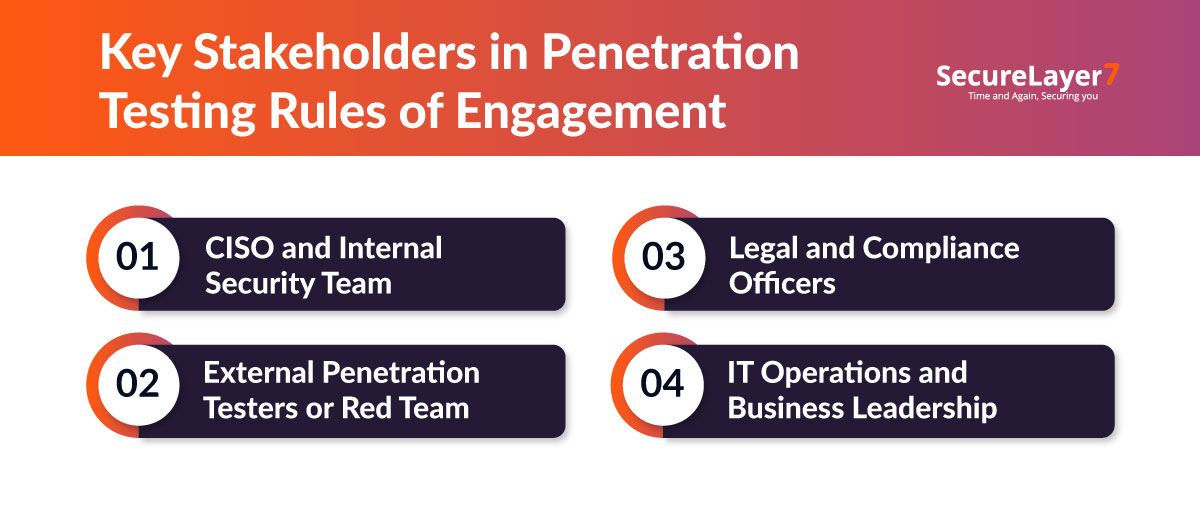
Drafting rules of engagement involves key stakeholders to ensure tests align with security, legal compliance, technical risks, and business continuity goals.
- CISO and Internal Security Team: The CISO and security team set security priorities and ensure the engagement aligns with overall business security objectives, addressing the organization’s most critical assets.
- External Penetration Testers or Red Team: External testers bring specialized expertise, design tailored attack scenarios, and advise on technical feasibility.
- Legal and Compliance Officers: Legal and compliance stakeholders review testing plans to ensure activities comply with laws and regulations.
- IT Operations and Business Leadership: Involvement of IT operations and business leaders ensures testing serves business objectives and minimizes risks to ongoing operations.
Common Mistakes in ROE Creation (and Consequences)
Setting clear Rules of Engagement (ROE) is crucial for effective and safe penetration testing. Overlooking common mistakes can expose organizations to security, legal, and communication risks.
Failing to clearly define which systems are in scope may result in testing unintended or sensitive assets, leading to outages, business disruption, or breaches of trust and confidentiality.
For example, if testers are unclear about the scope of production server testing, it can cause a temporary outage and customer complaints.
Not involving legal experts can create serious compliance issues, as testers might violate laws or regulatory requirements, exposing the organization to fines, lawsuits, or regulatory actions. For example, if personal data is accessed without consent, it may result in a regulatory investigation.
Without a predefined escalation plan, critical incidents may be detected but not promptly communicated to responsible teams, delaying response and potentially worsening security incidents or business impacts.
For example, a tester may discover active malware but, if unaware of the escalation matrix, could email non-relevant stakeholders instead of the incident response team, delaying containment efforts.
Inadequate instructions for interim and final reporting can lead to missed findings and confusion among stakeholders.
Consequences of the Lack of Penetration Testing Rules of Engagement
Rules of engagement don’t just help avoid risks; they play a critical role in forging trust and collaboration between the penetration testing team and the organization’s IT and security teams. By explicitly communicating what is authorized, when tests will occur, and how findings will be shared, ROE brings transparency to the entire process.
For example, an organization allowing pentesting without a well-defined ROE may create confusion among employees when unexpected scanning triggers firewalls or when testers attempt social engineering attacks.
As a result, the IT team may choose to block testers mid-engagement or leadership may question the value of testing altogether.
Real-World Example of ROE Success and Failure
A major financial institution hired a penetration testing partner to assess its internet and mobile banking applications. The RoE precisely defined scope, permissions, and testing times, escalation steps, reporting, data handling, communication channels, executive approvals, and scheduled off-peak hours.
Testers discovered and helped address critical vulnerabilities—such as flaws risking unauthorized access without disrupting business or violating legal boundaries.
Lesson Learned: Clear, comprehensive RoE empowers testers to operate confidently, helps organizations avoid legal or operational pitfalls, and ensures findings translate into concrete security improvements.
Best Practices: Penetration Testing Rules of Engagement
Below is a list of best practices for creating penetration testing ROE:
Clearly Define the Scope and Permissions
- Establish a detailed list of all assets, such as applications, networks, and physical locations.
- Explicitly state what testing methods are allowed or prohibited.=
- Document special items such as sensitive data handling or emergency shutoff procedures.
- Clearly specify restrictions on testing, if any.
- Identify any third-party systems that may be indirectly affected.
- Make a list of acceptable testing tools and techniques to avoid unintended disruptions.
Obtain Formal Written Authorization and Approvals
- Obtain signed approval from senior management and legal departments before testing starts.
- Confirm that all permissions cover both technical and physical testing activities (if applicable).
- Maintain copies of authorization as legal protection for both testers and the organization.
- Ensure external testers acknowledge and accept these terms formally.
- Clearly specify the timeframe for which the approval is valid.
Establish Comprehensive Communication
- Define primary communication channels (email, phone, messaging platforms) for routine updates and urgent alerts.
- Create a detailed escalation matrix listing personnel roles, contact info, and step-by-step escalation order for incidents.
- Incorporate procedures for handling emergencies such as unintended outages or data leaks.
- Document all communications to maintain an audit trail.
Schedule and Document Testing Windows and Constraints
- Agree upon specific testing dates and timeframes.
- Add contingency plans for pauses, rescheduling, or emergencies.
- Clearly communicate testing schedules to all affected parties (IT, business units, legal).
- Confirm test duration limits to prevent prolonged exposure or unintended persistence.
- Consider time zone differences if teams or systems are geographically dispersed.
Define Data Handling, Privacy, and Reporting Requirements
- Outline how sensitive data accessed during tests will be protected, stored, and destroyed post-engagement.
Detail what data can be included in reports, ensuring compliance with privacy regulations like GDPR. - Specify reporting frequency (interim and final), report formats, and distribution lists to guarantee transparency and actionability.
- Establish confidentiality agreements and nondisclosure clauses for testers and stakeholders.
Plan for Risk Management and Business Continuity
- Identify potential risks inherent in testing activities and set mitigation steps to minimize business impact.
- Prepare clear instructions on how to handle situations if critical systems are affected during testing.
- Coordinate with business continuity and disaster recovery teams to ensure alignment.
- Define escalation steps based on risk thresholds.
- Include insurance or liability considerations.
Penetration Testing RoE Readiness Checklist ( Or Pre-flight Checklist)
Use this checklist before a penetration test begins. The first item in each section represents a common RoE practice. The examples underneath should be defined according to the organization’s environment, risk tolerance, contractual obligations, and testing objectives.
1. Scope and Targeting
Common RoE practice
- All authorized targets are explicitly identified, including domains, IP ranges, applications, APIs, cloud resources, or physical locations where applicable.
- Out-of-scope systems and environments are explicitly documented.
- Third-party assets and services requiring separate authorization are identified.
Organization-specific examples
- Exclude shared-tenant infrastructure or specific production systems.
- Exclude legacy systems that cannot tolerate intrusive testing.
- Confirm required cloud-provider authorization or testing forms before testing begins.
2. Authorization
Common RoE practice
- Written authorization has been provided by an appropriate system or business owner.
- The authorized testing activities and targets are documented.
- The individuals or teams authorized to conduct the assessment are identified.
Organization-specific examples
- Issue a Letter of Authorization to the testing team.
- Require executive approval for production testing.
- Require a separate approval before expanding the scope or testing additional systems.
3. Scheduling and Blackout Periods
Common RoE practice
- Start and end dates and testing windows are documented.
- The applicable time zone is specified.
- Restricted or blackout periods are identified.
- Procedures for pausing, resuming, or extending testing are defined.
Organization-specific examples
- Prohibit intrusive testing during month-end financial closing.
- Suspend testing during major product releases.
- Restrict high-risk testing to designated maintenance windows.
4. Technique Guardrails
Common RoE practice
- Permitted testing techniques are documented.
- Prohibited techniques are explicitly identified.
- The permitted level of exploitation is defined.
- Testing restrictions designed to prevent service disruption are documented.
Organization-specific examples
- Prohibit denial-of-service testing against production systems.
- Set API or scanner request-rate limits.
- Allow proof-of-concept exploitation but prohibit destructive actions.
- Require additional approval before credential attacks or lateral movement.
5. Emergency Contacts and Escalation
Common RoE practice
- Primary and secondary contacts are identified.
- An emergency communication method is established.
- The escalation process for unexpected impact or critical findings is documented.
- The person or team authorized to stop testing is identified.
Organization-specific examples
- Share tester source IP addresses with the SOC.
- Provide an emergency phone number for after-hours incidents.
- Require critical vulnerabilities to be reported within a defined timeframe, such as 30 minutes.
6. Data Handling and Evidence
Common RoE practice
- Rules for collecting, storing, accessing, and destroying test evidence are documented.
- Sensitive information discovered during testing is handled according to applicable security and privacy requirements.
- Evidence retention and secure-destruction requirements are defined.
Organization-specific examples
- Require PII to be redacted from screenshots and reports where practical.
- Require encryption for stored test evidence.
- Define a 30-day evidence-retention period.
- Restrict evidence access to named members of the testing and security teams.
7. Completion and Cleanup
Common RoE practice
- Test accounts, files, scripts, credentials, and temporary access created during testing are identified.
- Procedures for removing testing artifacts are documented.
- The process for confirming cleanup at the end of the engagement is defined.
Organization-specific examples
- Remove temporary accounts within 24 hours of testing completion.
- Require the tester to provide a cleanup confirmation.
- Require a final review of persistence mechanisms or scheduled tasks created during testing.
Final Pre-Flight Check
Before testing begins, ensure:
- Scope is approved.
- Written authorization is confirmed.
- Testing windows are agreed.
- Permitted and prohibited techniques are documented.
- Exploitation limits are understood.
- Emergency contacts are reachable.
- Stop-testing conditions are understood.
- Data-handling requirements are agreed.
- Third-party authorization has been confirmed where necessary.
- Cleanup and evidence-retention requirements are documented.
Note: The “common RoE practice” items describe generally applicable elements of a penetration-testing RoE. The organization-specific examples are illustrative controls and thresholds, not universal industry requirements. Exact requirements should be determined by the organization’s systems, risk profile, contracts, regulatory obligations, and testing objectives.
Conclusion
Penetration testing rules of engagement serves as a basic manual for security teams. Ignoring it may put the process at risk, as it may become directionless. RoE protects the interests of all parties involved in the process. When security teams have a clear roadmap, they don’t wait for attacks to happen—they proactively handle vulnerabilities.
Ready to launch penetration testing? Avoid confusion and gain clarity from the start. Contact us today to schedule a 30-minute discovery call.
Frequently Asked Questions (FAQs)
The RoE must be formally approved by senior leadership (e.g., CEO, CISO) at the client organization before testing begins, and both parties (client and service provider) should sign off to confirm agreement.
The RoE must be explicit and comprehensive, covering scope (in/out of scope assets), timing, methods, contacts, communication protocols, incident response, data handling, and legal authorization, sufficient to prevent ambiguity and operational risk.
No action outside the approved RoE is permitted without prior, explicit client approval. Testers must pause and request authorization, as unauthorized activities risk legal and operational consequences.
The RoE should be reviewed and updated for each new engagement or whenever major changes occur in systems, compliance, or business objectives, typically annually or after significant system/process changes.
