
Kubernetes is widely used to deploy and manage containerized applications across cloud and on-premises environments. Its automation makes it easier to run applications at scale, but the complexity of a Kubernetes environment also creates security challenges. Each cluster can include APIs, workloads, containers, identities, network policies, and configuration settings that need to be secured.
Common Kubernetes security risks include misconfigured clusters, exposed APIs, vulnerable container images, excessive permissions, and weak access controls. These issues can expose sensitive data, allow unauthorized users to gain higher privileges, or disrupt applications. Finding and addressing these weaknesses early helps organizations protect workloads and maintain reliable Kubernetes environments.
Rise of Kubernetes as the Leading Container Orchestration Platform
As organizations adopt microservices, cloud-native development, and hybrid infrastructure, Kubernetes provides a practical way to deploy and manage applications across distributed environments. It automates tasks such as deployment, scaling, load balancing, and container management, reducing the amount of manual work required to operate applications at scale.
Kubernetes is used across both cloud and on-premises environments and is supported by a large open-source community and major cloud providers. Its flexibility makes it suitable for organizations with different infrastructure and application requirements, but the complexity of Kubernetes environments also creates security considerations that teams need to address.
Increasing Kubernetes Security Issues and Kubernetes Security Risks
As Kubernetes adoption reaches a tipping point, it has become a primary target for cyberattacks. The very complexity that makes it powerful also creates blind spots for security teams.
Critical Kubernetes Security Risks:
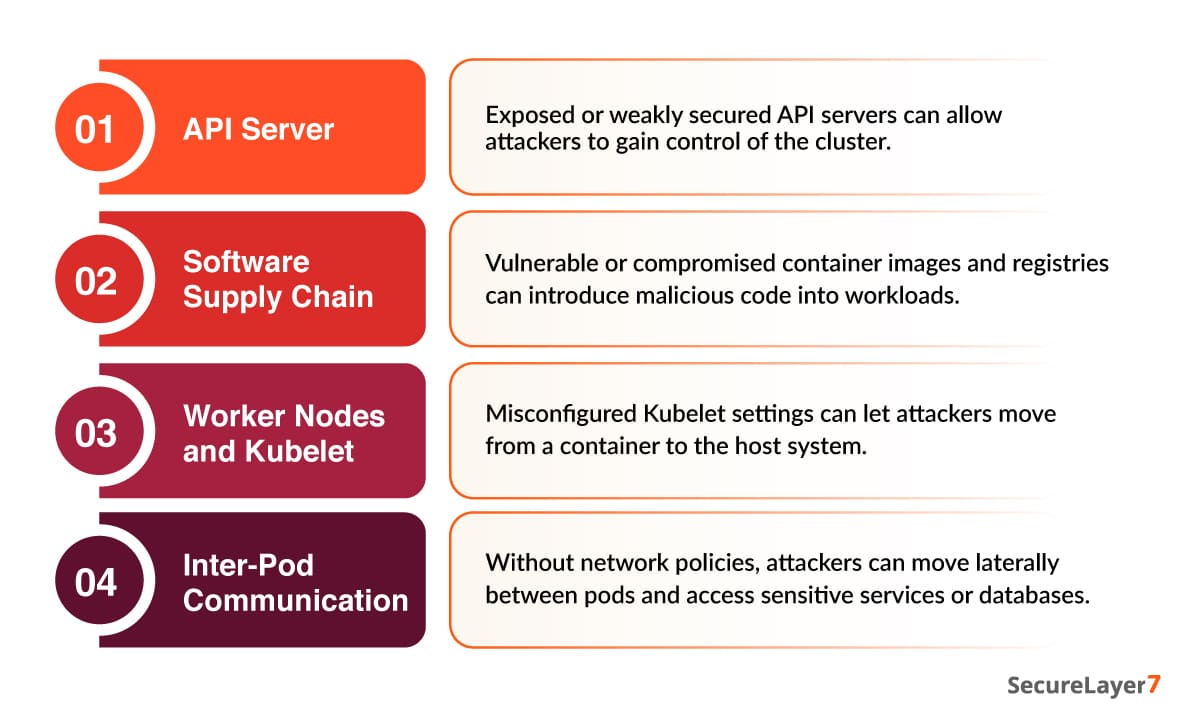
- Misconfigurations: Misconfigured Kubernetes environments are a common source of security risk. Exposing the API server to the public internet, keeping default settings, or running workloads without appropriate resource limits can increase the risk of unauthorized access and service disruption.
- Software Supply Chain Vulnerabilities: A compromised container image can introduce malicious code into a production cluster.
- Runtime Threats: Security risks continue after a container starts running. Attackers who compromise a container can use techniques such as cryptojacking.
- Excessive Permissions: Overly broad permissions can give users, containers, or service accounts access to resources they do not need.
Importance of Securing Kubernetes Environments in Modern DevOps
Moving fast without security is a recipe for disaster. Integrating security directly into the Kubernetes lifecycle often called DevSecOps is no longer optional.
Why Security Must Be Integrated:
- Zero Trust Architecture: In a containerized environment, you cannot assume the internal network is safe. Securing K8s requires a Zero Trust approach where every pod-to-pod communication is verified.
- Compliance and Governance: For industries like healthcare (HIPAA) or finance (PCI-DSS), a single unpatched Kubernetes vulnerability can lead to massive fines and loss of consumer trust.
- Shift Left Philosophy: By securing Kubernetes early in the development cycle teams save time and money that would otherwise be spent on firefighting breaches later.
What are Kubernetes Security Issues?
Kubernetes security issues include vulnerabilities, misconfigurations, and weak security practices that can expose clusters, containers, workloads, or sensitive data. These problems can occur at different layers of a Kubernetes environment, including cluster configuration, container images, APIs, networking, access controls, and workloads.
Kubernetes environments change frequently, so a small configuration error can sometimes create a significant security gap. Common examples include overly broad permissions, exposed dashboards or APIs, vulnerable container images, outdated components, and poorly configured network policies. Organizations can strengthen Kubernetes environments by applying controls for RBAC, network segmentation, container security, monitoring, and patching by following established Kubernetes security best practices.
Common Attack Surfaces in Kubernetes Clusters
Kubernetes clusters contain several key attack surfaces that attackers commonly target:
Kubernetes Architecture and Potential Weak Points
Securing Kubernetes starts with understanding how its core components interact. Every connection and service within the cluster can become a potential entry point for attackers if left unprotected.
Control Plane:
- etcd: Stores all cluster data and configurations. If compromised, attackers can gain visibility and control over the entire cluster.
- Controller Manager & Scheduler: Manage workloads and cluster state. Weak configurations can lead to resource exhaustion attacks that impact cluster stability.
Worker Nodes:
- Container Runtime: Runs containerized applications. Runtime vulnerabilities can allow attackers to escape containers and access the host system.
- Kube-Proxy: Handles network traffic between services. Misconfigurations can expose internal traffic or redirect requests to malicious destinations.
Shared Responsibility Model in Kubernetes Security
The shared responsibility model divides security responsibilities between the cloud provider and the organization using Kubernetes. Kubernetes environments running in public or hybrid clouds can also be assessed for configuration weaknesses, exposed services, access-control issues, and exploitable attack paths through cloud penetration testing
Provider Responsibilities
- Securing the underlying infrastructure, including servers, storage, and networking
- Managing and protecting Kubernetes control plane components such as the API server and scheduler
Customer Responsibilities
- Configuring RBAC, secrets management, and network policies
- Securing container images, workloads, and applications
- Protecting worker nodes through patching, hardening, and secure kubelet configurations
Top Kubernetes Security Risks
Kubernetes has become a critical platform for container orchestration, but its growing adoption brings an array of security challenges. Kubernetes offers powerful features, improper configurations, insecure practices, and overlooked security issues can expose your clusters to significant risks.
Understanding these vulnerabilities is the first step toward a resilient infrastructure.
1. Misconfigurations
Misconfigurations are the most common cause of security breaches in Kubernetes environments. Because K8s is flexible, it often defaults to usability over security.
- Insecure Default Configurations: Out-of-the-box settings often lack the Least Privilege principle. For example, some older versions or distributions may allow public access to the cluster dashboard or API.
- Improper RBAC Settings: Role-Based Access Control (RBAC) is often configured too broadly. Granting cluster-admin rights to service accounts or developers who don’t need them creates a massive security hole.
- Privilege Escalation: If a pod is misconfigured to allow Privilege Escalation: true, an attacker who compromises that pod can gain root-level access to the host node, effectively escaping the container.
2. Insecure Container Images
Your cluster is only as secure as the code running inside it. If you deploy a poisoned image, you are inviting attackers into your network.
- Vulnerable and Outdated Components: Many public images contain outdated libraries with known CVEs. Using these as base images inherits those risks.
- The Power of Image Scanning: Modern CI/CD pipelines must include Automated Image Scanning. Tools like Trivy or Clair check for vulnerabilities before the image ever reaches the registry, ensuring only clean artifacts are deployed.
3. Insufficient Network Policies
Kubernetes uses a flat network model where any pod can communicate with any other pod in the cluster.
- Lack of Network Segmentation: Without explicit Network Policies, a breach in a minor front-end service can lead an attacker straight to your sensitive backend database.
- Exposed APIs and Unsecured Channels: Internal communication should be encrypted. Failing to use Mutual TLS or leaving internal management APIs exposed to the entire cluster allows for easy sniffing of sensitive traffic.
4. Lack of Secrets Management
Managing passwords, API keys, and certificates is one of the most sensitive parts of Kubernetes administration.
- Improper Storage: A common mistake is storing secrets in plain text within YAML files or environment variables. This makes them visible to anyone with access to the repository or the kubectl command.
- Weak Encryption: Kubernetes has a native Secret object, it is only Base64 encoded, not encrypted by default. Without a dedicated provider, your sensitive data is essentially hidden in plain sight.
5. Insecure API Server Access
The API Server is the brain of the Kubernetes cluster. If it is compromised, the entire cluster is lost.
- Overexposed API Server: Making the API server accessible from the public internet is a high-risk move. It should ideally be restricted to private networks or specific VPN IP ranges.
- Authentication and Encryption Failures: Accessing the API without proper TLS encryption or using weak authentication methods allows attackers to perform Man-in-the-Middle (MitM) attacks or gain administrative privileges via brute force.
Kubernetes Security Vulnerabilities
Kubernetes security vulnerabilities are weaknesses within Kubernetes clusters, configurations, containers, or components that attackers can exploit to gain unauthorized access, escalate privileges, disrupt services, or compromise sensitive data. Security scanning can identify Kubernetes configuration and vulnerability issues, Kubernetes penetration testing helps validate that weaknesses can be exploited in real-world attack scenarios.
Following vulnerabilities often stem from misconfigurations, insecure APIs, outdated software, weak access controls, or vulnerable container images.
Kubernetes Security Vulnerabilities Identified by OWASP and Security Researchers
Kubernetes is continuously evaluated by security researchers, and organizations like OWASP have identified several common security risks linked to misconfigurations and the complexity of Kubernetes environments.
Key Kubernetes Vulnerabilities
- Misconfigured Access Control: Weak or overly permissive RBAC settings can lead to unauthorized access.
- Insecure Containers and Images: Outdated or unverified container images can introduce exploitable vulnerabilities.
- API Server Misconfigurations: Exposed or poorly secured API servers can allow attackers to control the cluster.
- Exposed Kubelet and Kube-Proxy: Unprotected Kubernetes components can become entry points for attackers.
CVEs (Common Vulnerabilities and Exposures) in Kubernetes
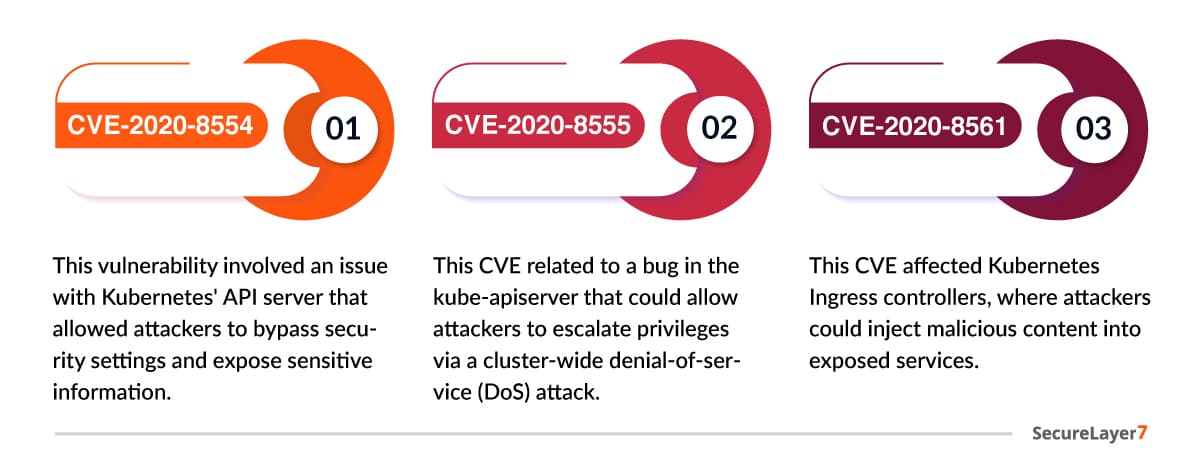
Common Vulnerabilities and Exposures (CVEs) are publicly disclosed security flaws in software systems. Kubernetes, like many open-source platforms, has several CVEs that have been identified over time. Understanding these CVEs and their impact on your environment is crucial for maintaining security.
Notable Kubernetes CVEs:
Impact of Kubernetes Vulnerabilities on Enterprise Environments
Kubernetes security vulnerabilities can cause data breaches, service disruptions, and loss of trust, especially when critical flaws or misconfigurations remain unresolved in enterprise environments.
Potential Impacts:
- Data Breaches: Attackers who gain unauthorized access to the Kubernetes API or compromise container images can steal sensitive data.
- Denial of Service (DoS): Exploiting vulnerabilities in control plane components can result in application downtime, affecting business operations.
- Privilege Escalation: Misconfigured RBAC or vulnerable components can allow attackers to escalate privileges and gain full administrative control over the entire cluster.
- Supply Chain Attacks: If a Kubernetes deployment is connected to third-party repositories, attackers can exploit vulnerabilities in dependencies or container images to inject malicious code.
How Kubernetes Security Works
Kubernetes security relies on multiple controls that protect clusters, workloads, containers, and network communications. These controls include authentication, role-based access control (RBAC), network policies, pod security settings, and container image scanning. They help restrict unauthorized access and reduce the risk of compromised workloads.
Security also depends on how Kubernetes environments are configured and maintained. Continuous monitoring can help detect suspicious activity, while regular patching addresses known vulnerabilities.
Securing the Key Components
Protecting a Kubernetes cluster requires securing the core services that manage and operate it.
- API Server: Secure all traffic with TLS encryption and enforce strong authentication and authorization controls.
- Kubelet: Block unauthenticated requests and use certificate rotation to secure node communication.
- Control Plane: Restrict access by isolating it from the public internet and allowing connections only through trusted access points such as VPNs or bastion hosts.
Implementing Security Controls
The architecture is set; you must implement active controls to manage how workloads interact.
Role-Based Access Control (RBAC):
RBAC is the primary tool for managing permissions. It uses Roles (rules for a namespace) and ClusterRoles (cluster-wide rules) to define what users and ServiceAccounts can do.
- Best Practice: Always follow the Principle of Least Privilege. Never use cluster-admin for daily tasks.
Network Policies:
Think of these as the internal firewalls of Kubernetes. By default, all pods can talk to each other. Network Policies allow you to:
- Isolate sensitive databases from front-end web pods.
- Restrict traffic to specific ports and IP ranges.
- Enforce a Deny-All default policy, only allowing explicitly permitted traffic.
Kubernetes Security Best Practices
As Kubernetes plays a critical role in managing containerized applications, securing the environment is essential. Without proper security practices, clusters can become vulnerable to breaches, data leaks, and service disruptions.
Proven strategies include adopting least privilege, enforcing zero-trust networking, enabling audit logging, and regularly updating Kubernetes components to address vulnerabilities.
Adopt Least Privilege for Kubernetes Roles
Least Privilege means ensuring that every user, service account, and pod has only the minimum permissions required to perform its function.
- Audit Cluster Roles: Many third-party Helm charts request cluster-admin privileges by default. Always review these and strip them down to specific Roles within a single namespace.
- Disable Service Account Automounting: If a pod does not need to query the Kubernetes API, disable the automatic mounting of the service account token in the pod’s specification: automountServiceAccountToken: false
- Use User-Specific Credentials: Avoid sharing administrative certificates. Use OIDC (OpenID Connect) to link Kubernetes access to your existing corporate identity provider .
Enforce Zero-Trust Networking Within Clusters
Traditional security assumes the internal network is safe, but in Kubernetes, every pod should be treated as a potential threat.
- Default Deny-All Policy: Implement a NetworkPolicy that blocks all ingress and egress traffic by default, then allow only required connections.
- Encrypt Traffic with mTLS: Use a service mesh to secure pod-to-pod communication with mutual TLS, preventing interception.
- Secure External Traffic: Use an Ingress Controller with a Web Application Firewall (WAF) to filter malicious traffic before it reaches services.
Enable Audit Logging to Monitor Access and Activities
Audit logging tracks all interactions with the Kubernetes API server, making it essential for monitoring, compliance, and incident investigation.
- Define an Audit Policy: Focus on high-risk actions like secret access, role changes, and pod deletions to reduce noise.
- Centralize Logs: Send logs to secure external systems to retain evidence even if the cluster is compromised.
- Real-Time Alerts: Configure alerts for suspicious activities such as repeated unauthorized access attempts or unusual namespace access.
Regularly Update Kubernetes Components to Patch Vulnerabilities
Kubernetes evolves rapidly, with frequent updates and security patches. Running outdated versions increases the risk of exploitation through known CVEs.
- Stay Within the N-2 Rule: Stay within the latest three supported Kubernetes versions to ensure access to critical security updates.
- Automate Node Patching: Use tools like Kured to safely reboot nodes after applying kernel-level security patches.
- Scan for Outdated Images: Regularly re-scan running container images to detect newly discovered vulnerabilities.
Kubernetes Security Tools and Solutions
As Kubernetes continues to be the go-to solution for container orchestration, securing the platform is of paramount importance. Kubernetes security tools help administrators identify vulnerabilities, misconfigurations, and potential risks within the environment. From container image scanning to infrastructure security, these tools offer comprehensive solutions for maintaining a secure Kubernetes deployment.
Kubernetes Security Benchmarking and Proactive Testing
Before a cluster goes live, audit it for misconfigurations and architectural weaknesses to prevent security gaps.
- Kube-bench: Validates your cluster against CIS Kubernetes Benchmarks and provides a Pass/Fail report on configurations.
- Kube-hunter: Identifies vulnerabilities from an attacker’s perspective, such as exposed services, open ports, and weak configurations.
- Falco: Monitors runtime behavior in real time and alerts on suspicious activities like shell execution, file changes, or unexpected network access.
Container Image Scanning Tools
Security starts in the registry. Container vulnerability scanning helps identify known vulnerabilities in container images and dependencies before deployment.
- Trivy: A fast, comprehensive scanner that detects vulnerabilities in OS packages, application dependencies, and even IaC files.
- Clair: Performs static analysis of container images and is often integrated with registries for automatic scanning.
- Checkov: Scans Kubernetes YAML and Helm charts to detect misconfigurations before deployment.
Infrastructure Security Platforms
For enterprises managing multiple clusters, comprehensive security platforms provide centralized visibility, advanced threat detection, and automated response.
- Aqua Security: Offers end-to-end protection with image scanning, CI/CD integration, and runtime enforcement to block unauthorized containers.
- Sysdig Secure: Built on Falco, it delivers unified security, monitoring, and strong forensic capabilities to analyze container activity.
- Prisma Cloud: A CNPP platform that provides deep visibility into Kubernetes risks, including network and identity analysis across hybrid environments.
Conclusion
Kubernetes security is essential for protecting cloud-native applications and maintaining service availability. Misconfigurations, exposed APIs, excessive permissions, vulnerable container images, and outdated components can create security gaps across clusters and workloads.
Organizations can reduce these risks by securing Kubernetes APIs, applying least-privilege RBAC, scanning container images, enforcing network policies, monitoring suspicious activity, and keeping Kubernetes components updated. Automated scanning and configuration reviews alone might not reveal complex attack paths or vulnerabilities that require manual validation.
SecureLayer7’s Kubernetes Penetration Testing service evaluates Kubernetes clusters, workloads, configurations, access controls, and potential attack paths to identify exploitable security weaknesses. The assessment combines security testing with expert analysis to help organizations understand real-world risks and prioritize remediation.
Explore SecureLayer7 Kubernetes Penetration Testing to identify security gaps and strengthen your Kubernetes environment against real-world attacks.
Frequently Asked Questions (FAQs)
Common Kubernetes security issues include misconfigurations, overly permissive RBAC settings, exposed API servers, insecure container images, lack of network segmentation, and poor secrets management.
Secure your Kubernetes environment by applying least privilege access (RBAC), using network policies for segmentation, scanning container images, managing secrets securely, enabling audit logging, and keeping all components updated with the latest patches.
Top risks include misconfigured access controls, vulnerable container images, exposed APIs, lack of encryption, insufficient monitoring, and lateral movement within clusters due to weak network policies.
No, Kubernetes vulnerabilities are not fixed automatically. While cloud providers may handle some control plane updates, organizations must regularly patch clusters, update components, and remediate vulnerabilities in images and configurations.
Adopt a shared responsibility model by aligning DevOps, security, and platform teams. Implement DevSecOps practices, automate security checks in CI/CD pipelines, enforce policies, and ensure continuous monitoring and training across teams.

