
Organizations are increasingly adopting AI-driven penetration testing to secure modern applications and infrastructure. Traditional testing methods struggle to keep up with dynamic environments like cloud, APIs, and microservices, leading to the emergence of AI-powered and AI-native pentesting approaches.
AI-powered pentesting enhances traditional, human-led testing with automation and analytics, improving efficiency but still relying heavily on manual expertise. AI-native pentesting uses AI as the core engine to deliver autonomous, continuous, and scalable security testing.
Rise of AI in Cybersecurity and Penetration Testing
Integration of Artificial Intelligence (AI) into cybersecurity is transforming how organizations detect and respond to threats. In penetration testing, AI is enabling faster vulnerability discovery, automated attack simulation, and deeper analysis of complex environments like cloud, APIs, and microservices.
As attack surfaces expand, traditional testing methods alone struggle to keep pace, making AI-driven pentesting a critical evolution in modern security strategies.
AI-Powered vs. AI-Native Pentesting: Why the Distinction Matters
AI-Powered Pentesting and AI-Native Pentesting represent two different approaches to applying AI in offensive security. AI-powered pentesting enhances human expertise with AI-assisted automation, analysis, and reporting, while AI-native pentesting leverages autonomous AI-driven workflows to perform continuous security testing at scale.
Both approaches play an important role in modern security programs depending on organizational requirements, risk appetite, compliance needs, and operational maturity.
The Increasing Need for Scalable and High-Quality Security Testing
Organizations today require both depth and scale in security testing. AI-powered pentesting helps security teams improve efficiency by automating repetitive tasks and accelerating vulnerability analysis while retaining expert human validation.
AI-native pentesting extends these capabilities by enabling continuous testing across rapidly changing environments. Together, these approaches help organizations improve coverage, reduce testing gaps, and strengthen overall security posture.
Why This Distinction Matters for Security Leaders
AI-powered and AI-native pentesting serve different purposes within modern security programs. The choice depends on what the user wants to achieve from the assessment.
If a user needs to accelerate traditional penetration testing, improve efficiency, and reduce manual effort while retaining expert oversight, AI-powered pentesting is the preferred approach. AI helps automate repetitive tasks such as reconnaissance, vulnerability analysis, and reporting, allowing security professionals to focus on validation and complex attack scenarios.
If a user needs autonomous security testing that can continuously discover, analyze, and execute attack paths with no human involvement , AI-native pentesting is the better choice. AI-native systems act as autonomous agents that continuously test environments, adapt to changes, and simulate real-world attacker behavior at scale.
What is AI-Powered Pentesting
AI-powered pentesting is the use of Artificial Intelligence (AI) to enhance traditional, human-led penetration testing. AI acts as an assistive layer to automate tasks like vulnerability scanning, data analysis, and report generation, security experts remain responsible for validation, exploitation, and decision-making.
Instead of replacing testers, AI improves efficiency by quickly identifying potential vulnerabilities and patterns that would take longer manually. Similar benefits are seen in web application penetration testing, where automation helps identify common vulnerabilities while human testers focus on complex attack scenarios and business logic flaws.
Definition of AI-Powered Pentesting
AI-Powered Pentesting is a human-led security methodology that integrates artificial intelligence (AI) and machine learning (ML) to enhance the effectiveness of a penetration test. It is not a replacement for human hackers but a force multiplier that uses AI to handle large-scale data analysis, vulnerability discovery, and exploit generation.
- AI as an Assistive Layer: AI serves as a Co-pilot, helping testers quickly identify patterns in massive datasets, such as cloud logs or API traffic, that would take hours for a human to sift through.
- Human-Led, AI-Supported: The critical decision-making – defining the scope, understanding business logic, and executing high-risk exploits – remains in the hands of a certified human professional.
Key Benefits
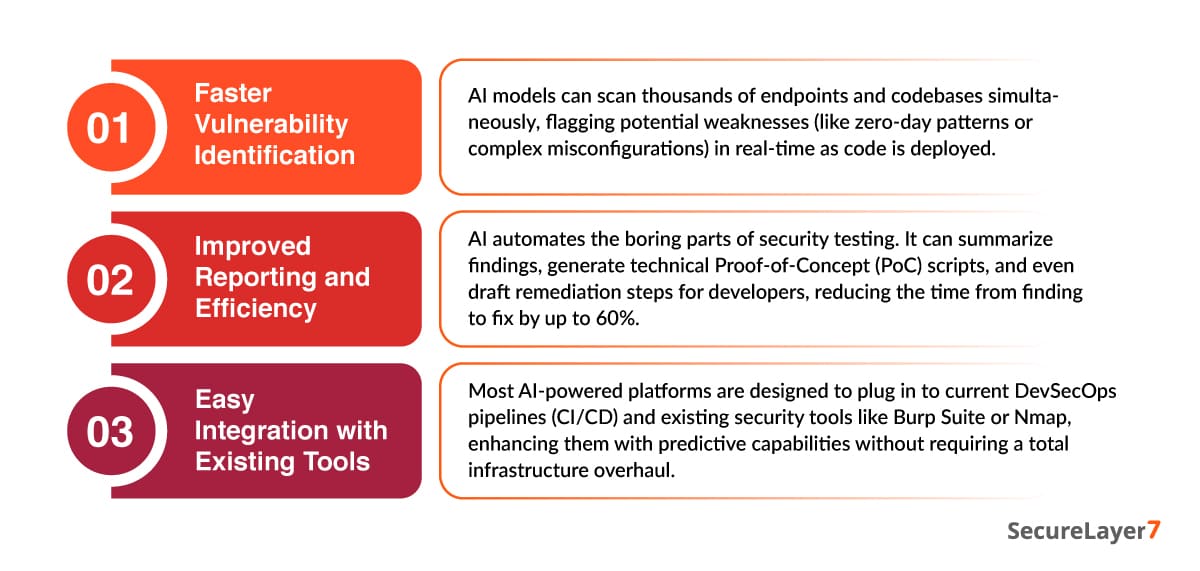
The integration of AI into the pentesting workflow provides three primary advantages:
Challenges and Limitations
Despite its power, AI-powered pentesting is not a set-and-forget solution.
- Dependency on Human Expertise: The AI is only as good as the prompt or the data it is fed. Without a senior pentester to guide the AI and interpret its findings, the results can be misleading or irrelevant to actual business risk.
- Limited Automation Capabilities: Unlike AI-Native Pentesting (which uses autonomous agents), AI-powered systems often struggle to chain exploits together independently.
- Possibility of False Positives: AI is prone to hallucinations it may confidently identify a vulnerability that doesn’t actually exist.
What is AI-Native Pentesting
AI-native pentesting is a modern approach where Artificial Intelligence acts as the core engine driving the entire penetration testing process. Unlike AI-powered methods, it enables autonomous discovery, exploitation, and reporting with no human involvement.
It continuously tests systems, adapts to changes, and simulates real-world attack scenarios across complex environments like cloud, APIs, and microservices. This makes AI-native pentesting scalable, adaptive, and future-ready for modern cybersecurity needs.
This approach is particularly beneficial for organizations focused on continuous API penetration testing
Definition of AI-Native Pentesting
AI-Native Pentesting (also known as Autonomous or Agentic Pentesting) is a security methodology where a Large Language Model (LLM) or a specialized AI agent serves as the core engine driving the entire process.
- AI as the Core Engine: The AI does not just assist; it reasons. It understands the target’s architecture, makes tactical decisions, and chooses which tools to use – just like a human attacker would.
- Fully Automated Lifecycle: From initial reconnaissance and fingerprinting to exploit validation and report generation, the AI manages the end-to-end workflow autonomously.
Key Benefits
AI-native systems offer capabilities that were previously impossible for automated scanners:
- Scalable Across Modern Environments: Human testers are limited by time and headcount, AI-native agents can scale across global, multi-cloud infrastructures, testing thousands of assets simultaneously without a drop in quality.
- Simulating Real-World Attacks: AI agents use Task-Tree Reasoning to chain vulnerabilities. If they find a leaked API key, they do not just report it; they automatically attempt to use it to see what data can be accessed, simulating the actual impact of a breach.
- Adaptive Security Testing: Traditional scanners follow a rigid checklist. AI-native pentesting is probabilistic – if a defensive barrier is encountered, the AI adapts its strategy in real-time, trying different bypass techniques until it finds a way through.
- Reduced Manual Intervention: By handling the heavy lifting of discovery and validation, AI-native pentesting allows security teams to focus on high-level strategy and remediation rather than manual clicking and script-writing.
Challenges and Limitations
The move toward full autonomy brings a new set of risks that security leaders must manage:
- Trust and Reliability Concerns: There is a lingering fear that an autonomous agent might accidentally cause downtime by running an aggressive payload on a sensitive production server.
- Lack of Transparency (Black-Box AI): Unlike a manual test with a detailed log, AI-native systems can sometimes reach conclusions via black-box reasoning, making it difficult for humans to understand exactly how a specific vulnerability was discovered.
- Risk of Over-Automation: Relying 100% on AI can lead to a false sense of security. AI may still struggle with unique, one-of-a-kind business logic flaws that require deep human context or knowledge of specific company policies.
- Security Risks Within AI Models: The pentester itself becomes a target. If an attacker can perform a Prompt Injection against the AI-native pentesting tool, they could potentially hijack the agent to turn it against the very company it was designed to protect.
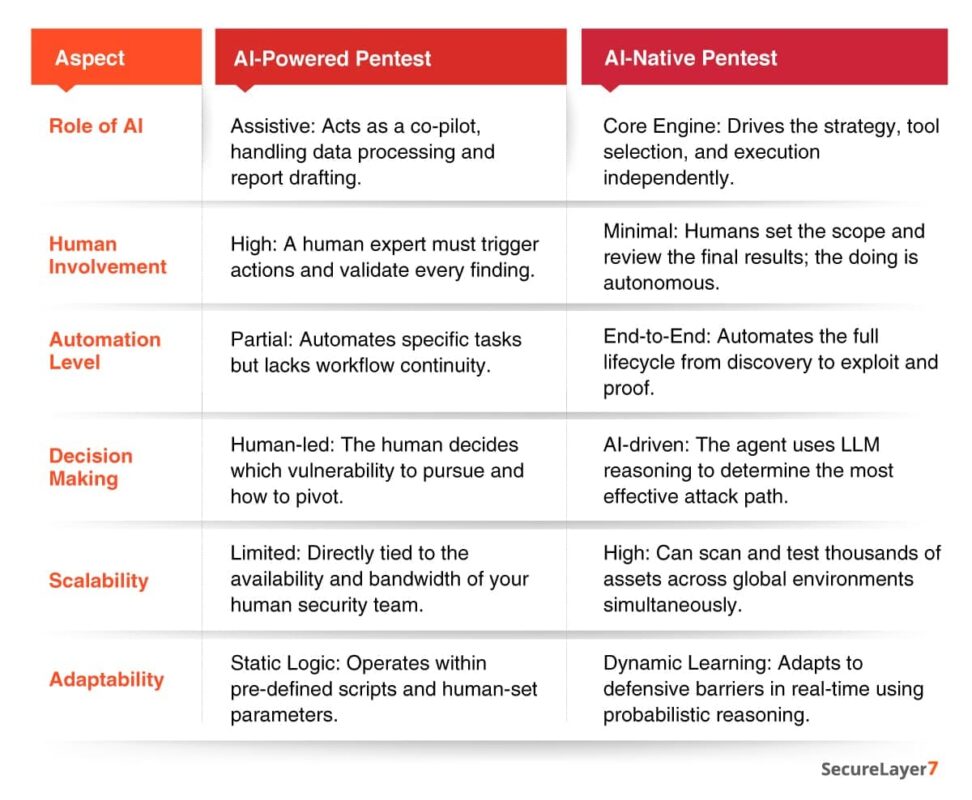
AI-Powered Pentest vs AI-Native Pentest: Core Differences
AI-powered systems focus on making the human hacker more efficient, AI-native systems aim to replicate the hacker’s cognitive process entirely.
Key Takeaways for 2026
Choosing the Right Approach
Choose AI-Powered Pentesting if:
- A user needs faster penetration testing without replacing human expertise.
- A user wants to improve efficiency in vulnerability discovery and reporting.
- A user prefers security experts to validate findings and make testing decisions.
- A user requires human-driven testing for business logic and application-specific scenarios.
- A user wants AI to act as an intelligent assistant rather than an autonomous attacker.
Choose AI-Native Pentesting if:
- A user needs autonomous attack execution and validation.
- A user wants continuous security testing across dynamic environments.
- A user requires AI-driven attack path discovery and exploit chaining.
- A user wants security testing to adapt automatically as environments change.
- A user needs scalable testing across cloud, APIs, microservices, and distributed infrastructures.
How Each Approach Works
Understanding how AI-powered and AI-native pentesting operate helps organizations choose the right security approach. Both use AI, they differ significantly in execution. AI-powered pentesting supports traditional workflows with automation, AI-native pentesting runs as an end-to-end, autonomous process, enabling continuous and scalable security testing in modern environments.
AI-Powered Pentesting Workflow: The Augmented Path
In this model, the workflow follows a traditional linear path, with AI acting as a high-performance engine for specific manual stages.
- Guided Reconnaissance: The human tester triggers an AI-enhanced scanner. The AI categorizes assets and flags unusual patterns, but the human must manually select which targets to investigate.
- Assisted Analysis: Instead of reading through thousands of lines of logs, the human asks an AI assistant, Show me any anomalous API calls from last night.
- Human-Triggered Exploitation: The AI might suggest a payload or generate a custom script for a specific vulnerability.
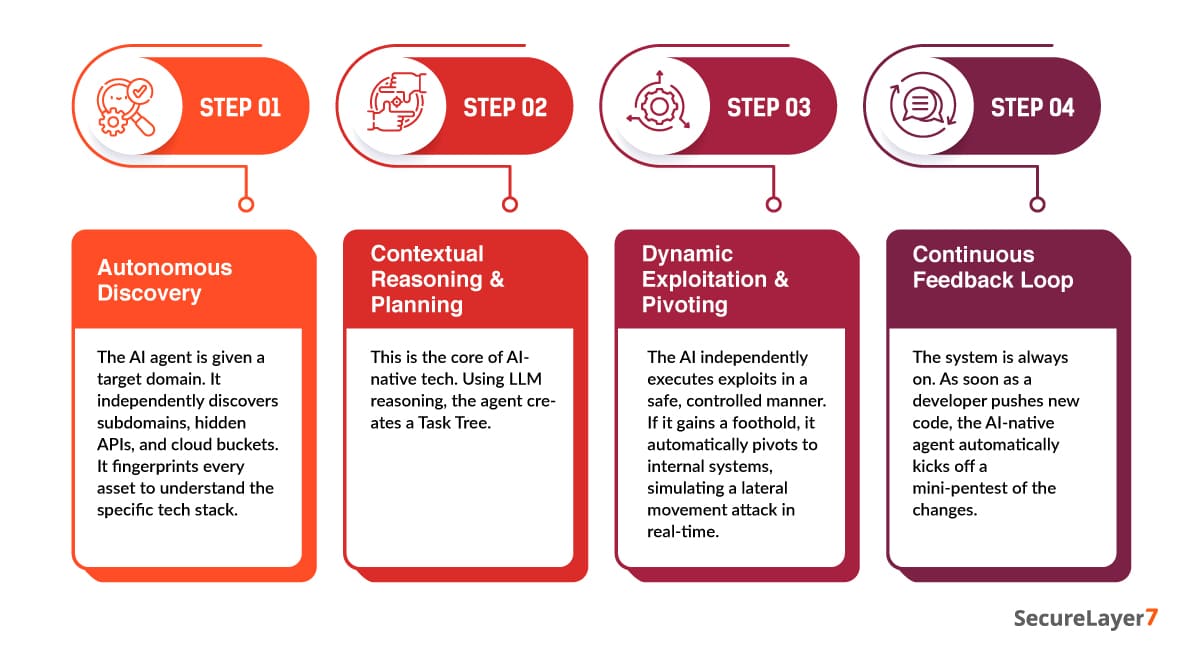
AI-Native Pentesting Workflow: The Autonomous Path
The AI-native workflow is non-linear and agentic. It operates more like a professional hacker’s brain than a software script.
Where Each Approach Fits (Use Cases)
There is no one-size-fits-all solution; rather, there are specific scenarios where one methodology clearly outshines the other.
When to Choose AI-Powered Pentesting
AI-powered pentesting is best suited for organizations that still rely on traditional human-centric security cycles but want to increase their technical horsepower.
- Basic Vulnerability Identification: Ideal for smaller organizations or standard web applications where a human eye is needed to ensure zero false positives for compliance audits.
- Initial Security Assessments: Perfect for Point-in-Time testing of a new product launch or a yearly check-up of a legacy system that doesn’t change frequently.
- Simpler or Less Dynamic Environments: If your infrastructure is relatively static, the high-speed adaptability of an autonomous agent may be overkill.
- High-Touch Manual Red Teaming: Use this when you want your best security researchers to perform deep-dive creative hacking.
When to Choose AI-Native Pentesting
AI-native pentesting is designed for the speed of the cloud. It is the preferred choice for modern, fast-moving digital enterprises.
- Complex, Cloud-Native Applications: For environments running on AWS, Azure, or GCP where assets are constantly being created and destroyed. An autonomous agent can hunt these dynamic assets in real-time. For more info visit: What Is Cloud Penetration Testing? A Complete Guide.
- Modern Architectures (APIs & Microservices): Testing the mesh of hundreds of interconnected microservices is nearly impossible for a human. AI-native agents excel at tracing data flows through APIs to find broken object-level authorization (BOLA) and other complex logic flaws.
- Advanced Threat Simulation: AI-native agents can simulate an end-to-end breach – from an initial phish to domain dominance – providing a true Attacker’s View of your risk.
- Continuous Security Validation (CSV): If your engineering team pushes code multiple times a day, you need a pentest-as-a-service that lives in your CI/CD pipeline and tests every single change automatically.
Decision Matrix: Which Approach Should You Choose
Choosing the right security testing methodology is the difference between a check-the-box compliance exercise and true cyber resilience. In the 2026 threat landscape, the window of exposure has shrunk to hours, making the speed and depth of your pentesting provider more critical than ever.
Use this decision matrix to determine which approach aligns with your organization’s technical maturity and risk profile.
AI-Powered Pentesting
AI-powered pentesting combines human expertise with AI-assisted analysis, helping security teams improve efficiency while maintaining expert oversight. It remains highly effective for compliance assessments, business logic testing, and complex security reviews that require human judgment.
AI-powered pentesting is ideal when the goal is to speed up security assessments while maintaining human oversight. It helps testers work faster, process larger amounts of data, and generate insights more efficiently without removing the expertise and judgment that experienced security professionals bring to the engagement.
AI-Native Pentesting
AI-native pentesting enables autonomous security testing across dynamic environments. It is particularly valuable for organizations seeking continuous validation, rapid scalability, and automated attack simulation in cloud-native ecosystems.
AI-native pentesting is ideal when the goal is autonomous security testing. Instead of simply assisting human testers, AI actively discovers targets, evaluates attack paths, executes testing workflows, and continuously validates security controls with minimal manual intervention.
Key Insight: The Shift from Assistive to Autonomous
The evolution of offensive security is driving greater adoption of both AI-assisted and autonomous testing approaches. Organizations increasingly use AI-powered pentesting to enhance expert-led assessments while adopting AI-native capabilities for continuous testing and attack surface coverage.
The future of penetration testing will likely involve a combination of human expertise and AI-driven automation working together to improve security outcomes.
Final Consideration
The choice between AI-powered and AI-native pentesting depends on the outcome a user is looking for.
If a user needs to improve the speed, efficiency, and productivity of traditional penetration testing while retaining human expertise and decision-making, AI-powered pentesting is the ideal choice.
If a user needs autonomous security testing that can independently discover vulnerabilities, execute attack paths, and continuously validate security controls, AI-native pentesting is the ideal choice.
Both approaches bring unique advantages. AI-powered pentesting focuses on accelerating human-led testing, while AI-native pentesting focuses on autonomous execution and continuous security validation.
Future of AI in Penetration Testing
The future of penetration testing will be shaped by increasing collaboration between human expertise and artificial intelligence. Organizations are adopting both AI-powered and AI-native security testing approaches to improve vulnerability discovery, automate repetitive tasks, expand testing coverage, and strengthen overall cyber resilience.
As security environments become more complex, AI will continue to play a larger role in enabling faster and more effective security assessments.
Shift Toward AI-Native Security Platforms
AI-native security platforms are no longer an add-on but the architectural foundation for enterprise defense. Unlike traditional tools that bolt-on AI features, these platforms are built as autonomous ecosystems.
- Behavioral Detections over Signatures: AI-native platforms learn from real-time behavioral signals across the environment, identifying shadow AI deployments and prompt injection attacks that traditional signature-based systems miss.
- Predictive Vulnerability Prioritization: Using global telemetry and exploit trend analysis, platforms can now predict which specific flaws are likely to be weaponized next, allowing teams to patch proactively rather than reactively.
- Integrated Auditability: Modern AI security stacks now prioritize Explainable AI (XAI), creating detailed audit trails of exactly why an AI-native agent made a specific security decision – critical for compliance with the EU AI Act.
Increasing Reliance on AI-Driven Attack Simulation
Continuous Breach and Attack Simulation (BAS) has replaced the annual manual audit as the primary method for risk assessment.
- Simulating the Agentic Adversary: Organizations now use Generative Adversarial Networks (GANs) to simulate how an autonomous AI bot would probe defenses, move laterally, and exfiltrate data.
- Continuous CI/CD Feedback: AI-driven simulations are integrated directly into the development pipeline. As soon as code is committed, an AI agent attacks the new environment to identify regressions or insecure API logic before it hits production.
- Machine-Scale TTPs: Simulations now include thousands of attack methods based on the MITRE ATT&CK framework, executed simultaneously to find blind spots in EDR and SIEM configurations.
Evolution of Autonomous Security Testing Capabilities
We have transitioned from Automated Scanning to Autonomous Reasoning. This marks the emergence of Agentic Pentesting.
- Task-Tree Reasoning: AI agents now possess pivoting logic. If an agent finds a low-level vulnerability, it can independently reason that this can be chained with a broken access control to reach a high-impact database.
- Adaptive Payloads: Autonomous tools can now morph their own payloads in real-time to bypass a specific Web Application Firewall (WAF) or Endpoint Detection (EDR) signature, mimicking the persistence of an Advanced Persistent Threat (APT).
- Evidence-Based Reporting: These systems do not just find bugs; they generate automated Proof-of-Concepts (PoCs), including video captures and technical logs, providing irrefutable evidence of risk.
Conclusion
AI is transforming penetration testing by enabling faster, more scalable, and more effective security assessments. AI-powered pentesting enhances human expertise through intelligent automation, streamlined analysis, and improved reporting, AI-native pentesting introduces autonomous testing capabilities that support continuous security validation across modern environments.
AI-powered and AI-native pentesting address different security objectives. If the goal is to improve the efficiency of traditional penetration testing while retaining expert oversight, AI-powered pentesting delivers faster analysis, streamlined workflows, and enhanced productivity. If the goal is autonomous security testing with continuous attack simulation and validation, AI-native pentesting provides the automation and scalability needed for modern environments.
At SecureLayer7, organizations can leverage both approaches based on their specific requirements. Whether the need is AI-powered penetration testing to accelerate expert-led assessments or AI-native security testing to enable autonomous attack execution and continuous validation, SecureLayer7 provides solutions designed to strengthen security across evolving digital environments.
Contact Seculayer7 today to secure your digital assets with advanced AI-driven security testing.
Frequently Asked Questions (FAQs)
AI-powered pentesting uses Artificial Intelligence as a support layer to enhance traditional penetration testing. It automates tasks like vulnerability scanning, analysis, and reporting, but still relies on human testers for validation, exploitation, and decision-making.
AI-native pentesting is a modern approach where AI acts as the core engine, performing end-to-end testing including discovery, exploitation, and reporting. It enables autonomous, continuous, and scalable security testing with no human involvement.
The difference lies in who makes the decisions. AI-Powered: A human uses AI tools to find bugs faster. It is episodic (scheduled) and limited by human bandwidth. AI-Native: An AI agent autonomously hunts for bugs. It is continuous (always-on) and scales infinitely across massive, complex cloud environments.
Yes, AI-native pentesting is highly effective for modern, complex environments like cloud, APIs, and microservices. It provides continuous testing and deeper coverage. Combining it with human oversight ensures better accuracy and strategic decision-making.
No. AI can automate many tasks and improve efficiency, human expertise remains essential for understanding business logic, interpreting results, and handling complex security scenarios. The best approach is a combination of AI capabilities and human intelligence.

