
Software-as-a-Service (SaaS) applications continue to dominate the digital landscape, securing them has become more critical than ever. SaaS platforms host sensitive business data and manage workflows across multiple industries, making them prime targets for cyberattacks. SaaS penetration testing is a proactive security measure that simulates real-world attacks on your SaaS environment to uncover vulnerabilities before malicious actors can exploit them.
The complexity and scale of SaaS applications demand a more comprehensive approach to penetration testing. Organizations must not only access code and APIs but also evaluate authentication mechanisms, cloud configurations, and third-party integrations to strengthen their security posture, comply with regulatory standards, and safeguard critical data.
SaaS (Software as a Service) Applications and their Growing Importance
Software as a Service (SaaS) refers to cloud-based applications that users can access over the internet without installing software locally. Unlike traditional programs, SaaS platforms are hosted on remote servers, making them scalable, cost-effective, and accessible from anywhere. Common examples include collaboration tools, CRM systems, project management software, and cloud-based accounting applications.
The growing reliance on SaaS is driven by businesses seeking flexibility, faster deployment, and lower infrastructure costs. As organizations increasingly store sensitive data and critical business operations on these platforms, SaaS applications have become prime targets for cyberattacks.
SaaS Penetration Testing and why it’s Crucial for Security
SaaS penetration testing is a controlled, authorized process in which security experts simulate real-world attacks on a SaaS environment to identify vulnerabilities and potential entry points. The purpose is to discover weaknesses before malicious actors can exploit them, helping organizations strengthen security and prevent data breaches.
As SaaS applications become increasingly connected to other cloud services, APIs, and third-party integrations, penetration testing ensures that both the core platform and its ecosystem remain secure. Regular SaaS pen testing is essential for protecting sensitive information, maintaining regulatory compliance, and reducing the risk of costly security incidents.
Key Terms Explained: SaaS Application Testing and SaaS Penetration Testing
When discussing security for SaaS platforms, two key terms often appear:
- SaaS Application Testing: This is the broader practice of evaluating SaaS applications for functional, performance, and security issues. Security is a key focus, but testing also includes usability, reliability, and compliance checks.
- SaaS Pen Testing (Penetration Testing): A focused subset of SaaS application testing, SaaS pen testing specifically targets vulnerabilities and simulates attack scenarios to test an organization’s defenses against cyber threats.
What is SaaS Penetration Testing
SaaS Penetration Testing (SaaS pen testing) is a security assessment that evaluates SaaS applications by simulating real-world cyberattacks. Ethical hackers probe for vulnerabilities in areas such as application logic, APIs, authentication systems, and data storage, identifying potential security risks before malicious actors can exploit them.
Testing SaaS applications helps protect sensitive data, maintain system integrity, and ensure compliance with regulations like SOC 2 or GDPR. By uncovering and addressing security gaps, organizations can strengthen their cloud applications, safeguard user trust, and reduce the likelihood of costly data breaches.
How SaaS Penetration Testing Helps Identify Security Flaws in SaaS Applications
SaaS penetration testing, or SaaS pen testing, is a controlled and authorized security assessment of Software-as-a-Service applications. Its main purpose is to simulate real-world cyberattacks to uncover vulnerabilities in the application, cloud infrastructure, APIs, authentication mechanisms, and third-party integrations.
This type of testing is particularly important because SaaS applications often manage sensitive user and corporate information, including financial records, intellectual property, and personal data. Detecting flaws early allows security teams to implement fixes, strengthen configurations, and prevent breaches – an essential practice in today’s highly interconnected cloud environments.
For broader context on pen testing methodologies, refer to our post A Deep Dive into Application Security Testing.
Differentiating between Traditional Penetration Testing and SaaS Application Testing
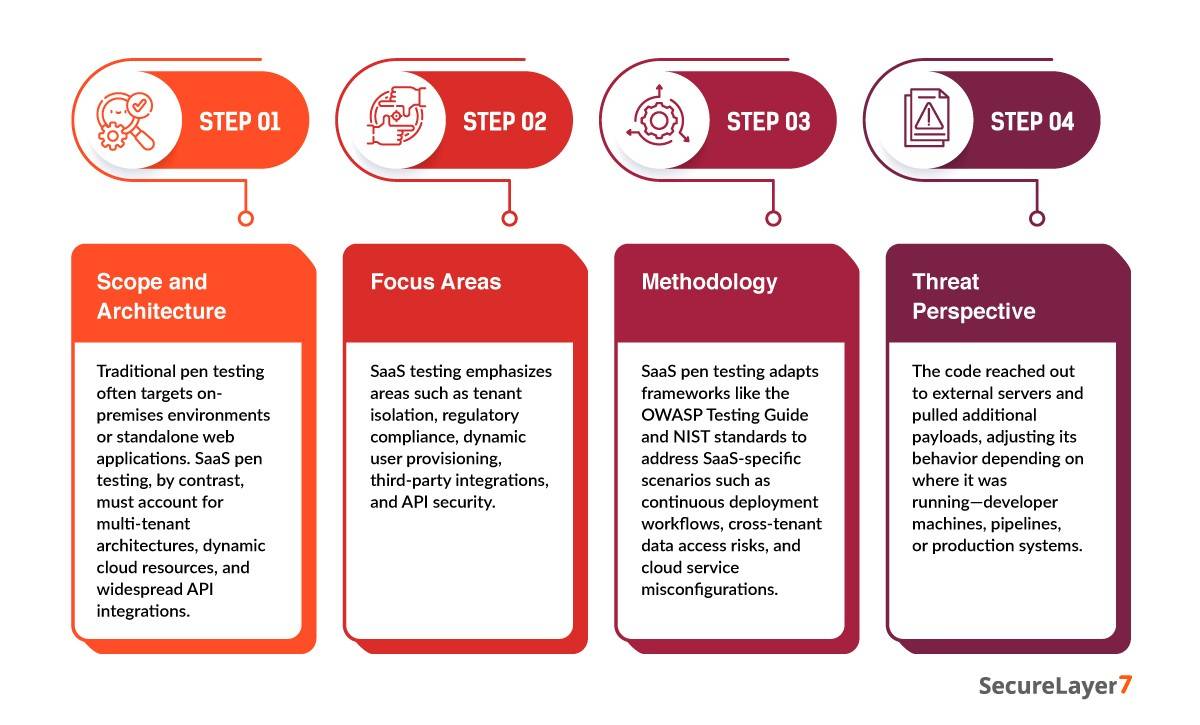
Traditional penetration testing and SaaS application testing share foundational methodologies, several key differences set them apart:
Why is SaaS Pen Testing Important
As businesses increasingly rely on SaaS applications, these platforms become attractive targets for cyberattacks. SaaS Penetration Testing (SaaS pen testing) enables organizations to proactively identify vulnerabilities in authentication systems, APIs, data storage, and multi-tenant environments.
Neglecting SaaS pen testing can result in data breaches, financial losses, regulatory non-compliance, and damage to reputation. By conducting routine tests, organizations not only strengthen overall security but also maintain compliance with standards such as SOC 2 and GDPR, while building trust with customers and stakeholders.
The Rising Number of Cyber Threats Targeting SaaS Applications
SaaS applications have become prime targets for cybercriminals due to the widespread shift to the cloud and the sensitive data they store. Attackers often exploit vulnerabilities in APIs, insecure integrations, and misconfigured cloud services to compromise these platforms.
Common threats include unauthorized data access, privilege escalation across tenants, account takeovers through stolen credentials, and business logic abuse. Because SaaS platforms often serve multiple customers simultaneously, a single vulnerability can have far-reaching consequences across the entire user base.
Consequences of Not Performing Regular Pen Testing on SaaS Platforms
Neglecting regular penetration testing leaves SaaS platforms dangerously exposed. Without proactive security assessments, vulnerabilities such as insecure APIs, misconfigured identity and access management, and flaws in multi-tenant data separation often go undetected until after exploitation. The consequences are severe:
- Data breaches exposing large volumes of sensitive customer or business data
- Loss of compliance standing with frameworks like SOC 2, ISO 27001, or HIPAA
- Financial penalties, litigation, and costly incident response efforts
- Loss of customer trust, damaged reputation, and potential business loss
- Silent compromise, where attackers gain persistent, undetected access to SaaS resources
Why SaaS Application Security Is Essential for Safeguarding Sensitive Data
SaaS platforms process vast amounts of confidential and regulated data every day, making robust security – including thorough penetration testing – critical to protecting it from accidental exposure, theft, or manipulation. Penetration testing evaluates the strength of access controls, isolation mechanisms between tenants, and the security of APIs and backend logic.
This proactive, in-depth assessment helps organizations demonstrate due diligence, maintain customer trust, and ensure that sensitive records, intellectual property, and business operations remain secure against constantly evolving threats.
Key Steps Involved in SaaS Penetration Testing
SaaS Penetration Testing is a structured process that identifies and addresses security vulnerabilities in SaaS applications. It helps organizations uncover weaknesses in authentication, APIs, data storage, and multi-tenant environments before malicious actors can exploit them.
By following a systematic approach, businesses can proactively strengthen their application security, protect sensitive data, and maintain compliance with standards like SOC 2 and GDPR. Regular SaaS application testing ensures that risks are minimized and the platform remains reliable and secure.
Following are the major stages involved in a comprehensive SaaS pen test.
Reconnaissance in SaaS Pentesting: Scanning & Mapping
Reconnaissance, focuses on information gathering. Testers collect as much data as possible about the SaaS environment, such as domain names, subdomains, exposed APIs, authentication mechanisms, and third-party integrations.
Key activities include:
- Network and application scanning: Identifying open ports, services, and end-points that could expose weaknesses.
- Enumerating user accounts and permissions: Detecting misconfigurations in access controls or exposed user data.
- API discovery and testing: Mapping all endpoints to pinpoint insecure configurations, weak tokens, or unvalidated inputs.
- Cloud configuration analysis: Reviewing security posture across SaaS-hosted components, including misconfigured storage buckets or outdated dependencies.
Exploitation: Attempting to Exploit Identified Weaknesses
Vulnerabilities are identified; the exploitation phase begins. Ethical hackers simulate real-world attack techniques to determine how these weaknesses can be weaponized.
- Injection attacks: Testing SQL, NoSQL, or command injection flaws within the SaaS application.
- Authentication and session attacks: Exploiting flaws like broken authentication, session fixation, or weak password policies.
- Cross-site scripting (XSS) and CSRF attacks: Checking for insecure input handling or insufficient validation in web-based interfaces.
- Privilege escalation: Attempting to move from a low-privilege user to administrative access.
Post-Exploitation: Assessing the Impact of Successful Attacks in SaaS Environments
Testers focus on understanding the depth and extent of the compromise. Rather than just proving a breach, they analyze what an attacker could do after gaining access – such as data exfiltration, privilege escalation, or persistence in the system.
- Impact analysis: Determining what sensitive information (like customer data or credentials) could be accessed.
- Privilege validation: Testing if higher-level permissions can be maintained or expanded.
- Data integrity testing: Evaluating whether compromised accounts can alter or delete key information.
- Lateral movement simulation: Exploring if attackers can pivot across SaaS modules or integrated applications.
Comprehensive Reporting in SaaS Penetration Testing: From Vulnerabilities to Recommended Fixes
The final stage, reporting, transforms all the findings into actionable insights for remediation. A well-structured SaaS penetration testing report provides both technical and executive-level clarity on the security posture.
- Executive summary: A concise overview of test scope, objectives, and key findings for non-technical stakeholders.
- Detailed vulnerability breakdown: Technical descriptions of each issue, including severity ratings, evidence, and reproduction steps.
- Risk assessment: Categorization of vulnerabilities using frameworks like CVSS to prioritize remediation.
- Remediation guidance: Practical recommendations to fix issues, harden configurations, and strengthen overall SaaS security posture.
Challenges in SaaS Penetration Testing
SaaS Penetration Testing presents unique challenges due to the cloud-based, multi-tenant nature of SaaS applications. Shared infrastructure, frequent updates, and complex integrations make it more difficult to identify vulnerabilities without impacting active users.
Testers also face hurdles such as securing APIs, handling sensitive data in compliance with regulations like GDPR and SOC 2, and working within limited system-level access.
Following are some of the key challenges that security teams face during SaaS application testing.
Security Complexities in Multi-Tenant Environments
SaaS platforms often operate on a multi-tenant architecture, where different customers share the same underlying infrastructure while keeping their data isolated.
- Data Isolation Risks: Testers must ensure that exploitation attempts do not inadvertently access or impact another tenant’s data.
- Shared Resources Vulnerability: Vulnerabilities in shared components, such as cloud storage buckets or authentication services, can impact multiple tenants simultaneously.
- Access Controls Validation: Permission boundaries between tenants must be rigorously tested without compromising production data integrity.
Data Privacy in SaaS Security Testing: Best Practices for Handling Sensitive Information
SaaS penetration testing often involves interacting with environments that process vast amounts of sensitive data, including personal identification information (PII), financial records, and proprietary business data.
- Compliance Requirements: Frameworks like GDPR, HIPAA, and SOC 2 impose strict rules on how testing teams handle sensitive data.
- Data Masking: Test accounts should use anonymized or synthetic data to avoid privacy breaches during exploitation attempts.
- Secure Storage: Any captured test data must be encrypted, stored securely, and disposed of following retention policies.
Balancing Thorough Security Testing with Business Continuity
Unlike traditional software testing, SaaS penetration testing is performed against live production environments that serve customers in real time. Interrupting service can result in financial losses, reputational damage, and customer dissatisfaction.
- Minimizing Downtime: Test schedules must be carefully planned to avoid peak usage hours, with fallback procedures ready if functionality is impacted.
- Controlled Exploitation: Simulated attacks should be isolated to sandbox environments or test accounts whenever possible.
- Operational Coordination: Continuous communication between testers, DevOps, and security teams ensures real-time risk management during testing.
Common Vulnerabilities in SaaS Applications
SaaS applications are widely adopted for their flexibility and scalability, but they also present unique security risks. Identifying common vulnerabilities is a critical step in SaaS penetration testing to protect sensitive data, ensure system integrity, and maintain customer trust.
Regular SaaS application testing helps organizations detect these vulnerabilities early, prioritize remediation efforts, and implement stronger security measures before attackers can exploit them.
Insecure APIs and Data Storage Vulnerabilities
APIs serve as the backbone of SaaS platforms – connecting services, integrating third-party tools, and enabling data exchange. Insecure APIs are among the most exploited entry points for attackers.
- Poor input validation allowing injection attacks.
- Exposed endpoints revealing sensitive system details.
- Improper authentication or token handling in API calls.
- Weak encryption or misconfigured storage in cloud environments like AWS S3 or Azure Blob.
Common SaaS Vulnerability: Insufficient Authentication and Authorization Measures
Weak authentication and authorization mechanisms are another common cause of SaaS security breaches. Inadequate implementation can allow unauthorized access, privilege escalation, or complete account takeover.
- Missing Multi-Factor Authentication (MFA).
- Poorly implemented Role-Based Access Control (RBAC) or Attribute-Based Access Control (ABAC).
- Hardcoded credentials or default passwords.
- Session hijacking due to insecure cookie handling.
Cross-site Scripting (XSS) and SQL Injection Risks
Classic web vulnerabilities like XSS and SQL injection continue to plague SaaS applications due to poor coding practices or insufficient input sanitization.
- Cross-Site Scripting (XSS): Attackers inject malicious scripts into user-facing pages, compromising session tokens, stealing credentials, or defacing websites.
- SQL Injection (SQLi): Exploiting unvalidated inputs to manipulate backend queries, allowing attackers to extract, modify, or delete sensitive data.
Best Practices for SaaS Pen Testing
Effective SaaS Penetration Testing (or SaaS pen testing) requires a systematic approach to ensure that vulnerabilities in SaaS applications are accurately identified and remediated.
Following best practices helps organizations maximize security coverage, minimize operational disruption, and maintain compliance with industry standards like SOC 2 and GDPR.
Regular Testing During the Development Lifecycle
Security testing should not be a one-time activity conducted after deployment. Incorporating penetration testing throughout the software development lifecycle (SDLC) ensures vulnerabilities are uncovered and mitigated before they reach production.
- Shift-Left Security Approach: Integrate security assessments early in the development phase to identify coding flaws and insecure configurations.
- Continuous Testing: Perform periodic penetration tests after major code updates, infrastructure changes, or new feature releases.
- CI/CD Integration: Automate security scans in the CI/CD pipeline to ensure every build and deployment meets security benchmarks before production rollout.
Collaboration with Developers and Security Teams
Penetration testing is most effective when it’s a collaborative effort between developers, DevOps, and security teams. Open communication bridges the gap between discovering vulnerabilities and implementing timely fixes.
- Knowledge Sharing: Security teams should provide developers with detailed insights into identified vulnerabilities, root causes, and secure coding practices.
- Coordinated Remediation: Jointly prioritize vulnerabilities based on risk levels to ensure efficient patching.
- Security Training: Conduct regular workshops or tabletop exercises to help development teams understand common attack vectors and prevention techniques.
Automation Tools vs Manual Testing in SaaS Environments
Automation plays a vital role in modern SaaS pen testing, allowing rapid scanning and continuous monitoring across large infrastructures. Relying solely on automated tools can lead to missed logical flaws and contextual vulnerabilities. It’s also useful to compare how automated and manual pen testing differ – see our analysis here: Automated vs Manual Pentesting.
Automation advantages:
- Continuous scanning of APIs and web interfaces.
- Quicker identification of known vulnerabilities and misconfigurations.
- Easier integration into CI/CD pipelines for real-time testing.
Manual testing advantages:
- Detecting business logic flaws, access control issues, and zero-day vulnerabilities that automated tools overlook.
- Providing contextual insights into how vulnerabilities affect specific SaaS features or user workflows.
Tools Used in SaaS Penetration Testing
SaaS Penetration Testing relies on a combination of automated tools and manual techniques to uncover vulnerabilities in SaaS applications. The right set of tools helps security teams efficiently identify weaknesses in authentication, APIs, data storage, and multi-tenant architectures while minimizing disruption to active users.
Popular tools for SaaS application testing include vulnerability scanners, proxy tools, and security testing suites that support both manual and automated testing workflows. Using these tools effectively allows organizations to perform comprehensive assessments, prioritize risks, and implement timely remediation strategies.
Popular Tools for SaaS Application Testing
- Burp Suite: A leading tool for web application security testing, Burp Suite offers both automated scanning and manual testing features. It helps identify issues such as SQL injection, cross-site scripting (XSS), and configuration errors by intercepting and analyzing web traffic.
- OWASP ZAP (Zed Attack Proxy): An open-source tool designed for continuous security testing of web applications and APIs. OWASP ZAP offers automated passive scanning, vulnerability detection, and integrates smoothly into CI/CD pipelines, making it ideal for SaaS environments emphasizing continuous testing.
- Nessus: A widely-used vulnerability scanner that excels in identifying known flaws, configuration weaknesses, and missing patches across cloud infrastructure and SaaS components.
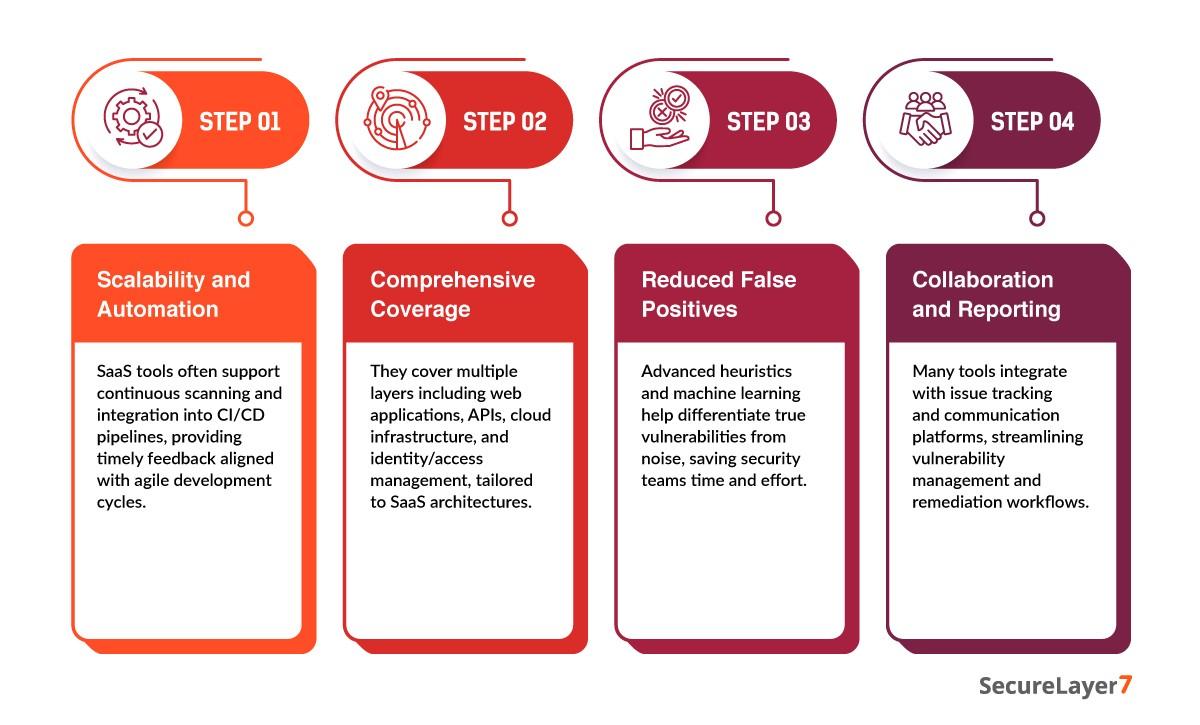
Benefits of Using Specialized SaaS Pen Testing Tools
How to Choose the Right SaaS Penetration Testing Service
Selecting the right provider for SaaS Penetration Testing is crucial to ensure your SaaS applications are thoroughly assessed and secured. The ideal service combines expertise in cloud-based, multi-tenant environments with a proven methodology that covers all potential attack vectors, from APIs and authentication systems to data storage and integrations.
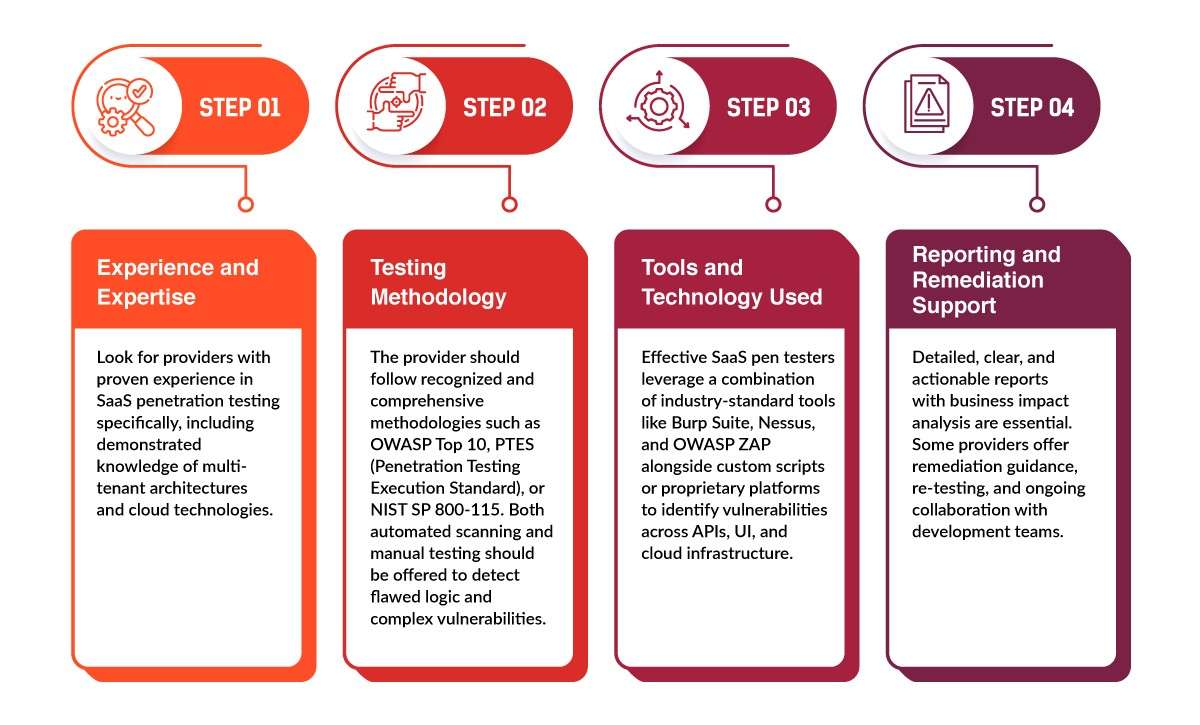
When choosing a provider, organizations should evaluate factors such as experience, certifications, compliance knowledge and the ability to deliver detailed, actionable reports.
Key Factors to Consider When Selecting a Penetration Testing Provider
Certification and Compliance Requirements
- SOC 2: Many SaaS companies pursue SOC 2 compliance, requiring penetration testing as part of the Trust Services Criteria for security, availability, and confidentiality. Verify that the provider understands SOC 2 requirements and can align testing to your audit timelines.
- GDPR and Other Privacy Regulations: If your SaaS handles personal data of EU citizens, your pen testing must account for GDPR mandates around data protection and breach notification. The provider should follow strict data handling policies during testing.
- PCI DSS (if applicable): For SaaS platforms processing payment cards, penetration testing must meet PCI DSS standards, including specific testing frequencies and scope.
Case Studies and Real-World Examples
Understanding the practical impact of SaaS Penetration Testing is easier through real-world examples. Case studies demonstrate how organizations across industries identify and mitigate vulnerabilities in SaaS applications, highlighting the importance of proactive security measures.
These examples provide insight into common security flaws, the effectiveness of different testing methodologies, and how remediation strategies are implemented. By reviewing real-world scenarios, businesses can learn best practices and understand the tangible benefits of regular SaaS application testing to protect sensitive data and maintain trust.
Examples of Successful SaaS Penetration Tests
SaaS penetration testing has become a crucial step for organizations to secure their cloud-based applications. Several real-world case studies illustrate how systematic SaaS pen testing can uncover critical vulnerabilities before they are exploited by malicious actors.
- Case Study 1: CRM SaaS Platform: A leading Customer Relationship Management (CRM) SaaS platform engaged a security firm to perform a comprehensive SaaS application testing exercise.
- Case Study 2: FinTech SaaS Application: A FinTech startup offering cloud-based payment solutions underwent a SaaS penetration testing engagement. The test uncovered vulnerabilities related to session management and multi-tenant data isolation.
Testing Outcomes: How Identified Vulnerabilities Were Mitigated
The primary goal of SaaS penetration testing is not only to identify security flaws but also to provide actionable recommendations for mitigation. In the cases above, the outcomes included:
- Prioritization of Critical Vulnerabilities: Each identified risk was assessed based on potential impact and likelihood, helping organizations focus on the most pressing threats first.
- Improved Authentication and Access Controls: Weak authentication mechanisms were strengthened, and access controls were tightened, reducing the risk of unauthorized access.
- Enhanced Data Protection: Encryption for data at rest and in transit was implemented or improved to safeguard sensitive customer information.
- Patch Management and Configuration Updates: Misconfigurations in APIs, databases, and servers were corrected, and patches were applied to vulnerable components.
Conclusion
SaaS Penetration Testing is essential for securing SaaS applications in today’s cloud-driven environment. By proactively identifying vulnerabilities in APIs, authentication systems, data storage, and multi-tenant architectures, organizations can protect sensitive data, maintain regulatory compliance, and build trust with customers and stakeholders. Regular SaaS application testing ensures that risks are minimized and the platform remains reliable, secure, and resilient against evolving cyber threats.
To safeguard your business and users, investing in comprehensive SaaS pen testing is no longer optional – it’s a necessity. Partner with SecureLayer7, a trusted leader in SaaS security solutions, to perform thorough penetration testing, receive actionable insights, and implement robust security measures that keep your applications and data safe.
Schedule a comprehensive SaaS penetration test with SecureLayer7 and safeguard your data and users from evolving cyber threats.
How SecureLayer7 helps
Frequently Asked Questions (FAQs)
SaaS Penetration Testing (or SaaS pen testing) is a security assessment process where ethical hackers simulate attacks on a SaaS application to identify vulnerabilities that could be exploited by malicious actors. It ensures the application is secure before and after deployment.
Regular SaaS application testing helps protect sensitive customer data, prevents potential breaches, and ensures compliance with security standards such as SOC 2, GDPR, and ISO 27001. It minimizes risks in multi-tenant environments.
Ideally, SaaS applications should be tested at least annually, with additional testing after significant updates or changes to the platform, APIs, or infrastructure.
Common vulnerabilities include insecure APIs, weak authentication mechanisms, misconfigured permissions, cross-site scripting (XSS), SQL injection, and improper data encryption in transit or at rest.
Traditional pen testing focuses on on-premises systems or single-tenant applications, while SaaS penetration testing addresses the unique challenges of cloud-based, multi-tenant environments, including shared infrastructure and continuous deployment cycles.

