

Modern-day businesses continue to be afflicted by the damage caused by the rising sophistication and effectiveness of hackers. They exploit companies with inadequate and vulnerable security systems to cause data breaches that cause damaging and expensive business setbacks.
In fact, it is estimated that worldwide, cybercrime will cost $10.5 trillion annually by 2025, and up until March 2019, a massive 14 billion+ data records have been lost or stolen!
When facing these technologically adept hackers, hypothesizing possible weaknesses is not as effective as realistic and intrusive practical testing of system security.
That’s where penetration testing and vulnerability assessments come in, a means to combat attackers by ethically harnessing their strategies and methodologies to develop more robust systems.
They help achieve this by keeping hackers and other malicious actors at bay while highlighting critical system flaws.
Through this article, we aim to explore penetration testing and how it can help rid organizations of any looming cybersecurity threat.
What is penetration testing?
Penetration testing is a planned and simulated attack purported to identify exploitable vulnerabilities in an organization’s systems and their applications to evaluate the effectiveness of its security mechanisms against cyber threats.
A pen test helps identify system weaknesses that require addressing through realistic methodologies and tools used by malicious attackers in real-world instances.
Why conduct a penetration test?
These simulated attacks identify and deploy safeguards that can effectively protect organizations from external or internal bad actors.
The principle is that if the organization can attack itself to highlight all its potential threats, it can build a robust, impenetrable system, lessening the likelihood of breaches from real-world actors.
The three approaches to penetration testing
Based on the business requirements, there are three approaches the pen tester can take to perform a breach. They are:

Black box
In the real world, barring unique situations, cyber attackers don’t possess the sensitive IT infrastructure information of the business.
In such instances, the attacker may take days or even months to scale for possible system vulnerabilities before honing in on the right point of attack. This process involves extensive surveillance, which can be time-consuming.
Black box or external penetration testing accurately simulates this situation where the pen tester is given little to no information on the company’s systems and sets out to identify and exploit system weak spots.
A thriving black box penetration test requires highly skilled testers with all the technical skills required. It is an exhaustive process requiring high effort, planning, implementing, testing, and reporting.
White box
White box testing is an internal pen test where the business provides the tester with administrative system access and complete system knowledge.
This access level often includes user protocols, network schematics, IP addresses, source code, binaries, containers, and other system artifacts.
When you hear terms such as glass box, clear box, and transparent box testing, you should know that they are just aliases for white box penetration testing.
Typically, white box tests internally evaluate the system’s security strength, especially in code quality and application design areas.
The major disadvantage of white box tests is that they are not accurate representations of real-world scenarios due to the level of access and knowledge provided to the tester beforehand.
This level of security clearance is not easily attainable for the average attacker.
Grey box
The grey box method is applied when the need for testing specific crucial areas suspected of having vulnerabilities arises.
Here, the business provides pen testers with limited knowledge of system design, architecture, and internal structures of the particular focus size, rather than complete information on the entire system.
By explicitly honing in on a fixed area with suspected vulnerabilities, testers achieve specific goals without scrutinizing the system as a whole for weak spots.
Through pen tests, security teams can identify system vulnerabilities in targets with the most significant risk to organizations and the highest value to the attackers.
The stages of penetration testing
Performing a successful pen test requires a meticulous and planned stagewise approach. Here are the stages of penetration testing:
Planning
The pen test scope allows testers to gauge all potential vulnerabilities and usable methodologies to achieve the task, which can aid in formulating the most effective strategy for attack.
The planning stage enables pen testers to collect the necessary intelligence to identify all potential vulnerabilities to carry out the breach.
Scanning
Next, the scanning phase comes in once the potential vulnerabilities are identified and the tester possesses a clear plan for exploring them.
The fundamental goal here is to check how the application reacts to different attacks. Static and dynamic analysis are the most common methodologies to scan the target application.
While a static analysis checks the entirety or parts of the code to understand how it works while running, a dynamic analysis studies the code while it’s running to ascertain a real-time view of the system’s performance.
Either way, it is here that the tester identifies the most concerning and exploitable vulnerabilities.
Gaining Access
Now comes the stage where potential vulnerabilities are exposed and exploited through methodologies such as backdoors, cross-site scripting, and SQL injection.
This stage is where the actual hack occurs, where testers attempt to gain admin control, interrupt network traffic, steal data, and inflict damage on the system.
Maintaining Access
The real threat of real-world attacks lies in the ability of hackers to gain long-term access by embedding their malicious code within the organization’s source code.
Testers mimic this attack by identifying and exploiting every possible juncture that could be a significant threat to sensitive company data or a potential gateway for attackers to gain prolonged access.
Analysis
The final stage is to present the vulnerabilities exploited, sensitive data acquired, time taken for the breach, and when it was ultimately detected to the business in detailed reports.
This information gives the organization actionable insights to devise patches and protective measures to prevent future breaches.
Penetration testing methods
Here are the various penetration testing methods commonly employed by industry professionals to scrutinize cybersecurity:
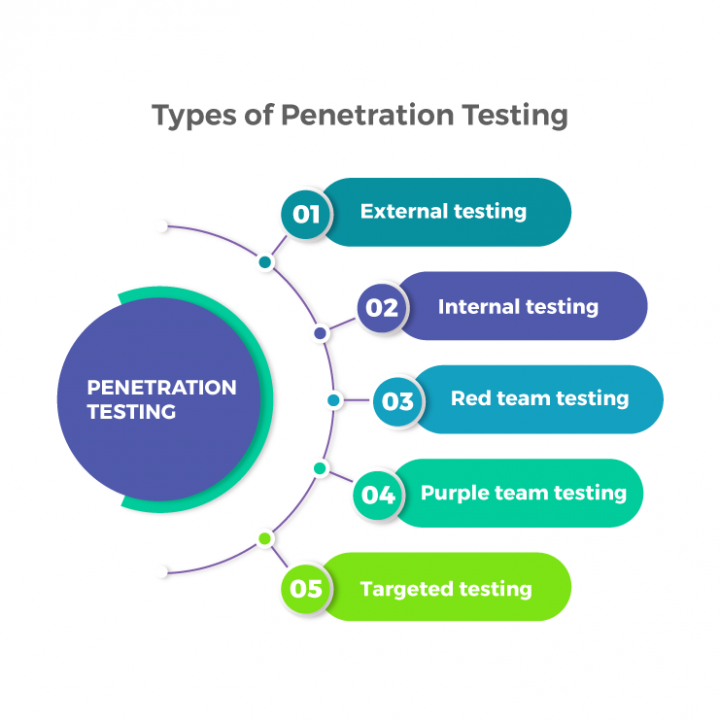
External testing
This testing method targets all facets of the business exposed to outside attackers.
The company’s website, email, DNS servers, application and web servers, firewalls, and web applications are common targets as they are prime targets for malicious attacks.
External testing aims to ascertain the strength of these assets and if they pose an external attack risk.
Internal testing
Sometimes the threats to an organization can arise from internal sources, such as attackers who have gained access through a phishing attack or even a disgruntled employee with unrevoked user privileges.
Either way, internal testing allows testers to simulate an internal attack and devise appropriate countermeasures to reduce the possibility of its lasting damage.
Red team testing
Red team testing involves a simulated real-world situation where testers have no information to work with except the target company’s name.
The tester must scale the company’s security measures and find the means to perform a breach while the security team and IT staff remain in the dark about the attack point or strategy.
Purple team testing
Purple team testing strengthens the IT and security teams’ countermeasures and response time to a real-world attack.
Critical security aspects such as incident identification protocols, response procedures, and security monitoring systems are tested during the simulated attack.
The security teams are kept unaware of the attack to get a realistic demonstration of their response.
In an ideal situation, only one or two organizational members outside the security teams should be made aware of the impending attack.
Targeted testing
Also known as the “lights turned on” approach, targeted testing allows for the IT staff and the testing team to work together to perform planned testing transparently.
This methodology provides IT security personnel with invaluable insights into the hacker’s point of view.
Penetration testing as a service
SecureLayer7 helps customers spot high-risk business vulnerabilities such as authentication, authorization, and logic vulnerabilities that may result in data breaches.
Our PTaaS services include application testing, mobile app penetration testing, thick client penetration testing, source code analysis, smart contract audit, and cloud penetration testing. We are renowned amongst enterprises and SME organizations that use our penetration testing application to perform and act on continuous pen tests.
We additionally help businesses securely maintain their cloud infrastructure by detecting and quarantining vulnerabilities in AWS, Azure, and Kubernetes systems at a reasonable cost.
Our network security service ensures that your corporate infrastructure complies with industry regulations and follows the best network security practices, reducing the risk of attacks on devices and servers.
SecureLayer7’s server hardening feature limits attacker entry points by preventing them from gaining access through unsecured ports. Server hardening is done by disabling unnecessary services and blocking unutilized protocols and ports.
Looking to strengthen your security posture? SecureLayer7 helps organizations identify vulnerabilities, reduce risk, and defend against evolving cyber threats. Contact our experts to get started.
How SecureLayer7 helps
Frequently Asked Questions
A vulnerability assessment scans systems and lists known weaknesses, then ranks them by severity. A penetration test goes further and actively exploits those weaknesses to prove what an attacker could reach. The assessment tells you what is broken; the pen test shows the real impact when someone breaks it.
Most engagements run one to three weeks, depending on scope, system size, and testing approach. Black box tests take longer because the tester spends days or weeks on reconnaissance with little starting information. White box tests move faster since the tester already has source code, network maps, and admin access.
Black box gives the tester little to no information, simulating an outside attacker who must discover everything. White box hands over full access including source code, network schematics, and credentials for a deep internal review. Grey box sits between the two, providing limited knowledge to focus testing on specific high-risk areas.
Run a pen test at least once a year and after any major change to infrastructure, applications, or network architecture. New code deployments, cloud migrations, and added services all introduce paths an attacker can use. Compliance standards such as PCI DSS also require annual testing plus retesting after significant changes.
Testing starts with planning, where the tester defines scope and gathers intelligence on potential targets. Scanning then maps live systems and identifies exploitable weaknesses. The remaining stages cover gaining access, maintaining that access, and reporting findings with remediation steps.

