
Kubernetes has become a key platform for deploying modern cloud-native applications, offering scalability, automation, and efficient container management. Complex Kubernetes architectures, exposed APIs, misconfigured clusters, weak access controls, and vulnerable workloads can introduce significant security risks. Kubernetes penetration testing helps organizations identify these weaknesses by simulating real-world attacks against clusters, containers, and cloud-native infrastructure.
A Kubernetes pentest can examine the API server, RBAC permissions, container images, secrets, network policies, and workload configurations. The assessment helps security teams validate Kubernetes security controls and identify weaknesses that could affect applications and workloads.
Growing Kubernetes Adoption in Cloud-Native Development
Kubernetes adoption is growing as organizations move to cloud-native architectures based on containers, microservices, and automated deployments. Its ability to manage distributed workloads, support scaling, and automate application delivery makes it a common choice for modern infrastructure.
As environments expand across multiple clusters, workloads, and integrations, maintaining consistent security controls becomes more challenging. This makes Kubernetes security testing an important part of maintaining secure cloud-native environments.
Increasing Security Risks in Kubernetes Environments
Kubernetes environments can become exposed when security configurations are not properly managed. Common risks involve cluster configuration, access controls, container images, secrets, network isolation, and runtime activity.
- Misconfigured Clusters: Exposed APIs, insecure settings, and weak network configurations.
- Weak IAM and RBAC Controls: Excessive permissions leading to unauthorized access.
- Container Vulnerabilities: Outdated images and insecure dependencies.
- Exposed Secrets: Improper handling of credentials and sensitive data.
- Insecure Network Policies: Poor workload isolation enabling lateral movement.
- Runtime Security Gaps: Limited monitoring allowing malicious activity to go undetected.
What is Kubernetes Penetration Testing
Kubernetes penetration testing is a specialized security assessment that evaluates Kubernetes clusters, containerized applications, and cloud-native workloads by simulating real-world cyberattacks. To identify vulnerabilities, misconfigurations, insecure access controls, and potential attack paths before attackers can exploit them.
Kubernetes security testing focuses on components specific to container orchestration environments, including Kubernetes API servers, worker nodes, container images, pods, namespaces, secrets, Role-Based Access Control (RBAC), and network policies. Kubernetes security best practices provide practical guidance for strengthening these controls.
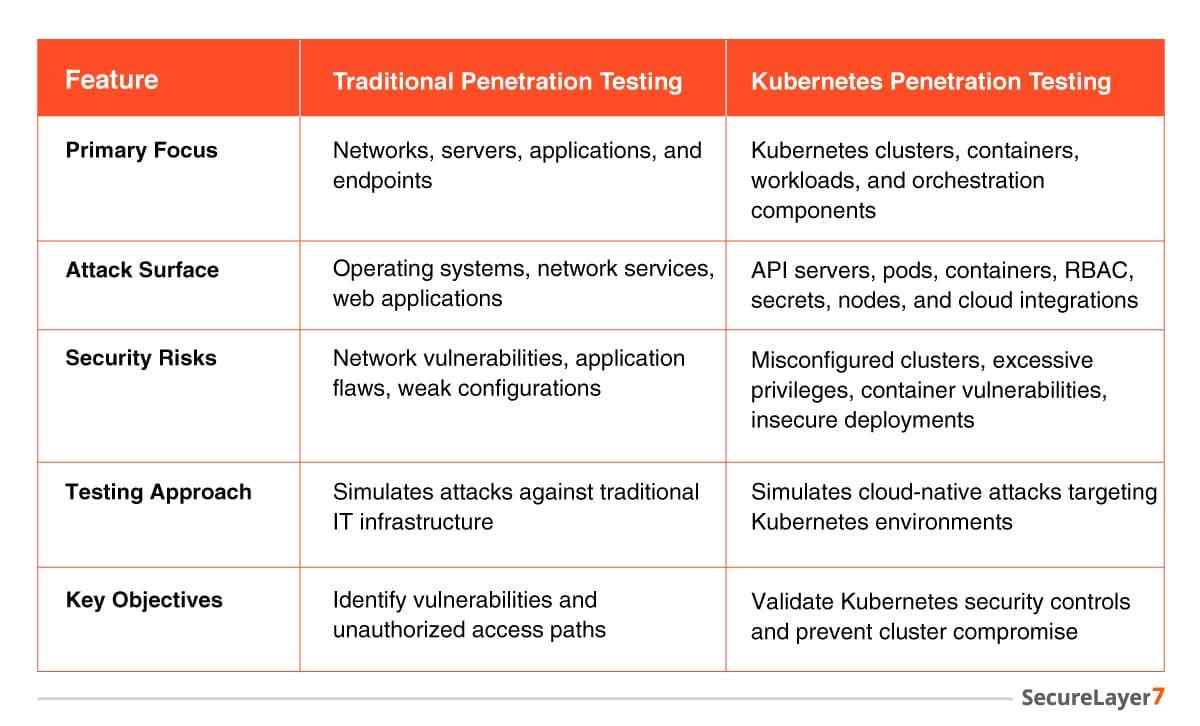
Kubernetes Security Testing vs Traditional Penetration Testing
Traditional penetration testing evaluates applications, networks, and infrastructure, Kubernetes security testing focuses on cloud-native environments and container orchestration security.
Role of Kubernetes Pentest in Cloud Security Strategy
Integrating regular penetration testing into a broader cloud security strategy provides crucial operational value. Cloud security posture management can help continuously identify configuration and compliance risks across cloud environments.
- Validating Infrastructure as Code (IaC): Ensures that rapid CI/CD deployments and GitOps pipelines have not introduced permissive role bindings or unsegmented network traffic into production.
- Prioritizing Remediation: Helps security teams focus engineering resources on high-impact vulnerabilities that pose an immediate risk of total cluster takeover.
- Maintaining Compliance and Resilience: Fulfills regulatory mandates for cloud security verifying that runtime defenses, monitoring tools, and incident response playbooks function effectively under simulated attack conditions.
Why Kubernetes Penetration Testing Matters
Kubernetes penetration testing helps organizations identify security weaknesses in clusters, containers, APIs, and workloads by simulating real-world attacks. It can uncover risks such as misconfigurations, excessive permissions, exposed secrets, and vulnerable container images.
Regular Kubernetes security testing helps organizations strengthen cloud-native defenses, validate security controls, improve compliance readiness, and protect applications from evolving cyber threats.
Risks from Misconfigured Clusters, Exposed APIs, and Excessive Permissions
Kubernetes security depends on properly configured APIs, access controls, and network policies. Misconfigurations can create attack paths that allow unauthorized access, privilege escalation, and lateral movement within clusters.
- Exposed API Servers: Publicly accessible Kubernetes APIs without strong authentication or access restrictions can enable attackers to probe and exploit cluster resources.
- Overly Permissive RBAC and Service Accounts: Excessive permissions and misconfigured roles can allow compromised workloads to escalate privileges and gain cluster-level access.
- Unsegmented Network Access: Without proper NetworkPolicies, attackers can move between pods, namespaces, and internal services after compromising a container.
Importance for DevSecOps and Cloud Security Programs
Integrating Kubernetes penetration testing into DevSecOps helps organizations identify real-world security risks beyond automated scans. It validates runtime defenses, strengthens collaboration, and embeds security into the development lifecycle.
- Shift Security Left: Identifies how Kubernetes configurations behave during real attacks, beyond basic code and IaC scanning.
- Validate Runtime Security: Tests container security controls, admission policies, and monitoring effectiveness.
- Improve Collaboration: Aligns developers, platform teams, and security teams to build secure CI/CD workflows.
Compliance and Security Validation Requirements
Kubernetes penetration testing helps organizations demonstrate continuous security assurance and meet regulatory requirements for cloud-native environments.
- Support Compliance Requirements: Helps meet standards such as SOC 2, ISO 27001, PCI DSS, and HIPAA through regular security validation.
- Validate Security Controls: Tests access controls, network isolation, secret management, and least-privilege policies against real-world attacks.
- Reduce Business Risk: Provides actionable insights to strengthen cloud resilience and prevent breaches, financial losses, and regulatory penalties.
Kubernetes Penetration Testing Methodology
A structured Kubernetes penetration testing methodology helps security teams systematically assess Kubernetes clusters, identify vulnerabilities, and simulate realistic attack scenarios. A comprehensive approach combines automated security assessments with manual testing to uncover misconfigurations, privilege escalation paths, and attack scenarios that could compromise Kubernetes environments.
Planning and Information Gathering
The planning phase sets the foundation for a successful Kubernetes pentest by defining the testing boundaries, objectives, and assessment scope. Security testers gather key information about the Kubernetes environment to understand potential attack surfaces and ensure testing activities align with business requirements.
- Define Scope and Objectives: Identify target clusters, testing goals, rules of engagement, and communication procedures.
- Collect Architecture Details: Review cluster components, control plane, worker nodes, workloads, namespaces, and integrations.
- Identify Attack Surfaces: Discover exposed APIs, services, container registries, network configurations, and external integrations.
Kubernetes Configuration Assessment
Kubernetes security heavily depends on proper configuration. Misconfigured clusters, weak access controls, and insecure deployment settings can create significant vulnerabilities. Configuration assessment helps identify weaknesses before attackers exploit them.
- Review Cluster Configurations: Analyze API server settings, authentication controls, namespaces, and workload configurations.
- Identify Misconfigurations: Detect privileged containers, weak security contexts, unrestricted communication, and insecure settings.
- Assess RBAC Permissions: Review user roles, service accounts, excessive privileges, and access controls to enforce least privilege. RBAC policies for Kubernetes clusters help security teams identify excessive permissions and strengthen access controls.
Vulnerability Identification
The vulnerability identification phase focuses on discovering security weaknesses across Kubernetes components, container workloads, and supporting infrastructure. This phase combines automated scanning with manual validation to identify exploitable risks.
- Container Image Analysis: Scan images for CVEs, outdated packages, insecure dependencies, and configuration issues.
- API and Component Testing: Evaluate API server exposure, authentication, authorization, and Kubernetes component security.
- Secrets and Privilege Testing: Identify exposed secrets, weak management practices, and excessive workload permissions.
Exploitation and Attack Simulation
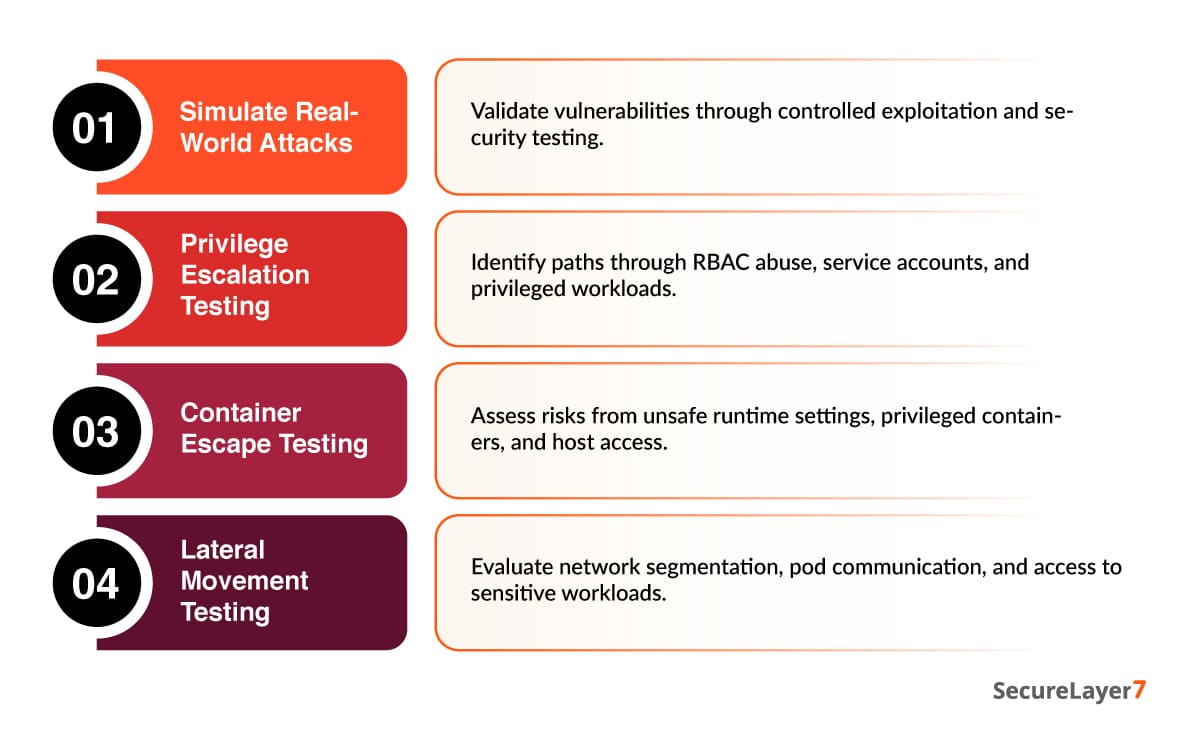
The exploitation phase validates whether identified vulnerabilities can be used to compromise Kubernetes environments. Security testers simulate realistic attacker behavior to understand potential business impact. Exploit-validated penetration testing focuses on demonstrating practical exploitability with supporting evidence.
Kubernetes Penetration Testing Tools
Effective Kubernetes penetration testing requires specialized tools that can identify security weaknesses across clusters, containers, configurations, and runtime environments. A combination of automated scanners, configuration assessment tools, vulnerability analysis platforms, and runtime security solutions helps security teams detect vulnerabilities, validate security controls, and strengthen Kubernetes security.
Kubernetes Security Scanners
Kubernetes security scanners evaluate clusters for security weaknesses, misconfigurations, and compliance gaps. These tools analyze Kubernetes components, workloads, and configurations against security best practices and industry benchmarks.
- Detects insecure Kubernetes configurations.
- Identify exposed services and risky cluster settings.
- Analyze RBAC permissions and access controls.
- Validate security policies and compliance requirements.
Container Vulnerability Scanners
Container vulnerability scanners analyze container images and workloads to identify known security vulnerabilities, outdated dependencies, and insecure software components.
- Vulnerable operating system packages.
- Known CVEs in application dependencies.
- Outdated libraries and software components.
- Malware or suspicious files within images.
Configuration Assessment Tools
Configuration assessment tools help security teams evaluate whether Kubernetes clusters follow recommended security practices.
- Kubernetes API server security checks.
- RBAC permission analysis.
- Pod security configuration reviews.
- Network policy validation.
- Secrets management assessment.
- Cluster hardening checks.
Runtime Security Monitoring Tools
Runtime security monitoring tools provide continuous visibility into Kubernetes workloads and detect suspicious activities after deployment.
- Detects abnormal container behavior.
- Monitor system calls and workload activities.
- Identify suspicious network communication.
- Detect privilege escalation attempts.
Benefits of Kubernetes Penetration Testing
As modern applications increasingly rely on containerized microservices and complex orchestration platforms, securing the underlying infrastructure has become essential. Default configurations can prioritize ease of deployment and operations over strict security hardening, leaving cloud environments exposed to hidden vulnerabilities.
Regular Kubernetes penetration testing helps organizations identify these weaknesses, validate security controls, and address gaps before attackers can exploit them.
Identifies Security Weaknesses Before Attackers Exploit Them
The primary benefits of Kubernetes pentesting are the ability to discover security vulnerabilities before they are targeted by malicious actors.
- Misconfigured Kubernetes clusters.
- Exposed API servers and services.
- Weak authentication mechanisms.
- Excessive RBAC permissions.
- Vulnerable container images.
- Exposed secrets and credentials.
Improves Kubernetes Configuration Security
Kubernetes security heavily depends on proper configuration. Incorrect settings can expose clusters to unauthorized access, privilege escalation, and data exposure risks.
- Kubernetes API server settings.
- RBAC roles and permissions.
- Network policies and segmentation.
- Pod security configurations.
- Container runtime settings.
Reduces Risk of Data Breaches and Service Disruption
Attackers who gain access to Kubernetes resources may exploit vulnerabilities to steal sensitive information, deploy malicious containers.
- Unauthorized access to sensitive workloads.
- Container escape opportunities.
- Privilege escalation vulnerabilities.
- Insecure application deployments.
- Weak isolation between workloads.
Challenges in Kubernetes Penetration Testing
Kubernetes penetration testing plays an important role in identifying security weaknesses and strengthening cloud-native security. Assessing Kubernetes environments presents unique challenges. The dynamic architecture of Kubernetes, constantly changing workloads, distributed components, and production availability requirements make security testing more complex than traditional penetration testing.
Understanding these challenges helps organizations plan effective Kubernetes pentesting engagements maintaining security, accuracy, and operational stability.
Complex Kubernetes Architectures
Kubernetes environments consist of multiple interconnected components, including control planes, worker nodes, containers, pods, services, APIs, networking layers, and cloud integrations.
- Multiple Kubernetes clusters across different environments.
- Complex microservices communication patterns.
- Hybrid and multi-cloud Kubernetes deployments.
- Integration with external services and cloud platforms.
- Dependencies between applications, containers, and infrastructure.
Rapidly Changing Cloud-Native Environments
Kubernetes environments are highly dynamic, with workloads frequently created, updated, scaled, and removed based on business requirements.
- Frequent container image updates.
- Continuous application deployments through CI/CD pipelines.
- Changing Kubernetes configurations and manifests.
- Temporary workloads becoming permanent resources.
- Configuration drift between development and production environments.
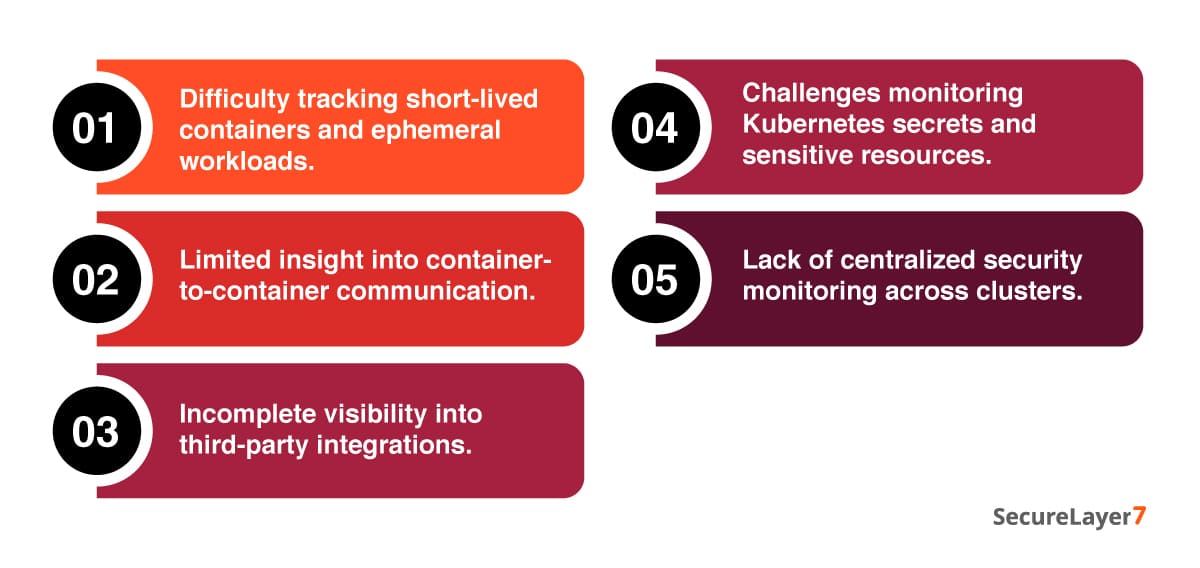
Limited Visibility Across Containers and Clusters
Modern Kubernetes environments often include hundreds or thousands of containers distributed across multiple clusters.
Best Practices for Kubernetes Security Testing
Securing modern cloud-native infrastructure requires more than basic compliance checklists and periodic vulnerability scans. Container orchestrators use distributed control planes, dynamic networking, and complex identity models, which require a structured approach to security.
The following four best practices help security and platform engineering teams identify, address, and prevent vulnerabilities across Kubernetes environments.
Perform Regular Kubernetes Penetration Testing
Static security assessments capture a snapshot in time, but cloud environments evolve continuously through rapid deployments and microservice updates.
- Schedule Periodic Assessments: Conduct dedicated Kubernetes penetration testing at least annually and immediately following major architectural overhauls, cloud migrations.
- Simulate Real-World Attack Chains: Regular testing proves how minor oversights can be chained together by real-world adversaries, ensuring your defenses hold up under actual attack conditions.
Combine Automated Scanning with Manual Testing
Neither automated tools nor manual assessments alone are sufficient to secure a complex containerized environment.
- Leverage Automated Scanners for Baseline Hygiene: Deploy tools like Trivy, kube-bench, and kube-hunter continuously within your CI/CD pipelines to catch known Common Vulnerabilities and Exposures (CVEs), manifest misconfigurations, and exposed ports early.
- Rely on Manual Testing for Deep Context: Pair automated scans with human-led penetration testing to evaluate intricate RBAC permission models, complex multi-stage privilege escalation paths.
Follow Kubernetes Security Benchmarks
Establishing a standardized baseline is essential for hardening control planes, worker nodes, and datastores against industry-recognized threats.
- Align with Center for Internet Security (CIS) Standards: Regularly audit your cluster configurations against the official CIS Kubernetes Benchmark to ensure control plane flags, API server authentication settings, and node security parameters are fully locked down.
- Automate Compliance Validation: Integrate configuration assessment tools into your operational workflows to continuously monitor and report on cluster drift, ensuring production environments remain compliant with hardening baselines.
Conclusion
As Kubernetes powers modern cloud-native applications, securing clusters, containers, and workloads is essential to reduce risks such as misconfigurations, exposed APIs, weak access controls, and vulnerable images. Combining structured methodologies, specialized tools, and manual testing helps organizations strengthen Kubernetes configurations, improve DevSecOps security, support compliance, and build more resilient cloud-native environments.
Secure your cloud-native infrastructure with Kubernetes penetration testing services from SecureLayer7. Its security professionals help identify hidden vulnerabilities, validate Kubernetes security controls, and provide actionable remediation guidance to strengthen containerized environments.
Partner with SecureLayer7 to proactively secure your Kubernetes ecosystem and protect critical applications from emerging threats.
Frequently Asked Questions (FAQs)
Kubernetes penetration testing is a security assessment that simulates real-world attacks against Kubernetes clusters, containers, workloads, and infrastructure. It identifies vulnerabilities in API servers, RBAC, container images, secrets management, and cluster configurations to improve Kubernetes security.
A Kubernetes pentest typically involves planning and information gathering to define the scope, objectives, and cluster architecture. Testers then assess configurations such as RBAC, access controls, and security settings, followed by vulnerability testing across containers, APIs, workloads, and secrets.
Common Kubernetes security issues include misconfigured RBAC permissions, excessive privileges, exposed Kubernetes API servers, weak authentication and authorization controls, vulnerable container images and dependencies, exposed secrets, insecure network configurations, and poor workload isolation.
Common Kubernetes security testing tools include kube-hunter for identifying Kubernetes security weaknesses and exposed services, kube-bench for checking configurations against CIS Kubernetes Benchmarks, Trivy for scanning container images and Kubernetes configurations, and Kubescape for evaluating Kubernetes security posture and compliance risks.

