
Enterprise Vulnerability Management (EVM) has emerged as a strategic security necessity for modern organizations operating across cloud, hybrid, and distributed environments. As attack surfaces expand and threats evolve rapidly, traditional, periodic vulnerability scanning is no longer enough. Enterprises need a continuous and scalable approach to identify and manage security weaknesses across infrastructure, applications, and digital assets.
EVM takes a risk-driven approach, prioritizing vulnerabilities based on real-world exploitability and business impact rather than raw severity scores. By aligning security efforts with operational context and business objectives, EVM enables organizations to reduce exposure proactively, improve remediation efficiency, and strengthen overall cyber resilience.
Why Vulnerability Management is Critical for Modern Enterprises
Vulnerability management is critical for modern enterprises because cyber threats evolve faster than traditional security controls can keep up. New software releases, frequent configuration changes, and constant infrastructure updates introduce vulnerabilities that attackers actively exploit.
Without a structured vulnerability management approach, organizations struggle to identify real risks in time, leading to data breaches, service outages, compliance violations, and financial losses. Organizations can strengthen this process through a structured Vulnerability Management Lifecycle that covers asset discovery, vulnerability identification, prioritization, remediation, and continuous validation.
Growing Attack Surface Across Cloud, Web, Endpoints, and APIs
The modern enterprise attack surface has expanded rapidly due to cloud adoption, web-based services, remote work, and API-driven architectures. Cloud environments introduce risks such as misconfigurations and exposed services, while web applications remain a frequent target for exploitation.
APIs add another layer of complexity by enabling seamless integration between systems but often lacking strong security controls. As these environments become more interconnected, a single vulnerability can provide attackers with access across multiple systems. Organizations can strengthen API visibility and identify weaknesses through API Security Testing, which evaluates risks such as injection flaws, BOLA, and improper API inventory management.
Overview of Enterprise Vulnerability Management
Enterprise Vulnerability Management (EVM) is a continuous and strategic process designed to identify, prioritize, and remediate vulnerabilities across an organization’s digital assets. It goes beyond periodic scanning by incorporating asset discovery, threat intelligence, and risk context to understand which vulnerabilities pose the greatest business impact.
By integrating vulnerability management into daily operations and the broader security strategy, enterprises can reduce exposure, improve response times, and strengthen overall security posture. EVM also supports long-term resilience by enabling organizations to adapt to evolving threats while aligning security initiatives with business goals.
What is Enterprise Vulnerability Management
Enterprise Vulnerability Management (EVM) is a continuous, risk-driven approach to identifying, prioritizing, and reducing security vulnerabilities across an organization’s entire attack surface, including on-premises, cloud, hybrid, and application environments.
Unlike traditional vulnerability scanning, EVM aligns technical findings with exploitability and business impact, enabling organizations to focus remediation efforts on the vulnerabilities that pose the greatest real-world risk to critical systems and operations.
Enterprise Vulnerability Management vs Vulnerability Scanning
Basic vulnerability scanning focuses primarily on identifying known vulnerabilities at a point in time, often generating large volumes of findings with limited context. While scanning is an important component, it does not provide guidance on prioritization, remediation ownership, or business risk.
Enterprise Vulnerability Management goes further by adding context and intelligence. It correlates vulnerabilities with asset criticality, exploitability, and threat data to help security teams focus on the most impactful risks. A broader Network Vulnerability Assessment goes beyond raw scanning by evaluating vulnerabilities, prioritizing risks, and translating technical findings into information that security teams and business leaders can act upon.
Role in an Organization’s Overall Cybersecurity Strategy
Enterprise Vulnerability Management plays a foundational role in an organization’s overall cybersecurity strategy. It acts as a bridge between security detection and risk reduction by ensuring vulnerabilities are not just identified but effectively mitigated. By prioritizing vulnerabilities based on business impact, EVM helps align security efforts with organizational goals.
When embedded into broader security operations, EVM supports incident prevention, compliance requirements, and resilience against evolving threats. It enables organizations to move from reactive security to a proactive, risk-driven approach – strengthening overall security posture and reducing the likelihood of successful cyberattacks.
Why Enterprises Need a Formal Vulnerability Management Program
Enterprises need a formal vulnerability management program to keep pace with expanding attack surfaces, complex hybrid environments, and rapidly evolving threats. Relying on ad hoc or periodic scanning leaves critical gaps in visibility and accountability, whereas a structured program enables continuous identification, risk-based prioritization, and coordinated remediation of vulnerabilities.
By formalizing vulnerability management, enterprises can reduce real-world risk, improve cross-team collaboration, and maintain a stronger, more resilient security posture at scale.
Increasing Scale and Complexity of Enterprise IT Environments
Enterprise IT environments have grown significantly in scale and complexity with the adoption of cloud computing, SaaS platforms, remote work infrastructure, and API-driven integrations. Organizations now manage thousands of assets across on-premises systems, multi-cloud environments, web applications, endpoints, and third-party services.
A formal vulnerability management program provides a centralized, structured framework to continuously identify and track vulnerabilities across all assets. It helps enterprises maintain control over rapidly changing environments, reduce blind spots, and ensure security efforts scale alongside business growth.
Limitations of Ad-Hoc or Periodic Vulnerability Scans
Ad-hoc or periodic vulnerability scanning is no longer sufficient to address modern security threats. These scans provide only a snapshot in time and often generate long lists of vulnerabilities without context or prioritization. As environments change rapidly, vulnerabilities identified during a scan may already be exploited or new ones may appear – before remediation begins.
Without a formal program, organizations struggle with inconsistent coverage, delayed remediation, and lack of accountability. A structured vulnerability management program ensures continuous assessment, risk-based prioritization, and clear remediation workflows, enabling security teams to focus on vulnerabilities that pose the greatest threat to the business.
Regulatory, Compliance, and Business Risk Considerations
Regulatory and compliance requirements have made enterprise vulnerability management a critical security function rather than an optional best practice. Organizations are expected to continuously identify, assess, and remediate vulnerabilities to meet regulatory standards, demonstrate audit readiness, and maintain clear evidence of risk management activities.
Unmanaged vulnerabilities introduce serious business risks, including data breaches, operational disruptions, financial losses, and reputational damage. Enterprise vulnerability management enables organizations to align security findings with business impact, prioritize remediation efforts effectively, and make informed risk decisions.
Vulnerability Assessment vs Vulnerability Management
Enterprise vulnerability assessment and vulnerability management serve different but complementary purposes in cybersecurity. A vulnerability assessment provides a point-in-time snapshot of existing security weaknesses, enterprise vulnerability management is a continuous, risk-driven program that prioritizes, tracks, and remediates vulnerabilities over time.
What an Enterprise Vulnerability Assessment Typically Includes
An enterprise vulnerability assessment is a structured evaluation designed to identify known security weaknesses across an organization’s IT environment at a specific point in time. It typically includes asset discovery, automated vulnerability scanning, configuration checks, and the identification of known CVEs affecting systems, applications, networks, and cloud resources.
Enterprise vulnerability assessments provide valuable visibility into existing security gaps, they are often periodic and limited in scope. They focus on detection rather than ongoing risk reduction, offering a snapshot of vulnerabilities rather than a continuously updated view of enterprise security posture.
Key Differences Between Assessment and Continuous Vulnerability Management
The primary difference between vulnerability assessment and vulnerability management lies in continuity and context. Vulnerability assessments are typically one-time or scheduled activities that identify vulnerabilities at a given moment. Vulnerability management is an ongoing, risk-driven process that continuously discovers assets, tracks vulnerabilities, prioritizes risk, and manages remediation across the enterprise.
Vulnerability management adds critical layers such as threat intelligence, asset criticality, remediation workflows, validation, and reporting. This enables organizations to focus on vulnerabilities that pose the greatest business risk rather than addressing findings in isolation. A VAPT Report can also help organizations understand the difference between vulnerability assessment findings and penetration-testing results, including how findings are prioritized for remediation.
Why Assessments Alone are Not Sufficient at Enterprise Scale
At enterprise scale, periodic vulnerability assessments alone are insufficient due to the size, complexity, and dynamic nature of modern IT environments. New assets, software updates, configuration changes, and emerging threats constantly introduce new vulnerabilities, making static assessments quickly outdated.
Without continuous vulnerability management, organizations struggle to maintain visibility, track remediation progress, and measure risk reduction over time. A comprehensive vulnerability management program ensures vulnerabilities are not only identified but also prioritized, remediated, and validated – providing sustained protection and improved security posture across the enterprise.
Core Components of Enterprise Vulnerability Management
Enterprise vulnerability management is not a single tool or task – it’s a structured, end-to-end security capability that helps organizations continuously identify, prioritize, and reduce cyber risk across complex environments. To be effective at scale, enterprise vulnerability management must be built on a set of core components that work together to provide visibility, context, and actionability.
Following are the foundational pillars every enterprise vulnerability management program should include.
Asset Discovery and Attack Surface Visibility
Asset discovery is the foundation of enterprise vulnerability management. Organizations must maintain complete visibility into all assets across on-premises systems, cloud environments, web applications, endpoints, APIs, and third-party services. Without accurate asset inventories, vulnerabilities remain hidden and unmanaged.
Attack surface visibility helps security teams understand how assets are exposed, interconnected, and accessible to attackers. This clarity reduces blind spots, improves risk awareness, and ensures vulnerability management efforts cover the entire enterprise environment.
Continuous Vulnerability Identification and Scanning
Enterprise environments change constantly, new workloads spin up, configurations change, and software is updated frequently. As a result, vulnerability scanning must be continuous, not periodic.
Key capabilities:
- Continuous scanning across infrastructure, applications, and cloud workloads.
- Support for both agent-based and agentless scanning.
- Detection of vulnerabilities, misconfigurations, and outdated components.
- Real-time updates as new vulnerabilities emerge.
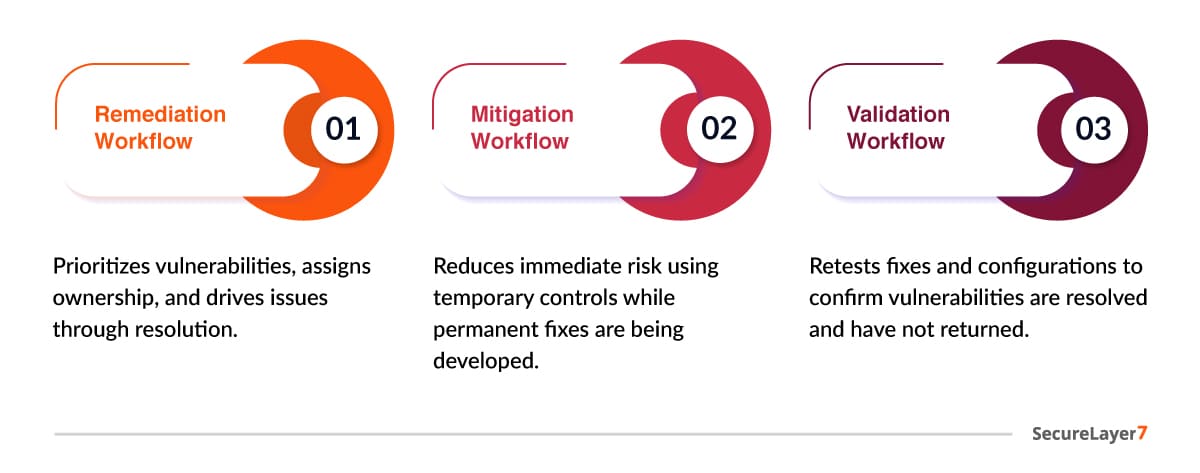
Remediation, Mitigation, and Validation Workflows
Reporting, Metrics, and Executive Visibility
Reporting, metrics, and executive visibility turn complex cybersecurity data into strategic business intelligence. They help leaders track progress, allocate resources, and demonstrate ROI on security investments.
- Reporting: Craft reports with clear executive summaries upfront, followed by key findings and recommendations.
- Metrics: Track mean time to remediate (MTTR) to gauge response speed, alongside remediation coverage rates showing fixed vulnerabilities over time.
- Executive Visibility: Build interactive dashboards with real-time KPIs, customizable filters, and automated alerts for breaches in thresholds.
Enterprise Vulnerability Management Tools
As organizations grow more complex, so does their attack surface. Modern enterprises operate across cloud platforms, on-prem infrastructure, remote endpoints, containers, APIs, and third-party integrations. This makes enterprise vulnerability management tools a critical pillar of any mature cybersecurity strategy.
Following are the breakdown of what to look for in an enterprise vulnerability management tool, with a focus on scalability, integrations, and automation.
What to Look for in an Enterprise Vulnerability Management Tool
Choosing the right enterprise vulnerability management tool goes beyond scan accuracy. The ideal platform should help security teams identify, prioritize, remediate, and verify vulnerabilities continuously.
Key capabilities to evaluate include:
- Comprehensive asset discovery across cloud, on-prem, and hybrid environments
- Risk-based vulnerability prioritization (CVSS + exploitability + business context)
- Real-time visibility into vulnerabilities and remediation status
- Strong reporting and executive-level dashboards
- Support for compliance and audit requirements
Scalability Across Large and Distributed Environments
Enterprise environments are rarely centralized. They span:
- Multiple cloud providers (AWS, Azure, GCP)
- Data centers and on-prem infrastructure
- Remote endpoints and BYOD devices
- Microservices, containers, and Kubernetes clusters
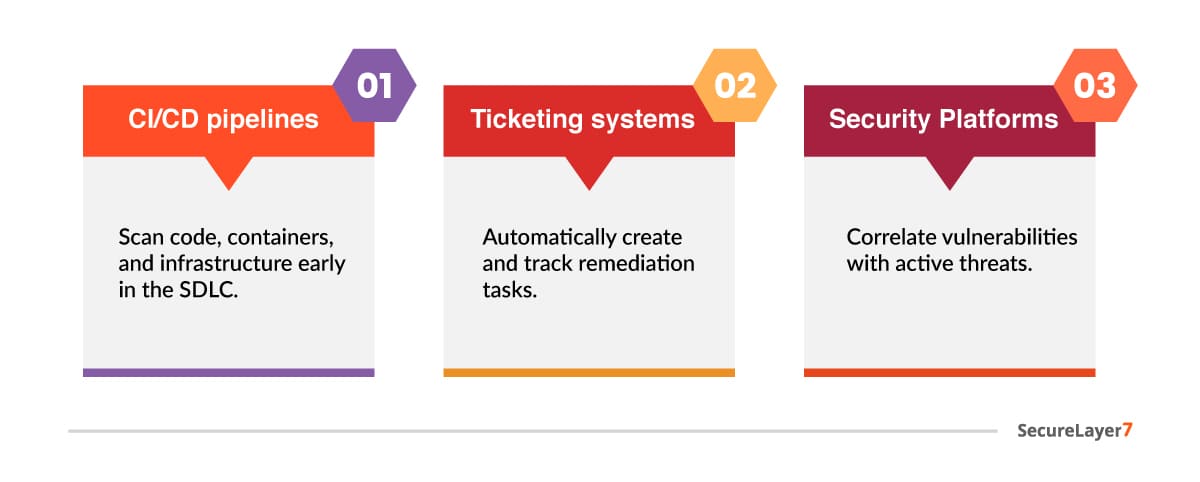
Integration with CI/CD, Ticketing, and Security Platforms
Modern security teams do not work in isolation. Vulnerability management tools must integrate seamlessly with the broader DevSecOps and SOC ecosystem.
Challenges in Enterprise Vulnerability Management
Enterprise vulnerability management is no longer a simple task of running periodic scans and fixing high-severity issues. As organizations adopt cloud, DevOps, and distributed architectures, vulnerability management has become continuous, complex, and cross-functional.
Following are the most common enterprise vulnerability management challenges organizations face today and why addressing them requires more than traditional scanning tools.
Managing Vulnerabilities Across Hybrid and Cloud Environments
Most enterprises operate in hybrid and multi-cloud environments, combining on-prem infrastructure with cloud services, containers, APIs, and SaaS platforms. This diversity creates significant visibility gaps.
Key challenges include:
- Inconsistent asset discovery across cloud and on-prem systems
- Ephemeral assets appearing and disappearing rapidly
- Limited visibility into cloud misconfigurations and identity-based risks
- Multiple tools producing fragmented vulnerability data
Alert Fatigue and False Positives
Enterprise vulnerability scanners often generate thousands or millions of findings. Many of these alerts are low risk, non-exploitable, or irrelevant to the organization’s real threat landscape.
Why alert fatigue happens:
- Overreliance on CVSS scores without exploit context
- Duplicate findings across multiple tools
- Lack of business or asset criticality mapping
- Poor vulnerability deduplication and validation
Coordination Between Security, IT, and Development Teams
Vulnerability management is not owned by security alone. It requires close coordination between security teams, IT operations, and development teams each with different priorities and workflows.
Common coordination issues:
- Security identifies vulnerabilities, but IT owns patching
- Developers receive findings late in the SDLC
- Lack of clear ownership for assets and fixes
- Manual handoffs through emails or spreadsheets
Best Practices for Effective Enterprise Vulnerability Management
Enterprise vulnerability management has evolved from periodic scanning into a continuous, risk-driven security discipline. With expanding attack surfaces, cloud adoption, and rapid software delivery cycles, organizations must move beyond traditional approaches and adopt best practices that prioritize real-world risk and operational efficiency.
Following are the best practices for effective enterprise vulnerability management that help organizations reduce exposure, improve remediation speed, and align security with business objectives.
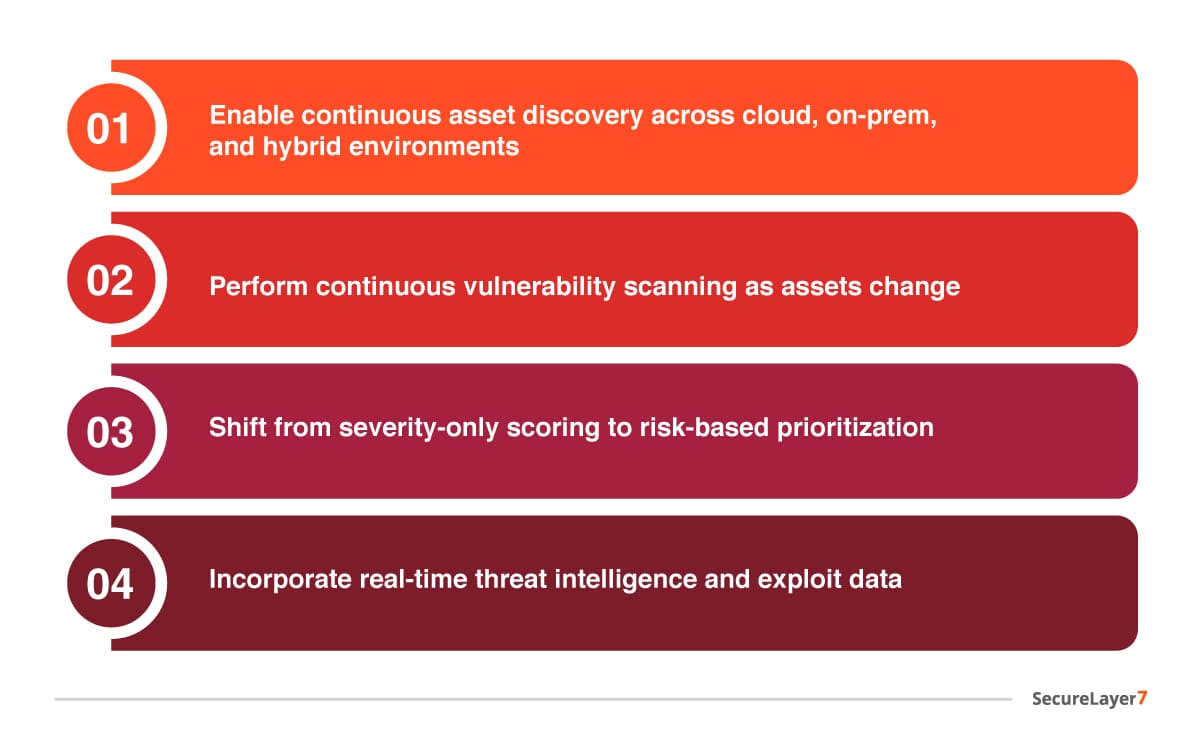
Continuous and Risk-Based Vulnerability Management
Traditional vulnerability management relies on scheduled scans that provide only point-in-time visibility. This approach leaves dangerous gaps.
Prioritization Based on Exploitability and Business Impact
Not all vulnerabilities pose the same level of risk. Effective enterprise vulnerability management prioritizes issues based on likelihood of exploitation and potential business impact. Security teams can use Common Vulnerability Scoring System (CVSS) as a standardized method for measuring vulnerability severity while combining CVSS with exploitability, asset criticality, and business context to make better remediation decisions.
Key prioritization factors:
- Known exploits and active attack campaigns
- Asset criticality and data sensitivity
- Exposure to the internet or untrusted networks
- Regulatory and compliance impact
Automation of Scanning and Remediation Workflows
Automation is essential for managing vulnerabilities at enterprise scale. Automated scanning enables consistent, repeatable assessments across large and complex environments, while reducing manual effort and human error. Automation also supports faster detection of new vulnerabilities introduced through software updates or infrastructure changes.
Beyond scanning, automating remediation workflows such as ticket creation, patch deployment, and validation – accelerates response times and improves accountability. Integrated automation helps organizations close vulnerabilities faster and maintain a stronger security posture.
Conclusion
Enterprise vulnerability management has become a strategic security necessity, not a reactive task. As attack surfaces grow and threats evolve, organizations must move beyond periodic scanning to a continuous, risk-based approach that prioritizes vulnerabilities based on exploitability and business impact.
Building a resilient and scalable vulnerability management program requires the right strategy, automation, and collaboration. SecureLayer7 helps enterprises move from vulnerability visibility to actionable risk reduction through expert-led, enterprise-grade vulnerability management solutions.
Connect with SecureLayer7 to strengthen your security posture and stay ahead of evolving threats.
Frequently Asked Questions (FAQs)
Enterprise vulnerability management is a continuous security process used to identify, prioritize, remediate, and monitor vulnerabilities across an organization’s entire IT environment, including networks, applications, cloud assets, and endpoints.
Vulnerability scanning identifies security weaknesses at a point in time, while enterprise vulnerability management is an ongoing program that includes asset discovery, risk-based prioritization, remediation tracking, and continuous improvement.
An enterprise vulnerability assessment is a structured evaluation of systems and applications to identify known vulnerabilities. It is typically periodic and forms one part of a broader vulnerability management program.
Large enterprises operate complex, distributed environments with rapidly changing assets. Without continuous vulnerability management, critical risks can remain unaddressed, increasing the likelihood of breaches and compliance failures.
Key components include asset inventory, continuous scanning, risk-based prioritization, remediation workflows, validation, reporting, and governance.

