
As Amazon Web Services (AWS) becomes an integral part of modern cloud infrastructure, securing AWS environments has never been more critical. AWS offers a vast array of services, but without proper security controls, businesses may expose themselves to serious risks. These risks range from data breaches and misconfigurations to lack of access control, making AWS security a top priority for organizations of all sizes.
Understanding common vulnerabilities such as IAM misconfigurations, S3 bucket exposure, and API security flaws is essential. Implementing actionable strategies to fix these issues ensures your AWS infrastructure remains secure, compliant, and resistant to cyber threats. Addressing these security challenges is crucial for security teams, developers, and business leaders to protect sensitive data and maintain operational integrity.
Growing Adoption of AWS Across Enterprises
Enterprises are increasingly adopting AWS to support cloud-native applications, data analytics, serverless computing, containers, generative AI, and digital transformation. Services such as Amazon EC2, S3, Lambda, EKS, and Bedrock enable organizations to scale workloads quickly while reducing reliance on traditional infrastructure.
As AWS adoption grows, environments become more complex, spanning multiple accounts, workloads, APIs, identities, and third-party integrations. This expanding cloud footprint increases the need for centralized visibility, strong access controls, secure configurations, and automated security monitoring to reduce AWS security risks. For a broader overview of AWS cloud security, explore the recommended practices and checklist.
Rise in AWS Security Issues and Concerns
As the attack surface expands, so do the threats. Attackers now deploy AI bots that can perform reconnaissance, exploit vulnerabilities, and exfiltrate data at speeds that outpace human intervention.
Current critical concerns include:
- Ransomware in the Cloud: Modern strains like the Interlock campaign now target cloud backups and storage layers specifically.
- Identity Sprawl: With the explosion of non-human identities, managing who has access to what has become the primary security bottleneck.
- Supply Chain Vulnerability: Third-party integrations and CI/CD pipelines have become lucrative entry points for attackers looking to masquerade as legitimate users.
The Importance of Proactive AWS Security
Reactive Security – waiting for an alert to trigger is a losing strategy. Organizations that survive the current threat landscape are those that embrace Proactive Security and Zero Trust Architecture. Proactive AWS security also requires validating whether security controls can withstand real-world attacks.
SecureLayer7 helps organizations identify exploitable vulnerabilities across cloud infrastructure, applications, APIs, and workloads before attackers can take advantage of them. Combining AWS-native security controls with proactive security testing provides deeper visibility into potential attack paths and security gaps. Organizations can also validate AWS environments through AWS penetration testing to identify security weaknesses that automated configuration checks may not reveal.
What are AWS Security Issues
AWS security issues refer to vulnerabilities, misconfigurations, and other weaknesses within an AWS environment that can be exploited by malicious actors. These issues typically arise due to incorrect settings, unpatched vulnerabilities, or insufficient access controls within AWS services, leaving sensitive data and systems exposed to risk.
Why Most AWS Breaches are Configuration-Related
Gartner projects that through 2026, 99% of cloud security failures will be the customer’s fault. The primary reason for this isn’t a lack of effort, but the sheer complexity of choice.
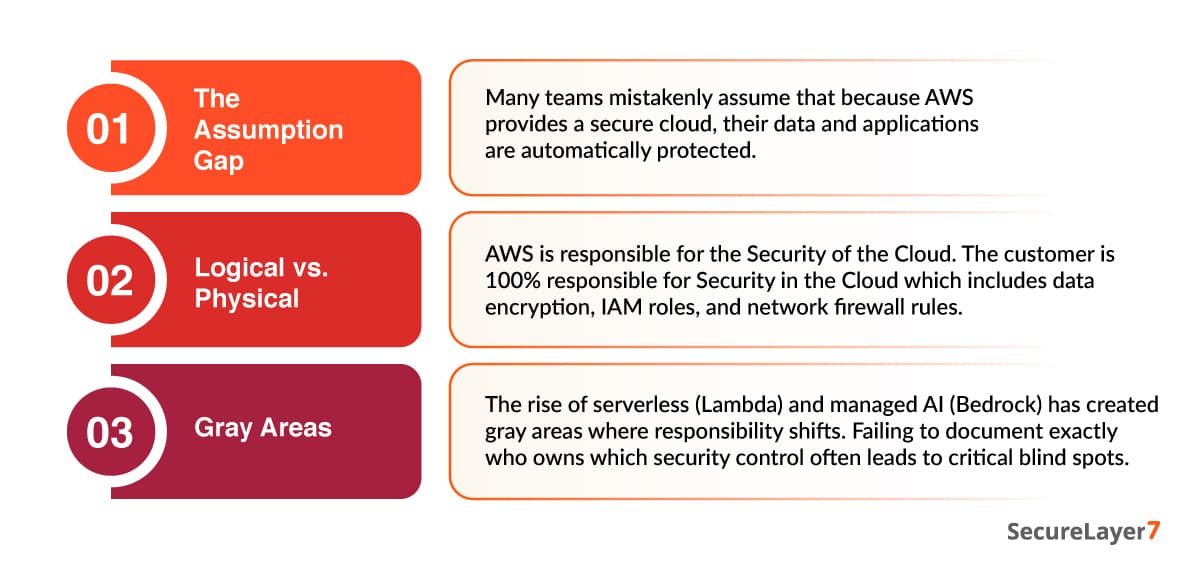
- The Shared Responsibility Gap: Many teams mistakenly assume AWS handles all security layers. AWS secures the physical cloud, the user is responsible for configuring the logical cloud.
- Human Error & Speed: Speed often trumps safety. A single typo in an Infrastructure-as-Code (IaC) template can instantly expose an S3 bucket to the global internet.
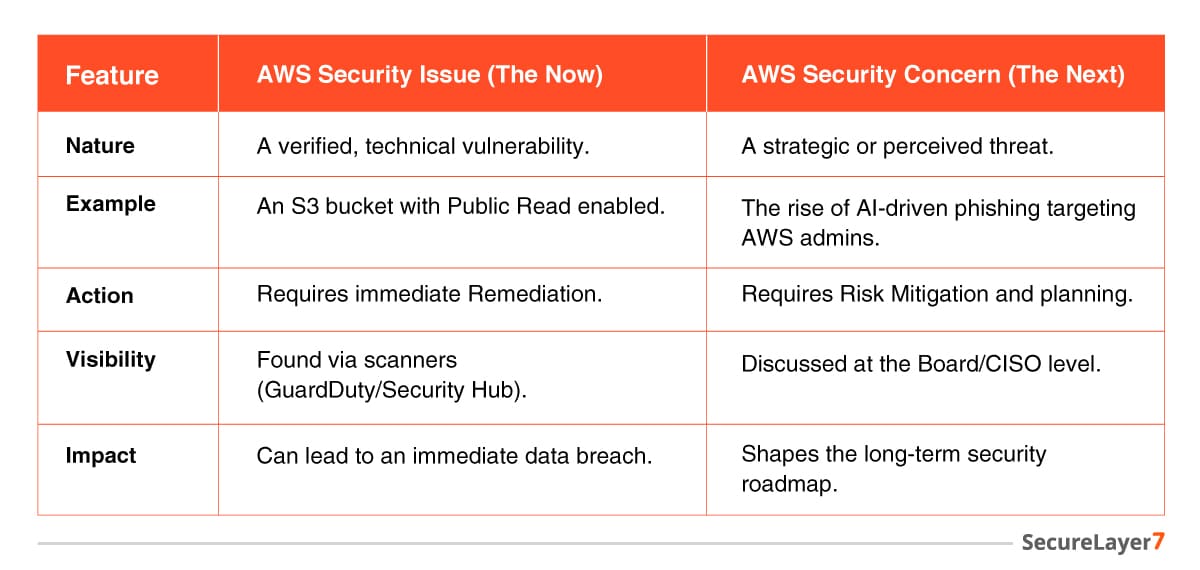
Difference Between AWS Security Issues vs. AWS Security Concerns
Often used interchangeably, these terms represent different stages of risk management.
Top AWS Security Issues in 2026
The AWS security landscape has been redefined by the dual forces of Agentic AI and Cloud-Native Maturity. The leaky bucket remains a threat, attackers have moved toward high-speed, automated exploitation of identity and runtime environments.
Misconfigured S3 Buckets
Despite AWS’s Block Public Access defaults, human error and legacy migration scripts continue to leave data exposed. Automated exfiltration tools can index and drain a newly exposed bucket in under 60 seconds.
- Impact: Public exposure of PII, financial records, or sensitive meeting transcripts, often leading to immediate compliance penalties under the EU AI Act or GDPR.
Weak Identity and Access Management (IAM)
Identity is now the primary perimeter. Identity Sprawl – the explosion of machine identities for AI agents and service accounts – has led to massive Privilege Creep.
- Impact: Attackers who compromise a single over-privileged service role can perform lateral movement to take over an entire AWS estate.
Lack of Multi-Factor Authentication (MFA)
Static MFA is increasingly vulnerable to MFA fatigue attacks and AI-driven social engineering.
- Impact: Account compromise remains a top entry point. The standard has shifted toward Adaptive MFA and FIDO2-compliant hardware keys to counter these sophisticated bypasses.
Unsecured APIs and Endpoints
With the rise of microservices, Shadow APIs often lack proper authentication or rate limiting.
- Impact: Attackers use these endpoints to perform Server-Side Request Forgery (SSRF) or mass data scraping, especially in AI-integrated applications where APIs handle raw data prompts.
Poor Network Configuration
Overly broad Security Groups and open management ports act as beacons for attackers.
- Impact: Vulnerabilities in infrastructure software are often exploited within hours of disclosure, allowing unauthenticated attackers to execute code as root.
Insufficient Logging and Monitoring
CloudTrail and CloudWatch provide logs; many organizations lack real-time correlation.
- Impact: Without automated monitoring, the average detection time for a cloud breach remains high – often exceeding 180 days, allowing attackers to maintain persistence long after the initial entry.
Data Encryption Gaps
Many teams focus on encryption at rest but neglect encryption in use.
- Impact: As AI agents pull sensitive data into prompts and vector stores, plaintext data becomes vulnerable in memory. Regulators now demand evidence that data is useless to an attacker even if the perimeter fails.
Vulnerable Workloads and Containers
Deploying known-bad code via container images or unpatched EC2 instances remains a critical lapse.
- Impact: Rogue container behavior and cryptojacking are common results of unpatched systems, often costing companies thousands in hidden compute charges before detection.
Secrets and Credential Exposure
Hardcoded API keys in GitHub or leaked credentials in public Slack channels are low-hanging fruit.
- Impact: One leaked key can bypass all network defenses. Modern attackers use LLM-powered scrapers to find these keys across the public internet with near-perfect accuracy.
Lack of Security Automation
Relying on manual security gates in a 2026 DevOps environment is a recipe for disaster.
- Impact: Human error in complex configurations leads to 78% of exposures. Organizations without Security as Code find themselves trapped in a cycle of controlled chaos, unable to keep pace with automated threats.
How SecureLayer7 Helps Identify AWS Security Issues
Identifying AWS security issues requires more than relying on automated alerts and configuration checks. Misconfigured cloud resources, excessive IAM permissions, exposed APIs, vulnerable workloads, insecure network configurations, and exploitable attack paths can remain undetected without deeper security testing.
SecureLayer7 helps organizations identify and validate security weaknesses across AWS environments through cloud security assessments and penetration testing. By evaluating cloud configurations, IAM controls, applications, APIs, workloads, and network exposure, SecureLayer7 helps security teams uncover exploitable vulnerabilities, prioritize high-risk findings, and remediate security gaps before attackers can exploit them.
Common AWS Security Concerns for Organizations
As organizations increasingly rely on Amazon Web Services (AWS) for their cloud infrastructure, they face growing security concerns that need to be addressed proactively. AWS provides a robust suite of security tools, businesses must navigate various vulnerabilities and challenges to safeguard their data, applications, and systems.
Following are the common AWS security concerns organizations face today:
Data Breaches and Compliance Risks
Data loss is a critical concern for organizations in 2026. A single breach can lead to catastrophic legal and financial consequences.
- Extinction-Level Events: Over 80% of organizations experienced a cloud breach in the past year, making incidents inevitable rather than avoidable.
- Regulatory Pressure: With regulations like GDPR, HIPAA, and the EU AI Act imposing higher penalties, organizations must ensure data sovereignty to prevent sensitive data from being exposed in non-compliant regions during automated scaling events.
Insider Threats and Privilege Misuse
Internal risk is often more dangerous than external threats because it bypasses the traditional perimeter. Least-privilege access can reduce the potential impact of compromised accounts. Read more: Minimizing Privileges for IAM Users for additional guidance.
- Accidental Insiders: The most common insider threat in 2026 is the well-meaning developer who inadvertently creates a backdoor via an over-privileged IAM role or a leaked API key.
- Malicious Actors: As remote work becomes the permanent standard, monitoring for behavioral anomalies is a major concern.
Complexity of Cloud Environments
AWS now offers over 200 services, and most enterprises run in Multi-Cloud or Hybrid environments. This complexity creates a visibility gap.
- Shadow IT: A major concern is forgotten infrastructure test databases or old S3 buckets that sit idle and unmonitored.
- Interconnectivity Risks: Organizations are concerned about how different services interact. A vulnerability in a single Lambda function could theoretically be chained to compromise a core RDS database, creating an attack path that is difficult to visualize manually.
Why AWS Security Issues Occur
AWS provides a wide array of robust security features, security issues still arise for many organizations using the platform. These issues typically stem from a combination of misconfigurations, poor governance, and lack of expertise. Understanding why these problems occur is crucial for mitigating risk and ensuring the integrity of AWS environments.
Following are some key factors contributing to AWS security issues:
Misunderstanding of the Shared Responsibility Model
The Shared Responsibility Model is the cornerstone of cloud security, yet it remains one of the most misunderstood concepts in IT.
Rapid Cloud Adoption Without Governance
To remain competitive, enterprises are migrating to AWS at an unprecedented pace. Speed often comes at the cost of oversight.
- The Shadow AI Factor: Individual departments often spin up AWS-based AI services without informing the central IT or security teams.
- Missing Guardrails: When organizations move fast without a Cloud Center of Excellence (CCoE), they lack standardized templates.
Poor Configuration Management
Because AWS is software-defined, a single click or a line of code can have catastrophic consequences.
- Complexity Overload: With over 200 services and thousands of configuration toggles, even experienced engineers can make mistakes.
- Configuration Drift: Even if a resource starts secure, it can drift over time. Manual changes in the AWS Console, temporary fixes that are never reverted, and automated scaling events can all introduce new vulnerabilities that were not there during the initial deployment.
Impact of AWS Security Issues
AWS security issues can have serious repercussions for organizations, affecting not only their technical infrastructure but also their financial stability, compliance standing, and reputation.
Following are the most significant impacts of security breaches or misconfigurations in AWS environments.
Financial Losses and Data Breaches
The immediate impact of an AWS security issue is often a staggering financial loss, as cybercriminals use AI to exfiltrate data at machine speed, draining high-value databases before humans can react.
- Direct Costs: Organizations incur an average cost of $165 per compromised record, covering forensic investigations, legal fees, and customer notifications.
- Ransomware & Extortion: Ransomware attacks now target AWS S3 backups. If recovery fails, the ransom is just a fraction of the total loss, with organizations losing millions daily while offline.
Regulatory Penalties (GDPR, DORA, HIPAA)
The Triple Penalty has become a harsh reality for regulated industries, where organizations face severe consequences for security breaches:
- GDPR: Fines can reach up to €20 million or 4% of global turnover. A simple S3 misconfiguration can lead to the maximum penalty, with regulators demanding proof of Data Protection by Design.
- DORA: For financial firms, DORA mandates strict resilience standards, with daily fines for cloud outages or breaches until compliance is demonstrated.
- HIPAA: U.S. organizations face up to $1.5 million per violation category for exposing Protected Health Information (PHI), putting sensitive data at significant risk.
Business Downtime and Disruption
Security incidents in AWS frequently lead to Operational Paralysis.
- The Cost of Silence: For small to medium businesses (SMBs), an AWS outage or security lockdown can cost up to $100,000 per hour in lost productivity and missed revenue.
- Idle Staff & Delayed Deliverables: If your IAM system is compromised or locked down for investigation, your entire workforce may be unable to access their tools, leading to thousands of paid hours wasted on idle time.
- Recovery Complexity: Rebuilding a clean AWS environment after a sophisticated breach is not a weekend project. Full recovery takes over 100 days, during which the business is only partially functional.
How to Fix AWS Security Issues
Security is no longer a one-time setup; it is a continuous cycle of hardening and validation. Fixing AWS security issues requires a transition from manual oversight to automated governance.
Follow this comprehensive roadmap to secure your infrastructure against modern, AI-driven threats.
Strengthen IAM Policies
Identity is the new firewall. Most breaches today occur through the abuse of over-privileged accounts.
- Implement Least Privilege (PoLP): Use IAM Access Analyzer to review actual resource usage. Automatically prune permissions that have not been exercised in the last 30 days.
- Phase Out Static Keys: Replace long-lived IAM user keys with IAM Roles Anywhere or OIDC-based authentication for CI/CD tools like GitHub Actions.
Enable Multi-Factor Authentication (MFA)
Credential stuffing and phishing remain top entry points. MFA is your most effective defense.
- Protect the Root Account: Secure your root user with a FIDO2 hardware security key and store it in a physical safe. Never use the root account for daily tasks.
- Enforce MFA via Policy: Do not just ask users to enable MFA; implement an IAM policy that denies all actions except MFA setup until a second factor is verified.
Secure S3 Buckets
Publicly exposed data is an avoidable disaster. Automated scrapers can find a leaky bucket in seconds.
- Account-Level Block: Enable S3 Block Public Access at the account or organization level. This acts as a master kill switch that overrides any individual bucket misconfigurations.
- Disable ACLs: Use S3 Object Ownership to disable Access Control Lists (ACLs) entirely, relying solely on centralized IAM and Bucket Policies for access.
- Bucket Versioning & Object Lock: Enable these to protect against accidental deletion or ransomware encryption.
Implement Network Security Controls
Network boundaries are vital for preventing lateral movement. For a practical example of reducing exposure from publicly accessible management ports, see more Restricting Open SSH Access in Security Groups.
- Use Amazon VPC Lattice: Simplify service-to-service communication with built-in zero-trust authentication.
- Zero-Inbound Security Groups: Close all management ports (SSH/RDP) to the public internet. Use AWS Systems Manager (SSM) Session Manager for secure, browser-based shell access.
- AWS Network Firewall: Deploy this for deep packet inspection (DPI) to filter traffic based on domain names or malicious patterns.
Enable Logging and Monitoring
You cannot stop what you cannot see.
- AWS CloudTrail: Ensure management and data events are logged across all regions. Enable Log File Integrity Validation to ensure attackers have not tampered with the audit trail.
- Amazon CloudWatch Alarms: Set up real-time alerts for critical events, such as ConsoleLogin without MFA or modifications to VPC peering.
- GuardDuty & Security Hub: Activate Amazon GuardDuty for AI-driven threat detection and aggregate all findings into AWS Security Hub for a single-pane-of-glass view.
Encrypt Everything
Encryption is the final line of defense if data is ever exfiltrated.
- At Rest: Enable default encryption for all S3 buckets, EBS volumes, and RDS databases using AWS KMS. Rotate your Customer Managed Keys (CMKs) annually.
- In Transit: Enforce TLS 1.2 or 1.3 for all endpoints. Use ACM (AWS Certificate Manager) to automate the renewal of SSL/TLS certificates.
AWS Security Best Practices
To ensure your AWS environment remains secure, adopting best practices and a proactive approach is essential.
Following are the top AWS security best practices that every organization should follow:
Follow the AWS Shared Responsibility Model
Understanding where AWS’s duties end and yours begin is the Job #1 of cloud security.
- Understand Shared Responsibility: AWS operates under a shared responsibility model, where AWS manages the security of the cloud infrastructure, and customers are responsible for securing their data and applications within the cloud.
- Clarify Responsibilities: Ensure that your organization understands which security tasks fall under AWS’s purview and which are your responsibility.
Adopt a Zero-Trust Security Approach
The internal network is no longer considered safe. Zero-Trust operates on the principle: Never Trust, Always Verify.
- Identity as Perimeter: Use AWS IAM Identity Center for context-aware, temporary credentials instead of long-lived access keys.
- Always Verify: Authenticate and authorize every request based on real-time data like device health and user behavior.
- Micro-Segmentation: Isolate services using Amazon VPC Lattice, limiting the impact of potential compromises.
Secure DevOps (DevSecOps) Integration
Security must be a feature of the development lifecycle, not a bottleneck at the end.
- Shift-Left Security: Integrate security early in the development lifecycle using AWS Code Build and Code Pipeline.
- Secrets Management: Use AWS Secrets Manager to securely manage and rotate credentials.
- Security by Design: Encourage a security-first culture with tools like Amazon CodeGuru to identify flaws during development.
Conclusion
AWS security issues such as S3 misconfigurations, excessive IAM permissions, exposed APIs, insecure network configurations, credential leaks, and insufficient monitoring can significantly increase an organization’s cloud attack surface. Addressing these risks requires more than enabling AWS security tools, it requires proactive testing, strong access controls, secure configurations, continuous visibility, and regular validation of security controls.
SecureLayer7 helps organizations identify and remediate AWS security vulnerabilities through cloud security assessments and penetration testing. By evaluating AWS infrastructure, applications, APIs, workloads, access controls, and potential attack paths, SecureLayer7 helps businesses uncover exploitable security gaps before attackers can take advantage of them.
Contact SecureLayer7 to secure your AWS environment against evolving threats.
Frequently Asked Questions (FAQs)
The most common AWS security issues include misconfigured S3 buckets, weak IAM policies, lack of multi-factor authentication (MFA), exposed APIs, unsecured endpoints, and insufficient logging and monitoring.
AWS security concerns for businesses include data breaches, regulatory compliance risks, insider threats, lack of cloud security expertise, and complexity in managing cloud infrastructure.
To prevent AWS security issues, businesses should strengthen IAM policies, enable MFA, secure S3 buckets, implement network security controls, and regularly monitor and audit their environments.
AWS provides robust security features, but it is not fully secure by default. Customers are responsible for securing their data, applications, and resources within AWS. Organizations must configure security settings, manage access controls, and enable monitoring to ensure the safety of their environments.
AWS offers several tools to improve security, including AWS Security Hub, AWS Config, AWS CloudTrail, AWS GuardDuty, AWS Shield, and AWS WAF. These tools help with monitoring, compliance tracking, intrusion detection, and protecting against DDoS attacks and other threats.

