
Executive summary (TL;DR)
Not every best red team provider is best for you. Before picking a name off this list, match it to what you actually need:
- Want objective-driven testing without enterprise overhead? SecureLayer7 offers hands-on operators, proof-of-exploit evidence, and flexible engagement models (Assumed Breach, Black Box, Threat-Led) at a more accessible price point.
- Need threat-intel-backed emulation of a specific adversary? Mandiant or Secureworks both draw on real incident-response history to design attacks around actual threat actors.
- Identity and Active Directory are your biggest risks? SpecterOps offers narrow focus, but unmatched depth in AD/Entra ID attack paths.
- Running a large, regulated, or multi-country program? NCC Group, IBM X-Force Red, or Kroll are built for scale, compliance frameworks, and cross-border delivery.
- Want testing folded into your existing security stack? CrowdStrike (endpoint/identity telemetry) or Cobalt (continuous, platform-based PTaaS).
- Need custom exploitation or novel research-driven attacks? Praetorian or TrustedSec are good picks that are smaller, technically deep, less standardized.
- Broad coverage across technical, physical, and human attack surfaces? GuidePoint Security or Bishop Fox.
The real decision driver isn’t the brand, but it’s whether the provider’s methodology matches your objective. Confirm operator experience, engagement model, and reporting depth before signing, not after.
A red team assessment does more than find security vulnerabilities. It tests how well an organization can defend itself against a real-world attack by showing how an attacker could combine weaknesses, move through systems, and reach a specific goal. This is important because organizations need to understand attack paths, not just individual security issues.
Choosing the right provider also matters because a red team engagement may involve production systems, employees, user accounts, cloud infrastructure, applications, and physical security.
This guide compares 14 red team assessment providers based on their red team and adversary simulation capabilities, technical coverage, detection validation, relevant expertise, engagement models, and buyer considerations. The goal is to help security and IT teams identify providers that align with their specific requirements rather than relying solely on brand reputation or generic provider rankings.
Why is a Red Team assessment a necessity in 2026?
A red team assessment is a simulated cyberattack that evaluates how well an organization can prevent, detect, and respond to realistic attacks. Unlike a traditional vulnerability assessment, it focuses on how an attacker could combine multiple weaknesses to reach a specific objective.
Red team assessments are necessary because having security controls in place does not always mean they will work effectively against a real attacker. A red team helps organizations:
- Identify gaps in real-world defenses that routine security testing may miss.
- Test detection and response capabilities by seeing whether security teams can identify and contain an active attack.
- Understand attack paths and business impact by demonstrating how individual weaknesses can be chained together.
- Validate security controls across people, processes, applications, networks, and infrastructure.
- Prioritize remediation based on weaknesses that could realistically lead to compromise.
By simulating how real attackers operate, red team assessments give organizations a practical view of their security readiness and help strengthen defenses before an actual attack occurs.
Red team scope typically includes reconnaissance, initial access, identity and endpoint attacks, lateral movement, privilege escalation, and testing of cloud, web, and APIs. Depending on the engagement, it may also cover social engineering, physical security, business-impact objectives, detection and response, and other attack paths.
Evaluation Parameters
The red team assessment providers listed in this blog were evaluated based on the following 12 parameters:
1. Technical Depth
Can the team uncover and exploit complex vulnerabilities, chain weaknesses, and bypass security controls? This matters when you need to find issues that routine testing may miss. Look for providers with strong hands-on offensive security expertise.
2. Red-Team Methodology
A red team should emulate a real attacker, not simply perform a longer penetration test. Look for objective-driven, adaptive engagements that test how an attacker could progress through your environment. This helps you assess your defenses against realistic attack scenarios.
3. Operator Quality
The skills of the people conducting the engagement directly affect its outcome. Consider their offensive security experience, research background, certifications, and familiarity with environments like yours. Ask who will actually perform the work, not just who leads the sales discussion.
4. Reporting & Deliverables
Look for reports that clearly document attack paths, evidence, timelines, business impact, and prioritized remediation steps. Strong reporting helps technical teams fix weaknesses and gives security leaders a clear view of the organization’s exposure.
5. Detection & Response Validation
A red team should test whether your security team can detect, investigate, and respond to realistic attacks. Check whether the provider evaluates SOC, SIEM, EDR, identity, and other detection capabilities. This reveals gaps that vulnerability-focused testing may not identify.
6. Threat Intelligence & Adversary Emulation
The provider should be able to use relevant threat intelligence, adversary TTPs, and realistic attack scenarios. This makes the engagement more representative of threats your organization actually faces. It is especially important for organizations targeted by specific threat actors.
7. Technical Breadth
Assess coverage across the technologies that make up your attack surface, such as web applications, APIs, identity, endpoints, Active Directory, cloud, SaaS, and mobile. Broad expertise helps providers follow attack paths across multiple systems instead of testing each layer in isolation.
8. Security Research Capability
Look for evidence of vulnerability research, CVEs, offensive tooling, technical publications, or contributions to the security community. Research-driven teams may bring deeper knowledge of emerging vulnerabilities and attack techniques that aren’t covered by standard testing approaches.
9. Customer References & Track Record
Relevant customer experience can validate what a provider claims about its capabilities. Look for references from organizations with similar technology, scale, risk profile, or regulatory requirements. This gives you a better indication of how the provider performs in environments like yours.
10. Pricing & Value
Compare the cost against operator expertise, engagement hours, scope, methodology, and expected outcomes—not price alone. A more expensive engagement may provide greater value if it uncovers risks that cheaper assessments miss. The goal is to maximize security outcomes for your investment.
11. Commercial & Operational Resilience
Consider whether the provider can reliably support the engagement through adequate staffing, backup personnel, secure infrastructure, escalation processes, and continuity measures. This reduces the risk of delays or disruptions during a complex engagement.
12. Fit for Your Organization
The right provider should match your technology, threat profile, objectives, communication style, and security maturity. A provider with impressive capabilities on paper may still be a poor fit for your environment. Prioritize teams that understand what you need the red team exercise to prove.
Top Red Team Assessment Providers
Before diving into the detailed profiles, the table below gives a quick snapshot of how the selected providers compare. It highlights each provider’s primary focus, key strengths, and typical red team capabilities, while the analysis that follows looks more closely at their offerings against the evaluation criteria.
Provider | Best for | Key Strength | Red Team Focus |
| SecureLayer7 | Objective-driven red team assessments | Attack-chain validation and offensive-security expertise | Network, identity, applications, cloud, phishing, physical and wireless |
| Mandiant | Threat-informed red teaming | Threat intelligence and incident-response expertise | Adversary emulation, cloud, identity, social engineering, C2 |
| Bishop Fox | Customized adversary emulation | Offensive-security expertise and detection validation | Technical, human, physical, cloud and application attack scenarios |
| SpecterOps | Identity-focused adversary simulation | Active Directory, Entra ID and attack-path expertise | Identity attacks, privilege escalation, credential attacks, lateral movement |
| Praetorian | Advanced offensive assessments | Offensive research and custom exploitation | Adversary emulation, cloud, identity, applications, attack paths |
| TrustedSec | Customized attack simulation | Offensive-security research and practitioner expertise | Network, AD, cloud, social engineering, physical security |
| NCC Group | Enterprise attack simulation | Global delivery and regulatory experience | Red/purple teaming, threat-led testing, physical and technical attack surfaces |
| NetSPI | Scalable offensive security testing | Enterprise security testing and ongoing risk visibility | Network, applications, cloud, identity, threat-led testing |
| IBM X-Force Red | Large-scale offensive security testing | Broad technical coverage and global delivery | Red teaming, adversary simulation, cloud, applications, hardware, physical |
| Secureworks | Detection and response validation | Threat intelligence and adversary simulation | External/internal attacks, C2, lateral movement, social engineering |
| GuidePoint Security | Multi-surface attack simulation | Technical, human and physical security coverage | Network, cloud, AD, applications, social engineering, physical |
| Kroll | Cyber resilience-focused testing | Threat intelligence and incident-response context | Network, cloud, social engineering, physical, adversary emulation |
| CrowdStrike | Endpoint and identity-focused adversary simulation | Threat intelligence, endpoint and cloud expertise | Endpoint, identity, cloud, AD, adversary simulation |
| Cobalt | Continuous security testing | Scalable platform-based security testing | Applications, cloud, network, adversary simulation, SOC validation |
1. SecureLayer7
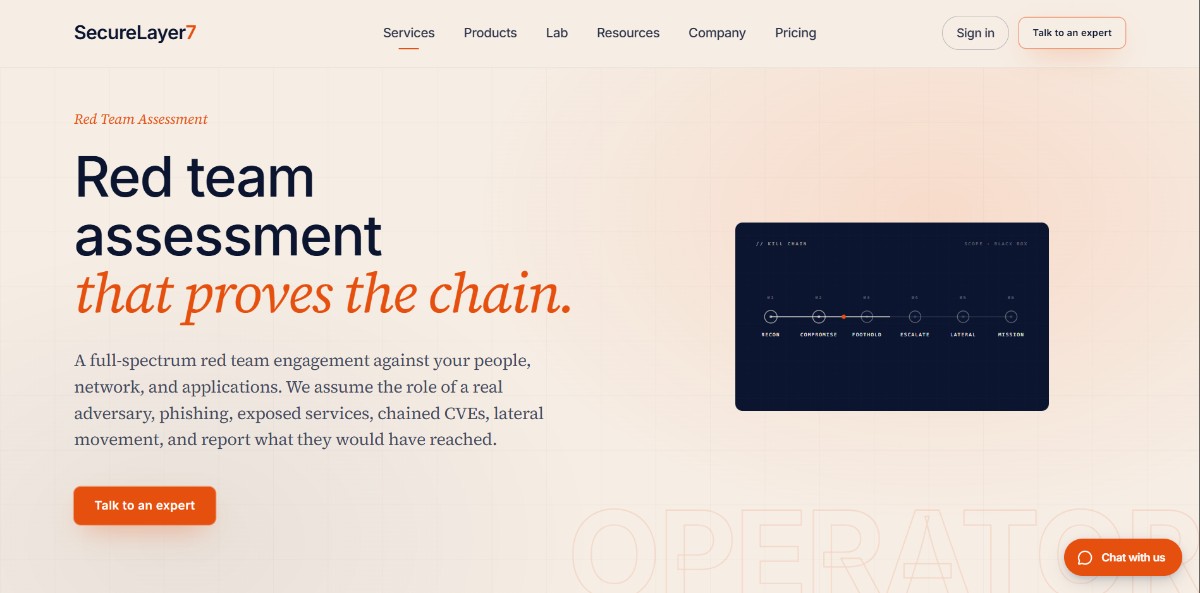
SecureLayer7 is an offensive-security company with roots in penetration testing and security research dating to 2012. A technically credible, relatively lean offensive-security provider that could be a better-value choice than several much larger firms.
The company describes itself as a CREST-accredited testing organization with teams operating from India and the US, supporting customers across fintech, SaaS, enterprise, telecom and other sectors. Its model emphasizes hands-on pentesters and researchers, original research, proof-of-exploit evidence and direct engagement ownership rather than highly standardized delivery
Key strengths
- Technical depth: SecureLayer7 covers network, identity, application, and cloud attack paths, with engagements designed to identify how weaknesses can be chained together rather than assessed only in isolation.
- Multiple engagement models: Its red team service offers three approaches: Assumed Breach, Black Box (Full-spectrum), and Threat-Led, allowing the engagement to be structured around the organization’s testing objective.
- Adversary emulation: The methodology emphasizes adaptive attacker behavior, including low-and-slow tradecraft, EDR-aware techniques, and changing tactics when detection becomes likely.
- Detection validation: A key objective is measuring how effectively security teams detect, investigate, and contain an attack, including where an attack chain is stopped and how long the operation progresses before detection.
- Research capability: SecureLayer7 maintains a public security research program with vulnerability disclosures and published CVE research. Its security-advisory index currently documents 40+ CVEs across 28 vendors.
- Broad attack surface coverage: Depending on the engagement, testing can extend across network, identity, applications, cloud, physical security, social engineering, and wireless environments.
- Hands-on testing: The company’s broader offensive-security approach emphasizes exploiting identified weaknesses and providing evidence of compromise rather than reporting scanner-generated findings alone. Its site states that findings are supported with proof of compromise, evidence, remediation guidance, and retesting.
- Industry coverage: SecureLayer7 identifies fintech, SaaS, education, enterprise, telecom, and security/critical-infrastructure organizations among the sectors it supports
Red Team and Adversary Simulation Capabilities
- External attack simulation
- Internal network testing
- Active Directory and identity/IAM testing
- Web and API security testing
- SaaS security testing
- AWS, Azure, and Google Cloud testing
- Assumed-breach testing
- Black-box/full-spectrum testing
- Threat-led testing
- Physical security testing
- Social engineering
- Wireless security testing
- Purple teaming
- Detection-engineering handoff
Detection validation
SecureLayer7 can evaluate whether simulated attacks are detected, investigated, and contained, including where an attack chain is disrupted and how long the activity continues before detection.
This can help organizations assess EDR, security telemetry, detection, and SOC response effectiveness during realistic attack scenarios.
Why consider it:
A strong option for organizations looking for hands-on offensive security expertise, broad attack-surface coverage, and realistic adversary simulations. Its approach places emphasis on technical depth, experienced operators, and validating how security controls perform against realistic attack scenarios.
Key considerations and trade-offs:
Its specialist offensive-security focus makes it well suited to organizations seeking hands-on expertise, while buyers with broader managed-security or global consulting needs may want to compare overall service coverage.
2. Bishop Fox
Bishop Fox is a cybersecurity company focused on penetration testing, red teaming, attack-surface management, and security research. Its red team services focus on realistic attacker behavior, including customized attack scenarios and evaluation of defensive security controls.
Key Strengths
Bishop Fox’s areas of focus include adversary emulation, stealth techniques, attack-path analysis, control validation, detection testing, and security research.
Red Team and Adversary Simulation Capabilities
- External and assumed-breach red teaming
- Internal network and Active Directory testing
- Cloud security testing
- Web and API security testing
- Social engineering
- Physical security testing
- Threat-informed adversary emulation
- Attack-path and graph analysis
- Security control validation
- Purple teaming
Detection Validation
Detection and response testing can be incorporated into the assessment to evaluate what the Blue Team detected, which systems were affected, and how quickly simulated attack activity was identified or disrupted. This provides insight into the effectiveness of monitoring and response capabilities during realistic attack scenarios.
Why Consider Bishop Fox
Consider Bishop Fox if your organization is looking for realistic attack scenarios, adversary emulation, stealth testing, and measurement of detection and response capabilities. It may be relevant for organizations that want to evaluate both technical security controls and SOC performance.
Key Considerations and trade-offs
Customized red team engagements can require additional planning, coordination, and clearly defined objectives, particularly when testing complex environments or multiple attack surfaces. Buyers should confirm the assessment scope, attack scenarios, testing methodology, and deliverables before signing the SOW.
3. SpecterOps
SpecterOps is a cybersecurity company specializing in adversary tradecraft, identity security, and attack-path management. It combines software, training, and professional services, with red team and adversary simulation work focused on practical attacker techniques. Its services have particular relevance to identity infrastructure and privilege relationships that attackers may use to reach critical assets.
Key Strengths
SpecterOps’ areas of focus include identity security, Active Directory, attack-path analysis, adversary tradecraft, and security operations.
Red Team and Adversary Simulation Capabilities:
- Active Directory security testing
- Microsoft Entra ID testing
- Kerberos attack simulation
- Identity privilege escalation
- Credential attack simulation
- Cloud identity testing
- Attack-path analysis
- Lateral movement
- Detection engineering
- Purple teaming
- Adversary emulation
Detection Validation
SpecterOps can assess whether security teams detect multi-step identity attack sequences, rather than only individual suspicious events. This can help identify gaps in identity monitoring, detection engineering, and response to privilege-based attack paths.
Why Choose SpecterOps
Consider SpecterOps when identity, Active Directory, or Entra ID security is an important part of your threat model. Its focus on identity attack paths can help organizations evaluate how compromised credentials could be used to escalate privileges, move laterally, and reach critical assets.
Key Considerations & Trade-offs
SpecterOps’ services are particularly focused on identity and directory-based attack paths. Organizations requiring extensive testing of non-identity areas, such as physical security, social engineering, or application security, should confirm the engagement scope and compare coverage with providers offering broader red team services.
4. Mandiant
Mandiant, now part of Google Cloud, combines cybersecurity consulting, threat intelligence, incident response, and defensive security expertise. Its experience investigating real-world breaches and sophisticated threat actors gives its red team and adversary simulation services a strong intelligence-led and threat-informed approach.
Key Strengths
Mandiant’s key strengths include threat intelligence, incident-response expertise, adversary knowledge, offensive security capabilities, and enterprise-scale delivery.
Red Team and Adversary Simulation Capabilities:
- External red team assessments
- Internal compromise and lateral movement
- Cloud security testing
- Identity security testing
- Malware and command-and-control (C2) simulation
- Adversary emulation
- Threat intelligence
- Social engineering
- Purple teaming
- Incident-response validation
Detection Validation
Mandiant can assess whether an organization’s SOC can detect, investigate, and contain realistic threat-actor activity. Its threat intelligence can help design exercises around specific adversaries, tactics, techniques, and attack patterns.
Why Choose Mandiant
Mandiant can be considered by organizations seeking threat-intelligence-led red teaming backed by real-world incident-response experience. It is particularly suited to organizations that want to emulate specific threat actors and determine whether their security controls and SOC can detect and contain those attack patterns.
Key Considerations & Trade-offs
Mandiant’s services are generally oriented toward enterprise security programs and complex environments. Smaller organizations or those seeking a narrowly scoped red team assessment should compare engagement scope, technical requirements, and pricing with specialist red team providers.
5. Praetorian
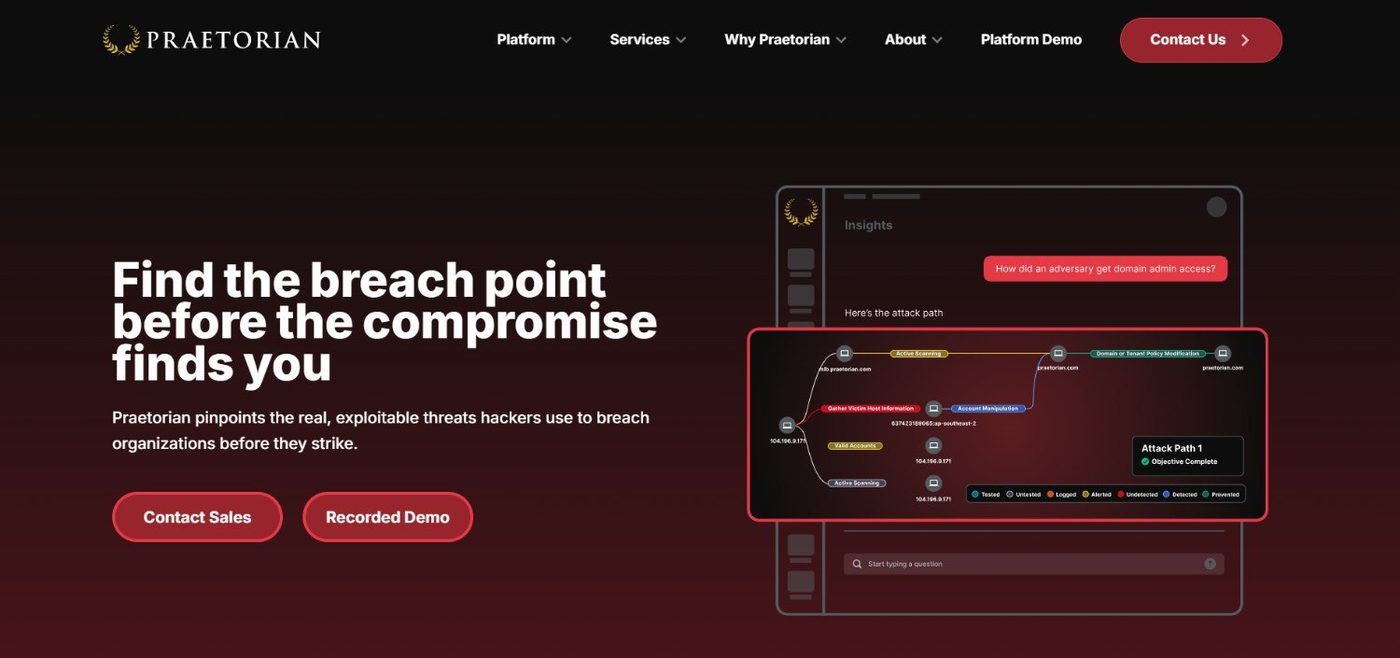
Praetorian is an offensive cybersecurity company focused on identifying and reducing material security risk from an attacker’s perspective. Its approach combines offensive security research, software engineering, custom exploitation, and adversary emulation across enterprise, cloud, application, IoT, and product environments.
Key Strengths
Praetorian’s key strengths include offensive research, custom exploitation, adversary emulation, attack-path analysis, and technical depth.
Red Team and Adversary Simulation Capabilities
- Advanced penetration testing
- Red team assessments
- Adversary emulation
- Cloud security testing
- Identity security testing
- Application security testing
- Custom exploitation
- Attack-path analysis
- Security research
Detection Validation
Praetorian can assess whether defensive controls can detect and respond to sophisticated attacker activity, including customized techniques that go beyond common or commodity attack methods.
Why Choose Praetorian
Praetorian is a good option for organizations seeking to understand what a highly capable attacker could achieve beyond conventional penetration testing. It is particularly suited to organizations that value custom exploitation, offensive research, adversary emulation, and technically complex attack paths.
Key Considerations & Trade-offs
Praetorian’s highly technical and customized approach may provide more depth than organizations need for a narrower or standardized security assessment. Buyers should ensure the engagement’s technical depth and scope align with their specific security objectives.
6. TrustedSec
TrustedSec is an offensive-security-focused consultancy founded by security practitioner David Kennedy. Its approach emphasizes experienced technical consultants, offensive research, custom tooling, and practical security outcomes, with a focus on tailored security assessments rather than highly standardized engagements.
Key Strengths
TrustedSec’s key strengths include operator expertise, offensive security research, custom tooling, technical depth, and engagement flexibility.
Red Team and Adversary Simulation Capabilities:
- External red team assessments
- Internal network testing
- Active Directory testing
- Cloud security testing
- Web and API security testing
- Social engineering
- Physical security testing
- Custom offensive tooling
- Adversary simulation
- Purple teaming
Detection Validation
TrustedSec’s operator-led approach can be used to assess whether defensive teams can detect and respond to realistic attacker behavior. This is particularly relevant when the engagement is designed around realistic attack paths rather than a predefined vulnerability checklist.
Why Choose TrustedSec
If you are seeking a highly tailored, hands-on red team engagement rather than a standardized security assessment, then TrustedSec is the way to go. Its approach may be particularly suited to organizations that value technical depth, custom attack scenarios, and experienced offensive-security operators.
Key Considerations & Trade-offs
Because TrustedSec takes a customized engagement approach, scope, attack scenarios, testing depth, and deliverables can vary between assessments. Buyers should confirm exactly what is included in the SOW and how the engagement will be measured before signing.
7. NCC Group
NCC Group is a global cybersecurity and business-resilience organization founded in 1999. It combines offensive security, defensive services, threat intelligence, incident response, research, and cybersecurity advisory capabilities. Its broad service portfolio and global delivery model make it particularly relevant to large and regulated organizations.
Key Strengths
NCC Group’s key strengths include enterprise scale, structured methodology, regulatory alignment, threat-led testing, broad technical coverage, and detection and response validation.
Red Team and Adversary Simulation Capabilities
- Red team assessments
- Purple teaming
- Threat-led testing
- TIBER and CBEST-oriented engagements
- Network security testing
- Cloud security testing
- Application security testing
- Physical security testing
- Social engineering
- Threat intelligence
- Regulatory security testing
Detection Validation
NCC Group’s broader attack-simulation approach can assess how effectively organizations detect, investigate, and respond to simulated attacks across technical, physical, and human attack surfaces. This can help validate both preventive controls and defensive response capabilities.
Why Choose NCC Group
NCC Group is helpful for organizations seeking enterprise-scale red teaming combined with threat-led testing, regulatory requirements, and resilience objectives. It is particularly suited to large or regulated organizations that require broad technical, physical, and human testing within structured assessment frameworks.
Key Considerations & Trade-offs
NCC Group’s global consulting footprint and broad service portfolio may be more extensive than necessary for smaller organizations seeking a narrowly scoped red team assessment. Buyers should confirm the engagement scope, methodology, team structure, and deliverables match their specific requirements.
8. NetSPI
NetSPI specializes in penetration testing, attack-surface management, and breach and attack simulation. Its approach combines security expertise, standardized processes, and technology to provide scalable security testing and ongoing visibility into exploitable risks.
Key Strengths
NetSPI’s key strengths include enterprise delivery, structured methodology, application security, threat-led testing, scalability, and regulatory alignment.
Red Team and Adversary Simulation Capabilities
- Network security testing
- Application security testing
- Cloud security testing
- Identity security testing
- Threat-led testing
- Assumed-breach testing
- Black-box testing
- Social engineering
- Purple teaming
Detection Validation
NetSPI can evaluate detection, response, and recovery capabilities through simulated attack scenarios. This helps organizations identify gaps in security monitoring and determine how effectively defensive teams respond to realistic threats.
Why Choose NetSPI
NetSPI is a feasible option for organizations seeking structured, scalable security testing with strong application, cloud, identity, and attack-surface capabilities. It is particularly suited to enterprises that need technical depth combined with consistent delivery, governance, and ongoing security validation.
Key Considerations & Trade-offs
NetSPI’s focus on scalable and continuous security testing may not suit organizations seeking a highly customized, hands-on traditional red team engagement. Buyers should compare its engagement model, level of adversary simulation, and customization options with specialist red team providers.
9. IBM X-Force Red
IBM X-Force Red is IBM’s offensive-security team, providing penetration testing, red teaming, adversary simulation, and vulnerability-focused services across applications, networks, cloud, hardware, mainframes, AI systems, and personnel. Its global scale and broader IBM ecosystem allow it to support complex, geographically distributed security programs with access to threat intelligence and incident-response capabilities.
Key Strengths
IBM X-Force Red’s key strengths include global scale, technical breadth, enterprise experience, specialized technology coverage, and international delivery capabilities.
Red Team and Adversary Simulation Capabilities
- Red team assessments
- Adversary simulation
- Cloud security testing
- Application security testing
- Network security testing
- Hardware security testing
- Mainframe security testing
- AI security testing
- Physical security testing
- Social engineering
- Threat intelligence
Detection Validation
IBM X-Force Red can use adversary simulation to assess security monitoring, detection, and incident-response capabilities against realistic attack scenarios. This helps organizations determine whether defensive teams can identify and respond to attacker activity across complex enterprise environments.
Why Choose IBM X-Force Red
IBM X-Force Red is useful for organizations that need global delivery, broad technical coverage, and experience supporting complex enterprise environments. It is particularly suited to large organizations with diverse infrastructure, multiple geographic locations, or specialized technologies such as mainframes, hardware, and AI systems.
Key Considerations & Trade-offs
IBM X-Force Red’s broad enterprise capabilities may provide more coverage than organizations need for a focused red team assessment. Buyers should confirm the specific offensive-security scope, methodology, team composition, and deliverables required for their engagement.
10. Secureworks (now part of Sophos)
Secureworks, now part of Sophos, is a cybersecurity company focused on threat intelligence, detection, response, and managed security. Its security services are closely connected to understanding attacker behavior and improving an organization’s ability to prevent, detect, investigate, and respond to threats.
For red team and adversary simulation engagements, Secureworks is particularly relevant to organizations where SOC effectiveness and defensive control validation are as important as demonstrating initial compromise.
Key Strengths
Secureworks’ key strengths include threat intelligence, adversary simulation, detection validation, SOC integration, and incident-response expertise.
Red Team and Adversary Simulation Capabilities
- External attack simulation
- Internal attack simulation
- Social engineering
- Command-and-control (C2) testing
- Lateral movement
- Threat-led adversary emulation
- Purple teaming
- MITRE ATT&CK-based testing
Detection Validation
Secureworks can test whether the SOC can detect, investigate, and contain realistic attacker activity before the simulated attack reaches its objective. This is particularly useful for organizations focused on improving SOC visibility, threat detection, investigation workflows, and incident response.
Why Choose Secureworks
Secureworks works well for organizations whose primary objective is to determine whether their SOC and defensive controls can detect and respond to realistic attacker behavior. It is particularly suited to assessments where defensive validation is as important as demonstrating how an attacker could gain and maintain access.
Key Considerations & Trade-offs
Because Secureworks also provides managed detection and response and broader security services, buyers should clearly distinguish between a standalone red team assessment and additional managed-security services when defining the engagement scope and deliverables.
11. GuidePoint Security
GuidePoint Security is a cybersecurity consulting and solutions provider founded in 2011. Its services include red team engagements, penetration testing, security assessments, incident response, security architecture, and cybersecurity advisory services. It also helps organizations evaluate and implement security technologies through professional services and technology partnerships.
Key Strengths
GuidePoint’s key strengths include broad technical coverage, enterprise integration, social engineering, physical security testing, network security, and cloud and identity testing.
Red Team and Adversary Simulation Capabilities
- External attack simulation
- Internal attack simulation
- Cloud security testing
- Active Directory testing
- Application security testing
- Social engineering
- Physical security testing
- Purple teaming
- Breach simulation
Detection Validation
GuidePoint can evaluate how effectively defenders detect, investigate, and respond to simulated attacks across network, cloud, identity, physical, and human attack surfaces. This helps organizations identify gaps in security monitoring and defensive response.
Why Choose GuidePoint Security
Choose GuidePoint if you are seeking broad technical, physical, and social-engineering coverage from a provider that can assess multiple areas of your security environment. It is particularly suited to organizations looking for a flexible, full-spectrum red team assessment.
Key Considerations & Trade-offs
Because GuidePoint offers a broad range of cybersecurity consulting and technology services, buyers should confirm the specific red team methodology, attack scenarios, scope, testing coverage, team expertise, and deliverables included in the engagement.
12. Kroll
Kroll provides cybersecurity, data resilience, risk, compliance, and investigative services. Its red team and adversary simulation capabilities are supported by experience in incident response, threat intelligence, regulatory engagements, financial crime investigations, and enterprise risk.
Key Strengths
Kroll’s key strengths include threat intelligence, incident response, operational resilience, social engineering, physical security testing, and enterprise security assessment.
Red Team and Adversary Simulation Capabilities
- External attack simulation
- Internal attack simulation
- Cloud security testing
- Social engineering
- Physical security testing
- Threat intelligence
- Adversary emulation
- Purple teaming
- Detection and SOC validation
Detection Validation
Kroll can assess how effectively an organization’s security teams detect, investigate, contain, and respond to simulated attacks. Its approach can connect detection testing with incident response, threat intelligence, and operational resilience, helping organizations identify gaps in monitoring, investigation workflows, response procedures, and overall preparedness for a security incident.
Why Choose Kroll
Choose Kroll if you want to connect red team testing with incident response, resilience, and broader risk management. It is particularly relevant for buyers seeking to understand both how an attacker could compromise the organization and how effectively the organization could withstand and respond to the resulting incident.
Key Considerations & Trade-offs
Kroll’s broader cyber-risk, investigation, incident-response, and resilience capabilities may provide more coverage than organizations need for a narrowly scoped red team assessment. Buyers seeking a highly specialized offensive-security engagement should compare Kroll’s approach with dedicated red team specialists.
13. CrowdStrike
CrowdStrike is a global cybersecurity company specializing in endpoint, cloud, identity, and threat intelligence security. Its red team and adversary simulation capabilities are particularly relevant to organizations that want to assess how sophisticated attacks interact with endpoint, identity, and cloud defenses, and whether security operations can detect and respond to those activities.
Key Strengths
CrowdStrike’s key strengths include endpoint telemetry, threat intelligence, cloud and identity security, adversary simulation, and detection validation.
Red Team and Adversary Simulation Capabilities
- Endpoint security testing
- Identity and Active Directory testing
- Cloud security testing
- External attack simulation
- Internal attack simulation
- Adversary emulation
- Red and blue team exercises
- AI security testing
- Detection and SOC validation
Detection Validation
CrowdStrike can assess how effectively an organization’s security controls and SOC detect, investigate, and respond to simulated attacker activity across endpoint, identity, and cloud environments. The assessment can help identify gaps in endpoint telemetry, threat detection, alert investigation, threat hunting, and incident response during realistic attack scenarios.
Why Choose CrowdStrike
CrowdStrike can be used by organizations that are looking to test endpoint, identity, cloud, and SOC defenses from an attacker’s perspective. It may be particularly well suited to organizations that rely heavily on endpoint telemetry, threat intelligence, threat hunting, and security operations.
Key Considerations & Trade-offs
CrowdStrike is particularly relevant when endpoint, identity, cloud, and detection capabilities are central assessment objectives. Buyers seeking extensive physical security, social engineering, or highly specialized application-layer testing should verify the proposed scope and compare coverage with specialist red team providers.
14. Cobalt
Cobalt is a cybersecurity company specializing in penetration testing as a service (PTaaS) and continuous offensive-security testing. Its platform combines technology with a global network of security researchers and penetration testers to provide repeatable, on-demand security testing. Its model is particularly suited to organizations seeking continuous validation rather than relying solely on periodic penetration tests.
Key strengths
The strongest parameters are scalability, platform integration, application security, enterprise testing, and flexible testing engagements.
Red Team and Offensive Security Capabilities:
- External attack surface testing
- Internal network testing
- Application and API security testing
- Cloud security testing
- Network security testing
- Social engineering
- Adversary simulation
- SOC and detection validation
Detection validation
Provides repeatable validation of security controls against realistic attack scenarios rather than relying on a one-time assessment.
Why choose Cobalt:
Choose Cobalt if you are looking for scalable and repeatable offensive testing rather than relying only on a traditional one-time red-team engagement. It is a good fit for organizations that want to integrate penetration testing more continuously into their security program.
Key Considerations & Trade-offs:
Its platform-oriented model may appeal to organizations seeking continuous testing, while buyers looking for a deeply bespoke, traditional red team operation should compare delivery models.
Common Mistakes to avoid when choosing a red team assessment provider
| Common Mistake | How to Avoid It |
| Choosing based only on reputation or brand name | Evaluate the provider’s red team methodology, relevant experience, technical expertise, and attack-surface coverage. |
| Treating red teaming like a standard penetration test | Choose a provider that uses realistic, objective-driven attack scenarios and tests complete attack paths. |
| Focusing only on price | Compare pricing alongside scope, testing duration, team size, attack scenarios, deliverables, and retesting. |
| Not defining clear objectives and scope | Establish what you want to validate and clearly define target systems, attack surfaces, testing boundaries, and rules of engagement. |
| Overlooking detection and response validation | Ask how the engagement will evaluate detection, alerting, investigation, containment, and response—not just whether the testers can gain access. |
| Not checking what the final report includes | Confirm that the deliverables provide attack-chain evidence, business impact, key weaknesses, detection observations, remediation guidance, and retesting where applicable. |
Actionable Steps to Find the Right Red Team Assessment Provider
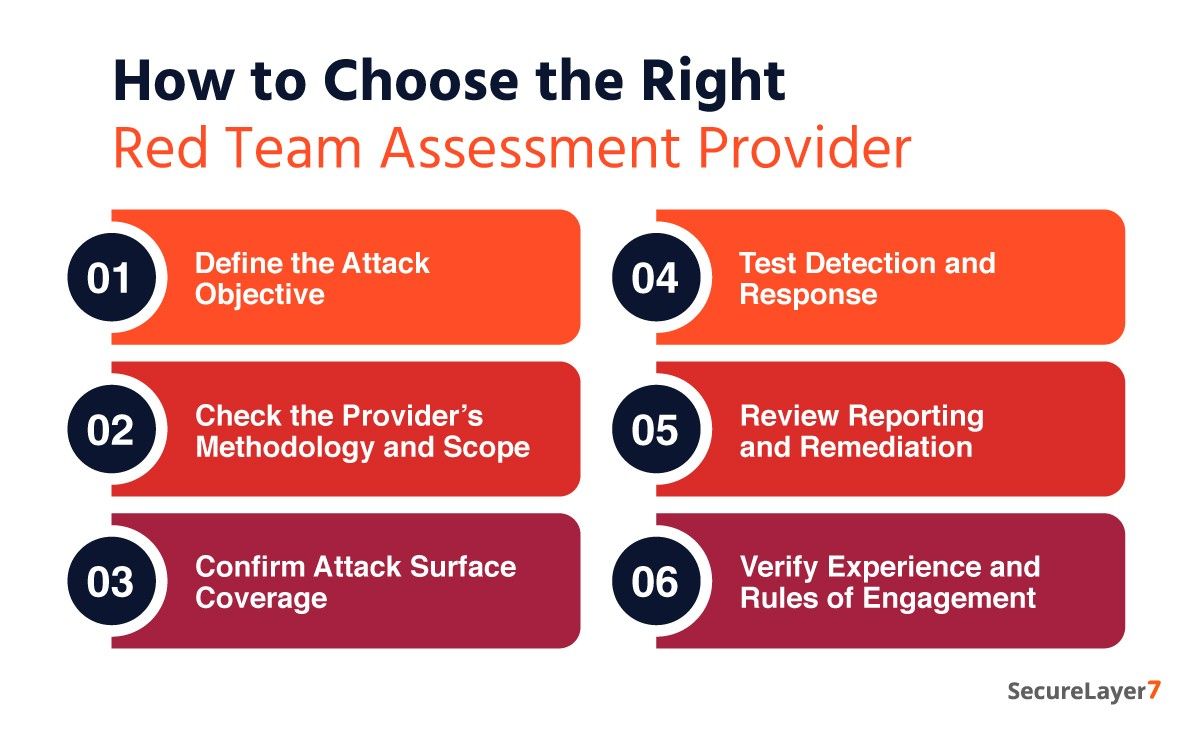
There is no single best red team provider for every organization. You should choose based on your business objective, attack surface, security maturity, and the depth of adversary simulation you need.
Before signing an SOW, confirm that the provider can:
Define the Attack Objective
Identify what you want the red team to achieve, such as accessing sensitive data, compromising privileged accounts, or reaching critical systems.
Check the Provider’s Methodology and Scope
Review the provider’s testing approach, techniques, and engagement scope to ensure they align with your objectives.
Confirm Attack Surface Coverage
Ensure the provider can assess the environments relevant to you, such as applications, APIs, cloud, endpoints, networks, and identities.
Test Detection and Response
Confirm whether the engagement evaluates your security team’s ability to detect, investigate, and respond to simulated attacks.
Review Reporting and Remediation
Look for reports that clearly document attack paths, evidence, security gaps, and actionable remediation recommendations. A strong red team report should clearly document the attack path, techniques used, evidence collected, security controls bypassed, objectives achieved, and prioritized remediation steps. This helps security and engineering teams understand how the attack progressed and what they need to address.
Verify Experience and Rules of Engagement
Check the provider’s relevant experience and establish clear rules covering targets, testing windows, prohibited techniques, and escalation procedures.
Conclusion
Choosing a red team assessment provider depends on your security objectives, attack surface, and the level of adversary simulation your organization requires. The right provider should go beyond identifying vulnerabilities and demonstrate how an attacker could chain weaknesses, reach a defined objective, and whether your defenses can detect and respond to the attack.
Among the providers reviewed, SecureLayer7 is worth considering for organizations looking for an objective-driven approach focused on realistic attack paths, evidence-based findings, and actionable remediation.
If you want to assess how an attacker could move through your environment and identify gaps in your defenses, explore SecureLayer7’s red team assessment services to learn more. SecureLayer7 Red Team Assessment Services
Frequently Asked Questions (FAQs)
A controlled simulation of a real-world cyberattack that tests an organization’s ability to prevent, detect, respond to, and contain threats.
Penetration testing focuses on finding exploitable vulnerabilities, while red teaming uses realistic attack techniques to achieve defined objectives and test overall defenses.
Evaluate technical expertise, operator experience, methodology, adversary emulation, detection validation, reporting quality, certifications, industry experience, and overall value.
Costs vary based on scope, duration, operators, attack surfaces, threat model, and testing requirements. Compare operator hours and deliverables, not just the headline price.
Look for attack narratives, objectives, timelines, techniques, evidence, attack paths, detection findings, business impact, and prioritized remediation recommendations.

