
Traditional penetration testing is commonly used to spot and fix security gaps. However, attackers keep changing their methods, and your business needs to stay alert and prepared for new threats.
That’s where the limitations of traditional pentesting become clear.
It’s often done once or twice a year, and you can still be at risk between tests. Attackers do not wait for your next security audit; they are always searching for ways to enter the system. That is why the role of continuous penetration testing (CPT) becomes important.
This article explains what continuous penetration testing is, how it works, and some best practices your organization can follow.
What is Continuous Penetration Testing?
Traditional penetration testing is a point-in-time exercise, while the current cyber threat landscape is constantly changing. There are solid reasons to consider continuous penetration testing:
- Proactive Security: CPT can flag real-time vulnerabilities introduced by code changes or configuration updates. This helps with timely remediation.
- Compliance with Regulations: Some businesses can’t afford to go even a single day without monitoring because of regulatory compliance mandates. Continuous testing supports ongoing adherence to standards such as PCI DSS, NIST, HIPAA, and GDPR.
- Improved Risk Management: Real-time insights from CPT allow organizations to track remediation progress and make informed decisions about resource allocation.
- Cost-Effective in the Long Run: Traditional penetration testing may seem cheaper upfront, but the consequences of an undetected breach can be far more costly than ongoing testing.
By preventing data breaches, legal liabilities, and reputational damage, continuous testing can deliver long-term savings despite higher initial setup costs.
Traditional Penetration Testing vs. Continuous Penetration Testing
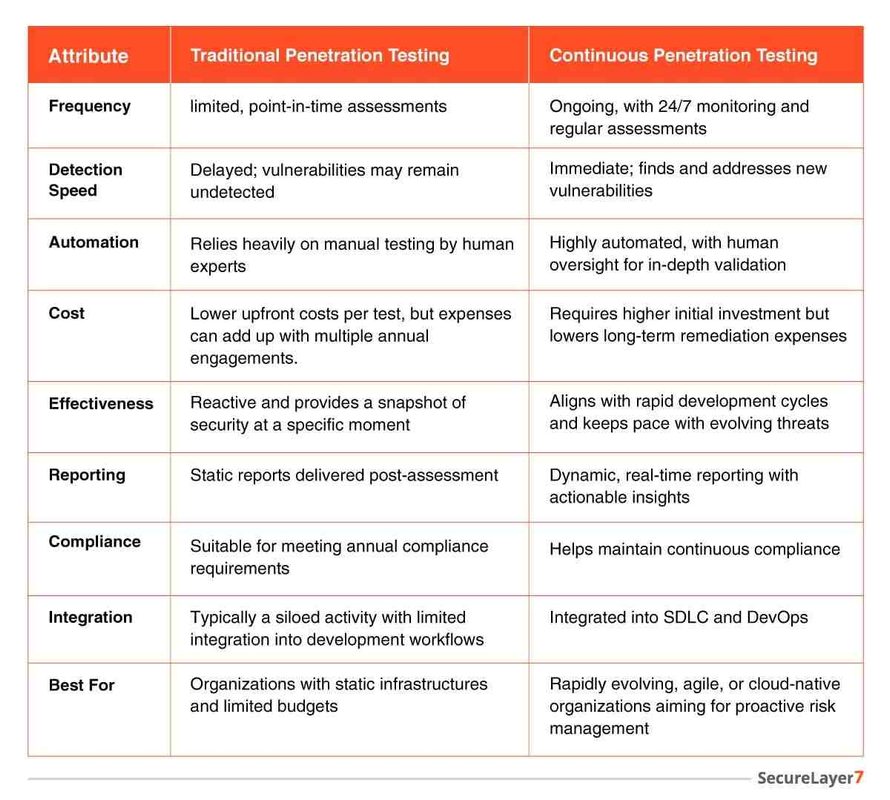
Traditional and continuous penetration testing both identify security vulnerabilities, but they differ in testing frequency, coverage, and response time. Traditional pentesting is periodic, while CPT provides ongoing security visibility. Both serve the same purpose, but there are some key differences:
How Continuous Penetration Testing Works
It combines automated security checks with regular testing to identify vulnerabilities as they appear. It continuously monitors changes, validates security controls, and helps security teams address risks before attackers exploit them.
Phase 1: Preparation: Align strategy with business risk
The preparation phase aligns security efforts with business risks, defines the attack surface, and ensures everyone understands the scope before testing begins.
Step 1: Define the scope
- Start with people, not tools. Bring CISOs, DevOps leads, app owners, and vendors together to agree what’s in and out.
- Use asset inventory and threat models to map the attack surface: public web apps, cloud accounts (AWS/Azure/GCP), internal/external APIs, containers and serverless.
- Document ownership, data flows and out-of-scope items to prevent scope creep and unnecessary toil.
Step 2:Optimize scanner configuration
- Generic scanners create noise. Optimize for the stack: scan depth (light vs. aggressive), credentialed access, authentication/workflow handling (session, CSRF), and plugin selection (turn off irrelevant checks for API-only services).
- Adopt a risk-based model when bandwidth or compliance is constrained.
- Prioritize KEVs, OWASP Top 10, and business-critical assets.
Step 3: Establish a baseline with initial scans
- Run a full-spectrum baseline across in-scope assets. Treat it as a risk benchmark, not a checkbox.
- Capture vulnerability density, count of critical/severe findings (SQLi, SSRF, misconfigurations), and any historical trend data available.
Phase 2: Continuous scanning: Automate with purpose
By scheduling scans around your DevOps cadence, teams can identify vulnerabilities early, respond faster, and maintain visibility as systems evolve.
Step 1: Schedule scans aligned to DevOps cadence
- Match scan frequency to your team’s development velocity.
- Daily for high-velocity CI/CD pipelines.
- Weekly for mature production environments.
- Event-triggered on git push, PR merge, or IaC changes.
- Use API scanners and webhooks so scans run when code or infra changes.
Step 2: Deliver actionable, role-based reporting
Different audiences need different outputs:
- Engineers: PoCs, curl commands, stack traces, reproduction steps.
- Security teams: Heatmaps, trend lines, remediation SLAs.
- Executives: Risk summaries and business impact.
Push issues into Jira/ServiceNow/Slack with context to avoid context-switching. Consider custom severity scoring (adjust CVSS with environmental impact) so prioritization reflects real business risk.
Phase 3: Remediation & rescans
Remediation turns vulnerability findings into action. This phase focuses on prioritizing risks, applying practical fixes, and rescanning affected systems to verify that vulnerabilities are truly resolved.
Step 1: Prioritize and remediate with context
Not all findings are equal. Prioritize using a matrix: CVSS, exploit availability (CISA KEV), asset criticality, and business impact. Remediation options should be pragmatic: patch libraries/OS, implement WAF rules as temporary compensations, and apply secure coding fixes for logic flaws.
Timely fixes protect revenue and reputation—practicality beats perfection.
Step 2: Validate fixes
Never assume a patch can fix a problem. Always run focused rescans on patched components to confirm resolution, check for regressions, and verify config persistence across redeploys. This validation supports compliance (PCI DSS, ISO 27001) and reduces repeat incidents.
Best Practices for Continuous Penetration Testing
Continuous penetration testing is about creating a security process that grows and adapts alongside your applications. Instead of finding every issue once, your goal is to stay ahead of new risks as they appear.
To do this well, you need a structured approach and the right mix of automation and human expertise.
- Begin by focusing on your most critical assets and then gradually expand supporting components like APIs, internal services, and integrations.
- Your experts need to confirm if issues are truly exploitable, understand the business impact, and spot deeper flaws that scanners might miss.
- Integrate findings into your existing workflows. By adding results to your CI/CD pipelines, you can catch vulnerabilities before they reach production.
- Syncing your findings with your ticketing systems helps your developers and security teams keep remediation visible and trackable.
- Critical issues should have tight timelines, while lower-risk ones can follow scheduled patch cycles.
- Regularly review your test scope and configurations. As your applications change, your attack surface changes too.
- Keep your test parameters up to date. This helps make sure your assessments stay relevant and that new features don’t slip through the cracks.
By combining automation for broad coverage with human insight for deeper analysis, you build a defense strategy that can keep up with real-world threats.
Conclusion
The shift toward continuous penetration testing signals a broader change in how organizations approach security. Instead of relying on periodic checks, security teams are moving to a model where vulnerabilities are surfaced and addressed as part of an ongoing process.
The result is less about ticking compliance checkboxes and more about building resilience into day-to-day operations. The question is no longer whether to adopt continuous testing, but how quickly they can integrate it into their existing workflows.
Looking to strengthen your security posture? SecureLayer7 helps organizations identify vulnerabilities, reduce risk, and defend against evolving cyber threats.
Contact our experts to get started.
Frequently Asked Questions (FAQs)
According to NIST, fixing a vulnerability post-deployment can cost more than addressing it during design. Continuous testing mitigates this by embedding security into CI/CD pipelines, reducing technical debt and breach risk.
Factors influencing the cost of continuous penetration testing include the number of targets, scan frequency, manual versus automated testing, compliance requirements, and integration complexity. Each web application, API endpoint, or cloud environment adds to the testing scope, while daily scans generally cost more than weekly scans but provide faster vulnerability detection. Fully automated tools are more cost-effective, whereas hybrid models that include ethical hacker validation can provide more comprehensive testing. Industries such as finance and healthcare may require deeper security validation to meet compliance requirements, increasing the overall cost. Additionally, integrating penetration testing with CI/CD pipelines, SIEM platforms, or ticketing systems may require customization, which can further affect the cost.
