
Traditional perimeter-based security models are no longer sufficient to protect organizations from sophisticated cyber threats. As businesses increasingly adopt cloud services, remote work, and distributed networks, the need for a more dynamic and resilient security framework has become essential. This is where Zero Trust Security comes into play – a modern cybersecurity approach built on the principle of never trust, always verify.
The Zero Trust Architecture challenges that notion by requiring continuous authentication, strict access controls, and real-time monitoring of every user, device, and connection. It’s safeguarding critical data, mitigating insider threats, or securing hybrid and cloud environments, the Zero Trust Network ensures that trust is never implicit – it must be earned and validated at every step.
Why Perimeter-Based Defenses Fail in Modern Hybrid Environments
Traditional security models were built on the idea of a strong network perimeter – once users and devices were inside, they were considered trustworthy. But in today’s hybrid environments, that assumption no longer holds. Data, users, and applications now span on-premises systems, cloud platforms, and remote devices, blurring the boundaries that once defined the corporate network.
Attackers can easily slip past static firewalls or VPNs through phishing, stolen credentials, or compromised endpoints. They can move laterally with little resistance. The shift to hybrid cloud, SaaS, and remote work has made these old defenses less effective, leaving organizations exposed to internal and external threats alike.
To understand how such movement happens, explore Fortifying Your Network: Combating Lateral Movement Threats.
Zero Trust Security: From Trust but Verify to Never Trust, Always Verify
The Zero Trust Security model represents a major shift in how organizations protect their systems and data. Instead of assuming everything inside the network is safe, Zero Trust follows the principle of never trust, always verify. Every user, device, and application must continuously prove who they are and what they are allowed to do – no matter where they are connecting from or how they authenticated before.
This approach enforces least-privilege access, continuous monitoring, and network segmentation to limit the impact of potential breaches. Even if one layer is compromised, the damage stays contained. For additional insight into implementing Zero Trust for modern organizations, explore Cybersecurity CISO: Zero-Trust Security Guide.
Relevance of Zero Trust in a Cloud, Remote Work, and IoT-Driven World
The traditional security framework assumes everything inside the corporate network is safe. This approach breaks down under three modern realities:
- Cloud Migration: Corporate data no longer sits neatly in an on-premise server rack. It lives across AWS, Azure, Google Cloud, and SaaS platforms, accessible from anywhere.
- Remote Work: Remote and hybrid work models mean employees connect via home Wi-Fi networks and public hotspots, turning every endpoint into a potential edge.
- IoT-Driven World: From smart HVAC systems and IP cameras to connected manufacturing tools, unmanaged IoT devices constantly plug into enterprise infrastructure, expanding the attack surface exponentially.
What is Zero Trust Security
Zero Trust Security is a cybersecurity framework that challenges the long-standing idea of implicit trust within a network. Instead of assuming that users or devices inside the corporate perimeter are safe, Zero Trust follows the principle of never trust, always verify. Every access request – whether it comes from inside or outside the organization – is continuously authenticated, authorized, and validated before access is granted.
This approach ensures that trust is earned dynamically based on factors such as user identity, device health, and context. By enforcing these checks, Zero Trust provides stronger protection for modern, cloud-driven, and hybrid environments where traditional security boundaries no longer apply.
Verifying every User, Device, and Connection Regardless of Location
Zero Trust Security is a modern cybersecurity framework designed around the principle of never trust, always verify. Unlike traditional security models that automatically trust anything inside the network perimeter, Zero Trust assumes that every user, device, and connection could be a potential threat – whether they originate inside or outside the organization.
Zero Trust Security continuously verifies every access request before granting entry to applications or data. It enforces strict identity validation, device health checks, and policy-based access control, ensuring that users and systems can only access the resources they are explicitly authorized for.
Continuous Authentication, Least Privilege Access, and Contextual Risk Evaluation
The foundation of Zero Trust lies in three core principles – continuous authentication, least privilege access, and contextual risk evaluation.
- Continuous Authentication: Instead of relying on one-time logins, Zero Trust continuously verifies user identity and device posture during each session.
- Least Privilege Access: Users are granted only the minimum level of access required to perform their tasks. This approach limits the potential damage from compromised accounts or insider threats by ensuring no one has unnecessary permissions.
- Contextual Risk Evaluation: Access decisions are not static – they are based on dynamic risk assessments considering factors like user behavior, device type, network environment, and data sensitivity.
Evolution of Network Security: From Perimeter to Zero Trust
Network security has evolved dramatically over the years. Traditional perimeter-based defenses – once the foundation of enterprise security – were built to protect a well-defined network boundary. But as organizations embrace cloud computing, remote work, and hybrid infrastructures, these static defenses can no longer keep up. A modern approach that removes implicit trust and continuously verifies every user, device, and connection before granting access.
Learn more about how attackers progress from initial access to privilege escalation and lateral movement in Attack Vector: Types, Examples, and Prevention Strategies.
Traditional Perimeter-Based Defenses and Their Limitations
Network security relied heavily on perimeter-based defenses – firewalls, intrusion prevention systems, and VPNs designed to protect the network’s outer boundary. The assumption was simple: threats existed outside, and everything inside the network could be trusted. This castle-and-moat model worked well when users, applications, and data were confined within corporate walls.
As technology evolved, this static defense model began to show cracks. Once an attacker breached the perimeter – whether through phishing, compromised credentials, or insider threats – they could move laterally within the network with little resistance.
The Impact of Data Mobility, Cloud Adoption, and Remote Work
The shift to cloud computing, remote work, and data mobility has completely changed how organizations operate. Applications now span hybrid and multi-cloud environments, employees connect through personal devices and public networks, and data moves freely beyond corporate boundaries.
This expanded attack surface has rendered traditional perimeter defenses ineffective. Cybercriminals exploit these decentralized entry points, while security teams struggle to enforce consistent authentication and policy controls across diverse platforms. The rapid growth of IoT devices, SaaS applications, and BYOD policies has made visibility and governance even more complex – leaving organizations vulnerable to insider threats and sophisticated cyberattacks.
Rise of Zero Trust Networks to Meet Modern Security Demands
To meet these evolving security challenges, the Zero Trust Network model has emerged as a more effective and adaptive approach. Rather than relying on a hardened perimeter, Zero Trust assumes that every access request from inside or outside the organization – could pose a threat. It applies continuous verification, least-privilege access, and network micro-segmentation to contain potential breaches.
Zero Trust shifts the focus from securing the network boundary to protecting every access interaction. Each user, device, and application must authenticate and prove legitimacy before connecting to critical systems or sensitive data. By integrating technologies such as multi-factor authentication (MFA), identity and access management (IAM), and endpoint security, organizations gain the visibility, consistency, and control needed to protect assets across cloud, hybrid, and on-premises environments.
Core Principles of Zero Trust Security
The Zero Trust Security model is built on the idea of never trust, always verify. It requires continuous validation of every user, device, and connection before granting access. Its core principles – verify explicitly, use least privilege access, assume breach, and continuously monitor activity – work together to minimize risks, limit lateral movement, and strengthen overall cybersecurity across modern hybrid and cloud environments.
Break down the Zero Trust Principles:
The Zero Trust framework follows a never trust, always verify approach by continuously validating every access request. It verifies identity, device context, and risk factors before granting access, helping organizations build a proactive security model against modern cyber threats.
- Verify Explicitly: Authenticate and authorize every request using identity, location, device health, MFA, SSO, and other risk signals.
- Use Least Privilege Access: Grant only the minimum permissions required through role-based access, JIT access, and regular access reviews.
- Assume Breach: Design security controls such as micro-segmentation, encryption, and threat detection to limit damage if attackers gain access.
- Continuous Monitoring and Risk Assessment: Analyze user behavior, device status, and access patterns in real time to detect threats and adjust permissions dynamically.
Understanding Zero Trust Architecture
Zero Trust Architecture (ZTA) is a security framework that treats every user, device, and connection as untrusted until verified. It replaces traditional perimeter defenses with continuous authentication, context-based access, and strict policy enforcement. By integrating identity, device, network, and data security, ZTA ensures consistent protection across cloud, hybrid, and on-premises environments.
Core Components of Zero Trust Architecture (ZTA)
Zero Trust Architecture (ZTA) is a holistic security framework that enforces strict identity verification, continuous monitoring, and adaptive access controls across every layer of an organization’s digital ecosystem. A typical ZTA consists of several core components that work together to establish continuous trust validation:
- Identity and Access Management (IAM): Ensures that only verified users and devices can access specific resources.
- Policy Decision Point (PDP): Evaluates access requests in real time based on identity, context, and risk factors.
- Policy Enforcement Point (PEP): Enforces the decisions made by the PDP, granting or denying access dynamically.
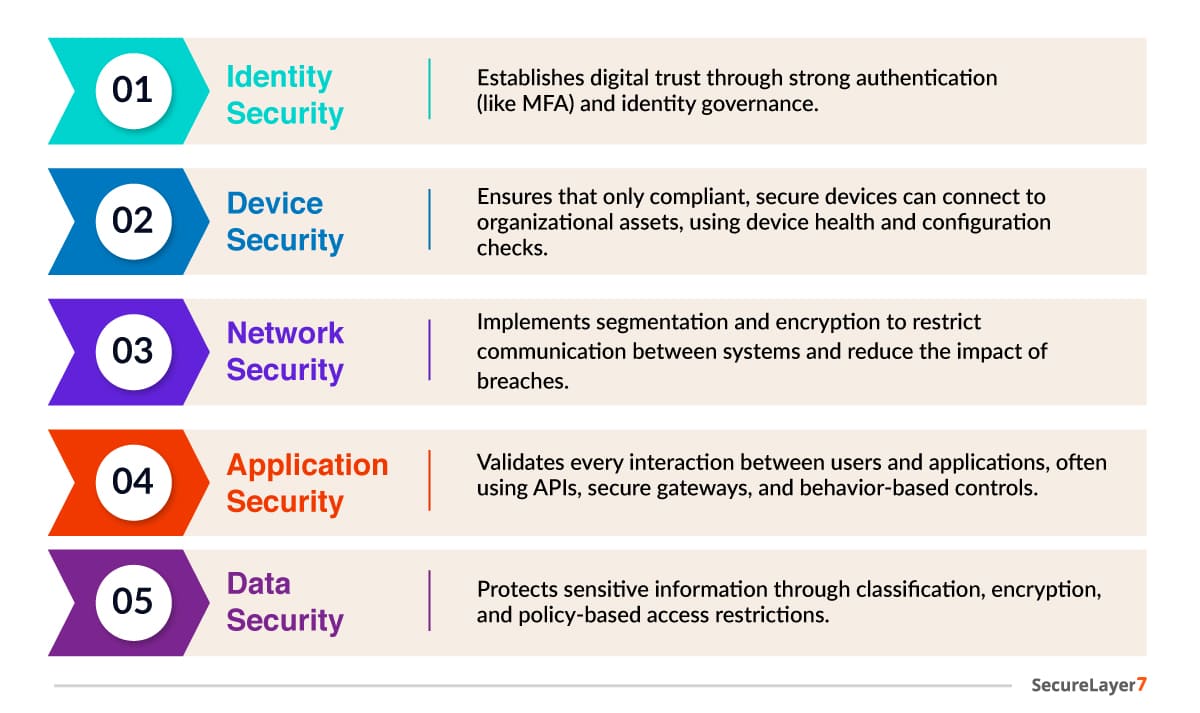
Integration Across Identity, Device, Network, Application, and Data Security
Zero Trust Architecture is not a single product but an integrated security approach spanning multiple domains:
Alignment with Frameworks like NIST SP 800-207
The National Institute of Standards and Technology (NIST) formalized the Zero Trust model through its Special Publication 800-207, which serves as a foundational framework for organizations adopting Zero Trust Architecture. NIST SP 800-207 outlines the principles, logical components, and operational considerations required to build and implement a Zero Trust environment.
It emphasizes identity-centric protection, policy enforcement, continuous validation, and adaptability to evolving threats. By aligning with NIST’s Zero Trust guidelines, organizations can create a standardized roadmap for implementation – ensuring interoperability, scalability, and compliance with modern cybersecurity standards.
Components of the Zero Trust Security Model
The Zero Trust Security Model is built on several key components that work together to ensure continuous verification and minimize risk. These include Identity and Access Management (IAM) to control user permissions, Multi-Factor Authentication (MFA) to strengthen login security, Network Segmentation and Micro-Segmentation to contain breaches, Device Security Posture Management to verify endpoint compliance, and Continuous Monitoring and Analytics to detect and respond to threats in real time.
Identity and Access Management (IAM)
At the heart of Zero Trust lies Identity and Access Management (IAM) – the foundation for verifying who is accessing organizational resources. IAM ensures that every user and service has a unique, verifiable identity and that access permissions are aligned with their roles and responsibilities.
IAM systems centralize user authentication, authorization, and identity lifecycle management. By integrating Single Sign-On (SSO), Role-Based Access Control (RBAC), and Just-in-Time (JIT) provisioning, IAM enforces least privilege access while maintaining visibility across all users and endpoints. Organizations can strengthen IAM controls by implementing Privileged Access Management (PAM) for sensitive accounts and elevated privileges.
Multi-Factor Authentication (MFA)
Multi-Factor Authentication (MFA) adds an essential layer of protection by requiring users to verify their identity using two or more authentication factors – typically something they know (password), something they have (security token or mobile device), and something they are (biometric verification).
MFA mitigates the risk of compromised credentials by ensuring that stolen passwords alone are not enough for unauthorized access. It is often combined with adaptive or risk-based authentication, which dynamically adjusts security requirements based on user behavior, location, or device type.
Network Segmentation and Micro-segmentation
Network segmentation divides the network into smaller zones, each with its own access control policies, while micro-segmentation takes it further by isolating workloads, applications, or even processes within a single environment.
This approach minimizes lateral movement – even if attackers infiltrate one segment, they cannot freely move to others. Micro-segmentation enables fine-grained control over east-west traffic and enforces security policies at the most granular level, strengthening the organization’s defensive posture. This strategy is also discussed in Understanding Security Misconfigurations which highlights segmentation and continuous monitoring as important controls for reducing attack exposure.
How Zero Trust Network Works in Practice
A Zero Trust Network ensures that no user or device is trusted by default. Using Zero Trust Network Access (ZTNA), it grants access only to specific applications after verifying identity, device health, and context. Unlike traditional VPNs, ZTNA enforces dynamic, risk-based policies and continuously monitors activity – ensuring secure, limited access and preventing lateral movement within the network.
Zero Trust Network Access (ZTNA)
ZTNA is the cornerstone technology that enables secure and intelligent access to applications without exposing the broader corporate network. Unlike traditional models that allow users to connect to the entire network once authenticated, ZTNA grants access strictly on a per-session, per-application basis.
It works in practice:
- A user attempts to access an application or service.
- ZTNA validates the user’s identity using Identity and Access Management (IAM) and Multi-Factor Authentication (MFA).
- The device posture is checked to ensure compliance with organizational security standards.
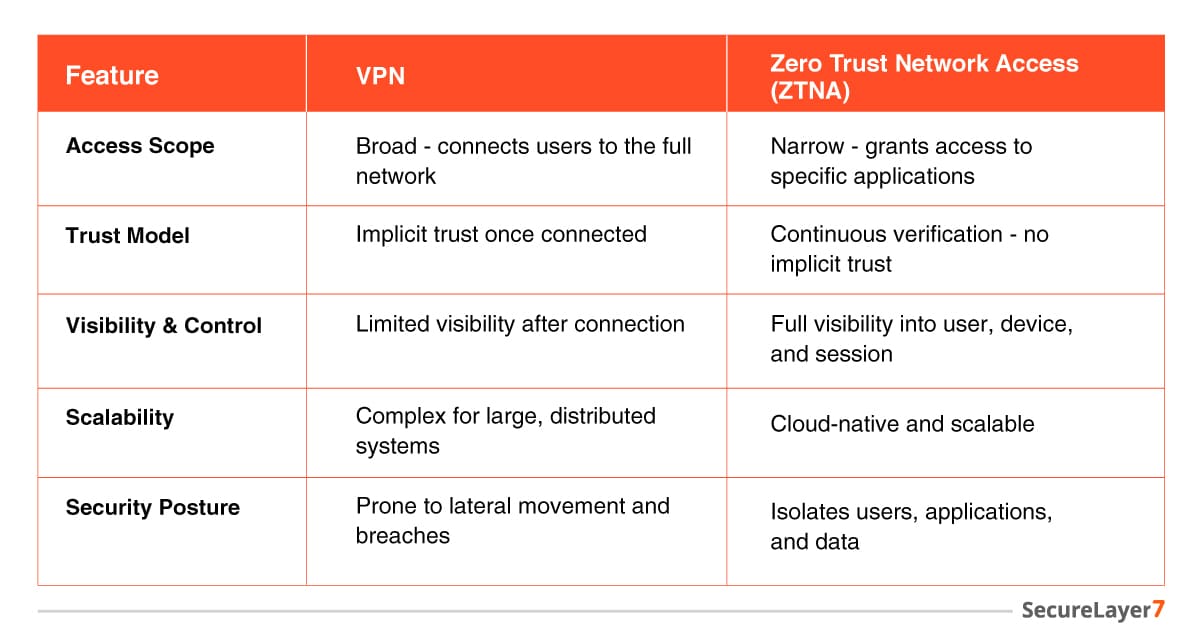
ZTNA vs. Traditional VPNs
Both ZTNA and VPNs enable remote access, their underlying philosophies are entirely different:
Dynamic Access Policies Based on Identity, Device, and Context
A key advantage of Zero Trust Network Access is its ability to enforce dynamic, context-aware policies. Instead of static permissions, access decisions are made in real time, based on:
- Identity: Verified through IAM, MFA, and role-based controls to confirm who is requesting access.
- Device Posture: Evaluates the health and compliance of the device – ensuring it’s patched, encrypted, and free from known vulnerabilities.
- Context: Considers where, when, and how the access request is made – factoring in elements like geolocation, network type, and behavioral patterns.
Benefits of Implementing Zero Trust Security
Implementing Zero Trust Security helps organizations strengthen their defenses through continuous verification and least privilege access. It reduces the attack surface by limiting lateral movement, provides greater visibility into users, devices, and data, and simplifies compliance through centralized policy enforcement and detailed auditing.
Zero Trust enhances security across hybrid and multi-cloud environments, ensuring consistent protection for users and applications wherever they operate.
Reduced Attack Surface and Lateral Movement
Traditional security models often allow attackers who breach the perimeter to move laterally within the network, escalating privileges and accessing sensitive systems undetected. Zero Trust Security eliminates this risk by enforcing least privilege access and micro-segmentation, ensuring users and devices only have access to specific, approved resources.
Even if one endpoint or account is compromised, Zero Trust policies isolate the breach, minimizing its potential impact. This approach significantly reduces the overall attack surface, preventing threat actors from exploiting internal vulnerabilities or spreading malware across the network.
Enhanced Visibility Across All Endpoints and Users
Zero Trust provides centralized visibility into every user, device, application, and network interaction. Through continuous monitoring, real-time analytics, and telemetry data, security teams can gain a unified view of who is accessing what – and from where.
This level of transparency helps in quickly identifying anomalies, unauthorized activities, and high-risk behavior. With User and Entity Behavior Analytics (UEBA) and Security Information and Event Management (SIEM) integrations, Zero Trust makes it easier to detect and respond to threats before they cause damage.
Simplified Compliance and Governance
Meeting compliance standards like GDPR, HIPAA, ISO 27001, and SOC 2 become more manageable with a Zero Trust framework. Its built-in focus on identity validation, access control, data encryption, and audit trails aligns closely with the requirements of modern data protection regulations.
By continuously enforcing policy-based controls and maintaining detailed logs of user and system activities, Zero Trust simplifies auditing and reporting, helping organizations demonstrate accountability and maintain regulatory compliance with less manual effort.
Increased Security for Hybrid and Multi-Cloud Environments
As organizations expand into hybrid and multi-cloud infrastructures, maintaining consistent security controls across platforms becomes a challenge. Zero Trust Security addresses this by providing a unified policy enforcement model that spans on-premises, cloud, and edge environments.
ZTNA (Zero Trust Network Access) and identity-based controls ensure that access decisions are made consistently across all environments, regardless of where users or applications reside. This results in stronger data protection, secure cloud adoption, and resilient remote access without relying on traditional perimeter-based defenses.
Challenges and Best Practices for Adoption
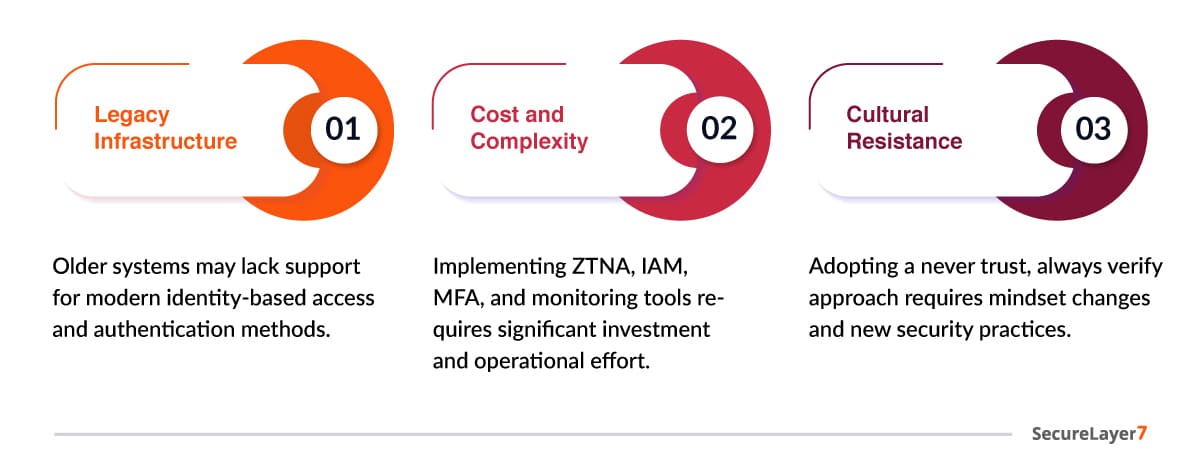
Adopting Zero Trust Security can be complex due to challenges like integrating legacy systems, managing implementation costs, and overcoming cultural resistance within organizations. To ensure success, a phased implementation approach works best – starting with high-risk areas and expanding gradually. Continuous monitoring, strong integration with Identity and Access Management (IAM), and regular policy updates are essential for maintaining effectiveness.
Common Challenges in Zero Trust Adoption
Best Practices for Successful Implementation
- Phased Implementation Strategy: Instead of attempting a complete overhaul, organizations should adopt Zero Trust in phases. Start with high-risk areas such as privileged access, remote users, or sensitive data systems.
- Continuous Monitoring and Adaptation: Zero Trust is an ongoing process, not a one-time deployment. Implement real-time monitoring of access requests, user activity, and device posture.
- Integration with Identity and Access Management (IAM): Seamless integration with a robust IAM system is essential to ensure that access controls remain consistent across all environments. Combining IAM with Multi-Factor Authentication (MFA), Single Sign-On (SSO), and Privileged Access Management (PAM) enables centralized policy enforcement and improved visibility.
Future of Zero Trust: The Road Ahead
The future of Zero Trust Security lies in deeper integration with AI-driven threat detection, Secure Access Service Edge (SASE), and cloud-native architectures that enable real-time, adaptive protection. Emerging trends such as identity-first security, Zero Trust for OT and IoT systems, and risk-based adaptive access models will further strengthen its relevance.
As automation and analytics continue to evolve, Zero Trust will shift from a framework to an intelligent, self-learning security ecosystem capable of anticipating and countering threats before they occur.
AI-Driven Threat Detection and Automation
Artificial Intelligence (AI) and Machine Learning (ML) are reshaping the future of Zero Trust by enabling real-time, predictive threat detection. Instead of relying solely on static policies, AI analyzes massive volumes of data – including user behavior, network patterns, and access requests – to identify anomalies and potential breaches before they occur.
AI-powered analytics can automatically adjust access policies, revoke suspicious sessions, and trigger alerts without human intervention. This self-learning capability transforms Zero Trust from a reactive model into a proactive, autonomous security system that continuously improves as new threats emerge. Organizations can explore The Role of AI and ML in Bolstering Offensive Security for additional context on AI-driven anomaly detection and automated security response.
Integration with SASE and Cloud-Native Infrastructure
The convergence of Zero Trust Network Access (ZTNA) with Secure Access Service Edge (SASE) marks a major step forward in the evolution of enterprise security. SASE unifies network and security functions – such as secure web gateways, cloud access security brokers, and firewall-as-a-service – under a single, cloud-delivered architecture.
By combining Zero Trust principles with SASE, organizations can ensure consistent policy enforcement, secure remote access, and real-time traffic inspection across distributed users and applications. This integration is especially vital for businesses operating in hybrid and multi-cloud environments, providing scalable and resilient protection for globally dispersed workforces.
Conclusion
Adopting a Zero Trust Security model is no longer optional – it’s essential for organizations navigating today’s complex, hybrid environments. By enforcing identity-driven access, continuous verification, and least-privilege principles, Zero Trust helps businesses reduce risks, prevent lateral movement, and gain full visibility across users and devices. A gradual, phased implementation ensures smooth adoption and long-term resilience.
SecureLayer7 empowers organizations to accelerate this journey with expert guidance and tailored Zero Trust solutions. From readiness assessments to scalable architecture design, our cybersecurity specialists help you build a secure, adaptive foundation for the future.
Partner with SecureLayer7 today to evaluate your Zero Trust readiness and implement a robust, identity-centric security framework for your business.
Frequently Asked Questions (FAQs)
Zero Trust Security is a cybersecurity framework based on the principle of never trust, always verify. It assumes that every user, device, and connection – inside or outside the organization – could be a potential threat. Access is granted only after continuous authentication, authorization, and validation at every interaction.
The core principles of Zero Trust include verifying explicitly by always authenticating and authorizing based on identity, device, and context; using least privilege access by granting users only the minimum permissions needed for their role; assuming breach by designing defenses as if attackers are already inside the network; and continuously monitoring and assessing risk by tracking user behavior and device health in real time to detect anomalies.
Zero Trust Architecture (ZTA) continuously validates every access request using identity, device posture, and contextual data. It enforces strict, policy-based access controls and uses technologies like Identity and Access Management (IAM), Multi-Factor Authentication (MFA), micro-segmentation, and continuous monitoring to protect resources across cloud, hybrid, and on-premises environments.
Traditional security models rely on a secure perimeter – once inside, users are often trusted by default. Zero Trust, on the other hand, removes implicit trust completely. Every request, regardless of origin, must be verified before granting access.
Implementing Zero Trust offers several benefits, including a reduced attack surface and better containment of breaches, enhanced visibility into users, devices, and data access, improved compliance with security and privacy regulations, and stronger protection for hybrid and multi-cloud systems.

