
Server-Side Template Injection (SSTI) is a critical web vulnerability that occurs when user input is embedded into server-side templates without proper validation. Modern applications use template engines like Jinja2, Twig, and Freemarker to generate dynamic content, but insecure handling of input can allow attackers to inject malicious code that executes on the server.
Unlike client-side attacks, SSTI directly impacts the server, enabling arbitrary code execution, data exposure, and full system compromise. As applications become more dynamic, understanding SSTI attacks and implementing secure coding and input validation practices is essential to prevent exploitation.
Growing Risks in Template-Driven Web Applications
Modern web applications increasingly rely on server-side template engines such as Jinja2, Twig, Freemarker, and Velocity to render dynamic content. These technologies improve performance and scalability; they also introduce hidden security risks when user input is not properly sanitized.
API-driven, and microservices architectures, templates often process large volumes of dynamic data, expanding the attack surface. Misconfigured template engines or insecure coding practices can allow attackers to inject malicious payloads, making template-based vulnerabilities a growing concern in modern application security.
How SSTI Can Lead to Severe Security Breaches
Server-Side Template Injection (SSTI) is a high-impact vulnerability that can result in remote code execution (RCE), data breaches, and full system compromise. When attackers inject malicious input into templates, the template engine may execute it as code rather than treating it as data.
This allows attackers to access sensitive files, extract credentials, manipulate backend logic, and even gain control over the server.
For a deeper understanding of how attackers execute system-level commands, refer to: Remote Code Execution (RCE): Risks & Prevention.
Why SSTI is Often Overlooked Compared to XSS and SQL Injection
SSTI is often overlooked because it is less widely understood compared to well-known vulnerabilities like Cross-Site Scripting (XSS) and SQL Injection. Many developers assume that template engines handle input safely by default, leading to inadequate input validation and testing.
SSTI vulnerabilities are harder to detect using traditional security tools, as they require deeper analysis of backend logic and template execution flows.
To understand how injection attacks work across different vectors, see: SQL Injection Attacks Explained.
Understanding Server-Side Template Injection
Server-Side Template Injection (SSTI) is a critical vulnerability that occurs when user input is embedded into server-side templates without proper validation, allowing it to be executed as code. Template engines like Jinja2, Twig, and Freemarker process dynamic content, but insecure handling of input can expose applications to exploitation.
Because SSTI operates on the server, it can lead to data exposure, application manipulation, and remote code execution (RCE). Attackers can interact with backend logic and system resources, making it a high-impact risk that requires secure input handling and proper template configuration.
What SSTI Means in Web Application Security
In the context of web security, SSTI represents a failure of input sanitization and contextual awareness.
- Server-Side vs. Client-Side: Unlike Cross-Site Scripting (XSS), which executes in the victim’s browser, SSTI executes on the company’s own server.
- Privilege Level: An SSTI exploit typically runs with the privileges of the web server process. If the server is poorly configured, an attacker can use this foothold to move laterally through the internal network or access cloud metadata services.
- The Silent Flaw: SSTI is often harder to detect than SQL injection because the syntax varies wildly between different programming languages and frameworks.
How Template Engines Process User Input
Template engines exist to separate the presentation layer (HTML/CSS) from the business logic (Python, PHP, Java).
The Secure Way (Data Binding)
The developer creates a static template and passes a context dictionary. The engine only replaces placeholders with strings.
- Template: Hello {{ user_name }}
- Context: user_name = “Alex”
- Result: Hello Alex (Safe)
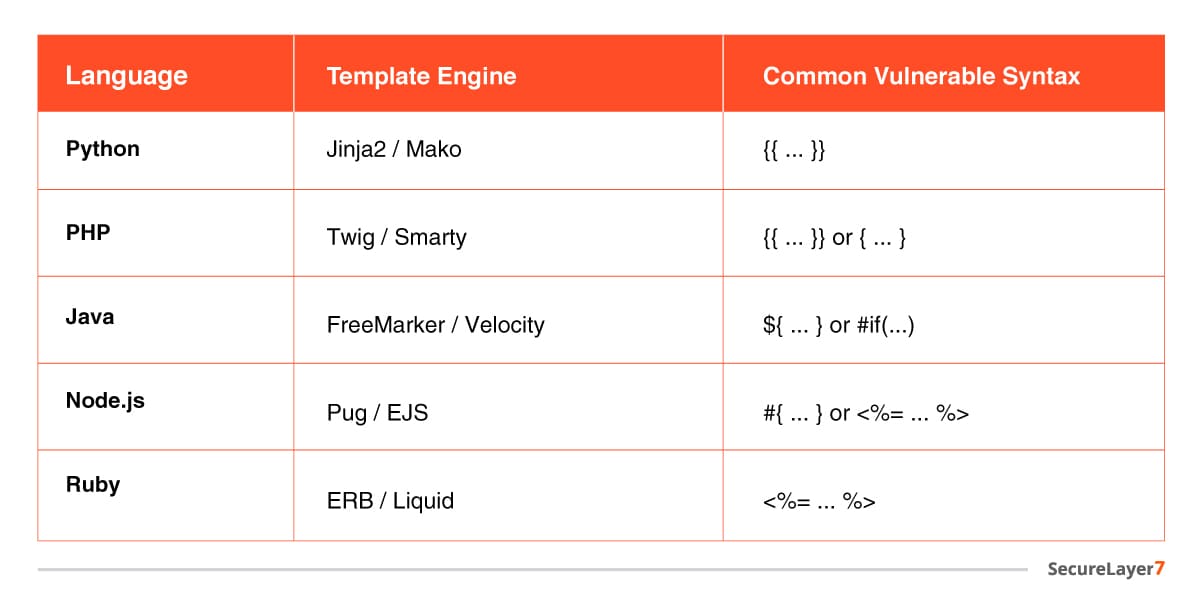
Common Template Engines
The logic of the attack is the same, the payloads used by attackers differ based on the engine being used.
How SSTI Vulnerabilities Occur
SSTI vulnerabilities occur when untrusted user input is directly embedded into server-side templates without proper validation or sanitization. Instead of treating the input as plain data, the template engine processes it as executable logic, allowing attackers to inject malicious expressions. As a result, attackers can manipulate template execution, leading to unauthorized data access, code execution, and potential system compromise.
Unsafe Handling of User Input
The primary cause of SSTI is a fundamental misunderstanding of how template engines process information. Developers often treat template engines as simple string-replacement tools, similar to a find and replace function in a word processor.
Template engines are actually mini-compilers. They possess their own syntax, logic, and the ability to call underlying programming language functions. When user input is handled unsafely, the engine cannot distinguish between the developer’s intended layout and the attacker’s injected logic.
Direct Embedding into Template Logic
The most common coding error leading to SSTI is string concatenation. This occurs when a developer builds the template string dynamically using a variable from a request (like a URL parameter or a form field) before passing it to the engine’s render function.
The Vulnerable Pattern (Example in Python/Jinja2):
Python
# VULNERABLE CODE
user_input = request.args.get('name')
template = "<html><h1>Welcome, " + user_input + "!</h1></html>"
return render_template_string(template)
In this scenario, if the user provides {{7*7}} as their name, the template variable becomes <html><h1>Welcome, {{7*7}}!</h1></html>. When render_template_string runs, it sees the curly braces, identifies them as code, and executes the math.
The Secure Pattern (Data Binding):
Python
# SECURE CODE
user_name = request.args.get('name')
return render_template_string("<html><h1>Welcome, {{ name }}</h1></html>", name=user_name)
In the secure version, the template is static. The engine is told: Here is a string, and here is a piece of data. Just put the data in the hole. Even if the data contains {{7*7}}, the engine treats it as a literal string and displays it exactly as typed.
Lack of Input Validation and Sanitization
The root cause is architectural (concatenation), the lack of a defense-in-depth strategy allows the exploit to succeed.
- Failure to Filter Special Characters: Many SSTI payloads rely on specific characters like {{, {%, ${, or <%. Applications that do not strip or encode these characters in high-risk inputs are essentially leaving the door unlocked.
- Over-Trusting Internal Sources: Developers often sanitize external input (from a web form) but trust “internal” data (from a database or a legacy API).
- Missing Contextual Encoding: Simply cleaning a string for HTML (to prevent XSS) is not enough to prevent SSTI. A payload like ${7*7} is perfectly valid HTML, but it is lethal to a Java-based Velocity or FreeMarker engine.
Attack Execution Flow
An SSTI attack begins when an attacker injects malicious input into a template-rendered field such as a form, URL parameter, or API request. If the application embeds this input directly into a server-side template, the template engine processes it as part of the template logic. This quickly escalates from simple input manipulation to full exploitation, potentially leading to remote code execution and system compromise.
Injecting Malicious Input into Templates
The attack begins when an adversary identifies a field that reflects data back to the page – such as a search bar, a profile username, or an email subject line. Instead of typing a standard name, the attacker injects template-specific syntax.
- The Polyglot Probe: Attackers use a universal string like ${7*7} or {{7*7}}.
- The Goal: They are looking for a change in the output. If the website displays 49 instead of the literal string {{7*7}}, the attacker knows that the input is being interpreted by a server-side engine rather than being treated as plain text.
Template Parsing and Execution on the Server
The injection point is confirmed, the magic happens behind the scenes on the web server.
- The Parsing Phase: The template engine (e.g., Jinja2 for Python or Twig for PHP) scans the template string. It identifies the injected characters (like {{ and }}) as delimiters that signal a command.
- The Execution Phase: The engine takes the content inside those delimiters and passes it to its internal evaluator.
- In a secure setup, the engine only has access to a limited “context” of safe variables.
- In a vulnerable setup, the engine has access to the global namespace of the underlying programming language.
Triggering Unintended Code Execution
This is the Breakout phase. The attacker moves beyond simple math to Object Discovery. They use the template engine’s syntax to explore the server’s memory and find dangerous functions.
- Class Exploration: In a Python/Jinja2 environment, an attacker might use {{ self.__class__.__mro__ }} to climb the object hierarchy until they find the object class.
- Method Injection: Once they reach the base object, they can look for subclasses that allow system interaction, such as os.popen or subprocess.Popen.
- The Final Payload: The attacker sends a command that instructs the server to execute a system-level task.
Security Impact of SSTI Attacks
Server-Side Template Injection (SSTI) attacks can have severe security consequences because they execute directly on the server. Successful exploitation allows attackers to access sensitive data, including configuration files, credentials, and internal application logic.
SSTI can lead to remote code execution (RCE), enabling attackers to run system commands, gain full control of the server, and move laterally across the network. This can result in data breaches, service disruption, and long-term persistence, making SSTI a critical risk for modern web applications.
Remote Code Execution (RCE)
The most devastating impact of SSTI is Remote Code Execution (RCE). Because template engines like Jinja2 (Python), Twig (PHP), or FreeMarker (Java) are designed to process logic, an attacker can escape the template sandbox.
- The Breakout: By navigating the application’s object hierarchy, an attacker can access the underlying operating system’s functions.
- The Result: The attacker gains a functional command prompt (shell) on your server, allowing them to run arbitrary system commands, install persistent backdoors, or deploy malware.
Access to Server-Side Data and Objects
An attacker can interrogate the server’s memory. Most template engines have a self or config object that contains a wealth of internal information.
- Object Inspection: Attackers can dump global variables and configuration dictionaries.
- Secret Theft: This often leads to the exposure of hard-coded API keys, database connection strings, secret salts for password hashing, and internal environment variables (.env files) that were never intended for public view.
Sensitive Data Exposure
SSTI provides a unique, high-privileged window into your private data. Because the engine processes the request on the server, it can be tricked into bypassing traditional application-level access controls.
- Bypassing Authorization: An attacker can move from their own limited user context to a global context, viewing the session tokens or private profile information of other users.
- Local File Read: In many cases, SSTI can be used to read sensitive files directly from the server’s disk, such as `/`etc/passwd or internal source code, providing a blueprint for further attacks.
Full System Compromise
In an interconnected environment, a single compromised web server is rarely the end goal. It is the starting point for a total infrastructure breach.
- Lateral Movement: Attackers use the pwned server as a jump box to scan the internal network, attacking microservices, databases, and admin panels that aren’t exposed to the internet.
- Cloud Metadata Exploitation: If the server is hosted on AWS, Azure, or GCP, the attacker can query the internal Metadata Service (IMDS) to steal IAM roles and cloud credentials, potentially compromising your entire cloud organization.
Identifying SSTI Vulnerabilities
Identifying Server-Side Template Injection (SSTI) requires a methodical approach that transitions from manual probing to automated deep-scanning. Because template engines are designed to be invisible to the end user, detection relies on forcing the engine to reveal itself through mathematical evaluations or specific error messages.
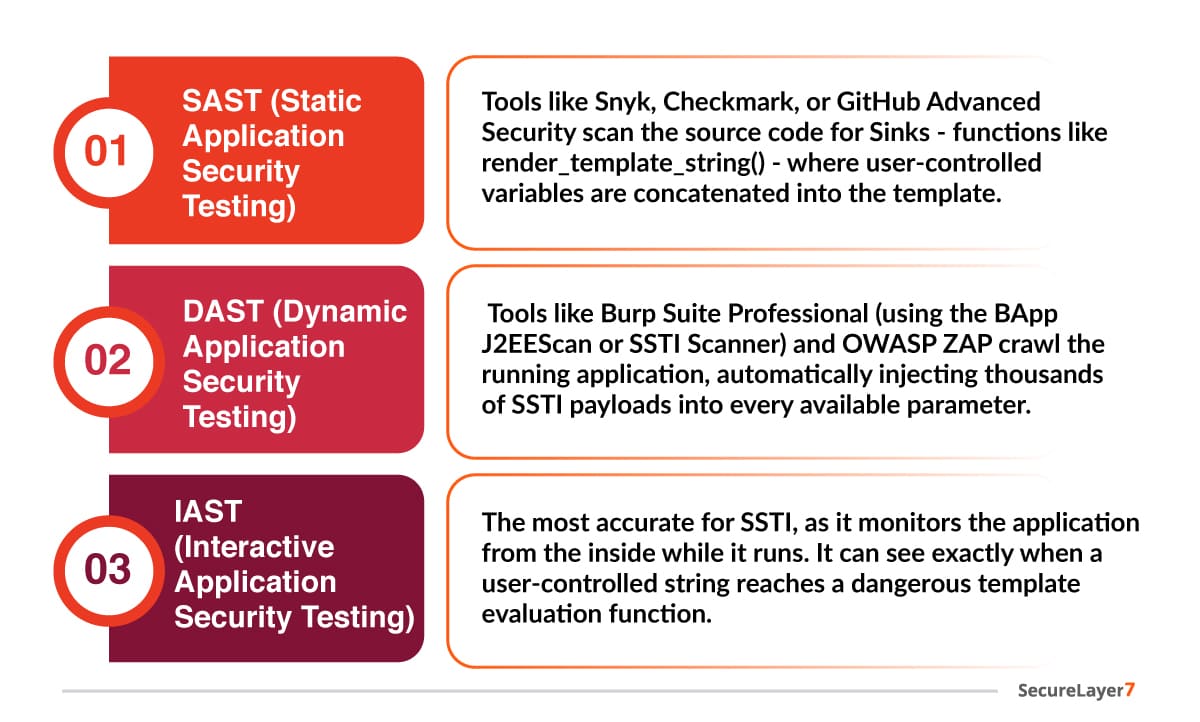
Using Automated Tools (SAST, DAST, IAST
Manual testing is essential, but automated tools provide the scale needed for modern enterprise environments. To understand different testing approaches, refer to: SAST vs DAST in Application Security.
Indicators of Vulnerable Template Handling
Even without a full exploit, certain architectural smells indicate a high risk of SSTI:
- User-Editable Templates: Any feature that allows users to “design” their own emails, PDF exports, or dashboards is a massive red flag.
- Dynamic Language Selection: Applications that use templates to translate content on the fly often accidentally concatenate the language string into a template path.
- Pass-Through Parameters: When a URL parameter (e.g., ?template=header) is used to choose which file to load, it often indicates the server is building a template string dynamically.
SSTI in Modern Application Security
Server-Side Template Injection (SSTI) has shifted from a niche CTF-style bug to a cornerstone of modern exploit chains. As applications move toward microservices and cloud-native deployments, the blast radius of a single template injection can extend far beyond the compromised web server.
Role of SSTI in the OWASP Top 10
The OWASP Top 10 traditionally highlights Injection as a broad category (A03:2021), SSTI is recognized as one of its most lethal variants. For more info: OWASP Top 10: All 10 Risks with Examples.
- Evolution of Injection: Historically, Injection meant SQLi. As ORMs (Object-Relational Mappers) have made SQLi harder to find, attackers have pivoted to Template Injection.
- Contextual Complexity: Unlike XSS, which is often viewed as a client-side nuisance, SSTI is categorized as a High/Critical finding because it directly results in Broken Access Control and Remote Code Execution (RCE).
- The Silent Entry: SSTI is used as the initial foothold to bypass Web Application Firewalls (WAFs) that are tuned for SQL keywords but fail to recognize malicious template logic.
Importance in DevSecOps Pipelines
In a DevSecOps environment, detecting SSTI is a Shift Left priority. Waiting until production to find an SSTI vulnerability is often too late.
- Static Analysis (SAST): Modern pipelines use tools like Semgrep or Snyk to flag Sinks – specific functions like render_template_string() (Python) or eval() – that accept unvalidated string concatenation.
- Dynamic Analysis (DAST): Automated scanners now include Polyglot payloads designed to trigger mathematical evaluations across multiple engines (Jinja, Twig, Velocity) during the CI/CD build process.
- Policy as Code: Teams are increasingly using Open Policy Agent (OPA) to enforce coding standards that strictly forbid the dynamic generation of templates from user-provided data.
Relevance in Cloud-Native & Microservices
The impact of SSTI is magnified in a microservices architecture where services often communicate via internal APIs with implicit trust.
- The Jump Box Effect: An attacker who gains RCE via SSTI in a small, low-security microservice can use that container to scan the internal Service Mesh.
- Cloud Metadata Exploitation: In cloud environments (AWS, GCP, Azure), an SSTI-born shell allows an attacker to query the Instance Metadata Service (IMDS).
- Serverless Risks: In AWS Lambda or Google Cloud Functions, SSTI can be used to leak environment variables containing sensitive database keys or external API secrets that are injected into the function at runtime.
Conclusion
Server-Side Template Injection (SSTI) is a high-impact vulnerability that can lead to remote code execution, data breaches, and system compromise. In modern applications, insecure template handling and poor input validation increase the risk of exploitation. Preventing SSTI requires strict input validation, secure template usage, and continuous security testing, ensuring stronger application security and reduced risk.
At SecureLayer7, we help organizations proactively identify and eliminate SSTI and other critical vulnerabilities through advanced penetration testing, DevSecOps integration, and application security solutions.
Secure your applications today contact SecureLayer7 and stay ahead of evolving threats.
Frequently Asked Questions (FAQs)
Server-Side Template Injection (SSTI) is a web application vulnerability where untrusted user input is embedded into server-side templates and executed as code. Instead of being treated as plain data, the input is interpreted by the template engine, allowing attackers to manipulate application behavior.
An SSTI attack works by injecting malicious template expressions into input fields that are processed by the server. When the application renders the template, the engine evaluates the injected payload, enabling attackers to access internal objects, execute commands, or retrieve sensitive data.
SSTI payloads are crafted input strings designed to exploit template engines. These payloads use template syntax (e.g., {{ }}, ${ }) to execute code, access variables, or interact with backend components during template rendering.
Yes, SSTI can lead to remote code execution (RCE) if the attacker successfully exploits the template engine. This allows them to run system commands, access server resources, and potentially gain full control over the application or underlying infrastructure.
Developers can prevent SSTI by avoiding direct embedding of user input in templates, implementing strict input validation, using secure template configurations, and applying proper output encoding.

