
Remote File Inclusion (RFI) is a critical web application vulnerability that allows attackers to execute malicious code by forcing an application to load files from an external source. Despite advances in secure frameworks and development practices, RFI continues to appear in real-world applications – particularly where dynamic file inclusion is poorly controlled or user input is improperly validated.
RFI attacks can lead to severe consequences, including remote code execution, data theft, website defacement, and complete server compromise. Because these attacks exploit application logic rather than infrastructure weaknesses, they often bypass traditional perimeter defenses. Understanding how Remote File Inclusion works, why it remains a persistent risk, and how to prevent it is essential for building secure web applications and protecting organizational assets.
Remote File Inclusion in Modern Web Security
Remote File Inclusion (RFI) is a web application vulnerability that allows attackers to load and execute malicious files hosted on external servers through insecure file inclusion mechanisms. It typically arises when applications dynamically include files based on user-supplied input without proper validation or restriction.
API-driven and cloud-based environments, RFI-like patterns can still emerge through misconfigured template engines, plugin systems, or dynamic resource loaders. As a result, RFI continues to be a recognized risk in web security guidance, including frameworks highlighted by OWASP, because it can directly lead to remote code execution and full system compromise.
Why RFI Remains a Critical Vulnerability Despite Secure Frameworks
Modern frameworks provide built-in protections such as input sanitization, secure defaults, and restricted file handling. RFI persists because security controls can be weakened or bypassed through misconfiguration, unsafe custom code, or improper use of framework features. Developers may disable safeguards for flexibility, rely on dynamic includes for extensibility, or trust user-controlled inputs more than they should.
Legacy components, third-party plugins, and rushed development cycles often introduce insecure patterns into otherwise secure applications. Attackers actively look for these weak points, knowing that a single misused include function or configuration flag can reopen the door to RFI – even in applications built on modern frameworks.
High-Level Impact of RFI Attacks on Security, Data, and Business Operations
The impact of a successful RFI attack is often severe and immediate. From a security standpoint, attackers can execute arbitrary code on the server, install backdoors, or pivot to other systems within the network. Sensitive data such as credentials, configuration files, and customer information may be exposed or exfiltrated.
RFI attacks can lead to service downtime, data breaches, regulatory non-compliance, and reputational damage. Because RFI often results in full server compromise, recovery can be costly and disruptive. This makes prevention – through secure coding, strict input validation, and hardened configurations – far more effective than post-incident response.
Understanding Remote File Inclusion (RFI)
Remote File Inclusion (RFI) is a serious web application vulnerability that occurs when an application loads and executes files from external sources based on untrusted user input. By abusing insecure file inclusion logic, attackers can force the application to retrieve malicious code hosted on remote servers and run it within the application’s execution context.
Because RFI often leads directly to remote code execution, it is considered one of the most dangerous web security flaws and remains a critical risk in modern web applications.
What Remote File Inclusion Is and How It Differs from Normal File Handling
Remote File Inclusion occurs when an attacker is able to manipulate a file inclusion mechanism so that the application fetches and executes a file hosted on a remote server. This malicious file typically contains executable code designed to give the attacker control over the application or underlying server.
Normal file handling is a controlled and intentional process. Applications load files only from trusted, local directories – such as templates, configuration files, or language packs – using predefined paths or whitelisted identifiers. The key difference is trust and control: normal file inclusion assumes trusted sources, while RFI breaks this assumption by allowing external, attacker-controlled content to be executed.
How RFI Vulnerabilities Arise in Web Applications
RFI vulnerabilities commonly arise when applications dynamically construct file paths using user-supplied input without proper validation or restriction. Developers may use inclusion mechanisms to support modular design, theming, or localization, but fail to adequately limit what files can be loaded.
Misconfigurations, legacy code, or unsafe custom logic often reintroduce this risk – even in applications built with modern frameworks. Security guidance from organizations such as OWASP emphasizes strict input validation and safe configuration, yet RFI persists due to overlooked edge cases, insecure defaults, and third-party components that bypass framework protections.
Difference Between Intended File Inclusion and Malicious Inclusion
Intended file inclusion is a legitimate and common practice in web development. It allows applications to reuse code, manage layouts, or support multiple languages by including predefined files from known locations. These inclusions are typically constrained by hardcoded paths, whitelists, or configuration rules that prevent arbitrary file loading.
Malicious inclusion occurs when attackers exploit weaknesses in this logic to load unauthorized files – often from remote servers they control. Instead of executing trusted application code, the server executes attacker-supplied scripts, leading to outcomes such as remote code execution, data theft, or full server compromise. This contrast underscores why strict control over file inclusion logic is critical to preventing RFI attacks.
How a Remote File Inclusion Attack Works
A Remote File Inclusion (RFI) attack works by exploiting insecure file inclusion logic in a web application to force it to load and execute a file from an attacker-controlled external source. When user input is improperly validated and used to determine which file should be included, attackers can supply a remote URL instead of an expected local file.
The application then fetches and executes the malicious file as part of its normal processing flow, often resulting in remote code execution, data compromise, or full server takeover.
High-level Explanation of a Remote File Inclusion Attack
A Remote File Inclusion (RFI) attack occurs when a web application dynamically includes files based on user-supplied input and fails to properly restrict or validate that input. Instead of loading a trusted local file, the application is manipulated into fetching a file from an external, attacker-controlled source.
At a high level, RFI attacks exploit the trust an application places in file inclusion mechanisms. What is intended to be a legitimate feature – such as loading templates, modules, or language files – becomes an attack vector when external resources are treated as executable code. This direct path from user input to remote code execution is what makes Remote File Inclusion a high-impact and dangerous web application vulnerability.
Attacker-controlled External File Loading
In a typical RFI scenario, the attacker first prepares a malicious script and hosts it on a server they control. This script may contain code to open a remote shell, extract sensitive data, or download additional malware. The attacker then crafts a request that passes the URL of this script into the vulnerable file inclusion parameter.
If the application allows remote file loading – either through misconfiguration or unsafe coding practices. It fetches the attacker’s file at runtime. From the server’s perspective, this external resource is processed just like an internal application file, making the attack both stealthy and effective.
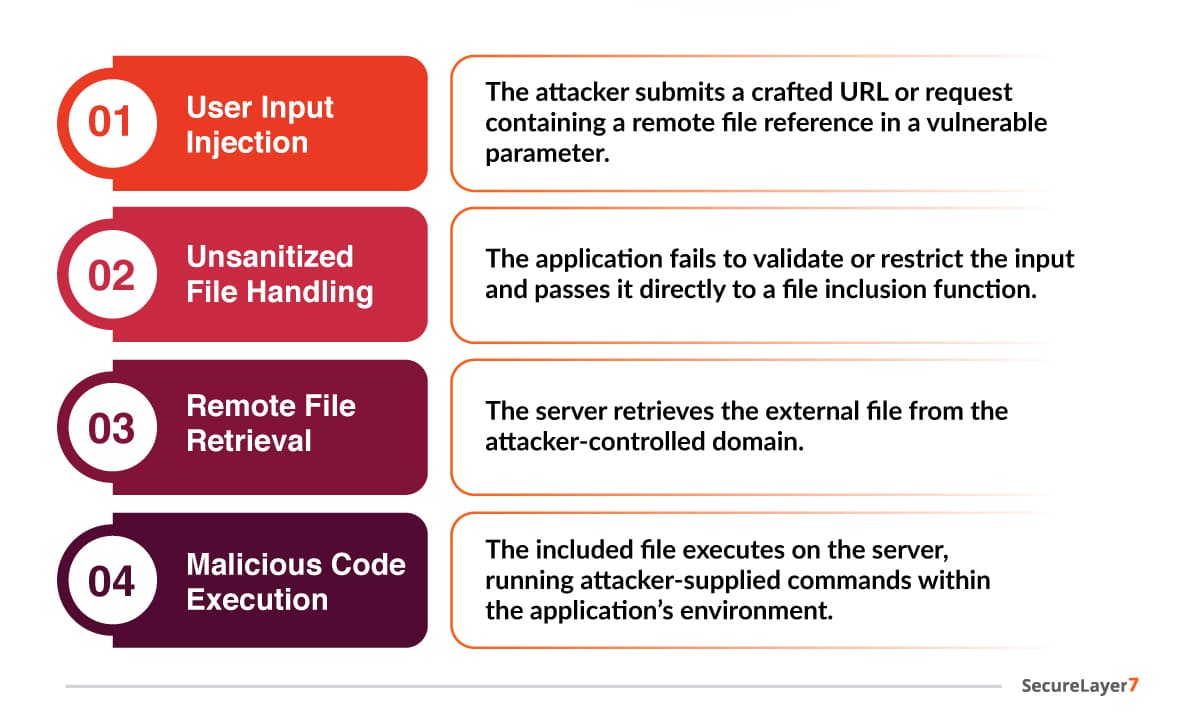
Execution Flow from User Input to Malicious Code Execution
The execution flow of an RFI attack typically follows these steps:
Remote File Inclusion vs Local File Inclusion
Remote File Inclusion (RFI) and Local File Inclusion (LFI) are closely related web application vulnerabilities that arise from insecure file inclusion logic. Both allow attackers to manipulate how an application loads files, but they differ in the source of the included file and the severity of impact. Understanding the distinction between RFI and LFI is important for accurately assessing risk.
Conceptual Difference Between RFI and LFI
Remote File Inclusion occurs when an application allows files from external, remote sources to be included and executed. In this case, attackers supply a URL pointing to a malicious file hosted on their own server, which the application fetches and executes as part of its code.
Local File Inclusion, on the other hand, involves including files that already exist on the local server. Attackers exploit this by manipulating file paths to access sensitive files such as configuration files, logs, or source code. Both vulnerabilities stem from insecure file inclusion logic, RFI extends the attack surface beyond the local system. Organizations should also understand Local File Inclusion (LFI) because attackers frequently chain LFI and RFI vulnerabilities to gain unauthorized access or execute malicious code.
Why RFI Often Leads to Remote Code Execution
RFI frequently results in remote code execution because the attacker controls the content of the included file. Once the application loads this external file, the attacker’s code is executed directly by the server with application-level privileges. This allows attackers to run system commands, install backdoors, or fully compromise the host.
LFI may not immediately lead to code execution unless combined with additional weaknesses – such as log poisoning or upload flaws. This makes RFI inherently more dangerous, as exploitation typically requires fewer steps to achieve full compromise.
Risk Comparison Between the Two Vulnerabilities
Both RFI and LFI are high-risk vulnerabilities, but RFI generally poses a greater immediate threat due to its direct path to code execution. A successful RFI attack can lead to complete server takeover in a single request, causing severe security and business impact.
LFI still represents a serious risk, particularly for information disclosure and privilege escalation when chained with other vulnerabilities. RFI’s ability to execute attacker-controlled code remotely makes it one of the most critical file inclusion vulnerabilities that organizations must prioritize for prevention.
Remote File Inclusion Attack Scenarios
Remote File Inclusion (RFI) attack scenarios demonstrate how a single file inclusion flaw can escalate into widespread security and operational damage. By forcing an application to load and execute attacker-controlled code, RFI enables a range of high-impact attacks – from initial system compromise to data theft and lateral movement.
Understanding these scenarios helps illustrate why RFI is considered a critical vulnerability and why proactive prevention is essential.
Remote Code Execution and Server Compromise
Remote Code Execution and server compromise are among the most severe outcomes of a successful Remote File Inclusion (RFI) attack. When an attacker forces an application to load a malicious remote file, the code within that file is executed by the server with the same privileges as the vulnerable application.
Once remote code execution is achieved, full server compromise often follows. Attackers can disable security controls, access sensitive configuration data, pivot to other systems in the network, and maintain long-term access. Because this execution happens at the application level, traditional perimeter defenses may not detect or prevent the attack, making RFI-driven server compromise both fast and highly destructive.
Malware Injection and Persistent Backdoors
After gaining initial access, attackers often inject malware or deploy persistent backdoors to maintain long-term control. These backdoors may include web shells, scheduled tasks, or modified application files that allow attackers to regain access even if the original vulnerability is patched.
Because the malicious code is executed within the application context, it can blend into normal operations and remain undetected for extended periods. This persistence makes RFI attacks especially damaging, as cleanup and recovery become significantly more complex.
Data Theft and Unauthorized Access
RFI attacks frequently lead to large-scale data exposure. Once attackers can execute code on the server, they can access configuration files, environment variables, databases, and credentials stored on the system. Sensitive data such as customer information, authentication secrets, and API keys are often targeted.
With these credentials, attackers may gain unauthorized access to internal systems, third-party services, or cloud resources. This expands the scope of the breach beyond the original application and increases regulatory and reputational risk for the organization.
Remote File Inclusion Examples
Remote File Inclusion (RFI) examples help illustrate how a simple flaw in file-handling logic can lead to severe security compromise. By examining common RFI scenarios, it becomes clear how attackers manipulate user-controlled inputs to load external, malicious files and execute them within a vulnerable application.
Following examples highlight why RFI remains a critical web security risk and how easily it can be exploited when proper controls are missing.
Simple Remote File Inclusion Example Illustrating the Vulnerability
A common RFI scenario occurs when a web application dynamically loads files based on user input, such as selecting a page, language, or template. For example, an application may accept a parameter to decide which file to include for rendering content. If this parameter is not properly validated or restricted to trusted local files, an attacker can manipulate it to reference an external resource instead.
The application treats the attacker-supplied input as a legitimate file path. Instead of loading an internal file, it fetches and executes a file hosted on an attacker-controlled server. This simple design flaw creates a direct path from user input to malicious code execution.
Typical Attacker Payloads and Exploitation Techniques
Attackers exploiting RFI usually host malicious scripts on remote servers under their control. These scripts are designed to execute commands, read sensitive files, or establish remote access once included by the vulnerable application. Rather than attacking the server directly, attackers rely on the application itself to retrieve and execute the malicious content.
Common exploitation techniques include testing multiple parameters to identify inclusion points, manipulating URL-based inputs, and repeatedly triggering the vulnerability to maintain access. Because the payload is external, attackers can update or change it at any time without modifying the initial exploit, increasing flexibility and persistence.
Real-World RFI Exploitation Patterns
RFI is often used as an initial access vector rather than a standalone exploit. Attackers scan applications for vulnerable inclusion points, exploit RFI to gain code execution, and then deploy additional tools or backdoors. These attacks are frequently automated, allowing large numbers of applications to be tested and compromised quickly.
RFI exploitation is also commonly chained with other weaknesses, such as weak credentials or misconfigured permissions, to expand access within the environment. Security advisories and guidance from organizations like OWASP continue to highlight RFI as a high-impact vulnerability because it often leads to full system compromise with minimal attacker effort.
Impact and Risks of Remote File Inclusion
Remote File Inclusion (RFI) is a high-impact web application vulnerability with consequences that extend far beyond a single coding flaw. When exploited, RFI can compromise application security, expose sensitive data, and disrupt critical business operations.
Understanding the impact and risks of RFI is essential to appreciating why this vulnerability is considered one of the most dangerous threats in web application security.
Security and Operational Risks
Remote File Inclusion (RFI) introduces serious security and operational risks because it allows attackers to execute malicious code directly within a vulnerable application. From a security standpoint, this can lead to full server compromise, unauthorized access to sensitive systems, installation of backdoors, and lateral movement across the environment. Attackers may disable security controls, escalate privileges, and maintain persistent access without immediate detection.
Operationally, RFI attacks can cause service outages, application instability, and extended downtime while systems are investigated and rebuilt. Incident response, remediation, and recovery efforts often require significant time and resources, disrupting normal business operations and increasing overall operational risk.
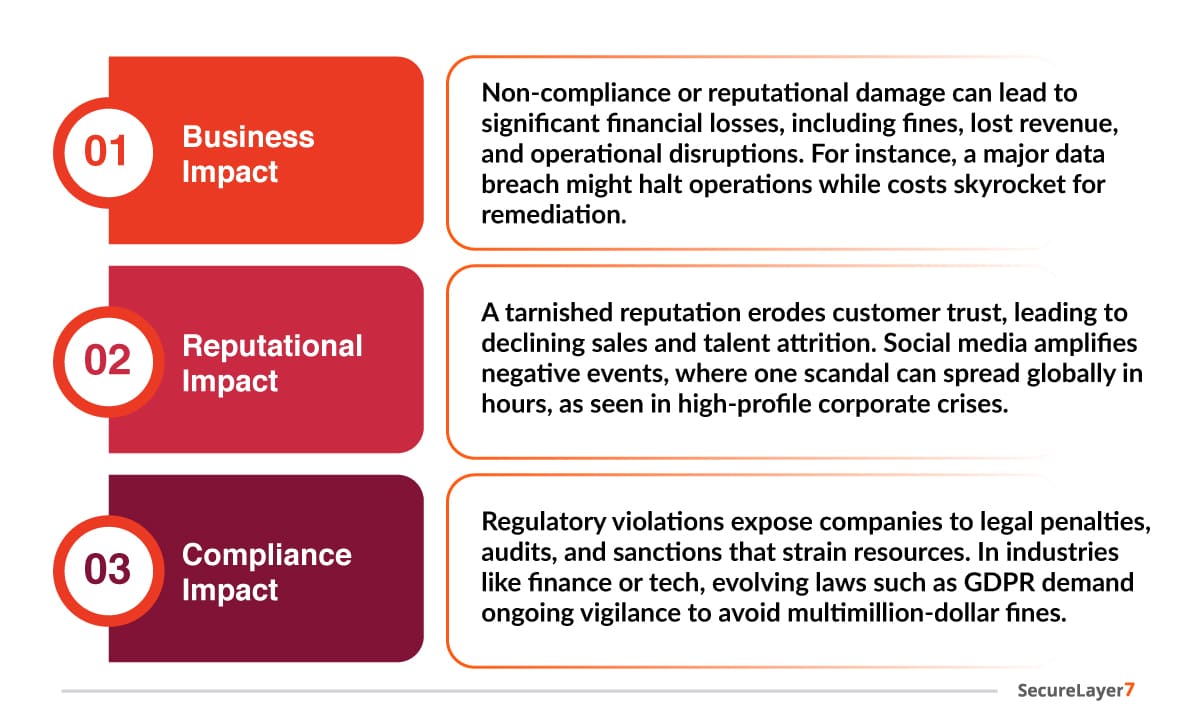
Business, Reputational, and Compliance Impact
Business, reputational, and compliance impacts are critical considerations for any organization, as they directly influence long-term success and stakeholder trust.
Long-Term Consequences of Unpatched RFI Flaws
Leaving RFI vulnerabilities unpatched creates long-term exposure. Attackers may establish persistent backdoors that remain hidden even after surface-level fixes are applied. These hidden footholds can be used for future attacks, data exfiltration, or ransomware deployment.
Unpatched RFI flaws signal weak security hygiene, making the organization an attractive target for repeat attacks. Over time, this can lead to escalating security incidents, higher remediation costs, and increased scrutiny from regulators and partners. Addressing RFI promptly is essential to preventing both immediate compromise and long-term damage. Several real-world remote code execution vulnerabilities have originated from insecure file handling and path validation issues, highlighting the importance of proactive remediation.
Detecting Remote File Inclusion Vulnerabilities
Detecting Remote File Inclusion (RFI) vulnerabilities is critical because successful exploitation often leads directly to remote code execution and full system compromise. Early identification of insecure file inclusion logic allows organizations to remediate risks before attackers can abuse them. Effective detection requires a combination of testing, scanning, and monitoring approaches tailored to how applications handle dynamic file loading.
Manual Testing Approaches
Manual testing remains one of the most effective ways to identify RFI vulnerabilities, especially in complex or custom-built applications. Security testers review areas where applications dynamically load files such as page loaders, template engines, language selectors, or plugin mechanisms and assess how user input influences file inclusion logic.
Testers look for parameters that accept file paths or names and evaluate whether input validation, allowlisting, and path restrictions are enforced. Manual testing is particularly valuable for uncovering logic flaws, misconfigurations, or edge cases that automated tools may miss, especially in modern frameworks or custom implementations.
Automated Security Scanning and DAST Tools
Automated Dynamic Application Security Testing (DAST) tools help identify potential RFI issues at scale by scanning applications for insecure file inclusion patterns. These tools simulate attacker behavior by injecting payloads into parameters and analyzing responses for signs of external file loading or code execution.
Automated scanners are useful for broad coverage and continuous testing, they may produce false positives or miss context-specific vulnerabilities. For best results, automated scanning should be combined with manual validation to confirm whether identified issues are truly exploitable. Combining manual testing with dynamic application security testing (DAST) helps identify insecure file inclusion logic before attackers can exploit it
Indicators of Successful RFI Exploitation
Detecting signs of active or successful RFI exploitation is equally important. Common indicators include unexpected outbound connections from the server, unusual file creation or modification, and the presence of unfamiliar scripts or backdoors within the application environment.
Additional warning signs may include unexplained system commands being executed, abnormal application behavior, or repeated requests targeting file inclusion parameters. Monitoring logs, network traffic, and file integrity can help organizations identify RFI exploitation attempts before they escalate into larger incidents.
Remote File Inclusion in Secure Development Practices
Remote File Inclusion (RFI) prevention is a fundamental part of secure development practices, not an afterthought. Because RFI often results from insecure design choices and unsafe coding patterns, it must be addressed throughout the software development lifecycle. Embedding RFI awareness into development standards helps ensure applications are built with controlled file handling, strong validation, and secure configurations from the start.
Role of RFI in a Secure SDLC
Remote File Inclusion (RFI) is a critical consideration in a secure Software Development Lifecycle (SDLC) because it often stems from insecure design and unsafe coding patterns. Addressing RFI early – during requirements and design – ensures that file inclusion needs are clearly defined, risks are identified through threat modeling, and only trusted, controlled resources are permitted.
During development and testing, secure coding standards, code reviews, and security testing help prevent unsafe dynamic file inclusion and validate proper input validation and allowlisting. By embedding RFI prevention throughout the SDLC, organizations reduce the risk of remote code execution and strengthen overall application security.
Importance of Code Reviews and Security Testing
Code reviews play a critical role in detecting RFI vulnerabilities that automated tools may overlook. Reviewing how user input influences file paths, configuration settings, or inclusion logic helps uncover subtle issues introduced during development or maintenance.
Security testing – including static analysis, dynamic testing, and penetration testing – further validates that file inclusion mechanisms are protected against abuse. Regular testing ensures that changes, third-party components, or configuration updates do not reintroduce RFI risks over time. Regular application penetration testing validates whether insecure file inclusion vulnerabilities can be exploited in real-world attack scenarios.
RFI Prevention as Part of a Broader Application Security Strategy
Remote File Inclusion (RFI) prevention must be part of a broader application security strategy rather than a standalone fix. Secure design principles such as strict input validation, allowlisting of trusted files, and controlled file inclusion logic form the foundation for preventing RFI.
When combined with defense-in-depth practices – such as code reviews, automated security testing, and continuous monitoring – RFI prevention strengthens overall application security. Integrating RFI awareness into security governance helps organizations reduce exposure to multiple attack vectors, not just file inclusion vulnerabilities. Organizations should complement secure coding with web application penetration testing to verify that file inclusion vulnerabilities cannot be exploited in production environments.
Conclusion
Remote File Inclusion (RFI) is a high-risk vulnerability that can quickly lead to remote code execution, data breaches, and full server compromise – even in modern applications. Because RFI exploits insecure file handling and design gaps, it must be addressed proactively rather than after an incident occurs.
At SecureLayer7, we emphasize continuous security testing, secure SDLC practices, and defense-in-depth to identify and prevent RFI before it is exploited. Strengthening input validation, file inclusion controls, and ongoing assessments is essential to protecting applications and business operations from this critical threat.
Partner with SecureLayer7 to strengthen your application security posture today.
Frequently Asked Questions (FAQs)
Remote file inclusion is a web application vulnerability that allows attackers to include and execute malicious files hosted on remote servers through improper input handling.
In a remote file inclusion attack, an attacker manipulates user input to force the application to load an external file, which is then executed on the vulnerable server.
A common remote file inclusion example is when an application dynamically includes files using user-supplied parameters without validation, allowing attackers to load malicious scripts from external URLs.
Remote File Inclusion (RFI) involves loading files from external servers, while Local File Inclusion (LFI) exploits access to files already present on the local server.
RFI is dangerous because it can lead to remote code execution, malware installation, data theft, and full server compromise.

