
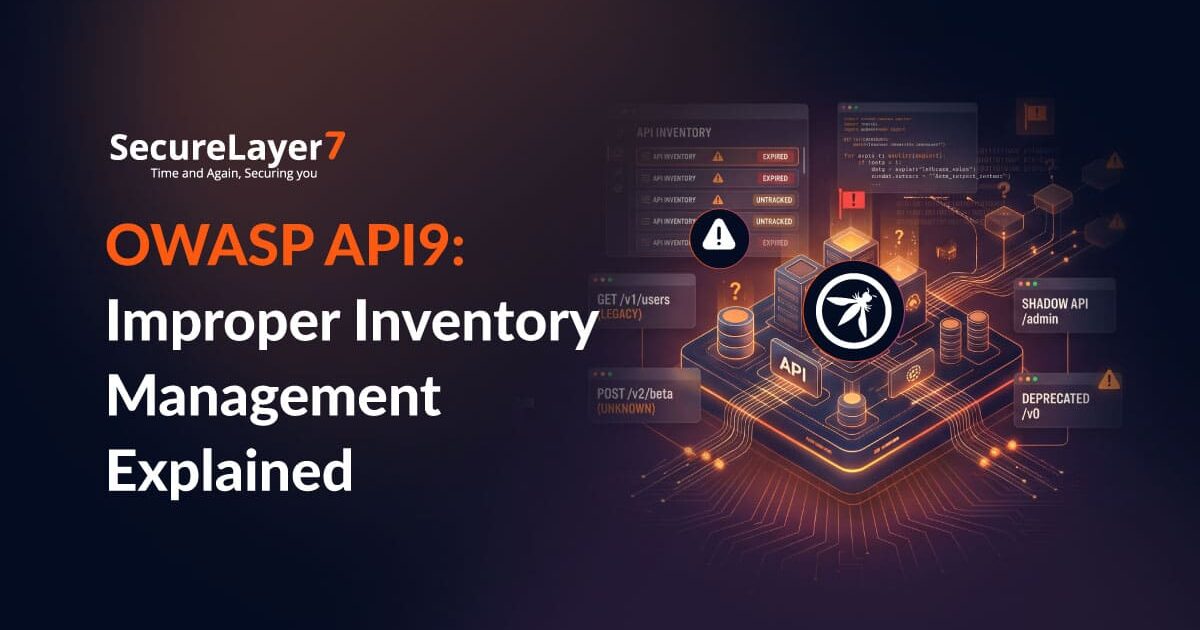
What is OWASP API9: Improper API Inventory Management Risk?
Improper API Inventory Management risk found its place in the OWASP API Top 10 Risks list because of its grave concern. When an organization cannot maintain an authoritative, continuously updated inventory of all API endpoints, versions, environments. It causes vulnerabilities like shadow APIs and Zombie APIs. As a result, organizations cannot reliably:
- Identify externally exposed endpoints.
- Validate applied access controls.
- Track deprecated or legacy API versions.
- Map sensitive data movement across services.
This expands the application’s attack surface, allowing attackers to frequently scan for forgotten endpoints or outdated API versions that bypass standard security controls.
In regulated environments, these exposures can also introduce compliance risks under frameworks such as GDPR and HIPAA.
Causes of improper inventory management
APIs become security risks when organizations lack clear visibility into their endpoints, versions, and data flows. Managing multiple API versions increases operational complexity and expands the attack surface, especially when outdated versions remain active.
A documentation blind spot occurs when:
- The purpose of an API host is unclear.
- The API environment is not identified (production, staging, testing, or development).
- Network access rules are undefined (public, internal, or partner access).
- The active API version is unknown.
- Documentation is missing or outdated.
- There is no retirement plan for older API versions.
- API inventory records are incomplete or outdated.
A data flow blind spot occurs when:
- APIs share sensitive data with third parties.
- There is no clear business justification or approval for data sharing.
- Sensitive data flows are not documented or tracked.
- Organizations lack visibility into what type of sensitive data is being shared.
These gaps make it difficult for security teams to monitor APIs effectively and increase the likelihood of unnoticed vulnerabilities or data exposure.
Risks of Improper API Inventory Management
Some the risks caused by APIs include the following:
1. Increased exposure of sensitive endpoints
If API endpoints are not visible, organizations cannot enforce strict security protocols, leaving them exposed to attacks. Malicious actors can exploit these gaps to inject malicious code, steal data, or gain unauthorized access to critical business information.
2. Expanded attack surface
An expanded attack surface increases security risks. A larger attack surface means more opportunities for threat actors to sneak into the system through undocumented or unmanaged APIs.
3. Regulatory compliance risks
Improper API inventory mismanagement can invite the wrath of regulatory bodies. Regulatory compliances, such as GDPR and HIPAA require stringent control over APIs and endpoints to protect data privacy. When sensitive information is left unsecured, it opens the door to fines and legal trouble.
4. Poor incident response preparedness
If data flows are not properly documented, it can hinder rapid containment during third-party breaches. This prolongs exposure and invites regulatory penalties due to untraceable data pathways.
Real-World Exploits and Case Studies
Here are some real world incidents of improper inventory management:
Example #1: Optus breach
The Optus breach was caused due to a forgotten API with broken access controls.The unmonitored API was part of Optus’s legacy systems but was never decommissioned or documented. Hackers used this gap to bypass the authentication mechanism. This breach exposed personal details of 9 million customers.
Example #2: Trello data leak
Trello faced a serious data leak due to an unsecured API endpoint that allowed threat actors to scrape email addresses and account details of 15 million users. The incident was caused because the API endpoint was not cataloged in the inventory and went unnoticed. This incident highlighted how undocumented APIs can evade security reviews.
These incidents could have been easily averted by enforcing strict access controls and maintaining a complete API inventory.
Attack Tactics Using Improper API Inventory Management
Poor inventory management can cause easily exploitable vulnerabilities. Below, we have curated a list of commonly used tactics by attackers:
1. Automated reconnaissance on untracked assets
Using tools like Burp Suite, Postman, and network scanners, attackers can help identify hidden APIs in your system. It helps them analyze traffic patterns and parse through JavaScript files. It allows security experts to uncover APIs without proper security controls.
2. Misconfigured APIs
Misconfigured APIs with weak authentication, such as missing rate limits or disabled encryption, can be misused by attackers. They can easily exploit these flaws using tactics such as forced browsing or IDOR (Insecure Direct Object Reference).
For instance, by merely tweaking URL parameters, hackers can infiltrate the system and steal sensitive data. Therefore, never leave any API endpoint exposed.
3. Session Hijacking and Token Theft
Unmonitored APIs sometimes expose session tokens in logs or URLs, making them vulnerable to exploitation. Attackers may enter the system using man-in-the-middle attacks or XSS to intercept the tokens for session hijacking. If the token validation is outdated, it allows attackers to perform replay attacks.
Therefore, protecting session tokens becomes critical as they can be used for impersonation by attackers.
Best Practices to Prevent Improper API Inventory Management Risks
The following strategies can be crucial for preventing improper inventory management risks:
1. Keep centralized documentation
Keeping centralized documentation ensures a single source of truth by eliminating confusion. It becomes easier to manage and update inventory.
2. Implement strict access control
Weak access control can lead to security vulnerabilities, which may invite malicious actors to exploit these gaps.
- Implement frameworks like OAuth 2.0 or OpenID Connect to enforce granular access control policies.
- Use API gateways to block unauthorized API requests and enforce zero-trust principles.
- Verify permissions at both the gateway and API levels to prevent bypassing controls.
3. Restrict Documentation Access
API documentation often contains sensitive information that should be protected. Limiting access to this documentation to authorized users only can help protect these assets. You can do it by implementing strict access controls.
4. Implement external protection measures
Use specialized API security solutions for all exposed versions of your APIs. It should not be limited to the current production version.
5. Avoid using production data in non-production environments
Ensure both non-production and production data receive a similar level of security. Try to minimize the risk of exposing sensitive data during the testing or development activities.
6. Prepare an inventory of all API hosts
- Document the environment (production, staging, test, development) for each API host.
- Specify who should have network access (public, internal, partners).
- Track the API version in use.
7. Categorize integrated services
- Explain each service function within the system.
- Map what data is exchanged between services.
- Classify the sensitivity of exchanged data.
8. Embed inventory checks in CI/CD pipelines
- Add pre-deployment checks to validate API specs against the inventory.
- Use tools like OWASP ZAP or Checkmarx to flag undocumented endpoints.
9. Automate API registration
- Use tools like OpenAPI/Swagger to auto-generate API specs during development.
- Integrate with API gateways (e.g., Kong, AWS API Gateway) to auto-register endpoints in a central inventory.
10. Regularly audit your API inventory
Conduct periodic audits to ensure all APIs in inventory are updated and that documentation is current and accurate.
11. Prepare comprehensive documentation
- Document authentication, error handling, redirects, rate limiting, and CORS policies.
- Include parameters, requests, and responses for each endpoint.
- Use tools to automate documentation and ensure accuracy.
12. Integrate inventory management into DevOps
- Integrate API scanning tools in CI/CD pipelines to detect outdated or unused APIs before they reach the production state.
- Automate security checks to enforce compliance and reduce human errors during API development and deployment.
- Implement appropriate version control for APIs to track changes and maintain consistency across environments.
13. Foster collaboration between teams
- Foster clear communication to align on API usage and share accountability for security practices.
- Organize joint workshops to address inventory gaps.
- Develop shared dashboards for API monitoring and quicker threat response.
14. Establish a clear retirement plan for APIs
This prevents zombie APIs by retiring unused versions.
- Use semantic versioning (e.g., /v1/users, /v2/users).
Automatically deprecate old versions after a defined period (e.g., 80, 90,120 days). - Use versioning practices and communicate deprecations clearly to API consumers.
- Track API usage to support clients transitioning to the new API and encourage early adoption.
15. Enforce documentation-as-code
- Treat API documentation as part of the codebase (e.g., store OpenAPI specs in Git).
- Update documentation for every API change via pull requests.
16. Conduct regular inventory cleanup
- Schedule quarterly audits to compare deployed APIs to inventory.
- Automate scans using tools like Postman Collections or Burp Suite.
Future Trends in Inventory Management for APIs
AI is changing the security landscape. The trend will further gain momentum.
- AI/ML models will further evolve: ML models will accelerate identification of shadow APIs, policy compliance, and auto-update of inventories. AI-driven API gateways will minimize manual oversight while ensuring accuracy and proactive threat detection.
- Continuous security monitoring will be the norm: Periodic security auditing will gradually become obsolete. When integrated with SIEM systems, they’ll replace periodic audits with always-on visibility to combat emerging threats.
- Predictive analytics and risk management: The accuracy of predictive models in forecasting vulnerabilities will increase. In the future, it will be possible to preemptively forecast API governance related weaknesses before threat actors exploit them.
Conclusion
On a final note, poor inventory practices arise from unmonitored and undocumented API endpoints, legacy API versions, and unclear data flows. These risks can be eliminated by automating discovery, centralizing documentation, enforcing access controls, and auditing regularly.
Looking to strengthen your security posture? SecureLayer7 helps organizations identify vulnerabilities, reduce risk, and defend against evolving cyber threats. Contact our experts to get started.
Frequently Asked Questions (FAQs)
Improper inventory management means failing to track APIs, their versions, or access, leaving systems exposed to unauthorized use and outdated vulnerabilities.
It creates blind spots, allowing rogue or unpatched APIs to be exploited by attackers, increasing exposure to data theft and system compromise.
Signs include undocumented endpoints, unused APIs still active, excessive permissions, outdated versions, and frequent security incidents or unexpected outages.
Organizations should catalog all APIs, enforce strict access controls, maintain updated documentation, and use monitoring tools to detect anomalies and misuse.
Automation tracks APIs in real time, updates records dynamically, flags risks, and ensures compliance, reducing manual errors and saving time.
Standards like GDPR, PCI DSS, and HIPAA require tracking data flows through APIs, indirectly mandating robust inventory practices for compliance.
Audits identify unused or risky APIs, uncover unauthorized access, ensure compliance, and provide insights to strengthen overall API security.
An API inventory includes details such as API endpoints, version histories, authentication methods, associated applications, and security measures.
