

Modern applications rely on APIs, cloud services, and third-party components, creating more entry points for attackers. Bringing security testing into the early stages of the SDLC helps teams find vulnerabilities before production and fix them when changes are easier to manage.
Offensive security testing examines applications from an attacker’s perspective. It helps uncover exploitable vulnerabilities, authorization flaws, business logic issues, and attack paths that automated tools can miss. Using automated and manual security testing throughout the SDLC helps teams identify real security risks earlier and reduce the chance of exploitable weaknesses reaching production.
Growing Application Attack Surfaces and Faster Release Cycles
Development environments change constantly as teams release features, connect new services, and update existing components. Each change can introduce vulnerabilities in application code, configurations, APIs, or dependencies.
Security testing needs to happen alongside development. Adding relevant security checks during development and QA helps teams find issues earlier, fix them before release, and avoid relying only on security testing at the end of the development cycle.
How Early Testing Helps Identify Exploitable Weaknesses Sooner
Bringing security testing into the SDLC earlier gives developers faster feedback on security issues. Automated tests can detect common vulnerabilities during development; manual offensive testing can uncover complex flaws that require deeper investigation and security expertise.
This allows teams to:
- Detect security weaknesses closer to the point of introduction.
- Validate important vulnerabilities before production.
- Identify business logic and compound vulnerabilities.
- Reduce late-stage security fixes and rework.
- Address security defects as part of normal development.
What is Secure Software Development
Secure software development is an approach to building software where security is considered throughout the Software Development Life Cycle (SDLC) rather than being addressed only before deployment. Security activities can be incorporated into planning, design, coding, testing, release, and maintenance so that vulnerabilities are identified and addressed closer to where they are introduced.
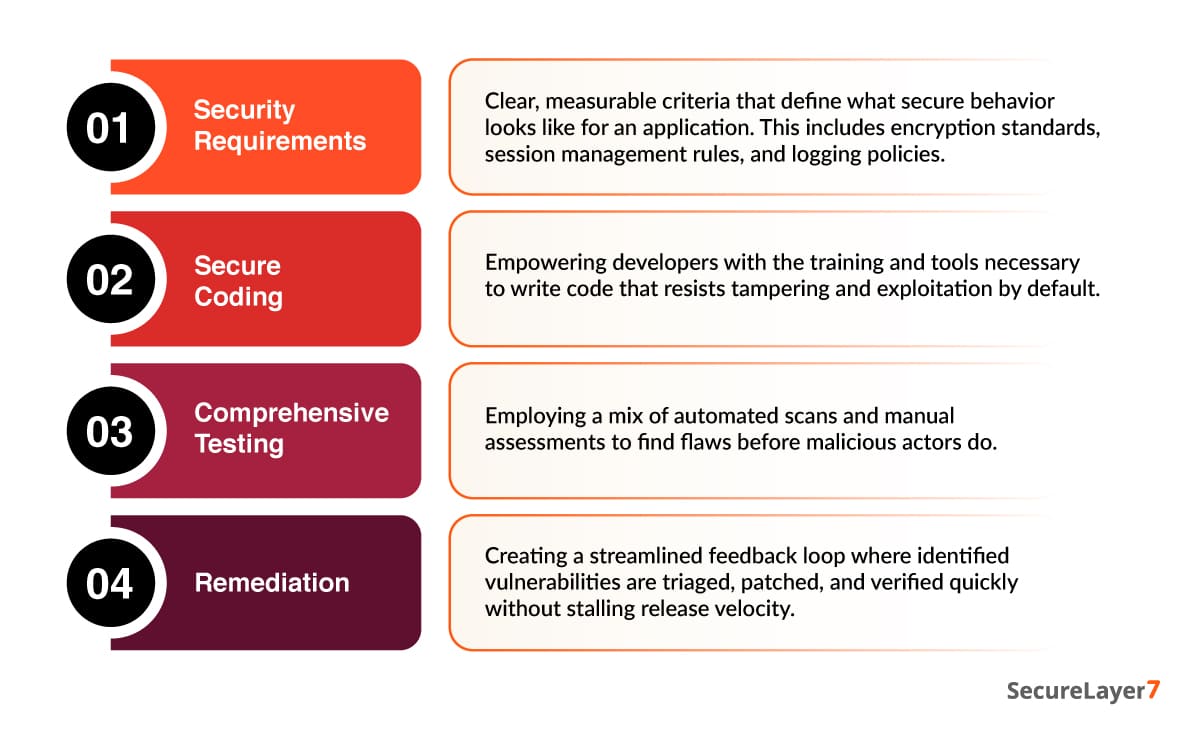
Security Requirements, Secure Coding, Testing, and Remediation
A mature secure software development program relies on four interconnected pillars:
Why Secure Development Needs Offensive Security Validation
Secure coding and automated testing can catch many security issues, but some weaknesses require deeper investigation. Offensive security testing examines applications from an attacker’s perspective to determine if vulnerabilities can be exploited. Penetration testing can confirm exploitable flaws, manual testing can uncover design issues, business logic weaknesses, and combinations of vulnerabilities that automated tools often miss.
Adding offensive security testing at relevant stages of the SDLC helps teams find exploitable weaknesses before production. It works alongside automated testing by providing deeper analysis where human expertise is needed. Security testing also needs to continue after deployment because applications, configurations, and attack methods change over time.
Why Scanners and Code Review Leave a Gap
Automated testing and secure code reviews can identify many security issues, but each covers different areas of an application. Knowing where these methods fall short helps teams decide when manual offensive testing is needed to investigate vulnerabilities and confirm real security risks.
What Automated Testing Does Well
Automated security testing provides speed, consistency, and broad coverage across development environments. It can help teams identify common security weaknesses early and provide rapid feedback as applications change.
Automated testing is particularly useful for:
- Known vulnerability detection: Identifying common and previously documented security weaknesses.
- Dependency and configuration risks: Detecting vulnerable software components, outdated dependencies, and insecure configurations.
- Regression testing: Rechecking applications after code changes to identify security issues that have been reintroduced.
What Automated Testing Can Miss
Automated tools rely on predefined security checks and cannot always understand how an application is intended to work or how connected services interact. Some vulnerabilities depend on business logic, user behavior, or system context, making manual analysis necessary to identify and validate them.
Common gaps can include:
- Authorization and business logic flaws: A tool may identify an endpoint but not understand a user can perform an action that violates the application’s intended business rules.
- Trust assumptions between services: Applications often depend on APIs and interconnected services. Security weaknesses can occur when one service incorrectly trusts data, identity, or permissions received from another service.
- Chained vulnerabilities and attack paths: Multiple weaknesses that appear low risk individually can sometimes be combined to achieve a more significant security outcome.
What Offensive Testing Looks Like Across the SDLC
Offensive security testing works best when it is included at different stages of the Software Development Life Cycle (SDLC), rather than performed only before production. Testing can become more detailed as the application moves through design, development, QA, release, and maintenance. This helps teams find security weaknesses earlier and confirm critical risks before and after deployment.
Design and Planning
Security testing begins with understanding how the application is designed and where potential attack opportunities could exist.
Key activities include:
- Threat modeling: Identify potential threats, trust boundaries, and security weaknesses before implementation.
- Attack-surface analysis: Identify applications, APIs, services, integrations, and other components that could become attack targets.
- Security requirements and abuse cases: Define security expectations and consider how application features could be misused or attacked.
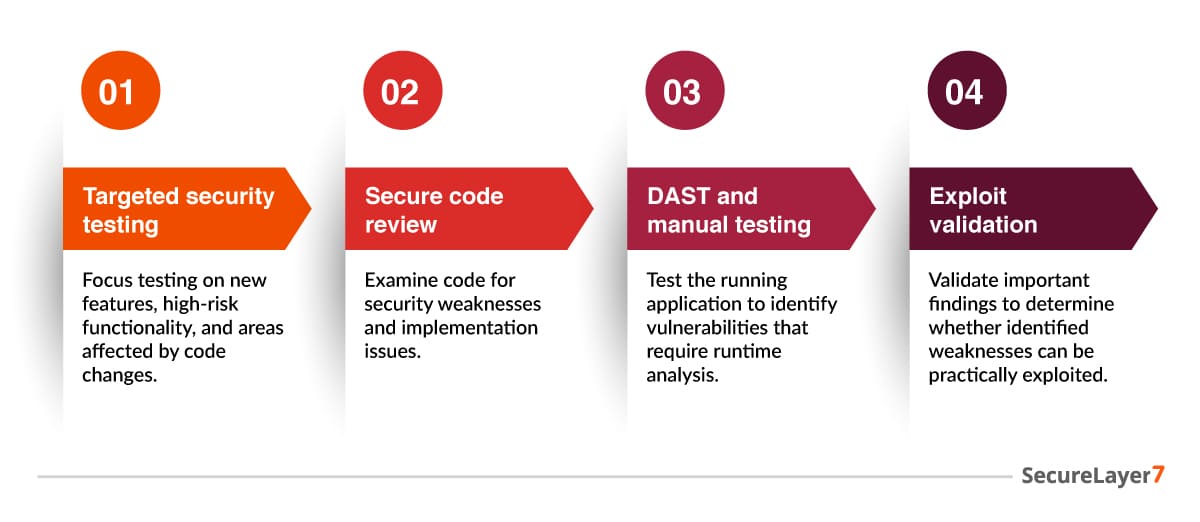
Development and QA
As development progresses, security testing can become more targeted and closely integrated with development and QA activities.
Key activities include:
Pre-Release and Post-Deployment
Before an application reaches production, focused penetration testing can provide a deeper view of its security risks. Testers examine critical functions, confirm exploitable vulnerabilities, and identify attack paths that could lead to unauthorized access or compromise.
Key activities include:
- Focused penetration testing: Assess high-risk applications, features, APIs, and attack surfaces.
- Final security validation: Confirm that significant security findings have been addressed before release.
- Remediation and retesting: Verify fixes and determine whether vulnerabilities remain exploitable.
Offensive Security Techniques for Secure Software Development
Secure software development uses different offensive security techniques throughout the SDLC. Vulnerability assessments and automated testing help identify common security issues across a broad scope, secure code reviews and penetration testing provide deeper analysis of specific weaknesses. Red team testing examines how well an organization can detect and respond to realistic attack scenarios. Applying each technique at the right stage helps teams find vulnerabilities earlier and confirm which weaknesses pose a real security risk.
Vulnerability Assessment
Vulnerability assessment helps security teams identify weaknesses across applications, networks, systems, and supporting components. It can uncover known vulnerabilities and configuration issues, assess their potential risk, and help teams decide what needs to be fixed.
It also provides a baseline for understanding an organization’s security exposure and highlights findings that need further investigation, testing, or remediation.
Secure Code Review
Secure code review examines source code to find security flaws and unsafe coding practices. Reviewing code during development helps teams catch problems before they move into testing or production.
Code review is especially useful for security-sensitive areas such as authentication, authorization, input validation, data processing, and access controls.
Penetration Testing
Penetration testing uses controlled attack techniques to determine if vulnerabilities can be exploited in an application or network. It goes beyond identifying weaknesses by examining how attackers could use them to compromise the target environment.
Manual penetration testing can also uncover design flaws, business logic issues, and combinations of vulnerabilities that automated tools may not detect.
Red Team Testing
Red team testing simulates realistic attacks to assess how an organization responds to a security threat. Instead of focusing only on individual vulnerabilities, it tests how people, processes, technology, and security controls work together during an attack.
Red team exercises typically cover a broader scope than application-level penetration testing. They help organizations identify gaps in their defenses and evaluate their ability to detect and respond to attacks.
Security Configuration Testing
Security configuration testing checks applications, systems, networks, cloud services, and infrastructure for insecure settings. It can uncover exposed services, weak access controls, unnecessary permissions, and configuration errors that attackers could exploit.
It complements vulnerability testing by checking how security controls are configured and applied across the environment.
Automated Security Testing
Automated security testing adds repeatable security checks to development and CI/CD workflows. Teams can use SAST, DAST, IAST, dependency analysis, and other automated methods to find vulnerabilities during different stages of the SDLC.
Running these checks early gives developers faster feedback and helps them fix security issues closer to where they were introduced. This can also reduce the number of vulnerabilities that reach later testing stages or production. Using SAST and DAST together can provide broader coverage by identifying weaknesses in source code as well as vulnerabilities that appear when the application is running.
What Waiting to Test Actually Costs
Delaying security testing can increase the time and effort needed to fix vulnerabilities and can slow down releases. Problems become harder to address when they require architectural changes or affect several connected components. Late testing also increases the risk of exploitable weaknesses reaching production.
Late Discovery of Design Flaws and Architectural Rework
Security flaws found late in development can require changes to application logic, architecture, APIs, authentication flows, or data handling. Design flaws are often harder to fix because they can affect several connected components instead of a single piece of code.
Threat modeling and offensive security analysis during the early stages of development can identify possible attack paths and design weaknesses before they become part of the application architecture.
Development and Release Delays
Security issues found close to release can create extra work for development and QA teams. Critical vulnerabilities may require code or functionality changes, followed by another round of testing to confirm the fix before deployment.
Testing for security earlier in the SDLC gives developers more time to fix vulnerabilities and reduces last-minute changes that can delay a release.
Increased Production Security Risk
The biggest risk of delaying security testing is allowing an exploitable vulnerability to reach production. Once an application is exposed to users, APIs, integrations, and external traffic, attackers may have more opportunities to exploit weaknesses, gain unauthorized access, or expose sensitive data.
Early offensive testing does not replace penetration testing before release. It helps teams find and fix security issues throughout the SDLC, reducing the chance of critical vulnerabilities remaining undetected until the application reaches production.
Attack Scenarios Early Offensive Testing Can Catch
Early offensive security testing can uncover weaknesses that automated scans and basic code reviews may miss. Testing an application from an attacker’s perspective can reveal authorization flaws, tenant isolation issues, business logic weaknesses, and security gaps between applications and internal resources.
Finding these issues earlier in the SDLC gives development teams more time to fix them before the application reaches production.
Broken Object-Level Authorization
Broken object-level authorization occurs when an application does not properly check if a user has permission to access a specific resource. For example, changing an object ID in an API request could expose another user’s data if the server does not enforce the correct authorization checks.
Manual offensive testing examines user roles, object references, and API workflows to confirm that access controls prevent users from accessing resources outside their permissions.
Multi-Tenant Isolation Failures
Applications that support multiple customers or tenants need controls that keep each tenant’s data and resources separate. Weak tenant isolation can allow one customer to access another customer’s information or functionality.
Early offensive testing checks how these boundaries work across application features, APIs, databases, and connected services. This helps teams identify access control gaps before they lead to cross-tenant data exposure.
Business Logic Abuse
Business logic vulnerabilities occur when attackers can use valid application functions in unintended ways to bypass business rules. Automated scanners can miss these issues because individual actions may appear legitimate even when a specific sequence leads to unauthorized access or another security issue.
Manual testing examines workflows, authorization decisions, transactions, and application rules to identify these weaknesses before the application reaches production.
How to Make Early Findings Useful
Finding a vulnerability early in the Software Development Life Cycle (SDLC) is useful only if development and security teams have enough information to understand and fix it. Each finding needs clear evidence, an explanation of the root cause, and practical remediation guidance.
Providing this context helps developers understand what went wrong, where the issue exists, and how to address it without spending extra time investigating the finding.
Provide Exploit Path and Evidence
A useful security finding explains how the vulnerability can be reached and what happens when it is exploited. Depending on the issue, evidence can include affected requests and responses, screenshots, logs, or controlled proof-of-concept results.
Clear evidence helps developers understand the actual risk, reproduce the issue, and verify the finding without unnecessary investigation.
Explain Root Cause
A security finding needs to explain why the vulnerability exists, not just describe what went wrong. Identifying the root cause helps developers locate the problem in the code, configuration, or application design and apply the right fix.
For example, an authorization issue could result from a missing server-side access check, incorrect role validation, or a weakness in another access control. Clearly identifying the cause makes remediation more focused and effective.
Give Actionable Remediation Guidance
Remediation guidance needs to explain what developers need to fix without adding unnecessary implementation details. Recommendations need to address the root cause and help prevent the same vulnerability from appearing again.
Clear guidance also reduces repeated discussions between security and development teams, making it easier to fix vulnerabilities as part of the existing development workflow.
Convert Confirmed Vulnerabilities into Regression Tests
After a vulnerability is fixed, teams can turn the relevant security check into a regression test when practical. This helps confirm that the fix continues to work as the application changes and prevents the same issue from returning unnoticed.
For example, after fixing an authorization flaw, a regression test can confirm that users cannot access resources outside their assigned permissions. The same approach works for authentication, input validation, API access controls, and other security-sensitive functions.
How SecureLayer7 Supports Secure Software Development
SecureLayer7 provides security testing for web applications, APIs, mobile applications, cloud environments, and infrastructure. The testing process combines automated tools with manual analysis to identify vulnerabilities, confirm which weaknesses can be exploited, trace possible attack paths, and provide clear remediation guidance.
SecureLayer7 also performs retesting after remediation to confirm that reported vulnerabilities have been fixed and the applied security controls work as expected.
Web Application and API Security Testing
SecureLayer7 provides web application and API security testing to identify weaknesses in application functionality, authentication, authorization, input handling, and API access controls. Testing helps organizations identify security issues before they create greater exposure in production environments. Regular web application penetration testing provides deeper validation of authentication, authorization, input handling, business logic, and other application security controls.
Mobile Application Security Testing
Mobile application security testing checks mobile apps and their backend services for vulnerabilities. It focuses on areas such as authentication, authorization, data handling, API communication, and security controls to identify weaknesses that could expose user data or application functionality.
Cloud and Infrastructure Security Testing
SecureLayer7 assesses cloud and infrastructure security to identify vulnerabilities, exposed services, insecure configurations, and weaknesses that could increase an organization’s attack surface. This can help security teams understand risks across cloud workloads and supporting infrastructure.
Cloud penetration testing helps identify cloud-specific vulnerabilities and misconfigurations across APIs, storage, access controls, encryption, and other cloud resources.
Manual Vulnerability Validation and Exploitation
Automated tools can detect potential vulnerabilities, but some findings need deeper investigation. SecureLayer7 uses manual validation and controlled exploitation to confirm if attackers can realistically exploit a weakness and understand the potential impact on the affected systems.
Actionable Remediation Recommendations
Security findings are easier to address when development teams know what caused the issue and what needs to change. SecureLayer7 provides clear remediation recommendations that explain the weakness and help security and development teams identify the right corrective action.
Retesting to Verify Security Fixes
Security testing should continue after vulnerabilities are remediated. SecureLayer7 can perform retesting to verify whether reported vulnerabilities have been successfully addressed and whether the original security weakness remains exploitable.
Conclusion
Secure software development requires security throughout the SDLC, not only before production. Combining automated testing, code review, vulnerability assessment, and offensive testing helps identify vulnerabilities early, validate exploitable weaknesses, and reduce security risks.
SecureLayer7 provides expert-led security testing for web applications, APIs, mobile applications, cloud environments, and infrastructure. Its approach combines automated tools with manual testing to identify exploitable vulnerabilities, assess attack paths, and provide practical remediation guidance.
Connect with SecureLayer7 to integrate offensive security testing into your SDLC and address critical vulnerabilities before they reach production.
Frequently Asked Questions (FAQs)
Early penetration testing helps teams find security weaknesses before an application reaches production. Developers have more time to fix vulnerabilities, avoid late-stage rework, and reduce the risk of exploitable issues reaching a release.
Offensive testing can uncover issues that depend on application context and human analysis. These include business logic flaws, authorization weaknesses, trust boundary issues, and vulnerabilities that become more serious when combined. Manual testing can also confirm if an identified weakness can actually be exploited.
Offensive security can start during planning and design with threat modeling and attack surface analysis. Targeted testing can continue through development and QA, followed by penetration testing before release. Testing can also be repeated after major changes to applications, APIs, architecture, or infrastructure.
No. Early testing helps teams find and fix weaknesses during development, while pre-release penetration testing provides another level of validation before deployment. Testing after deployment can identify new risks introduced by application, configuration, or infrastructure changes.
Organizations can track how many vulnerabilities are found early, how long remediation takes, how many issues reach later SDLC stages, and how often the same vulnerabilities return. Teams can also track the percentage of confirmed findings that are fixed and successfully verified through retesting.

