
![Top 10 Autonomous Pentesting Tools [2026]](https://blog.securelayer7.net/wp-content/uploads/2026/09/Top-10-Autonomous-Pentesting-Tools-2026-1200x630.jpg)
As modern applications are evolving, new APIs, cloud workloads, containers, and other digital assets are exploding, expanding the attack surface. And it’s happening so fast that it’s almost impossible to capture the vulnerabilities through point-in-time penetration testing.
The situation becomes even more complex for organizations that have multiple applications and IT infrastructure. Autonomous AI penetration testing tools can address this challenge. However, not all testing tools are the same.
Best Autonomous Pentesting Tools [2026]
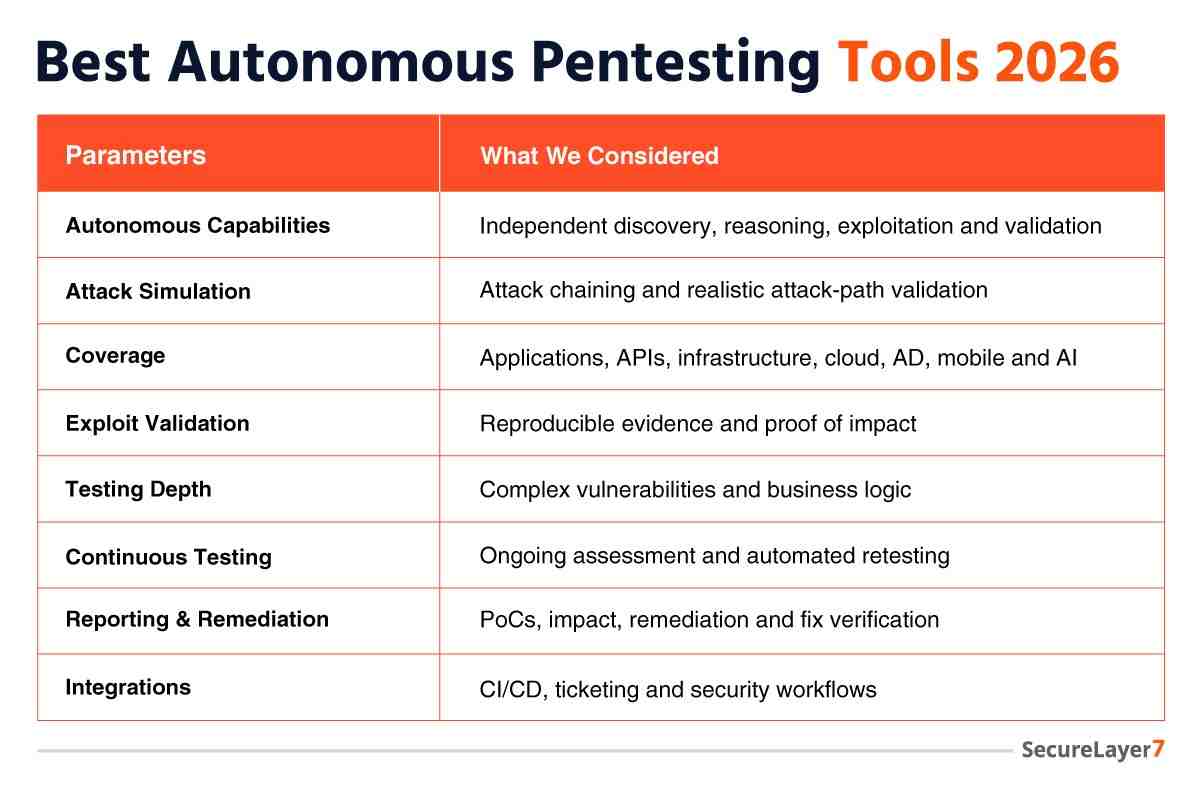
We evaluated the following parameters to select the tool that includes the breadth of coverage, such as web applications, APIs, infrastructure, cloud, Active Directory, mobile, and AI applications, attack simulation, exploit validation, continuous testing.
1. BugDazz
SecureLayer7’s BugDazz automation penetration testing platform has been designed to test web applications, APIs, Active Directory, and several other vulnerabilities. It caters to organizations looking to switch to continuous penetration testing and periodic assessments.
What stands out aboutBugDazz testing platform is Rabit0, a proprietary validation gateway. This not only flags a potential vulnerability but also reproduces the attack in the target environment before the findings are reported. You just need to pick a surface and leave the rest to BugDazz autonomous pentesting platform.
The platform provides reports backed by response evidence, CVSS details, impact information, proof-of-concept scripts, remediation guidance, and retest after fixes. With vulnerabilities found, disclosed, and fixed in production software. Linked to the source on each row.
Additionally, it combines autonomous testing with security expertise, allowing organizations to automate repetitive discovery and validation while retaining human involvement for complex attack scenarios.
It is best suited for organizations looking for on-demand autonomous pentesting across web applications, APIs, and Active Directory. Rabit0 is a validation gateway that reproduces attacks and provides proof-driven findings with evidence, PoCs, remediation guidance, and re-verification.
Key USPs:
- AI agents attack custom business logic beyond generic checklists by mapping unique app state paths
- Strict Rabit0 trust layer gates every payload and finding before it leaves your system
- Safe production testing uses reversible probes and auto-halts when configurable error thresholds are breached
- Execution stays inside your private VPC boundary with encrypted credentials and isolated tool pools
- Real-time transparent logs cryptographically sign and record every AI decision and HTTP exchange made.
- Eliminates false positives by reproducing end-to-end proof-of-concept exploits and auto-retesting fixed patches immediately.
- Delivers executive reports, developer request logs, and JSON bundles pre-mapped to major compliance standards.
Why Choose It:
Go with SecureLayer7 BugDazz autonomous pentesting if you are looking for on demand pretesting.
2. NodeZero

NodeZero by Horizon3.ai is an autonomous penetration-testing platform focused strongly on infrastructure, identity, cloud, and attack-path validation. NodeZero autonomously chains attack vectors like attackers do and safely exploits them to demonstrate vulnerabilities.
It allows you to understand the path, proof-of-exploit, and impact.
Its testing capabilities extend beyond traditional internal network pentesting. NodeZero supports internal, external, cloud, Kubernetes, and WebApp testing, along with Active Directory password auditing and other security assessments.
Key USPs:
- Autonomous internal and external penetration testing
- Supports on-prem infrastructure, external attack surface, and cloud infrastructure testing
- Credential discovery and exploitation
- Provides detailed remediation guidance
Why Choose It:
NodeZero can be a strong choice for enterprises that want to understand what an attacker could achieve after gaining access to their network or identity environment. Its ability to chain weaknesses and demonstrate impacts such as domain compromise and sensitive-data exposure makes it relevant for organizations focused on internal attack paths.
3. XBOW

XBOW is an autonomous penetration-testing platform focused strongly on automated application security and advanced web-vulnerability exploitation. XBOW autonomously discovers, validates, and exploits security vulnerabilities in web applications and API environments just like an elite human attacker. Its testing capabilities extend beyond basic signature scanning to deep, contextual reasoning.
XBOW supports black-box testing, automated API fuzzing, and complex logic flaw exploitation, allowing organizations to continuously find high-impact vulnerabilities before malicious actors do.
Key USPs:
- Autonomous web and API penetration testing
- Context-aware vulnerability exploitation without manual scripting
- Low false positive validation through verified proof-of-concepts (PoCs)
- Real-time, actionable remediation playbooks
Why Choose It:
Organizations seeking to automate high-fidelity security testing directly inside CI/CD pipelines to stop vulnerabilities before release.
4. Aikido Security
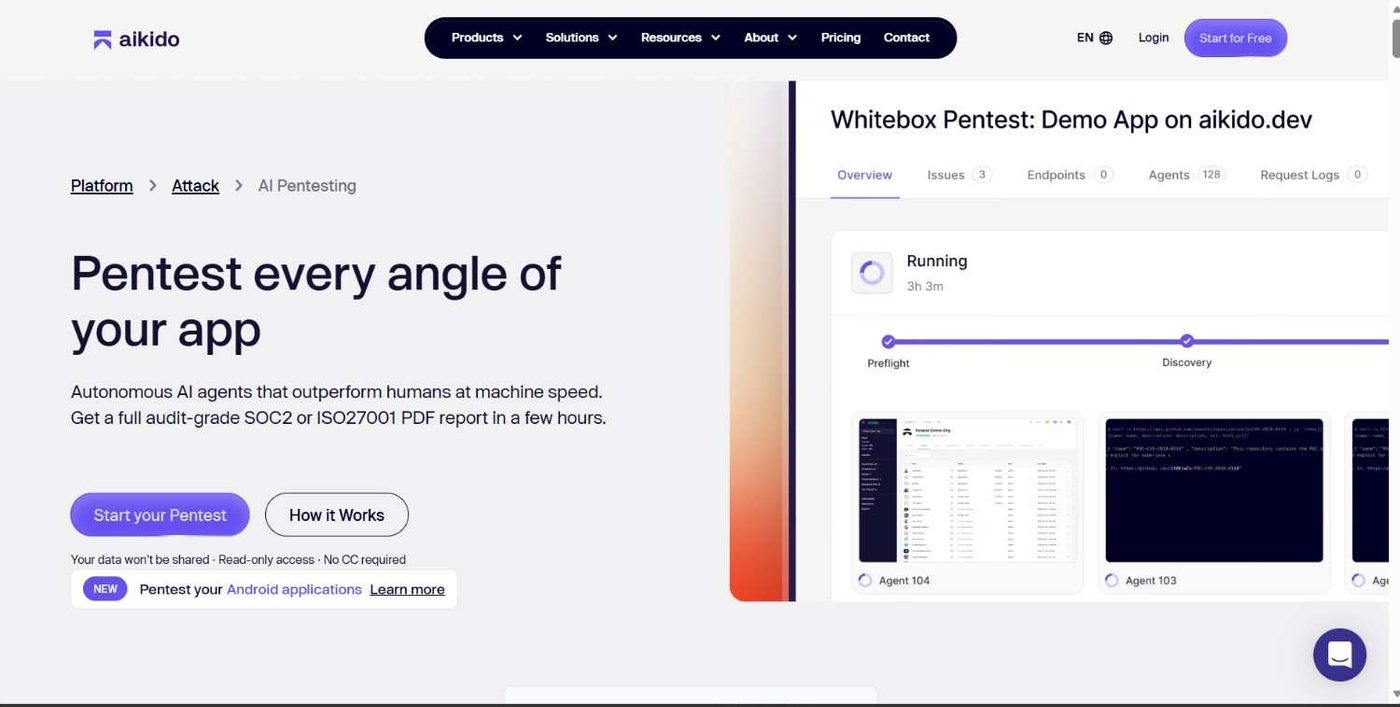
Aikido Security is a developer-first autonomous pentesting platform that combines agentic, AI-powered penetration testing. Aikido Pentest uses hundreds of autonomous agents to discover, exploit, and validate vulnerabilities across applications, APIs, and infrastructure.
Key USPs:
- Agentic AI penetration testing
- Hundreds of autonomous testing agents
- Provides white-box, grey-box, and black-box testing
- Web application and API testing
- Developer-focused security workflows
- Controls designed to prevent scope drift
Why Choose It:
Go with the Aikido if your development teams seek autonomous pentesting integrated into their broader application-security workflow.
5. Astra Security
Astra’s autonomous pentesting approach combines systematic testing with more exploratory attack behavior. Its structured penetration testing agents methodically test application surfaces, roles, APIs, authentication flows, business logic, and infrastructure.
At the same time, its bounty hunter approach searches for high-impact vulnerabilities through more exploratory attack paths.
Astra positions the platform around contextual vulnerabilities, including business-logic issues, access-control weaknesses, IDORs, workflow manipulation, payment abuse, and race conditions.
Key USPs:
- Autonomous end-to-end penetration testing
- Structured Pentest approach
- Bounty Hunter testing mode
- Business-logic testing
- Proof-of-concept generation
Why Choose It:
Astra can be a good fit for organizations looking for autonomous application and API testing that emphasizes complex vulnerabilities and business logic. Its combination of systematic coverage and exploratory testing can help organizations go beyond standard vulnerability categories.
6. RunSybil
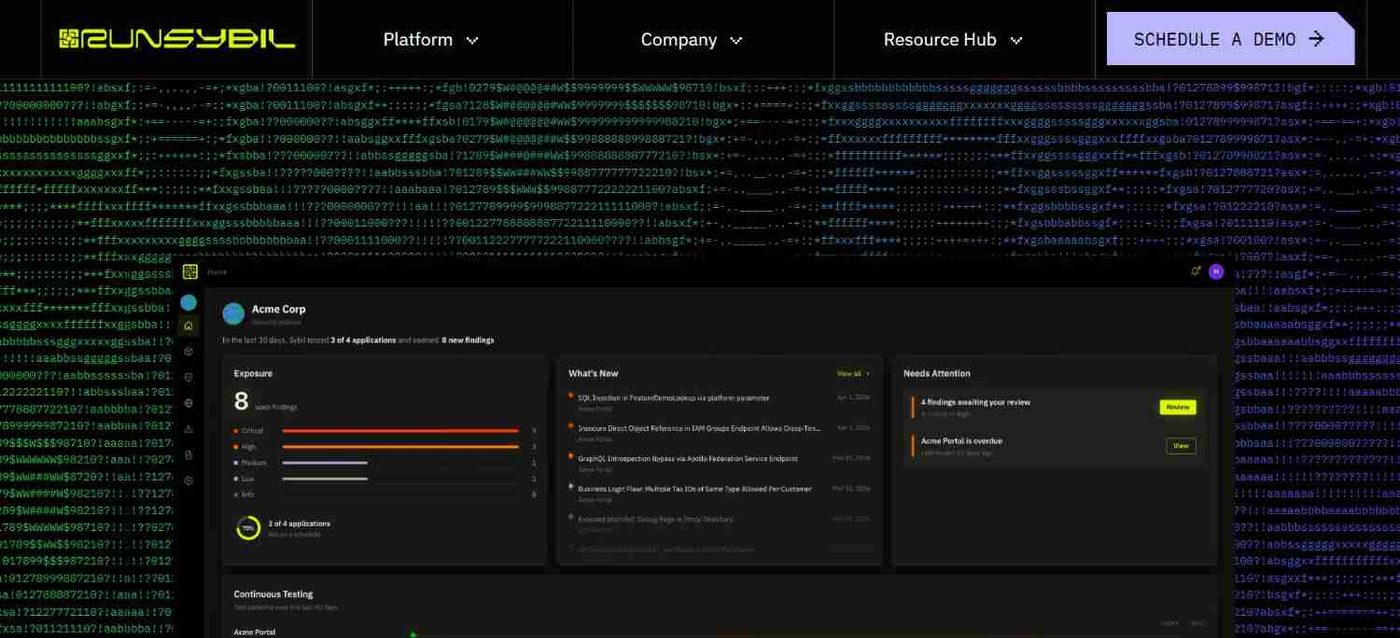
RunSybil is an AI-native offensive security platform designed to continuously test applications and infrastructure for exploitable vulnerabilities.
RunSybil’s Sybil system uses AI agents to reason about an application in a way that resembles an experienced security researcher. It maps the application, attacks it, validates findings, supports remediation, and can continuously reassess the environment as it changes.
The platform supports black-box, gray-box, and white-box testing. Its validation process includes reproducibility and false-positive checks before surfacing findings to users. It integrates directly into release pipelines to automatically re-evaluate attack surfaces on every deployment.
Key USPs:
- AI-native offensive security platform
- Continuous autonomous penetration testing
- Black-box, gray-box, and white-box testing
- Web and API security testing
- Automated remediation retesting
- Developer-workflow integration
Why Choose It:
RunSybil can be relevant for organizations who need offensive security testing to operate continuously alongside software development rather than as an annual or periodic assessment. Its focus on application logic, attack chains, and validated exploitability makes it particularly suitable for modern SaaS and application-heavy environments.
7. Novee Security
Novee Security is an AI-powered penetration-testing platform that uses autonomous agents to identify and validate exploitable vulnerabilities continuously.
Novee also supports automated retesting after remediation. Its platform covers web, mobile, AI applications, APIs, and external attack surfaces, according to the company’s current product information.
Key USPs:
- Autonomous AI penetration testing
- Continuous offensive security
- Black-box, gray-box, and white-box testing
- Web, mobile, API, and external attack-surface coverage
- Business-logic and exploit-chain testing
- Proof-of-concept validation
Why Choose It:
Novee can be a good option for organizations that want autonomous testing across both traditional applications and newer AI-enabled systems. Its support for AI application red teaming also makes it relevant for companies deploying LLM applications, copilots, and autonomous AI workflows.
8. Hadrian Nova
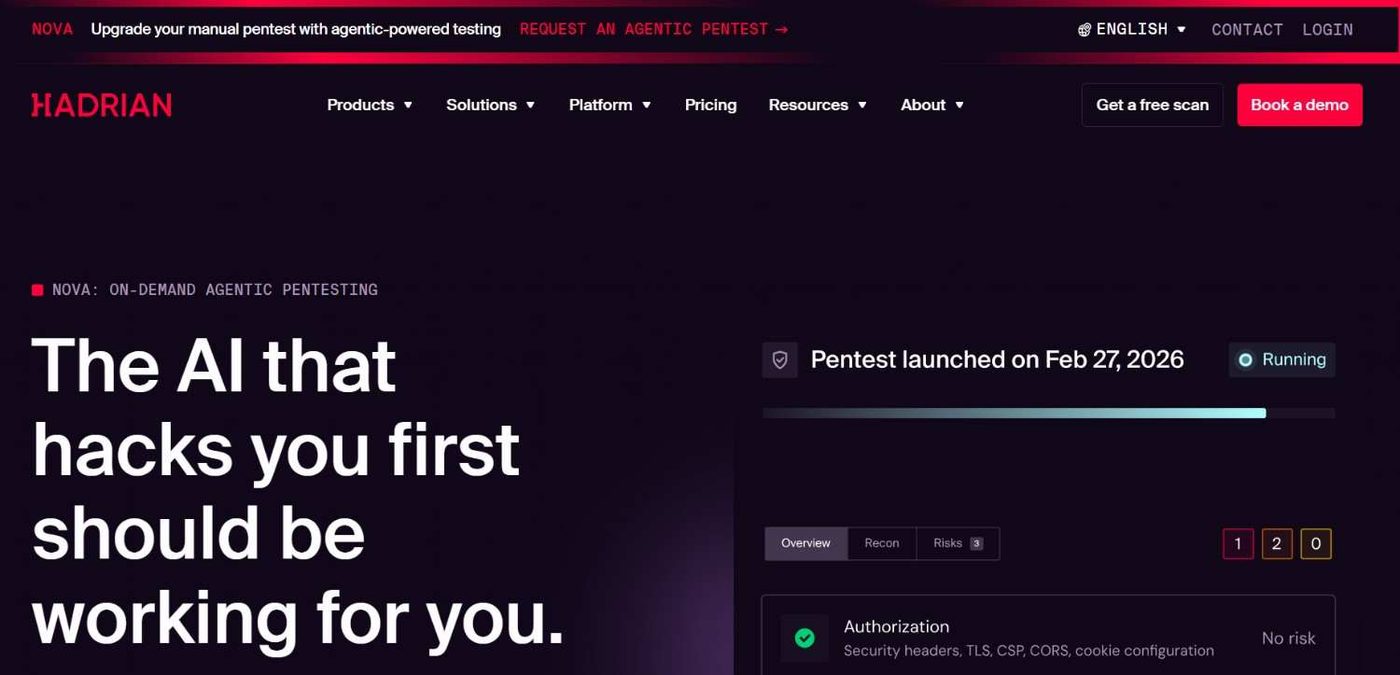
Hadrian Nova is an agentic penetration-testing solution focused specifically on external attack surfaces. It’s an on-demand alternative to traditional external penetration testing, delivering validated findings within hours so teams can act faster than a conventional engagement cycle.
Hadrian’s broader platform combines Nova with Atlas, its continuous external exposure-management product. Atlas continuously maps the external attack surface and validates which exposures are actually exploitable, while Nova provides deeper on-demand agentic pentesting for more immediate buyer value.
Key USPs:
- Autonomous vulnerability validation
- Attack-path exploration
- Vulnerability chaining
- On-demand pentesting
- Continuous external exposure management through Atlas
Why Choose It::
Hadrian Nova can be a good choice for organizations primarily concerned with internet-facing assets and external attack paths. It is particularly relevant when security teams need to continuously understand what an external attacker can discover and exploit.
9. Cyberware
Cyberware identifies vulnerabilities, proves impact, and traces attack paths that extend beyond individual weaknesses. The platform supports black-box testing and can also use source code for deeper white-box analysis. Its reports map findings to security standards, including OWASP Top 10, CWE, and ISO 27001 controls, to support prioritization and action.
Cyberware also emphasizes safety controls for autonomous testing, including fixed engagement boundaries and protection against prompt-injection attempts originating from target systems.
Key USPs:
- Autonomous penetration testing
- Adaptive attack techniques
- Vulnerability chaining
- Working attack-path validation
- Black-box testing
Why Choose It:
Cyberware is a good choice for organizations looking for autonomous application security testing that combines vulnerability discovery with deeper attack-path validation and clearer insight into impact.
10. Penligent
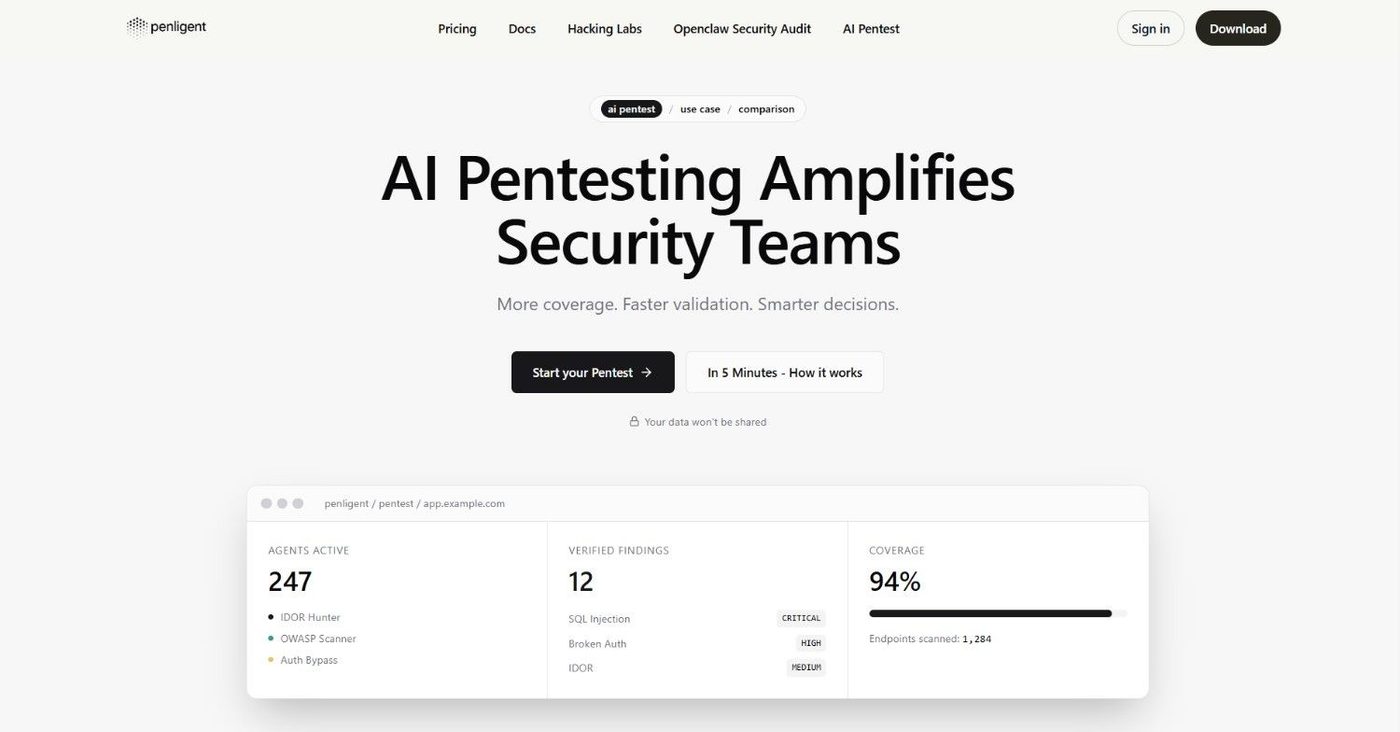
Penligent is an agentic AI penetration-testing platform that takes a broader tool-orchestration approach. The platform is designed for security engineers, penetration testers, and red teams that want an AI-driven layer to manage offensive security tooling.
Its natural-language workflow lets you describe testing objectives without manually coordinating every security tool. Penligent also offers reporting aligned with frameworks such as SOC 2 and ISO 27001.
Key USPs:
- 200+ security tool integrations
- Agentic AI penetration testing
- Natural-language testing workflows
- Automated asset discovery
- Red-team and security-engineering workflows
Why Choose It:
Penligent can be a suitable option for security teams looking for a broader agentic penetration-testing platform rather than a tool dedicated to only one attack surface.
How to Choose an Autonomous Pentesting Platform
All autonomous penetration testing platforms are not the same. Security teams should select a platform based on the attack surface they need to test, the amount of autonomy they are comfortable with, and whether the primary objective is vulnerability discovery, exploit validation, attack-path analysis, continuous testing, or red-team simulation.
Before selecting a platform, ask the following questions:
- What is my primary attack surface?
- How autonomous does the platform need to be?
- Can it prove exploitability?
- Can it chain vulnerabilities?
- How safely does it operate?
- Can it operate continuously?
- Does it support authenticated testing?
- Does it provide evidence?
- Can it retest fixes?
Final Thoughts
The autonomous pentesting market is no longer a single category. It includes specialized web and API platforms, internal attack-path testing, external attack-surface validation, AI application red teaming, developer-focused security platforms, and broad agentic offensive-security tools.
The platforms in this list take different approaches to autonomous security testing.
Autonomous pentesting can help organizations move beyond periodic security assessments toward more continuous validation of whether their systems can actually be compromised.
Looking to strengthen your security posture? SecureLayer7 helps organizations identify vulnerabilities, validate real-world security risks, and defend against evolving cyber threats. Contact our experts to get started.
Frequently Asked Questions (FAQs)
Automated vulnerability scanners generally identify known vulnerabilities, configuration weaknesses, or suspicious security conditions. Autonomous pentesting attempts to go further by reasoning about the target, interacting with it dynamically, attempting exploitation, and potentially chaining multiple weaknesses together.
Not completely. Autonomous pentesting can automate repetitive testing and increase coverage and testing frequency, but human penetration testers remain important for complex business logic, unusual attack scenarios, highly contextual assessments, and deeper red-team engagements. A combination of autonomous testing and human expertise can provide broader security coverage.
XBOW, SecureLayer7, Astra Security, Aikido Security, RunSybil, Novee Security, and Cyberware all have significant application-security capabilities. However, the best option depends on whether your priority is exploit validation, business-logic testing, continuous testing, developer workflows, or broader attack-surface coverage.
