
AI is rapidly becoming a core part of modern business, but it also introduces new security risks that traditional application security cannot address. According to IBM’s 2025 Cost of a Data Breach Report, 13% of organizations experienced breaches involving AI models or applications, and 97% of those lacked proper AI access controls.
Shadow AI breaches cost an average of $4.63 million, which is $670,000 more than standard breaches, while 63% of affected organizations had no AI governance policy or were still developing one.
AI security helps close these gaps by protecting AI models, data, and applications through governance, security controls, testing, and continuous monitoring. This guide explains the key AI security risks, frameworks, best practices, and testing methods to help you secure your AI environment.
What Is AI Security?
AI security is the practice of protecting AI systems, including AI models, training data, prompts, APIs, and supporting infrastructure, from attacks, unauthorized access, data theft, and misuse. Unlike traditional software, AI systems can change over time as they learn from new data or respond to different inputs. This means AI security isn’t something you do only before deployment but it’s an ongoing process that requires continuous monitoring, testing, and improvement.
AI Is Both a New Attack Surface and a New Defense Capability
AI plays two important roles in modern cybersecurity it creates new security risks while also helping organizations defend against attacks.
As a new attack surface, every AI application, whether it’s a chatbot, recommendation engine, copilot, or AI-powered workflow, can become a target. For example, attackers can use prompt injection to trick an LLM-based chatbot into ignoring its instructions and revealing sensitive information. Other threats include training data poisoning, model theft, data extraction, and manipulated AI outputs, which can affect industries such as finance and healthcare.
As a defense capability, AI helps security teams detect and respond to threats faster. AI-powered security tools can analyse millions of log events, identify unusual user behaviour, detect phishing and malware, and spot potential ransomware or insider threats much earlier than manual analysis.
Both roles exist at the same time within the same organization. That’s why AI security must protect AI systems from attacks while also ensuring AI can be safely used to strengthen an organization’s security posture.
Traditional Application Security vs. AI Security
| Feature | Traditional AppSec | AI Security |
| Protects | Code, APIs, servers, databases | Models, training data, inference pipelines, prompts, outputs |
| Common flaws | SQLi, XSS, CSRF, broken auth | Prompt injection, data poisoning, adversarial inputs, model theft, model inversion |
| Stability | Largely stable post-deployment | Continuously evolving retraining and drift reopen risk |
| Scope | Software logic | Software logic and learned model behavior |
The distinction matters in practice: an e-commerce site can have encrypted databases, hardened APIs, and strong authentication, and still have its AI recommendation engine manipulated into promoting fraudulent products through poisoned ratings data. The application passes every traditional check. The model doesn’t.
Why AI Security Is Now a Board-Level Priority
Let us understand the relevance of AI security and why it matters to businesses:
- Enterprise AI adoption has outpaced governance: AI has moved from experimentation into revenue- and operations-critical systems faster than most risk programs were built to track.
- LLMs, copilots, and RAG applications introduce risks with no traditional equivalent: prompt injection, uncontrolled data leakage through retrieval, and agents that can take unauthorized action.
- The attack surface keeps expanding: Every API, plugin, vector database, and connected enterprise system an AI feature touches is a new entry point.
- Regulatory pressure is catching up: The EU AI Act, sector-specific rules (HIPAA, GDPR), and emerging AI-specific audit expectations now require organizations to demonstrate governance, not just intent.
- The cost of getting it wrong is direct: Breaches, operational disruption, regulatory penalties, and loss of customer trust all trace back to the same underlying gap: AI systems tested like software, not like adaptive systems.
Is Your Organization Already at Risk?
Many organizations assume AI security only applies after they build their own AI models. In reality, your AI attack surface grows the moment your business adopts AI-powered tools or integrates third-party LLMs.
If your teams use Microsoft Copilot, GitHub Copilot, ChatGPT Enterprise, AI-powered customer support, retrieval-augmented generation (RAG) applications, AI agents, or APIs from providers like OpenAI or Anthropic, your organization is already exposed to AI-specific risks such as prompt injection, sensitive data leakage, unauthorized tool access, and model misuse.
The first step toward securing AI isn’t deploying more controls, but it’s identifying where AI is already being used across your organization and understanding the risks each system introduces.
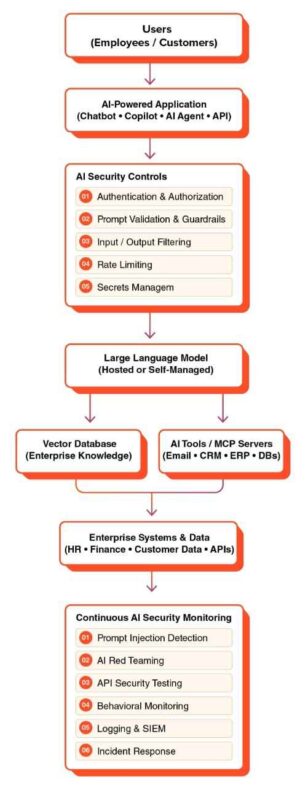
The diagram below provides a high-level overview of an enterprise AI application’s architecture and shows where key security controls are applied to protect AI systems.
Mapping the Enterprise AI Attack Surface
Securing AI means securing every layer of the AI ecosystem not just the model itself. Each layer introduces its own risks and requires appropriate security controls, including:
- AI models: targets for theft, adversarial manipulation, and behavior extraction.
- Training and fine-tuning data: poisoning here produces biased, inaccurate, or backdoored behavior downstream.
- Prompts: the primary interface attackers use for injection and jailbreak attempts.
- Vector databases: store the embeddings behind RAG; weak access control here exposes whatever enterprise knowledge base feeds the model.
- AI APIs: connect models to applications and services; insecure endpoints enable unauthorized access, data leakage, or usage abuse.
- Plugins and MCP servers: extend AI systems into enterprise tools; a compromised plugin is a direct path to unauthorized actions.
- AI agents and workflows: automate multi-step tasks; without authorization boundaries, a manipulated agent can act, not just answer.
- Third-party foundation models: introduce supply-chain risk that needs the same scrutiny as any other vendor dependency.
| AI Component | Typical Attack | Business Impact |
| LLM | Prompt Injection | Data Leakage |
| Vector DB | Unauthorized Retrieval | Sensitive Information Exposure |
| APIs | Broken Authentication | Account Takeover |
| Agents | Unauthorized Tool Calls | Fraud |
| Plugins | Supply Chain Attack | Remote Compromise |
Generative AI Security vs. Agentic AI Security
Not all AI risk looks the same, and lumping it together leads to the wrong controls. It’s worth separating two categories before going through specific risks.
Generative AI security is mostly about data flow. A chatbot, copilot, or RAG application takes input, produces output, and the main exposure is what goes in (sensitive data pasted into a prompt) and what comes out (a leaked secret, a hallucinated fact treated as truth). These risks are largely addressable with the controls already covered above: input/output filtering, DLP, access controls, shadow AI discovery.
Agentic AI security is a different problem. An agent doesn’t just respond; it acts: it can call APIs, move files, trigger transactions, and chain multi-step tasks without a human approving each one. That changes the risk profile in three ways:
- It often operates below the network layer. An agent working through a local browser session, a desktop app, or an OS-level integration can access data and take actions that never pass through the network controls built to catch traditional threats.
- It runs at machine speed. A human making a bad decision does it once, slowly. A manipulated agent can repeat a bad action thousands of times before anyone notices.
- It maintains persistent context. An agent’s memory of prior steps, credentials, and task state creates a standing target: compromise the context once, and every subsequent action inherits that compromise.
The practical implication: a read-only chatbot and a transaction-authorized agent are not the same risk tier, even if they’re built on the same model. Treat agent deployments as a distinct category in your asset inventory and risk assessment (see the checklist below), with mandatory human approval on high-risk actions and endpoint-level visibility, not just API-level monitoring.
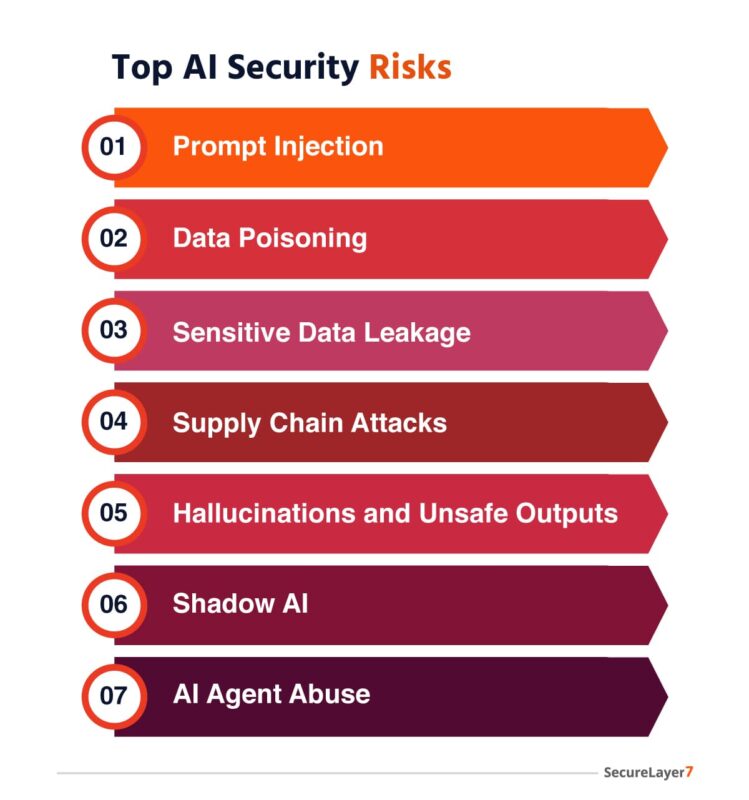
Top AI Security Risks
Before you craft an AI security strategy, it is essential to understand the types of AI security risks, ways to mitigate them and their business impact.
1. Prompt Injection Attackers craft inputs that cause a model to ignore its instructions, disclose confidential data, or take unauthorized action.
Impact: data leakage, policy bypass, compromised responses.
Mitigate by validating and isolating system prompts from user input, filtering outputs, and applying least-privilege to anything the model can call.
Example: A customer uploads a PDF containing hidden instructions. The RAG system retrieves those instructions, causing the chatbot to ignore internal rules and reveal confidential information.
2. Data Poisoning: Manipulated data introduced during training or fine-tuning skews model behavior toward incorrect or biased outputs.
Security researchers found roughly 100 malicious models hosted on Hugging Face. They separately documented that poisoning can cut accuracy by 27% in image recognition systems and 22% in fraud-detection models while poisoned models still perform normally on standard benchmark tests, which is what makes the attack hard to catch.
Impact: bad predictions, fraudulent approvals, degraded reliability.
Mitigate by sourcing only from verified data, validating datasets before ingestion, and monitoring data integrity continuously not just at training time.
3. Model Theft: Attackers steal model weights directly or reconstruct a model through repeated, systematic querying (model extraction).
In June 2026, Anthropic disclosed to the U.S. Senate Banking Committee that operators linked to Alibaba’s Qwen lab had created roughly 25,000 fraudulent accounts and run more than 28.8 million interactions against Claude between April and June 2026, Anthropic called it the largest documented model-distillation attack to date
Impact: IP loss, competitive disadvantage, reuse of an asset that cost real money to build.
Mitigate with authenticated endpoints, encrypted model artifacts, rate limiting, and monitoring for abnormal query patterns.
An attacker repeatedly queries a proprietary LLM API thousands of times to reconstruct the model’s behavior.
4. Sensitive Data Leakage: Confidential information surfaces through prompts, training data, RAG retrieval, or misconfigured access controls.
Impact: privacy violations, IP loss, regulatory exposure.
Mitigate by masking sensitive fields, enforcing RBAC, encrypting data at rest and in transit, and blocking unapproved data from entering training pipelines.
5. Insecure AI APIs: Weakly secured endpoints let attackers manipulate requests, abuse services, or extract data.
Impact: unauthorized access, runaway costs, service disruption. Mitigate with strong authentication, API gateways, rate limiting, input validation, and continuous API security testing.
6. Supply Chain Attacks: Compromised third-party models, libraries, or plugins reach the organization before anyone reviews them.
Impact: backdoors, malware, large-scale compromise.
Mitigate by verifying provenance, scanning dependencies, and maintaining an SBOM-equivalent for AI components.
7. Hallucinations and Unsafe Outputs: Models generate fabricated, biased, or harmful responses from insufficient grounding.
Impact: bad decisions, misinformation, compliance exposure.
Mitigate with human review on high-risk decisions, output guardrails, and grounding responses in verified enterprise data.
8. Shadow AI: Employees use unauthorized AI tools without IT oversight, often pasting sensitive business data into them.
Example: Employees paste confidential financial reports into public AI chatbots to summarize documents.
Impact: uncontrolled data exposure, inconsistent governance.
Mitigate with a clear usage policy, an approved internal alternative, and ongoing monitoring for unsanctioned tool use.
9. AI Agent Abuse: Attackers manipulate autonomous agents into unintended workflows or unauthorized transactions.
Impact: fraud, operational disruption, unauthorized system changes.
Mitigate with least-privilege permissions, mandatory human approval on high-risk actions, and continuous activity monitoring.
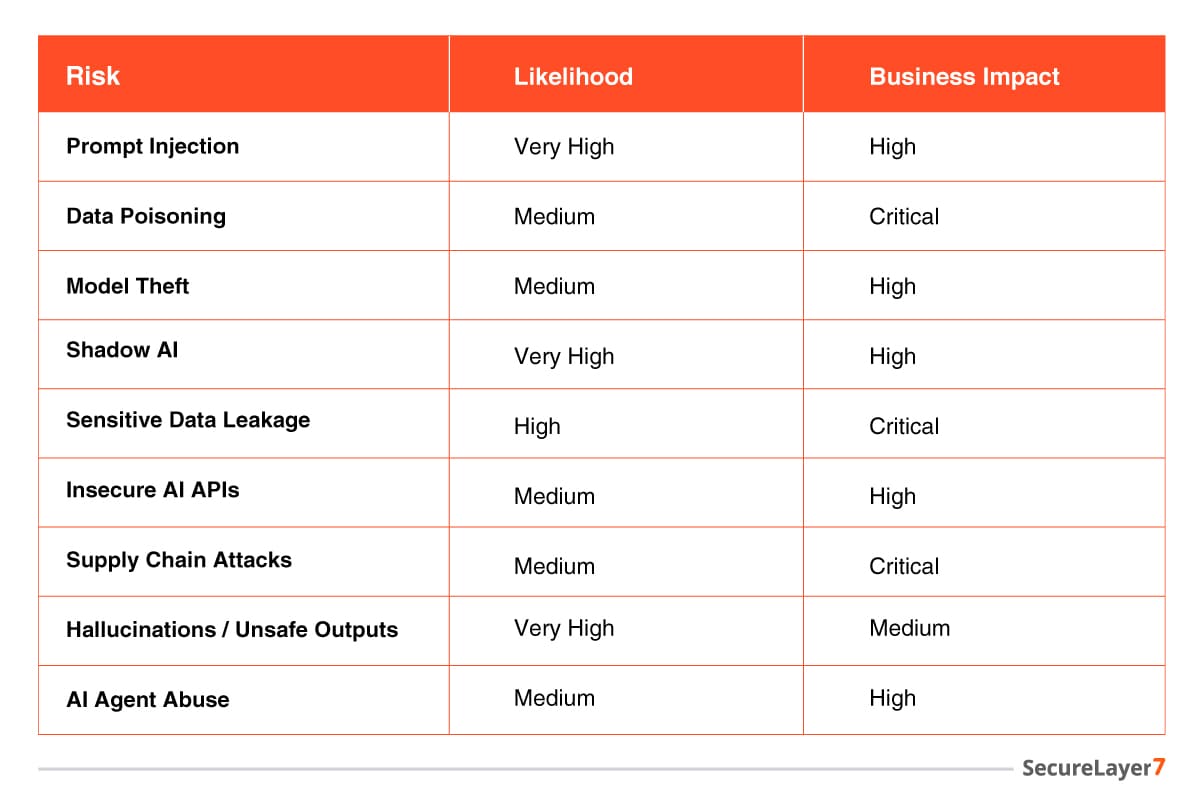
Below is a severity table to help you prioritize these risks based on their impact on your business:
Securing AI Across the Lifecycle
Most AI security vulnerabilities originate during design, development, or deployment, not just after launch. Embedding security throughout the AI lifecycle helps prevent risks early, reduces costly fixes, and creates more resilient, trustworthy AI systems.
Secure Design:
- Threat models the system (prompt injection, poisoning, extraction) before writing code; a short workshop upfront is far cheaper than rework later.
- Classify training data by sensitivity so compliance requirements are known before the model touches it.
- Weigh open-source, proprietary, and fine-tuned model options against actual risk tolerance, not just benchmark performance.
Secure Development:
- Validate and sanitize every input that reaches the model, such as prompts, uploads, and API payloads, applying the same level of scrutiny to SQL inputs.
- Scan the ML libraries and pre-trained components pulled into the project for known vulnerabilities.
- Store API keys, model weights, and training credentials in a Secrets Manager, never in notebooks or config files that end up in a repo.
Secure Deployment
- Isolate model-serving environments so a compromised model can’t become a foothold elsewhere.
- Rate-limit and authenticate every endpoint serving model output; unprotected inference APIs are one of the most common extraction vectors.
- Assign distinct identities per service and pipeline rather than a shared credential. Apply least-privilege to training data, model weights, and inference endpoints.
Continuous Monitoring
- AI systems degrade quietly rather than failing outright, which makes this stage non-negotiable. Log prompts, outputs, and decisions, not just system metrics so incidents can be reconstructed.
- Track drift as a security signal, since a sudden behavioral shift often indicates poisoning rather than routine data decay.
- Watch for repeated jailbreak attempts or unusual query volumes the same way you’d watch for brute-force login attempts.
- Maintain an AI-specific incident response plan; standard IR playbooks rarely cover extracted training data or manipulated outputs.
Governance and Retirement
- Version every model in production so an incident can be traced to the exact model responsible. Define and enforce retention limits on training data and logs
- Indefinite retention is a compliance liability, not a safety net.
- Map each lifecycle stage to relevant frameworks (GDPR, HIPAA, the EU AI Act) so governance is a continuously updated record, not a one-time checkbox.
AI Red Teaming vs. AI Penetration Testing
Most organizations run a web app pentest, get a clean report, and assume their AI application is covered. It isn’t. An AI system can pass every traditional security check and still be manipulated into leaking data or taking unauthorized action because penetration testing and red teaming find two different kinds of problems.
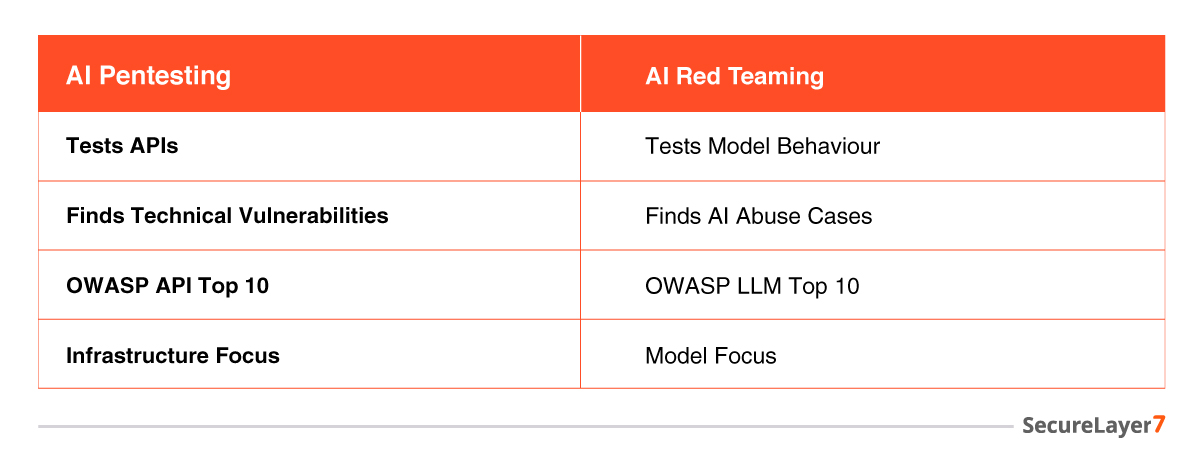
AI penetration testing applies offensive security methodologies to the systems surrounding an AI model, including APIs, authentication mechanisms, infrastructure, integrations, and access controls. It evaluates whether an attacker can exploit vulnerabilities in the surrounding application or infrastructure to gain unauthorized access to data, perform unauthorized actions, or compromise the AI system. These are traditional security flaws such as Broken Object Level Authorization (BOLA), insecure APIs, excessive permissions, and authentication or authorization weaknesses that exist independently of the AI model itself.
For example, a BOLA vulnerability in an AI application’s API exists regardless of whether anyone is interacting with the model. It remains exploitable at 3 a.m. just as it does during peak usage, even if no prompts are being sent to the AI.
AI red teaming targets the model’s behavior itself: can an attacker make it do something harmful even when nothing around it is technically broken? A model with locked-down APIs, solid authentication, and hardened infrastructure can still be talked into revealing its system prompt or triggering an unauthorized tool call, purely through how it’s prompted.
There’s also a reporting difference. A jailbreak that succeeds once may fail the next ten attempts depending on context window, temperature, or retrieved content, so red team findings need a confidence level established across repeated trials, not a single proof-of-concept.
Neither replaces the other. Penetration testing without red teaming leaves the model itself untested against manipulation. Red teaming without penetration testing leaves broken authorization sitting undetected regardless of how well the model resists jailbreaks. A complete assessment runs both, against both layers.
When to test:
- Before initial deployment, to establish a baseline for both disciplines
- After any fine-tune or retraining, previously resolved bypasses can reappear
- After any system prompt or guardrail change, however small
- After connecting new tools, plugins, or data sources
- On a recurring schedule, quarterly at minimum for production systems
- Before regulatory audits, to have current evidence rather than a year-old report
What a complete assessment covers:
- Maps the full attack surface: model, prompts, training data, vector databases, APIs, plugins, agents
- Tests infrastructure against standard vulnerability classes
- Runs structured jailbreak suites against known and emerging techniques
- Tests direct and indirect prompt injection, including hidden instructions in retrieved documents
- Attempts data and model extraction through repeated, varied querying
- Tests whether the model can be tricked into unauthorized tool calls
- Reviews output filtering for PII and internal data leakage
- Maps findings to OWASP Top 10 for LLMs and MITRE ATLAS, so results feed a governance record instead of a one-off report
Choosing the Right Framework
You have already decided that you want to implement AI security; the next question that comes is which framework to use.
Below are four AI security frameworks to help you get started.
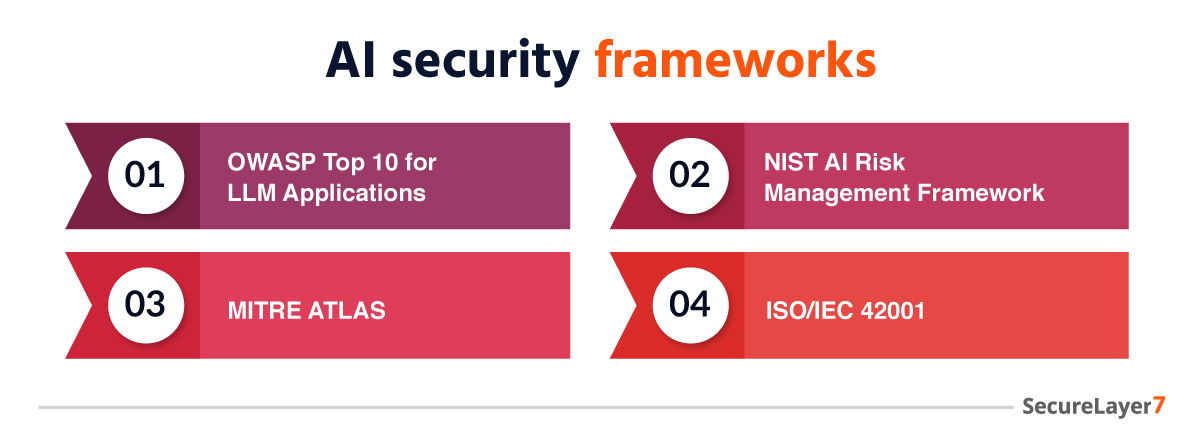
OWASP Top 10 for LLM Applications: the most tactical of the four: a catalog of specific vulnerability classes (prompt injection, insecure output handling, training data poisoning, model theft) with clear technical descriptions.
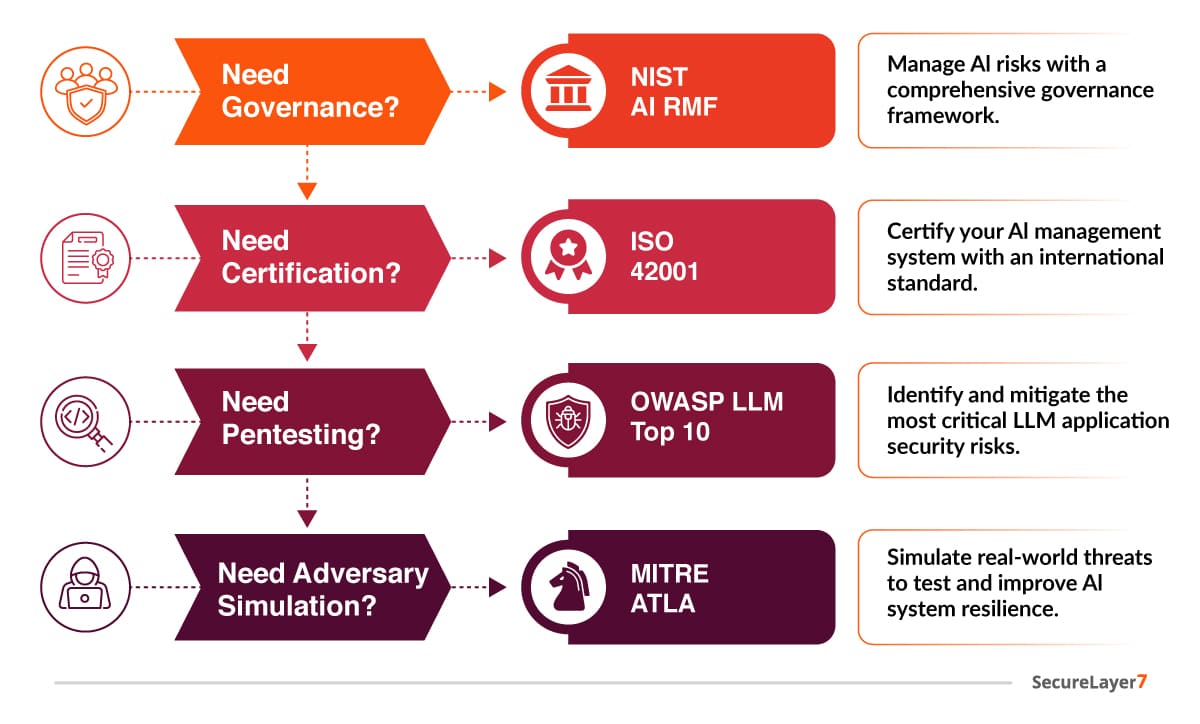
Reach for this when scoping a pentest or red team engagement, or when developers need a concrete list of what to defend against while building an LLM feature.
It answers “what could go wrong with this application,” not “how should we govern AI organization-wide.”
NIST AI Risk Management Framework: structured around four functions (Govern, Map, Measure, Manage), deliberately broader than security alone; covers trustworthiness, fairness, and reliability alongside security risk.
Reach for this when a CISO needs a framework to present to a board, or when building internal AI governance policy from scratch.
MITRE ATLAS: catalogs real-world adversary tactics and techniques against AI systems, the AI equivalent of ATT&CK for traditional infrastructure.
Reach for this during red team planning and reporting, or when translating findings into language a threat intel or SOC team already uses.
ISO/IEC 42001: a certifiable, auditable AI management system standard, structured like ISO 27001 but for AI.
Reach for this when a customer or regulator requires third-party certification, or when AI governance needs to sit alongside an existing ISO 27001 program.
Putting them together: a mature program layers all four: NIST or ISO for organization-wide governance, OWASP Top 10 for application-level testing, MITRE ATLAS for tracking adversary techniques across red team engagements. A board wants NIST or ISO; a pentester wants OWASP; a threat intel team wants ATLAS.
A small flowchart below will give you a quick understanding of which framework to choose when:
AI Security Checklist for Security Teams
A working checklist, not a one-time audit where each item defines what “done” looks like, not just the task name.
Asset inventory
- Maintain a live inventory of every AI model, LLM integration, and AI-powered feature in production, including shadow AI surfaced through browser/network monitoring.
- Record owning team, data touched, first- vs. third-party status, and connected APIs/plugins/agents for each asset.
- Re-run discovery quarterly where AI tool adoption outpaces most inventory cycles.
Risk assessment
- Threat-model every new AI system before deployment, covering at minimum prompt injection, data poisoning, and model extraction.
- Assign a risk tier based on data access and action authority; a read-only chatbot and an agent with transaction authority are different risk classes.
- Re-assess after any fine-tune, retraining, new integration, or system prompt change, not just annually.
Data governance
- Classify training and fine-tuning data by sensitivity before it touches a model.
- Verify provenance and integrity of any third-party or synthetic training data before ingestion.
- Define and enforce retention limits for training data, logs, and prompt history.
- Track data lineage so you can answer “where did this training data come from” during an incident.
Prompt security
- Keep system prompts separated from user input via role-based message structure never concatenated.
- Filter prompts for known injection and jailbreak patterns before they reach the model.
- Scope retrieval by tenant and use case so a model instance can only reach the documents it should.
- Require explicit authorization for any tool call or transaction the model attempts and no silent auto-execution on high-risk actions.
API protection
- Authenticate and authorize every inference and management endpoint, including internal ones.
- Rate-limit per API key against baseline traffic, with hard blocks above a defined multiple.
- Test AI APIs against the OWASP API Security Top 10 on the same cycle as other production APIs.
- Scope third-party integration permissions to the minimum required.
Logging and monitoring
- Log full prompt-response pairs, not just system metrics.
- Feed AI-specific logs into the existing SIEM/SOC workflow instead of a siloed dashboard.
- Alert on repeated near-identical prompts from one session, known jailbreak markers, or query volume spikes.
- Track model drift as a security signal, not just a data science concern.
Vendor risk management
- Evaluate every third-party or foundation model for provenance, update cadence, and known vulnerability history before adoption.
- Require vendors to disclose their own red teaming and penetration testing cadence during procurement.
- Maintain an SBOM-equivalent for externally sourced libraries, pre-trained models, and fine-tuning datasets.
- Re-review vendor risk annually or after any major vendor incident.
Employee AI usage policy
- Publish a specific policy on which AI tools are approved and what data can and can’t be entered into them.
- Providing a sanctioned enterprise AI tool policy without an alternative just drives usage underground.
- Train employees on AI-specific risk at onboarding and on a recurring cadence.
- Monitor for shadow AI continuously, not just at policy rollout.
Regular security testing
- Run AI penetration testing on the same cycle as other production systems, which is typically every 6–12 months.
- Run AI red teaming before deployment, after every fine-tune or prompt change, and quarterly at minimum for production systems.
- Map findings from both to OWASP Top 10 for LLMs and MITRE ATLAS so results build an auditable record.
- Confirm retesting actually happens after major model updates this is the step most programs skip.
Common AI Security Mistakes to Avoid
- Treating AI like a traditional application. Hardening the code and infrastructure around a model isn’t the same as securing the model because that risk lives in behavior, not the surrounding code.
- Testing only for direct prompt injection. Indirect injection hidden in retrieved documents, emails, or web content needs dedicated testing, not a line item in a risk register.
- Letting sensitive data reach public AI tools. Employees pasting internal documents or customer data into consumer AI tools is one of the most common, least monitored ways data leaves an organization, and a policy alone doesn’t stop it without a sanctioned alternative.
- Deploying AI without a defined owner or risk tier. No one is accountable when something goes wrong, and no one tracks the system’s existence until an incident forces the question.
- Trusting AI outputs without validation, especially when outputs trigger approvals, transactions, or automated actions without a human or business-rule check in between.
- Assuming one assessment covers the system indefinitely. Fine-tunes, prompt changes, and new tool integrations can all reopen previously closed gaps.
AI Security Tools
No single tool can secure every aspect of an AI system. Depending on your security goals, you may need different tools for vulnerability assessment, red teaming, prompt injection detection, adversarial testing, and API security.
| Tool | Purpose |
| Garak | LLM Vulnerability Testing |
| PyRIT | AI Red Teaming |
| Lakera | Prompt Injection Detection |
| Protect AI | Model Security |
| Microsoft Counterfit | Adversarial Testing |
| OWASP ZAP | API Security |
How SecureLayer7 Helps Secure Enterprise AI
SecureLayer7 works across the full AI security lifecycle described above rather than testing a model in isolation:
- AI security assessments that map the complete attack surface, including model, training data, prompts, vector databases, APIs, plugins, and connected agents before scoping any testing.
- LLM penetration testing against the infrastructure and APIs serving a model: authentication, authorization, rate limiting, and integration security.
- AI red teaming using structured jailbreak and adversarial testing suites, reported with confidence levels across repeated trials rather than a single proof-of-concept.
- API security testing benchmarked against the OWASP API Security Top 10 for every endpoint an AI feature exposes.
- Secure SDLC reviews that catch AI-specific gaps such as sanitized prompt handling, unmanaged secrets, unscanned ML dependencies found during development, not after launch.
- Cloud security assessments for the infrastructure hosting model training and inference.
- Continuous AI security validation on a recurring cadence tied to fine-tunes, prompt changes, and new integrations, not a single point-in-time report.
Conclusion
As AI adoption continues to accelerate, securing AI systems is no longer optional; it’s a business imperative. Unlike traditional applications, AI introduces unique risks that require dedicated security controls across the entire AI lifecycle, from governance and secure development to rigorous testing and continuous monitoring. By adopting proven security frameworks and implementing AI-specific security practices, organizations can build trustworthy AI systems while reducing security, privacy, and compliance risks.
Connect with SecureLayer7 to assess, secure, and strengthen your AI applications, enabling your organization to innovate with confidence and deploy AI you can trust.
Frequently Asked Questions (FAQs)
AI security is the practice of protecting AI systems, including models, training data, prompts, APIs, and supporting infrastructure, from cyberattacks, unauthorized access, data leakage, and misuse. It also includes governance, continuous monitoring, and security testing to ensure AI systems remain secure throughout their lifecycle.
AI applications introduce unique risks such as prompt injection, data poisoning, model theft, and sensitive data leakage that traditional application security cannot fully address. AI security helps organizations protect their AI systems, maintain compliance, and reduce the risk of data breaches and operational disruptions.
The most common AI security risks include prompt injection, data poisoning, model theft, sensitive data leakage, insecure AI APIs, supply chain attacks, hallucinations, shadow AI, and AI agent abuse. Understanding these risks is the first step toward building a secure AI environment.
AI penetration testing focuses on identifying vulnerabilities in the infrastructure, APIs, authentication, and integrations surrounding AI systems. AI red teaming evaluates the AI model itself by simulating attacks such as prompt injection, jailbreaks, and model manipulation to identify weaknesses in model behaviour.
Organizations can strengthen AI security by implementing AI governance policies, performing threat modelling, protecting training data, securing AI APIs, enforcing access controls, continuously monitoring AI systems, and regularly conducting AI penetration testing and AI red teaming.

