
The Vulnerability Management Lifecycle is a comprehensive, structured approach to identifying, assessing, and addressing security vulnerabilities within an organization’s IT infrastructure. As modern IT environments become more complex – spanning cloud services, endpoints, APIs, and third-party integrations the need for a well-defined vulnerability management strategy is more critical than ever.
By understanding and implementing each stage of the vulnerability management lifecycle, organizations can strengthen their security posture and minimize exposure to evolving cyber risks. Taking a proactive approach helps businesses address vulnerabilities before they can be exploited by attackers, ensuring long-term resilience and robust protection against security breaches.
Why Modern Organizations Need Continuous Vulnerability Oversight
IT environments evolve rapidly. New devices, applications, workloads, and updates appear every day. This constant change means new vulnerabilities can emerge at any moment. Attackers exploit newly disclosed flaws within hours, making traditional periodic scanning or annual assessments ineffective.
Modern organizations need continuous vulnerability oversight because:
- Security weaknesses can appear anytime through new deployments or updates
- Delayed remediation leaves systems exposed to active threats
- Business-critical systems rely on secure, uninterrupted operations
Rising Risks Due to Expanding Attack Surfaces, Cloud Adoption, and Complex IT Environments
As organizations adopt more digital tools, cloud services, and interconnected systems, their attack surfaces continue to expand. Every new endpoint, application, API, and cloud resource introduces additional pathways that attackers can target. This ongoing growth makes it harder to maintain visibility, enforce consistent security controls, and detect vulnerabilities in time.
Cloud adoption intensifies these challenges, especially as businesses operate across multi-cloud and hybrid environments. Misconfigured storage buckets, overly permissive IAM roles, unmanaged shadow IT assets, and rapidly changing cloud workloads increase the likelihood of security gaps.
Why Vulnerability Management Matters Today
Modern businesses operate in an environment where cyber threats evolve faster than traditional security practices can keep up. As digital transformation expands the attack surface – cloud workloads, APIs, SaaS platforms, mobile apps, remote assets – vulnerabilities are no longer rare exceptions but an everyday reality.
The Increase in Vulnerabilities Discovered Every Year
Every year, the number of publicly reported vulnerabilities continues to rise. According to industry databases like NVD, tens of thousands of new vulnerabilities are discovered annually – many rated critical or high severity.
This rapid increase is driven by:
- The expanding number of digital systems, devices, and microservices
- More researchers and automated scanners identifying flaws
- Growth in open-source software usage
- Complex supply chains with inherited third-party risks
Real-World Impact of Unpatched Systems and Poor Visibility
Unpatched vulnerabilities remain one of the most common causes of major cyberattacks. From ransomware outbreaks to data breaches, threat actors exploit the simplest gaps – missing patches, misconfigurations, and forgotten assets.
High-profile incidents such as Equifax, WannaCry, and MOVEit attacks all stemmed from known vulnerabilities that were left unresolved. Poor visibility magnifies the problem. Many enterprises don’t have a complete inventory of:
- Cloud assets
- Containers and microservices
- Shadow IT resources
- Endpoint devices
- Third-party integrations
The Need for Proactive, Continuous Risk Reduction
Cybersecurity can no longer rely on periodic scans or annual audits. Threat actors operate 24/7, exploiting new vulnerabilities within hours of public disclosure. To keep pace, organizations must shift from reactive patching to proactive, continuous vulnerability management,
Which includes:
- Ongoing scanning across cloud, on-premise, and hybrid environments
- Real-time prioritization based on exploitability, asset value, and risk context
- Automated remediation workflows to accelerate patching and configuration fixes
- Integration with SIEM, SOAR, and ITSM tools to streamline response
- Continuous validation to ensure fixes are effectively applied
The Stages of the Vulnerability Management Lifecycle
The Vulnerability Management Lifecycle is a systematic process for identifying, prioritizing, and remediating security vulnerabilities across an organization’s IT systems. With the increasing complexity of modern infrastructures, this lifecycle helps businesses proactively manage risks, reduce exposure, and strengthen overall security by addressing vulnerabilities efficiently at each stage.
Asset Discovery and Inventory
Asset Discovery and Inventory is the foundational stage of the vulnerability management lifecycle. It involves identifying every IT asset within an organization’s environment, including servers, endpoints, network devices, cloud resources, applications, containers, and shadow IT components.
A continuously updated inventory is essential because modern infrastructures evolve rapidly. New cloud instances spin up, employees connect personal devices, applications get deployed, and configurations change frequently. Real-time discovery tools help track these changes and prevent assets from falling outside the security scope.
Vulnerability Scanning and Discovery
Vulnerability scanning and discovery are critical components of a robust vulnerability management lifecycle. This stage involves using automated tools to scan an organization’s systems – servers, endpoints, networks, and applications for weaknesses such as outdated software, misconfigurations, weak credentials, and known vulnerabilities.
The process includes both internal scanning, which assesses assets within the organization’s network, and external scanning, which simulates an external attacker’s view of public-facing systems.
Vulnerability Analysis and Prioritization
Once vulnerabilities are discovered through automated scanning, the next critical step is analyzing and prioritizing them based on severity and risk. The Common Vulnerability Scoring System (CVSS) is commonly used to assess the severity of vulnerabilities. CVSS assigns a score to vulnerabilities based on factors such as exploitability, the complexity of an attack, and the potential impact on an organization.
Prioritization takes into account several other factors, such as the asset value, exploitability, and business impact. Vulnerabilities affecting mission-critical systems or high-value assets should always be prioritized higher, even if their CVSS scores are lower.
Remediation and Mitigation
Remediation and Mitigation are critical stages in the vulnerability management lifecycle, focusing on resolving identified vulnerabilities and reducing the risk they pose to the organization. Remediation involves fixing the root cause of vulnerabilities, typically through patching software, reconfiguring systems, or applying security updates.
Mitigation strategies may include applying temporary controls, such as firewalls, access restrictions, or compensating controls, to reduce the vulnerability’s potential impact while a permanent fix is being developed. Both remediation and mitigation require collaboration across IT, DevOps, and security teams, ensuring that changes are made in alignment with organizational goals and do not disrupt other systems.
Verification and Monitoring
After remediation, the next essential step is verification, which ensures that the fixes applied have effectively resolved the vulnerabilities. This stage involves re-scanning the systems to confirm that the patches or configuration changes were correctly implemented and that no vulnerabilities remain.
Continuous monitoring is also vital for maintaining long-term security. As IT environments evolve, vulnerabilities can reappear due to configuration drift, new deployments, or changes in access controls. Ongoing monitoring ensures that any newly discovered vulnerabilities or recurring issues are detected early.
Reporting and Continuous Improvement
The final stage of the vulnerability management lifecycle focuses on reporting and continuous improvement. Reporting provides transparency and accountability, offering leadership insights into the effectiveness of the vulnerability management program. Dashboards and metrics track key indicators such as remediation times, vulnerability trends, and SLA compliance.
Continuous improvement ensures that the vulnerability management process evolves over time. By analyzing trends, patterns, and recurring vulnerabilities, organizations can refine their approach to asset discovery, vulnerability scanning, and remediation.
Key Challenges in the Vulnerability Management Lifecycle
Vulnerability management is essential for protecting organizations from cyber threats, but several challenges can hinder its effectiveness. From incomplete asset inventories and patch management delays to the overwhelming volume of vulnerabilities and difficulties in prioritizing real threats, organizations face multiple barriers in maintaining a strong security posture.
Understanding these challenges is the first step toward creating a more efficient and proactive vulnerability management strategy.
Following are the most common challenges security teams face across the vulnerability management lifecycle.
Shadow IT and Incomplete Asset Inventories
Shadow IT introduces critical blind spots in an organization’s security posture. When teams deploy their own tools, servers, cloud resources, or SaaS platforms without IT approval, these assets fall outside official monitoring and patch cycles.
Incomplete asset inventories weaken vulnerability management efforts. Many organizations still rely on manual or outdated inventory processes, which fail to keep pace with modern, dynamic environments. Cloud instances spin up and down quickly, remote devices connect from multiple locations, and applications continuously change.
Patch Management Delays Due to Operational Constraints
Patching remains one of the most effective ways to eliminate known vulnerabilities, yet operational reality often slows the process. Production systems may require long testing cycles, maintenance windows may be limited, and patch deployment may risk service interruptions. In environments where uptime is a priority, patches are sometimes postponed, leaving critical vulnerabilities open longer than acceptable.
Operational workflows also contribute to patching delays. Larger organizations require formal change approvals, cross-team coordination, and rollback planning, which lengthen remediation timelines. Legacy systems complicate the process further, as patches may introduce instability or compatibility issues.
High Volume of Vulnerabilities vs Limited Resources
Modern IT environments generate an overwhelming number of vulnerability findings, making it difficult for security teams to keep up. Automated tools often detect thousands of issues across applications, endpoints, and cloud environments, but not every finding requires immediate action. With limited staff, competing operational demands, and tight remediation deadlines, teams struggle to filter signals from noise.
Limited resources amplify the challenge. Many security teams operate with lean staffing and cannot dedicate full-time personnel to vulnerability triage, tracking, and remediation. Budget constraints also limit the ability to invest in automation or advanced tooling.
Difficulty Prioritizing Real Threats
Prioritizing which vulnerabilities to fix first requires more than looking at severity scores. Security teams must consider exploit availability, asset value, business impact, and exposure. Without proper risk context, organizations may spend time on low-impact vulnerabilities while high-risk issues remain unaddressed.
The lack of integrated threat intelligence complicates prioritization. Without visibility into which vulnerabilities attackers actively target, teams may misjudge urgency.
Coordination challenges across teams
Vulnerability management requires synchronized effort across security, IT, DevOps, network, and cloud teams. Each group has different priorities and workflows, making coordination difficult. Security teams focus on risk reduction, while IT teams emphasize system stability and uptime.
Clear ownership and accountability are often lacking. Without defined responsibilities, tasks fall through the cracks, and SLAs are missed. Communication gaps can delay fixes, especially when vulnerabilities require changes across environments or involve third-party systems.
Best Practices to Strengthen Your Vulnerability Management Lifecycle
To effectively manage vulnerabilities and reduce risk, organizations must implement best practices that ensure each stage of the vulnerability management lifecycle is optimized. From maintaining accurate asset inventories to automating scans and defining clear remediation SLAs, these best practices help improve efficiency, speed up response times, and ensure vulnerabilities are addressed proactively before they can be exploited.
Maintain Accurate, Real-Time Asset Inventories
A strong vulnerability management program begins with complete visibility into every asset across your infrastructure. Real-time inventories ensure that servers, endpoints, applications, APIs, containers, and cloud workloads are continuously tracked and monitored.
Dynamic IT environments require ongoing asset discovery rather than periodic audits. Automated discovery tools help identify newly deployed cloud resources, ephemeral workloads, and devices added by remote teams. Maintaining an accurate inventory enables more precise vulnerability scanning, better prioritization, and stronger resource allocation for remediation.
Automate Scanning and Ticket Creation
Automation is essential for keeping pace with the growing number of vulnerabilities uncovered each day. Automated scanners ensure continuous evaluation of systems, detecting misconfigurations, outdated software, weak credentials, and known CVEs as soon as they appear.
Automating ticket creation streamlines the remediation process. When vulnerabilities automatically generate tasks in ITSM or DevOps systems, there is less risk of delays or missed findings. Automated workflows ensure accountability, accelerate response timelines, and eliminate the gaps caused by manual coordination.
Integrate Vulnerability Tools With SIEM/SOAR
Integrating vulnerability scanning platforms with SIEM and SOAR systems enhances the organization’s ability to respond quickly and intelligently. SIEM platforms provide real-time logs and event correlation, helping teams understand how vulnerabilities are exploited or attempted across their environment.
SOAR integrations allow organizations to automate repetitive responses, coordinate workflows across teams, and initiate predefined playbooks for high-severity vulnerabilities. This increases operational efficiency and ensures a consistent, standardized response across the entire vulnerability lifecycle.
Use Threat Intelligence for Better Prioritization
Threat intelligence provides crucial insights into which vulnerabilities are actively being weaponized in the wild. Prioritizing vulnerabilities using real-world exploit data helps teams focus on issues that pose genuine and immediate danger.
By combining CVSS scores with exploit trends, attacker tactics, and advanced analytics, organizations can create a risk-based vulnerability management strategy. This approach ensures that remediation efforts align with the evolving threat landscape, enabling more proactive and effective decision-making.
Define Clear Remediation SLAs
Well-defined remediation SLAs help teams establish expectations for how quickly vulnerabilities must be resolved based on their severity. SLAs create accountability and discipline across IT, DevOps, and security teams, ensuring that high-risk vulnerabilities receive the prompt attention they require.
Clear timelines promote consistent execution and prevent backlogs from accumulating. SLAs also help organizations report progress to leadership, track performance across departments, and demonstrate compliance with regulatory or industry standards.
Train Teams on Secure Configurations and Patch Hygiene
Human error remains a major cause of vulnerabilities, underscoring the importance of continuous training. Educating teams on secure configuration practices, patch hygiene, and common misconfiguration pitfalls helps prevent vulnerabilities before they occur.
Training also fosters a culture of security awareness across departments. DevOps, IT, and engineering teams benefit from updated best practices, hands-on training exercises, and knowledge-sharing sessions. This reduces misconfigurations, accelerates patching, and makes the entire vulnerability management process more efficient.
Adopt Continuous Monitoring Across Cloud and On-Premise Environments
Modern environments demand real-time monitoring rather than scheduled periodic reviews. Continuous monitoring ensures rapid detection of new vulnerabilities, misconfigurations, compliance drift, and emerging threats across cloud, hybrid, and on-premise systems.
Continuous monitoring platforms also help detect reintroduced vulnerabilities caused by configuration changes, new deployments, or patch failures. By maintaining a persistent watch over the environment, organizations can significantly reduce their exposure window and maintain a more resilient security posture.
Automation in the Vulnerability Management Lifecycle
Automation plays a crucial role in enhancing the efficiency and effectiveness of the vulnerability management lifecycle. By automating tasks such as vulnerability scanning, ticket creation, and patch deployment, organizations can respond faster, reduce human error, and ensure consistent, repeatable processes.
Automation helps security teams prioritize and remediate vulnerabilities in real-time, ultimately strengthening the organization’s security posture and minimizing exposure.
Automated Scanning and Triage
Automated scanning tools continuously evaluate servers, endpoints, cloud workloads, and applications for vulnerabilities without requiring manual intervention. These tools detect misconfigurations, outdated software, and known CVEs in real time, ensuring organizations identify threats as soon as they appear.
This automated approach eliminates delays caused by periodic manual scans and ensures consistent visibility across dynamic environments. It also reduces the risk of human error, enabling faster and more reliable detection of vulnerabilities across large, complex infrastructures.
Automatic Assignment of Remediation Tasks
Vulnerabilities are identified and triaged, automation can assign remediation tasks directly to the responsible teams through ITSM, DevOps, or project management platforms. Automated ticket creation ensures no vulnerability is overlooked or delayed due to manual coordination.
Automatic task assignment streamlines workflows, accelerates the remediation process, and creates a standardized, repeatable process for handling vulnerabilities.
Orchestrating Patching Workflows Through SOAR Platforms
Security Orchestration, Automation, and Response (SOAR) platforms take automation a step further by coordinating end-to-end patching workflows. SOAR playbooks can automatically verify vulnerability details, check patch availability, initiate patch deployment, validate installation, and escalate exceptions.
SOAR-driven orchestration also ensures consistency across departments by enforcing predefined processes and compliance rules. This structured automation minimizes the risk of patching errors, shortens remediation windows, and aligns patch management with broader security operations.
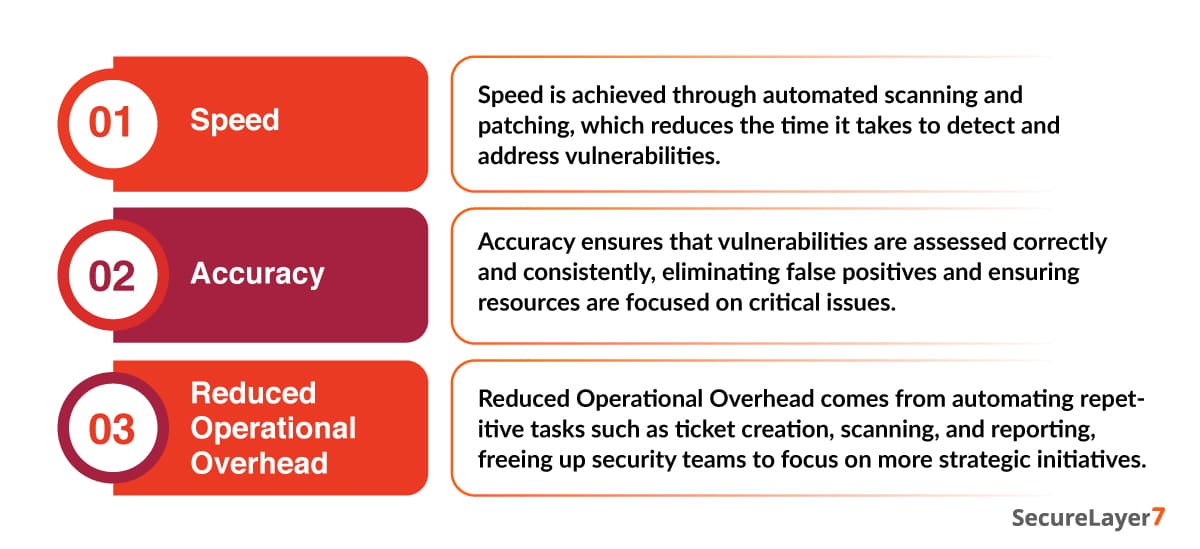
Benefits: Speed, Accuracy, and Reduced Operational Overhead
Effective vulnerability management relies on speed, accuracy, and reduced operational overhead. Automation plays a key role in achieving these benefits, enabling organizations to identify, assess, and remediate vulnerabilities faster while minimizing human error and resource strain.
Real-World Examples of Vulnerability Lifecycle Failures
Despite best efforts, many organizations still face significant security breaches due to failures in their vulnerability management processes. Due to patch delays, misconfigurations, or incomplete asset inventories, these failures provide valuable lessons.
By examining real-world incidents, organizations can better understand common pitfalls in the vulnerability lifecycle and implement more effective strategies to avoid similar mistakes in the future.
Example: Patch Delay Leading to a Ransomware Attack
Ransomware groups frequently exploit known vulnerabilities that have publicly available patches. A financial services company delayed applying a critical patch due to concerns about system downtime and application compatibility. Attackers used a months-old vulnerability to gain initial access, deploy ransomware across workstations and servers, and encrypt sensitive data.
This type of incident is common because many businesses still manage patching manually or rely on quarterly update cycles. By the time patches are applied, attackers may have already built automated exploits targeting these vulnerabilities.
Example: Misconfigured Cloud Resource Exposing Sensitive Data
Cloud misconfigurations have become one of the most frequent causes of data exposure. In a widely publicized incident, a company accidentally left a cloud storage bucket publicly accessible.
This failure highlights the danger of relying solely on traditional on-premise scanning practices. Cloud environments change rapidly, and manual checks are not enough to keep pace. The lesson for organizations is to treat configuration monitoring as a continuous process and ensure automated policy enforcement across all cloud assets.
What Organizations Can Learn from Each Case
These examples reveal a common theme: most breaches occur not because organizations lack security tools, but because their vulnerability management lifecycle breaks at critical points. Delayed patching creates windows of exposure, misconfigurations arise when monitoring is inconsistent, and incomplete inventories result in assets slipping through the cracks.
To avoid similar incidents, organizations must implement continuous asset discovery, automate patch workflows, enforce cloud configuration policies, and ensure full lifecycle visibility from detection to remediation.
Conclusion
The Vulnerability Management Lifecycle is a crucial framework for identifying and addressing security weaknesses before they can be exploited. As organizations grow and their IT environments become more complex, managing vulnerabilities efficiently is essential to protecting sensitive data and ensuring business continuity.
To strengthen your vulnerability management lifecycle, SecureLayer7 offers automated tools, advanced threat intelligence, and a comprehensive suite of security solutions designed to streamline detection, remediation, and reporting. Embrace a proactive approach to cybersecurity and ensure your organization remains resilient in the face of evolving threats.
Reach out to SecureLayer7 today to learn how we can help you build a robust vulnerability management strategy.
Frequently Asked Questions (FAQs)
The vulnerability management lifecycle is a continuous process that helps you discover, assess, prioritize, fix, and monitor security vulnerabilities in your IT assets. Its goal is to reduce risk and prevent attackers from exploiting weaknesses.
It helps you stay ahead of threats by identifying security gaps before attackers do. Without a structured lifecycle, vulnerabilities can remain unpatched for months and lead to data breaches or ransomware attacks.
Scans should be run continuously or on a frequent schedule (weekly or monthly), depending on the size and criticality of your environment. High-risk systems may require daily or real-time scanning.
Organizations typically use vulnerability scanners, SIEM platforms, SOAR tools, patch management systems, and asset inventory tools. These systems help automate scanning, prioritization, and remediation workflows.
Prioritization is based on severity scores (like CVSS), exploitability, asset value, business impact, and threat intelligence. Critical issues affecting high-value assets should be addressed first.

