
Application penetration testing is a controlled offensive security assessment that determines whether weaknesses in an application can be exploited under realistic attack conditions. Instead of producing only a list of potential vulnerabilities, penetration testers safely demonstrate how individual flaws or combined attack paths could lead to account takeover, unauthorized data access, privilege escalation, transaction manipulation, or business disruption.
By uncovering security weaknesses from an attacker’s perspective, application penetration testing helps organizations strengthen their security posture, meet regulatory compliance requirements, and reduce the risk of costly data breaches.
Why Applications are the Biggest Attack Surface
Modern applications span multiple layers, from web and mobile interfaces to APIs, microservices, cloud functions, databases, identity providers, and third-party integrations. This distributed architecture creates complex attack paths that simple scanning often misses.
Attackers can chain minor information disclosures, exploit API flaws, or abuse authorization gaps to access sensitive accounts or administrative functions. Application penetration testing evaluates both public and authenticated functionality, including workflows, file handling, account recovery, administrative interfaces, and third-party services, mapping vulnerabilities across trust boundaries to prevent cascading breaches.
Limitations of Traditional Security Testing
Organizations relied heavily on Static Analysis (SAST) and basic Vulnerability Scanning. These tools are excellent for catching known code flaws, they have significant blind spots:
- False Positives: Automated tools often flag non-issues, leading to alert fatigue for developers.
- Context Blindness: Scanners cannot understand Business Logic Flaws such as an attacker bypassing a payment gateway or escalating their own privileges.
- Static Nature: Traditional testing often happens at a single point in time, failing to account for the dynamic nature of modern, microservice-based architectures.
Where Penetration Testing Fits in DevSecOps
Continuous scanning can identify common security defects during development, while penetration testing validates the risks that require human judgment.
In a DevSecOps programme, penetration tests are particularly valuable:
- Before major releases
- After changes to authentication or authorization
- Following significant API or architecture changes
- Before launching sensitive business workflows
- After a security incident
- When automated testing identifies high-risk findings requiring validation
What is Application Penetration Testing?
Application Penetration Testing is the process of simulating a cyberattack on an application to identify security vulnerabilities that hackers could exploit. To assess how well an application can withstand real-world attacks, uncover weaknesses in its defenses, and offer actionable insights to improve its security.
Unlike traditional vulnerability assessments, which often only identify issues, penetration testing attempts to exploit vulnerabilities in real-time, mimicking the tactics used by cybercriminals. By performing a real-world attack simulation, penetration testers can identify weaknesses that may not be discovered by automated tools alone.
Definition and Core Objectives
Application Penetration Testing is the process of identifying, exploiting, and reporting security vulnerabilities in web, mobile, or desktop applications.
The core objectives include:
- Identifying Logical Flaws: Finding bugs that scanners miss, such as the ability to bypass a payment screen or access another user’s private data.
- Risk Quantification: Determining the actual impact of a vulnerability.
- Validating Defenses: Testing whether your WAF (Web Application Firewall) and authentication systems actually stop a skilled hacker.
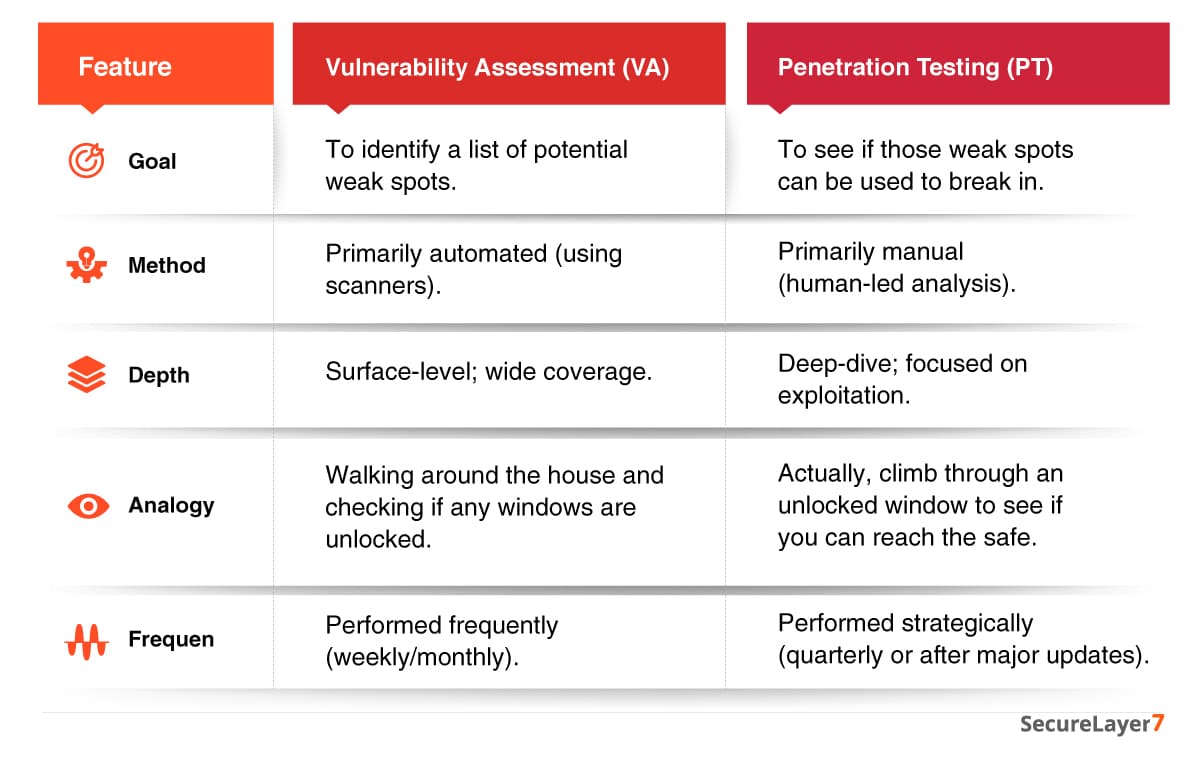
Vulnerability Assessment vs. Penetration Testing
These terms are often used interchangeably; they are fundamentally different services. Think of it like a home security check:
Real-World Attack Simulation Approach
Application penetration testing evaluates complete attack paths instead of treating every finding as an isolated weakness. Rather than just following a checklist, testers replicate the actual techniques used by cybercriminals today.
- Reconnaissance: Testers gather public info about your app, such as tech stacks and employee details, to find the path of least resistance.
- Chaining Vulnerabilities: Real attackers rarely rely on one big bug. A pen tester might combine three low severity issues – such as a descriptive error message, a weak password policy, and an insecure cookie – to gain full control of an account.
- Lateral Movement: Once the tester gains User access, they simulate the next step of an attack: trying to move horizontally to other accounts or vertically to become a System Admin.
- Evasion: The tester checks if your security team or automated monitoring systems even notice the attack happening, providing a true test of your Incident Response capabilities.
Types of Application Penetration Testing
Application penetration testing can be classified into various types based on the type of application being tested. Each type focuses on different attack vectors and techniques to ensure comprehensive security coverage. Following are the most common types:
Web Application Penetration Testing
Web application penetration testing evaluates browser-based functionality, server-side processing, session controls, access restrictions, and business workflows.
For a detailed breakdown of the assessment process, refer to our Web Application Penetration Testing Methodology guide, which explains planning, reconnaissance, exploitation, and reporting in depth.
Testing commonly covers:
- Authentication and account-recovery bypass
- Session fixation and token manipulation
- Horizontal and vertical privilege escalation
- Injection vulnerabilities
- Cross-site scripting
- Server-side request forgery
- Insecure file uploads
- Checkout and workflow manipulation
- Administrative-function exposure
Mobile Application Penetration Testing
Mobile testing goes beyond the code to look at how the app interacts with the device’s operating system (Android or iOS).
- Android & iOS Security: Testing focuses on platform-specific risks, such as insecure use of Intents on Android or Keychain issues on iOS.
- Data Storage: A critical check is whether the app stores sensitive data (like passwords or tokens) in plain text on the phone’s local storage.
- Reverse Engineering: Testers attempt to decompile the app’s binary file (.apk or .ipa) to find hardcoded API keys or hidden logic that could be exploited.
- API Calls: Every request the mobile app sends to the server is intercepted and analyzed for security gaps.
API Penetration Testing
Modern apps often rely on APIs to communicate. If the API is insecure, the entire ecosystem is at risk.
APIs are a primary attack surface, organizations should also understand the OWASP Top 10 API Security Risks and apply appropriate security controls throughout the API lifecycle.
- REST & GraphQL: It’s a traditional REST API or a flexible GraphQL setup, testers look for vulnerabilities specific to these structures.
- Broken Object-Level Authorization (BOLA): This is the #1 API threat. It occurs when an API doesn’t properly check if the user requesting a specific resource actually has permission to see it.
- Injection Flaws: Just like web apps, APIs can be tricked by malicious input that targets the underlying database or server-side logic.
Thick Client Application Penetration Testing
Thick clients are desktop-based applications (like a banking portal or medical software) that run on a user’s PC but communicate with a central server.
- Client-Server Architecture: Unlike web apps, a large portion of the thinking happens on the user’s computer, which provides more surface area for an attacker.
- Binary Analysis: Testers analyze the application’s executable files for memory corruption bugs (like Buffer Overflows) that could allow for remote code execution.
- Communication Testing: The traffic between the desktop app and the server is captured and analysed to see if it can be manipulated or if the encryption is weak.
Application Penetration Testing Methodology
Effective Application Penetration Testing (AppSec Pen Testing) is a critical process for identifying vulnerabilities and securing applications from cyber threats. To achieve thorough results, penetration tests must follow a structured methodology that ensures complete coverage of all possible attack vectors and surfaces. Organizations looking for a practical implementation approach can also explore our guide on Web Application Penetration Testing, covering testing scope, methodology, and reporting best practices.
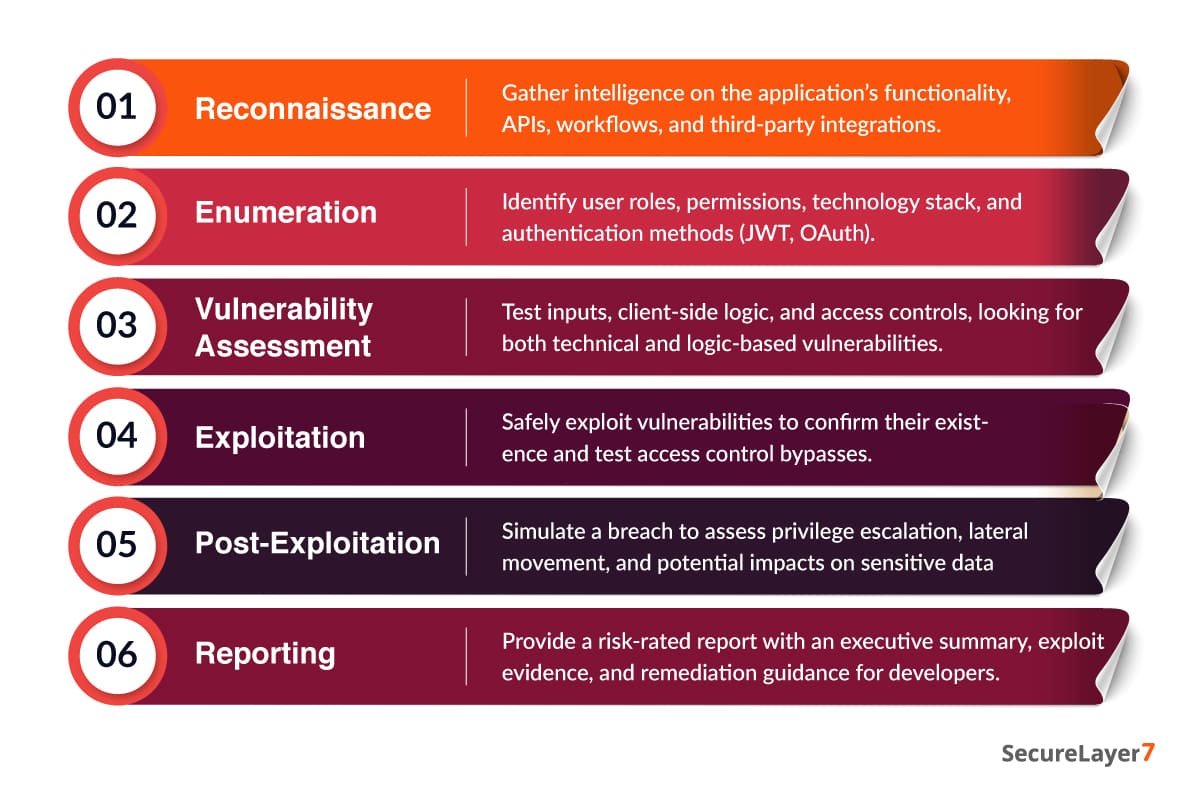
Following are the essential stages and key areas of focus in an Application Penetration Testing Methodology.
Holistic Application Coverage
Modern security testing must go beyond a simple URL. It requires a 360-degree view of the digital ecosystem:
- Omni-Channel Testing: Validating security across Single Page Applications (SPAs), traditional web apps, and mobile front-ends.
- Infrastructure Interconnectivity: Testing the connective tissue between microservices, REST/GraphQL APIs, and legacy backend services.
- Surface Mapping: Rigorous testing of both unauthenticated surfaces (login portals, public APIs) and authenticated surfaces (internal dashboards, user-specific data silos).
Authentication, Authorization & Business Logic Security
The most devastating breaches today aren’t from technical bugs but from flaws in how the application thinks.
- Authentication: Testing for MFA bypasses, session fixation, and weak password reset workflows.
- Authorization: Ensuring that a User cannot access Admin functions (Vertical Escalation) and that User A cannot view User B’s private data (Horizontal Escalation/IDOR).
- Business Logic Probing: Analyzing critical workflows like checkout processes or data exports to ensure they cannot be manipulated to bypass payments or leak information.
Testing Data Flows Across Trust Boundaries
A Trust Boundary is anywhere data moves from an untrusted source (a user) to a trusted one (your database).
- Injection Risks: Moving beyond simple SQLi to test for NoSQL injection, Template Injection (SSTI), and Prompt Injection in AI-integrated features.
- Insecure Object Access: Verifying that identifiers (like account IDs) are not predictable or easily guessable.
- Trust Boundary Violations: Ensuring that the backend does not “blindly trust” client-side logic or data.
Key Steps in the Methodology
Compliance Frameworks and Penetration Testing
Penetration testing is required in some compliance contexts and can provide valuable security-assurance evidence in others, not just a best practice. Compliance frameworks now dictate not only the frequency of tests but also their depth and methodology to ensure legal and operational compliance.
Key Frameworks and Testing Requirements
- PCI DSS 4.0 (Payment Card Industry): Requires internal and external penetration testing every 6 months and after significant changes. Multi-tenant security validation is crucial for service providers.
- SOC 2 (System and Organization Controls): Penetration testing is not explicitly required, penetration testing can support SOC 2 evidence by demonstrating that security controls and remediation processes are operating effectively, although the exact audit requirements depend on the organization’s controls and auditor expectations.
- ISO 27001: Treats penetration testing as part of the Information Security Management System (ISMS), requiring continuous risk assessment rather than a one-time test.
- GDPR (General Data Protection Regulation): Article 32 mandates regular testing and evaluation of security, with penetration testing can support the regular testing and evaluation of technical security measures expected under GDPR risk-management practices.
- HIPAA (Healthcare Portability and Accountability Act): Penetration testing can support HIPAA risk analysis and technical-security evaluation, but the Security Rule does not prescribe penetration testing as a universal standalone requirement.
How Application Penetration Testing Supports Compliance
- Frequency: Frameworks set predictable testing schedules, moving away from ad-hoc testing, often requiring bi-annual or annual assessments.
- Scope: Regulations define Compliance Boundaries. For example, PCI DSS focuses on the Cardholder Data Environment (CDE), ensuring no breach extends to critical payment systems.
- Standardized Reporting: Frameworks like CVSS ensure consistent risk scoring, with vulnerabilities treated with the same urgency across industries.
- Mandatory Remediation Timelines: Some frameworks, including PCI DSS and SOC 2, require proof of fixed vulnerabilities, necessitating retesting before closing the audit.
Common Vulnerabilities in Application Penetration Testing
Application penetration testing is crucial for identifying and mitigating security vulnerabilities before malicious attackers can exploit them. During penetration tests, ethical hackers seek out a variety of vulnerabilities that can compromise an application’s security.
Following are some of the most common vulnerabilities found in applications:
SQL Injection (SQLi)
Occurs when an app improperly handles user input, allowing attackers to inject malicious SQL queries. To better understand this attack vector, read our comprehensive guide on SQL Injection, including exploitation techniques and prevention best practices.
- Risk: Unauthorized access, data modification, or full database control.
- Example: Attacker uses ‘ OR ‘1’=’1 to bypass login.
Cross-Site Scripting (XSS)
When untrusted data is included in a webpage, allowing attackers to run malicious scripts in users’ browsers. Learn more about the different Types of XSS Attacks and effective mitigation strategies to protect modern web applications.
- Risk: Session hijacking, account takeover, defacement, or redirection.
- Types: Stored XSS (script stored on server) and Reflected XSS (script from a link or form).
Broken Authentication
Occurs when authentication mechanisms are flawed, allowing attackers to impersonate users.
- Issues: Weak passwords, insecure recovery processes, lack of MFA, exposed session IDs.
Security Misconfigurations
Result from errors during setup or default settings, often exposing sensitive data.
- Examples: Default admin passwords, unnecessary services enabled, detailed error messages revealing internal info.
Application Penetration Testing vs Other Security Testing Methods
When it comes to ensuring the security of an application, various testing methods are used to identify and mitigate vulnerabilities. Application Penetration Testing (AppSec Pen Testing) is one of the most effective techniques, it’s important to understand how it compares to other security testing methods like Vulnerability Scanning, SAST, DAST, and IAST.
Penetration Testing vs. Vulnerability Scanning
This is the most frequent comparison. Both aim to find weaknesses, their approach and depth are miles apart.
- Automation vs. Depth: Vulnerability scanning is a high-speed, automated process that sprays a target with known signatures to find missing patches or common misconfigurations.
- The PenTest Advantage: Penetration testing uses the results of a scan as a starting point. A human tester then performs a deep dive to see if those vulnerabilities can actually be exploited to gain access, something a scan cannot do.
Penetration Testing vs. SAST (Static Application Security Testing)
SAST is often referred to as White Box testing because it looks at the application from the inside out.
- Static Code vs. Attack Simulation: SAST analyzes the source code without executing the program. It finds coding errors early in the development cycle.
- The PenTest Advantage: A PenTest is Dynamic. It tests the application while it is running. SAST might find a theoretical bug that is actually neutralized by a secondary security control (like a WAF).
Penetration Testing vs. DAST (Dynamic Application Security Testing)
DAST and Pentesting are more similar because both test the running application from the outside.
- External Scanning vs. Manual Exploitation: DAST is essentially an automated web crawler that looks for vulnerabilities like XSS or SQLi by interacting with the web interface.
- The PenTest Advantage: DAST tools struggle with complex authentication, multi-step forms, and business logic. A human penetration tester can navigate a multi-factor authentication wall or a complex checkout process that would cause a DAST scanner to stall.
Penetration Testing vs. IAST (Interactive Application Security Testing)
IAST is a newer technology that combines elements of both SAST and DAST. It uses an agent inside the application to monitor it during execution.
- Runtime Insights vs. Attacker Mindset: IAST provides incredible detail to developers by showing exactly which line of code was triggered during a vulnerability. It offers runtime visibility that is highly accurate.
- The PenTest Advantage: IAST is great for identifying technical bugs, it lacks the attacker mindset. An IAST tool won’t realize that your application allows a user to force browse to a hidden administrative panel – but a penetration tester will find it in minutes.
Application Penetration Testing Tools
The efficiency of a penetration test often depends on the synergy between the tester’s expertise and the tools in their arsenal. The toolset has evolved to include AI-augmented scanners that can predict attack paths, though the human element remains irreplaceable. Before beginning a security assessment, teams can follow this Web Application Pentest Checklist to ensure comprehensive test coverage aligned with OWASP recommendations.
Automated Tools vs. Manual Testing
A common misconception is that a tool can perform a penetration test. Tools and humans play distinct roles:
- Automated Tools: These are the force multipliers. They are excellent for scanning thousands of parameters in seconds, identifying known CVEs, and performing repetitive tasks like brute-forcing or fuzzing.
- Manual Testing: This is the brain. Manual testing is required to verify the findings of automated tools and to uncover Complex Logic Flaws.
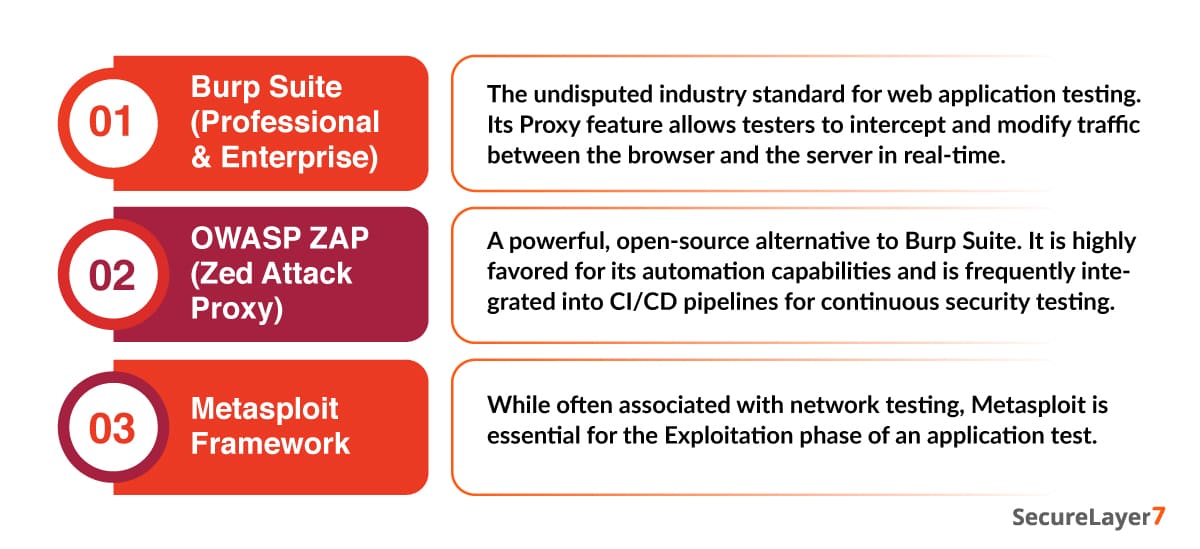
Popular Tools of the Trade
The landscape is vast; three names consistently dominate the professional environment:
Challenges in Application Penetration Testing
Penetration testing is an important component of application security, but its effectiveness depends on scope, tester expertise, application access, and integration with other security practices, it is not without its hurdles. As technology evolves, the difficulty of executing a high-quality, comprehensive test increases. Security teams must navigate these common challenges to ensure their testing remains effective.
Complex Modern Architectures
Gone are the days of simple, monolithic applications. Today’s software is a living organism of interconnected parts.
- Microservices & APIs: A single user action might trigger a chain reaction across dozens of microservices.
- Serverless & Cloud-Native: With functions scattered across cloud providers serverless applications shift the testing focus toward cloud permissions, exposed functions, event triggers, APIs, secrets, and service-to-service trust.
Time and Cost Constraints
A thorough manual penetration test is an investment of both time and money.
- Speed of Business: Developers are pushing code updates daily, or even hourly. A manual pen test that takes two weeks to complete can feel like a bottleneck in a fast-paced Agile environment.
- Budgeting for Security: High-quality testing requires specialized firms or highly paid in-house experts. Smaller organizations often struggle to balance the cost of a deep-dive assessment against the need for rapid feature development.
Keeping Up with Evolving Threats
Application technologies and attacker techniques change rapidly, requiring testing methods and expertise to be updated regularly. What was considered a secure configuration six months ago might be a critical vulnerability today.
- AI-Augmented Attacks: Hackers are now using AI to discover vulnerabilities and craft sophisticated phishing or prompt-injection attacks at scale.
- Zero-Day Research: Staying ahead of the curve requires constant monitoring of new CVEs and emerging exploit techniques.
Best Practices for Application Penetration Testing
Application penetration testing is an essential part of a comprehensive cybersecurity strategy. To maximize the effectiveness of penetration tests, organizations should follow best practices that ensure thorough testing, efficient use of resources, and alignment with business goals. Organizations should also understand when to conduct a web application penetration test, especially after major releases, infrastructure changes, or compliance-driven milestones.
Following are some of the best practices for conducting Application Penetration Testing to improve your application’s security.
Hybrid Approach: Combine Automated + Manual
Efficiency comes from automation, but security comes from human intuition. A best-in-class test balances both.
- Automate the Routine: Use automated scanners (DAST/SAST) in your CI/CD pipeline to catch low-hanging fruit like outdated libraries or simple injection flaws before they reach production.
- Focus Human Expertise: Reserve your skilled penetration testers for what they do best: Business Logic Testing. Let humans focus on how an attacker might manipulate a multi-step workflow or bypass complex authorization layers that a machine cannot understand.
Prioritize High-Risk Vulnerabilities
Not all bugs are created equal. A low severity finding on a critical admin panel is often more dangerous than a high severity finding on an abandoned marketing page.
- Risk-Based Remediation: Use a scoring system like CVSS (Common Vulnerability Scoring System) combined with your own internal business context to decide what to fix first.
- Exploitability vs. Impact: Focus on vulnerabilities that are both easy to exploit and have a high impact on sensitive data.
Conclusion
Application penetration testing enables organizations to move beyond theoretical vulnerability lists by demonstrating how attackers could exploit weaknesses, manipulate workflows, and access sensitive data. A thorough assessment examines technical vulnerabilities, user roles, authorization controls, business logic, APIs, and defensive monitoring. Detailed reporting and retesting help development and security teams resolve confirmed attack paths and verify effective remediation.
SecureLayer7 provides expert human-led penetration testing for web, mobile, API, and thick-client environments. Our assessments combine automated discovery with manual exploitation to uncover business-logic flaws, authorization gaps, and complex attack vectors often missed by automated tools.
Contact SecureLayer7 today to strengthen your security and mitigate risks.
Frequently Asked Questions (FAQs)
Application penetration testing is the process of simulating cyberattacks on an application to identify vulnerabilities before malicious actors can exploit them. It involves assessing and exploiting weaknesses in the application’s security defenses.
Application penetration testing should ideally be performed bi-annually or after significant updates to the application. It is also important to conduct tests after major changes to infrastructure or business logic to ensure new vulnerabilities have not been introduced.
Web penetration testing focuses on testing web-based applications for vulnerabilities such as SQL injection and XSS. Application penetration testing is broader and covers all types of applications, including web, mobile, and desktop apps, and focuses on finding vulnerabilities across various platforms, business logic flaws, and more complex attack vectors.
Popular tools used in application penetration testing include Burp Suite, OWASP ZAP, Metasploit, and Nessus. These tools help identify vulnerabilities such as SQL injection, XSS, and broken authentication.
Yes, many compliance frameworks like PCI DSS, HIPAA, GDPR, and ISO 27001 require regular penetration testing to ensure that applications meet security standards and regulatory requirements.

