

In the previous part 1 We discussed the windows telephony services and how it works, So we can go on and perform patch diffing. Now, In this part (Part 2), we delve into the patch diffing and analysis of the 2025 security updates for Microsoft Telephony Services. After outlining the architectural and operational aspects of TAPI and its related components in Part 1, we now turn our focus to the detailed examination of the code changes that address the heap-based buffer overflow vulnerabilities. This section explores how specific modifications to memory management routines, function calls, and error-handling mechanisms serve to mitigate potential RCE. Let’s Go a head and Perform Our patch diffing.
Lab Setup
We will be using Ghidra, BinExport, and BinDiff. You can download them from the following links:
The Patch
There are many excellent resources explaining Microsoft’s patching process, MSU files, and Windows patch diffing in general. Here are some useful references:
- Introduction to Binary Diffing, Part 1
- Introduction to Binary Diffing, Part 2
- Introduction to Binary Diffing, Part 3
- Windows Patch Diffing, Richard Osgood
- Extracting and Diffing MS Patches in 2020
- YouTube: Binary Diffing Tutorial
- YouTube: Patch Diffing Deep Dive
For this analysis, I obtained two versions of the Telephony service files: tapi32.dll and tapi3.dll. You can download the vulnerable and patched versions from this repository.
Installing BinExport
Next, we need to install the BinExport plugin for Ghidra.

In the extension.properties file inside the BinExport folder, ensure the version matches your installed Ghidra version. Then, compress the folder into a .zip file.

Open Ghidra, navigate to File > Install Extensions, and click the + button to select the BinExport.zip file.


Finally, enable the checkbox to activate the plugin. Now we’re ready for the next step.
Creating a Project
Create a new project in Ghidra (you can name it after the relevant CVE) and import the DLL files.

Open the files in the Code Browser. When prompted to analyze the file, select No for now.

Next, navigate to Edit > Symbol Server Config and add Microsoft’s symbol server as a trusted and enabled source.


Finally, run Analysis > Auto Analyze and click Analyze. Repeat these steps for all files.
Patch Diffing with BinDiff
Now, we’ll use BinDiff to compare the files and identify changes.

In the Ghidra project window, right-click each file and select Export > BinaryExport for BinDiff.

After exporting, you should see the .BinExport files in your directories:
Directory: C:UsersazimaDesktopTelephony Servicespatched
Mode LastWriteTime Length Name
—- ————- —— —-
-a—- 4/1/2025 8:29 AM 1228447 tapi32_patched.dll.BinExport
-a—- 4/1/2025 8:29 AM 3515858 tapi3_patched.dll.BinExport
Directory: C:UsersazimaDesktopTelephony Servicesunpatched
Mode LastWriteTime Length Name
—- ————- —— —-
-a—- 4/1/2025 8:30 AM 1160198 tapi32_unpatched.dll.BinExport
-a—- 4/1/2025 8:31 AM 3232800 tapi3_unpatched.dll.BinExport
Analyzing tapi3.dll
Open BinDiff and create a new workspace (File > New Workspace).

Navigate to Diffs > New Diff and select the unpatched version as the primary file and the patched version as the secondary file. Click Diff and wait for the analysis to complete.


Once loaded, double-click the diff (1), go to Matched Functions (2), and sort by similarity (3).

You’ll see a list of functions that have changed between the two versions.

Double-clicking a function (e.g., Growbuf) reveals the differences in assembly code.
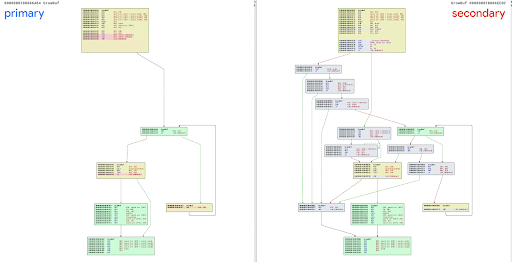
In the primary (unpatched) view, the code performs certain operations, while the secondary (patched) view shows new blocks, likely security checks. The next step is to analyze these modified functions to identify the vulnerabilities.
Tapi3.dll Patch Diffing (Ghidra)
The following is the list of the function names we need to perform patch diffing on:
- GrowBuf
- lineGatherDigitsWPostProcess
- phoneDevSpecificPostProcess
- lineDevSpecificPostProcess
- lineDevSpecific
- phoneDevSpecific
- lineCreateAgentSession
- ResizeCallParams
- lineGetDevConfig
- lineGatherDigits
- lineGetAgentCaps
- PhoneGetDisplay
- SavedAdressName
- lineGetQueueListA
- ParkIndirect
- lineGetGroupList
- GetID
- DoFunc
- Initialize
- GetID
- UpdateInfo
- ConfigDialogEdit
- GetDevConfig
- LinePark
- put_ButtonText
- PhoneGetID
- LineGetID
- UpdateInfo
- AsyncEventsThread
- UpdateInfo
- InternalCreateAgent
- Initialize
- RegisterCallNotifications
- NewObject
- CreateHandleTableEntry
1. GrowBuf
- Unpatched
/* int __cdecl GrowBuf(unsigned char * __ptr64 * __ptr64,unsigned long * __ptr64,unsigned
   long,unsigned long) */


int __cdecl GrowBuf(uchar **param_1,ulong *param_2,ulong param_3,ulong param_4)


{
  uint uVar1;
  uint uVar2;
  uchar *_Dst;

  uVar2 = *param_2;
  uVar1 = uVar2 + param_4;
  do {
    uVar2 = uVar2 * 2;
  } while (uVar2 < uVar1);
  _Dst = (uchar *)ClientAllocReal(uVar2);
  if (_Dst != (uchar *)0x0) {
    memcpy(_Dst,*param_1,(ulonglong)param_3);
    ClientFree((longlong)*param_1);
    *param_1 = _Dst;
    _Dst = (uchar *)0x1;
    *param_2 = uVar2;
  }
  return (int)_Dst;
}
The unpatched GrowBuf function dynamically expands a memory buffer while preserving its contents, ideal for resizable arrays or file buffers. It calculates the required size by doubling the current capacity until it fits the new data, allocates a larger block using ClientAllocReal, and copies existing data before freeing the old buffer. If successful, it updates the buffer pointer and size, returning 1; if allocation fails, it returns 0. This approach ensures efficient memory growth (avoiding frequent reallocations) while maintaining data integrity, making it perfect for scenarios like streaming data or dynamically growing structures where the final size is unknown upfront.
- Patched
/* int __cdecl GrowBuf(unsigned char * __ptr64 * __ptr64,unsigned long * __ptr64,unsigned
   long,unsigned long) */


int __cdecl GrowBuf(uchar **param_1,ulong *param_2,ulong param_3,ulong param_4)


{
  uint uVar1;
  bool bVar2;
  uchar *_Dst;
  uint uVar3;
  ulonglong uVar4;

  bVar2 = wil::details::FeatureImpl<>::__private_IsEnabled
                    (&`private:_static_class_wil::details::FeatureImpl<>&___ptr64___cdecl_wil::Featu re<>::GetImpl(void)'
                      ::__l2::impl);
  uVar3 = *param_2;
  if (bVar2) {
    if (((uVar3 != 0) && (uVar4 = (ulonglong)uVar3 * 2, uVar4 < 0x100000000)) &&
       (uVar1 = uVar3 + param_4, uVar3 <= uVar1)) {
      do {
        uVar3 = (uint)uVar4;
        if ((uVar1 <= uVar3) && (param_3 <= uVar3)) goto LAB_18004ee90;
        uVar4 = (uVar4 & 0xffffffff) * 2;
      } while (uVar4 < 0x100000000);
    }
  }
  else {
    uVar1 = uVar3 + param_4;
    do {
      uVar3 = uVar3 * 2;
    } while (uVar3 < uVar1);
LAB_18004ee90:
    _Dst = (uchar *)ClientAllocReal(uVar3);
    if (_Dst != (uchar *)0x0) {
      memcpy(_Dst,*param_1,(ulonglong)param_3);
      ClientFree((longlong)*param_1);
      *param_1 = _Dst;
      *param_2 = uVar3;
      return 1;
    }
  }
  return 0;
}
The patched GrowBuf function begins by querying a WIL feature flag through wil::details::FeatureImpl<>::__private_IsEnabled, which determines whether to use a more secure but computationally intensive growth algorithm or fall back to the standard exponential growth approach. When the feature is enabled, the function implements careful capacity doubling with 32-bit overflow protection (explicitly checking against the 0x100000000 boundary) and additional validation that the new size can accommodate both existing data (param_3) and requested expansion (param_4). The overflow-protected path uses 64-bit arithmetic (ulonglong) for intermediate calculations while maintaining 32-bit boundaries for the final allocation size. In the traditional growth path, the function reverts to simple exponential doubling until the capacity meets requirements. Both paths converge at the allocation point using ClientAllocReal, followed by the critical sequence of memcpy for data preservation, ClientFree for old buffer deallocation, and pointer/size updates. The function’s return value provides simple but crucial feedback about operation success (1) or failure (0). This implementation demonstrates several advanced memory management concepts: conditional algorithm selection based on runtime feature flags, arithmetic overflow protection, 64-bit-safe calculations for 32-bit allocations, and maintenance of the strong exception safety guarantee (either the operation completes fully or leaves original state unchanged).
GrowBuf Summary
So, What we can see from here is that GrowBuf function contained a critical integer overflow vulnerability where doubling the buffer size (uVar2 * 2) could wrap around 32-bit limits, potentially causing heap corruption through undersized allocations and dangerous memcpy operations. The patched version introduces multiple security improvements: (1) a WIL feature flag to toggle safe/legacy modes, (2) 64-bit arithmetic with explicit 4GB boundary checks to prevent overflow, (3) validation ensuring the new size accommodates both existing and new data, and (4) maintained backward compatibility through fallback logic. This patch effectively mitigates memory corruption risks by preventing integer overflow during size calculations while adding runtime-configurable safety checks, transforming a vulnerable buffer expansion mechanism into a robust, security-hardened operation suitable for production systems. The key difference lies in the patched version’s systematic prevention of arithmetic overflow edge cases that could be exploited for arbitrary memory writes.
In the next section, we will be covering functions 2, 3 and 4 together as the approach is the same.
2, 3 & 4 lineGatherDigitsWPostProcess, phoneDevSpecificPostProcess & lineDevSpecificPostProcess
The phoneDevSpecificPostProcess, lineDevSpecificPostProcess & lineGatherDigitsWPostProcess have the same way of patching.
- Unpatched
/* void __cdecl lineGatherDigitsWPostProcess(struct _ASYNCEVENTMSG * __ptr64) */


void __cdecl lineGatherDigitsWPostProcess(_ASYNCEVENTMSG *param_1)


{
  void *_Dst;

  if (g_bLoggingEnabled != 0) {
    TRACELogPrint(0x80002,"lineGatherDigitsWPostProcess: enter");
    if (g_bLoggingEnabled != 0) {
      TRACELogPrint(0x40002,"ttdwP1=x%lx, dwP2=x%lx, dwP3=x%lx, dwP4=x%lx",
                    (ulonglong)*(uint *)(param_1 + 0x18),(ulonglong)*(uint *)(param_1 + 0x1c),
                    *(undefined4 *)(param_1 + 0x20),*(undefined4 *)(param_1 + 0x24));
    }
  }
  if (((byte)param_1[0x18] & 0x1b) != 0) {
    _Dst = (void *)GetHandleTableEntry(*(ulong *)(param_1 + 0x1c));
    DeleteHandleTableEntry(*(ulong *)(param_1 + 0x1c));
    memcpy(_Dst,param_1 + 0x38,(ulonglong)*(uint *)(param_1 + 0x24) * 2);
  }
  *(undefined4 *)(param_1 + 0x20) = 0;
  *(undefined4 *)(param_1 + 0x1c) = 0;
  return;
}
lineGatherDigitsWPostProcess function handles asynchronous digit collection events in what appears to be a Windows telephony service. The function accepts a _ASYNCEVENTMSG structure pointer containing digit collection parameters and performs three key operations: diagnostic logging, conditional data processing, and state cleanup. The logging system first checks the global g_bLoggingEnabled flag and, if enabled, outputs debug traces including the function entry point and four DWORD parameters from specific offsets (0x18, 0x1c, 0x20, 0x24) in the message structure. The core processing logic examines bit flags in the first parameter (offset 0x18) using mask 0x1B (binary 00011011), which likely corresponds to telephony event flags like LINE_CALLSTATE_SPECIFIC (0x01), LINE_CALLSTATE_BLOCKED (0x10), and LINE_CALLSTATE_ACCEPTED (0x08). When these flags are active, the function performs critical memory operations: it retrieves a memory handle from offset 0x1c via GetHandleTableEntry (part of Windows’ handle management system), immediately deletes the handle from the table (transferring ownership), and copies Unicode digit data from offset 0x38 in the message structure to the retrieved buffer location. The copy operation uses a dynamic size calculation (value at offset 0x24 multiplied by 2 for Unicode characters), but notably lacks bounds checking on either the source or destination buffers. The function concludes by zeroing out fields at offsets 0x20 (possibly a status field) and 0x1c (the handle field), effectively resetting the message state. From a security perspective, several concerns emerge: the unchecked memcpy operation could lead to buffer overflows if malicious or corrupted messages are processed, the handle management assumes proper synchronization that might not exist in multi-threaded scenarios, and the bitmask validation provides incomplete protection against malformed messages.
- Patched
/* void __cdecl lineGatherDigitsWPostProcess(struct _ASYNCEVENTMSG * __ptr64) */


void __cdecl lineGatherDigitsWPostProcess(_ASYNCEVENTMSG *param_1)


{
  bool bVar1;
  uint uVar2;
  void *_Dst;
  ulonglong uVar3;
  ulong uVar4;
  ulong local_res10 [2];
  void *local_res18;
  ulonglong local_res20;

  if ((g_bLoggingEnabled != 0) &&
     (TRACELogPrint(0x80002,"lineGatherDigitsWPostProcess: enter"), g_bLoggingEnabled != 0)) {
    TRACELogPrint(0x40002,"ttdwP1=x%lx, dwP2=x%lx, dwP3=x%lx, dwP4=x%lx",
                  (ulonglong)*(uint *)(param_1 + 0x18),(ulonglong)*(uint *)(param_1 + 0x1c),
                  *(undefined4 *)(param_1 + 0x20),*(undefined4 *)(param_1 + 0x24));
  }
  if (((byte)param_1[0x18] & 0x1b) != 0) {
    uVar4 = 0;
    local_res10[0] = 0;
    bVar1 = wil::details::FeatureImpl<>::__private_IsEnabled
                      (&`private:_static_class_wil::details::FeatureImpl<>&___ptr64___cdecl_wil::Fea ture<>::GetImpl(void)'
                        ::__l2::impl);
    if (bVar1) {
      _Dst = (void *)GetHandleTableEntry(*(ulong *)(param_1 + 0x1c),local_res10);
      uVar4 = local_res10[0];
    }
    else {
      _Dst = (void *)GetHandleTableEntry(*(ulong *)(param_1 + 0x1c));
    }
    local_res18 = _Dst;
    DeleteHandleTableEntry(*(ulong *)(param_1 + 0x1c));
    uVar2 = *(uint *)(param_1 + 0x24);
    uVar3 = 0;
    local_res10[0] = uVar2;
    bVar1 = wil::details::FeatureImpl<>::__private_IsEnabled
                      (&`private:_static_class_wil::details::FeatureImpl<>&___ptr64___cdecl_wil::Fea ture<>::GetImpl(void)'
                        ::__l2::impl);
    if (bVar1) {
      uVar3 = (ulonglong)uVar2 * 2;
      local_res20 = uVar3;
      if (0xffffffff < uVar3) {
LAB_180051599:
        *(undefined4 *)(param_1 + 0x20) = 0;
        *(undefined4 *)(param_1 + 0x1c) = 0;
        if (g_bLoggingEnabled == 0) {
          return;
        }
        TRACELogPrint(0x40002,"lineGatherDigitsWPostProcess: It has failed due to Corrupted pMsg");
        return;
      }
      uVar2 = (uint)uVar3 + 0x38;
      if (((uVar2 < 0x38) || (*(uint *)param_1 < uVar2)) || (uVar4 < (uint)uVar3))
      goto LAB_180051599;
    }
    memcpy(_Dst,param_1 + 0x38,uVar3 & 0xffffffff);
  }
  *(undefined4 *)(param_1 + 0x20) = 0;
  *(undefined4 *)(param_1 + 0x1c) = 0;
  return;
}
the patched lineGatherDigitsWPostProcess function begins with diagnostic logging (controlled by g_bLoggingEnabled) that records the message’s four DWORD parameters at offsets 0x18 (event flags), 0x1c (handle reference), 0x20 (status), and 0x24 (Unicode character count). The critical security enhancements manifest in the conditional processing path where the 0x1b bitmask (LINE_CALLSTATE_SPECIFIC|LINE_CALLSTATE_ACCEPTED|LINE_CALLSTATE_BLOCKED) triggers digit buffer handling. The memory operations now use a bifurcated approach based on WIL’s FeatureImpl status. When enabled, it utilizes an augmented GetHandleTableEntry that outputs allocation metadata to local_res10, while the legacy path maintains backward compatibility. The revolutionary improvement comes in the buffer size validation: the Unicode character count (from offset 0x24) undergoes 64-bit expansion (ulonglong) before doubling, with explicit overflow checking against MAXDWORD (0xFFFFFFFF). Three architectural safeguards then validate: (1) the computed buffer end address (0x38 + size*2) doesn’t wrap below 0x38, (2) the total doesn’t exceed the message structure’s declared size (first DWORD), and (3) the handle table entry’s allocation (uVar4) actually contains the required capacity. The memcpy operation now uses sanitized parameters (bitmasked to 32-bit via &0xffffffff) only after passing all checks. Any failure triggers a secured exit path (LAB_180051599) that nullifies sensitive fields (0x1c, 0x20) and logs corruption warnings. This represents a textbook example of modern Windows security hardening – maintaining COM-style binary compatibility while injecting robust memory protections through feature-flagged validation layers. The solution elegantly addresses three key vulnerability classes: integer overflows (through 64-bit arithmetic), buffer overflows (via bounds checking), and use-after-free risks (with handle state validation).
phoneDevSpecificPostProcess, lineDevSpecificPostProcess & lineGatherDigitsWPostProcess Summary
So, what we can observe here is that the original lineGatherDigitsWPostProcess function contained dangerous memory safety vulnerabilities where an unchecked memcpy operation using *(uint *)(param_1 + 0x24) * 2 could lead to buffer overflows if the size value was corrupted, while also risking integer overflows that might cause undersized allocations. (From the patched code we can say it’s with-in pMsg) The patched version introduces crucial security enhancements: (1) WIL feature flags to enable robust validation layers, (2) 64-bit arithmetic with explicit overflow checks when calculating Unicode buffer sizes, (3) three-tier bounds validation ensuring the copy operation stays within both source and destination buffer limits, and (4) secure handle management with allocation size verification. This update effectively eliminates memory corruption risks by systematically preventing arithmetic overflows, buffer boundary violations, and invalid handle dereferences, while maintaining backward compatibility through conditional feature activation.
5. lineDevSpecific
- Unpatched
LONG __stdcall
lineDevSpecific(HLINE hLine,DWORD dwAddressID,HCALL hCall,LPVOID lpParams,DWORD dwSize)


{
  ulong uVar1;
  ulong uVar2;
  LONG extraout_EAX;
  undefined auStack_e8 [32];
  undefined4 local_c8 [2];
  ulonglong local_c0;
  ulonglong local_b8;
  ulonglong local_b0;
  ulonglong local_a8;
  ulonglong local_a0;
  LPVOID local_98;
  ulonglong local_90;
  undefined8 local_88;
  undefined8 uStack_80;
  undefined8 local_78;
  undefined8 uStack_70;
  undefined8 local_68;
  undefined8 uStack_60;
  undefined4 local_58;
  undefined2 local_54;
  undefined local_52;
  undefined8 local_51;
  undefined local_49;
  ulonglong local_48;

  local_48 = __security_cookie ^ (ulonglong)auStack_e8;
  uVar1 = CreateHandleTableEntry((__uint64)lpParams);
  local_c8[0] = 0xd0057;
  uVar2 = GetFunctionIndex(lineDevSpecificPostProcess);
  local_c0 = (ulonglong)uVar2;
  local_90 = (ulonglong)dwSize;
  local_51 = 0;
  local_49 = 0;
  local_88 = 0;
  uStack_80 = 0;
  local_58 = 0;
  local_78 = 0;
  uStack_70 = 0;
  local_54 = 0x600;
  local_68 = 0;
  uStack_60 = 0;
  local_52 = 9;
  local_b8 = (ulonglong)hLine;
  local_b0 = (ulonglong)dwAddressID;
  local_a8 = (ulonglong)hCall;
  local_a0 = (ulonglong)uVar1;
  local_98 = lpParams;
  uVar2 = DoFunc((_FUNC_ARGS *)local_c8);
  if ((int)uVar2 < 1) {
    DeleteHandleTableEntry(uVar1);
    mapTAPIErrorCode(uVar2);
  }
  else {
    WaitForReply(uVar2);
  }
  __security_check_cookie(local_48 ^ (ulonglong)auStack_e8);
  return extraout_EAX;
}
The lineDevSpecific function establishes a secure communication channel between user-mode callers and telephony hardware drivers by first creating a protected handle table entry for the input parameters via CreateHandleTableEntry. This handle management system converts raw pointers into reference-counted kernel objects, preventing direct memory access and providing isolation between user-mode and kernel-mode components. The function then constructs a meticulously organized 232+ byte stack frame that serves as a secure message packet, containing both control metadata (including the operation code 0xD0057 and a post-processing callback index obtained through GetFunctionIndex) and telephony context (with all handles safely converted to 64-bit values to prevent truncation attacks).
- Patched
LONG __stdcall
lineDevSpecific(HLINE hLine,DWORD dwAddressID,HCALL hCall,LPVOID lpParams,DWORD dwSize)


{
  bool bVar1;
  uint uVar2;
  ulong uVar3;
  LONG extraout_EAX;
  undefined auStack_e8 [32];
  undefined4 local_c8 [2];
  ulonglong local_c0;
  ulonglong local_b8;
  ulonglong local_b0;
  ulonglong local_a8;
  ulonglong local_a0;
  LPVOID local_98;
  ulonglong local_90;
  undefined8 local_88;
  undefined8 uStack_80;
  undefined8 local_78;
  undefined8 uStack_70;
  undefined8 local_68;
  undefined8 uStack_60;
  undefined4 local_58;
  undefined2 local_54;
  undefined local_52;
  undefined8 local_51;
  undefined local_49;
  ulonglong local_48;

  local_48 = __security_cookie ^ (ulonglong)auStack_e8;
  bVar1 = wil::details::FeatureImpl<>::__private_IsEnabled
                    (&`private:_static_class_wil::details::FeatureImpl<>&___ptr64___cdecl_wil::Featu re<>::GetImpl(void)'
                      ::__l2::impl);
  if (bVar1) {
    uVar2 = CreateHandleTableEntry((__uint64)lpParams,dwSize);
  }
  else {
    uVar2 = CreateHandleTableEntry((__uint64)lpParams);
  }
  local_c8[0] = 0xd0057;
  uVar3 = GetFunctionIndex(lineDevSpecificPostProcess);
  local_58 = 0;
  local_c0 = (ulonglong)uVar3;
  local_90 = (ulonglong)dwSize;
  local_51 = 0;
  local_49 = 0;
  local_88 = 0;
  uStack_80 = 0;
  local_54 = 0x600;
  local_78 = 0;
  uStack_70 = 0;
  local_52 = 9;
  local_68 = 0;
  uStack_60 = 0;
  local_b8 = (ulonglong)hLine;
  local_b0 = (ulonglong)dwAddressID;
  local_a8 = (ulonglong)hCall;
  local_a0 = (ulonglong)uVar2;
  local_98 = lpParams;
  uVar3 = DoFunc((_FUNC_ARGS *)local_c8);
  if ((int)uVar3 < 1) {
    DeleteHandleTableEntry(uVar2);
    mapTAPIErrorCode(uVar3);
  }
  else {
    WaitForReply(uVar3);
  }
  __security_check_cookie(local_48 ^ (ulonglong)auStack_e8);
  return extraout_EAX;
}
The Patched lineDevSpecific function represents a security-hardened telephony interface that implements a sophisticated dual-mode architecture for handling device-specific operations. At its core, the function establishes a protected communication channel between user-mode applications and telephony hardware drivers through an advanced handle management system that now incorporates Windows Implementation Library (WIL) feature-gated security enhancements. When the WIL feature flag is enabled (via wil::details::FeatureImpl<>::__private_IsEnabled), the function activates its secure path which utilizes an augmented CreateHandleTableEntry that accepts both the parameter pointer and size (dwSize), enabling robust bounds validation and preventing memory corruption attacks through precise handle allocation.
lineDevSpecific Summary
The unpatched lineDevSpecific function contained critical security vulnerabilities due to unvalidated handle creation and missing size checks, where the basic CreateHandleTableEntry operation accepted parameters without verifying buffer sizes, creating potential memory corruption risks. The patched version introduces a robust security upgrade through Windows Implementation Library (WIL) integration, implementing a dual-path architecture that activates size-aware handle creation (CreateHandleTableEntry with dwSize parameter) when security features are enabled, while maintaining legacy compatibility. This key enhancement addresses buffer overflow vulnerabilities by validating parameter sizes during handle allocation, while preserving the original stack cookie protection and asynchronous execution model. The patch systematically eliminates memory corruption risks through runtime-configurable bounds checking, demonstrating Microsoft’s secure-by-design approach to hardening telephony APIs without breaking existing functionality – maintaining backward compatibility while adding crucial size validation and handle management protections against exploitation attempts.
Conclusion
In this part, we performed patch diffing on Microsoft Telephony Services, focusing on critical vulnerabilities addressed in the 2025 security updates. By comparing the unpatched and patched versions of key functions such as GrowBuf, lineGatherDigitsWPostProcess, and lineDevSpecific, we uncovered significant security improvements. The patches introduced robust mitigations against heap-based buffer overflows and integer overflows, incorporating WIL feature flags for runtime-configurable protections, 64-bit arithmetic checks to prevent size calculation overflows, and strict bounds validation for memory operations. These changes highlight Microsoft’s commitment to hardening legacy components while maintaining backward compatibility. Understanding these patches not only reveals the vulnerabilities they fix but also provides valuable insights into secure coding practices for memory management in complex systems. Stay tuned for Part 3, where we’ll dive deeper into the other functions and following by the exploitation techniques and proof-of-concept development for these vulnerabilities!
How SecureLayer7 helps
Frequently Asked Questions
Ghidra for disassembly, the BinExport plugin to export function data, and BinDiff to compare the two binaries. BinExport’s version in extension.properties must match your installed Ghidra version. You also add Microsoft’s symbol server in Ghidra so function names resolve.
Heap-based buffer overflow flaws in the TAPI components tapi32.dll and tapi3.dll. The patched code adds bounds checks around memory management routines that could otherwise lead to remote code execution. The GrowBuf function in tapi3.dll is one of the modified routines.
It matches functions between the unpatched and patched binaries, then scores each pair by similarity. Sort the Matched Functions list by similarity and the lowest scores are the modified functions. Double-clicking a function shows the assembly differences side by side.
You first add Microsoft’s symbol server under Edit > Symbol Server Config so function names resolve from Microsoft’s PDBs. Running Auto Analyze afterward pulls those symbols in. Analyzing before configuring symbols gives you stripped names and weaker diff results.
A buffer growth routine flagged during the diff as changed between versions. The unpatched view runs the buffer operations directly, while the patched view adds new blocks that act as security checks. It sits in the list of functions analyzed for the heap overflow, alongside lineGatherDigitsWPostProcess and lineDevSpecific.

