
How can you determine if an application is secure?
Most organizations don’t have a clear answer. Some depend on annual penetration tests, while others follow compliance checklists, assuming these measures are sufficient.
This approach can help you tick the checkbox and submit compliance reports to auditors, but you cannot claim your application is secure. So, what is the solution?
The OWASP Application Security Verification Standard (ASVS) addresses this problem by clearly defining what “secure” actually means for applications. It matters because security efforts become measurable.
What is OWASP ASVS?
Simply put, ASVS is a structured application security standard developed by OWASP. It provides a clearly defined framework to test application security controls, including associated technical safeguards that help defend against risks like cross-site scripting (XSS) and SQL injection.
Related Article: A Deep Dive into Application Security Testing
It provides a measurable framework for assessing and strengthening the security of web applications.
In practice, you get two things:
- A secure development checklist
- A verification framework for testing and validation
The purpose of this framework is to improve synchronization among different teams that often function in silos.
- Developers know what needs to be built.
- Security teams know what to test.
- Leadership gains clearer visibility into risk posture.
Without a standard like ASVS, security efforts become inconsistent. One team prioritizes code scanning, while another focuses on penetration testing. As a result, important controls may slip through because different teams are not on the same page.
Why ASVS Matters More Today
APIs, cloud-native deployments, third-party integrations, and rapid release cycles have increased complexity across nearly every application stack. ASVS helps organizations maintain consistency in their security approach in these complex application environments.
Related Article: What Is Attack Surface Management And Why Is It Important?
Furthermore, it aligns well with modern DevSecOps practices because many controls can be integrated directly into CI/CD workflows and automated verification pipelines.
What Changed in ASVS 5.0?
ASVS 5.0 updates the framework to better match how modern applications are built and deployed today.
Some important changes include:
- Improved management of security controls based on development stages and application architecture
- Simpler and clearer requirement descriptions that are easier to implement
- New requirement IDs for improved tracking, reporting, and audits
- Updated language to support cloud-native applications, APIs, and DevOps workflows
- Removal of outdated requirements and consolidation of duplicate controls
ASVS 5.0 includes 17 chapters and around 350 security requirements, making it the most detailed and practical version of the framework so far.
Using ASVS in the Development Lifecycle
ASVS works best when it is integrated early in the development cycle and not treated as an end-stage audit. Mature organizations usually apply it across the software development lifecycle.
The Structure of ASVS
The ASVS framework has been divided into 17 chapters, with each chapter covering a specific area of application security. These chapters help organizations verify whether critical security controls are properly implemented across the application lifecycle.
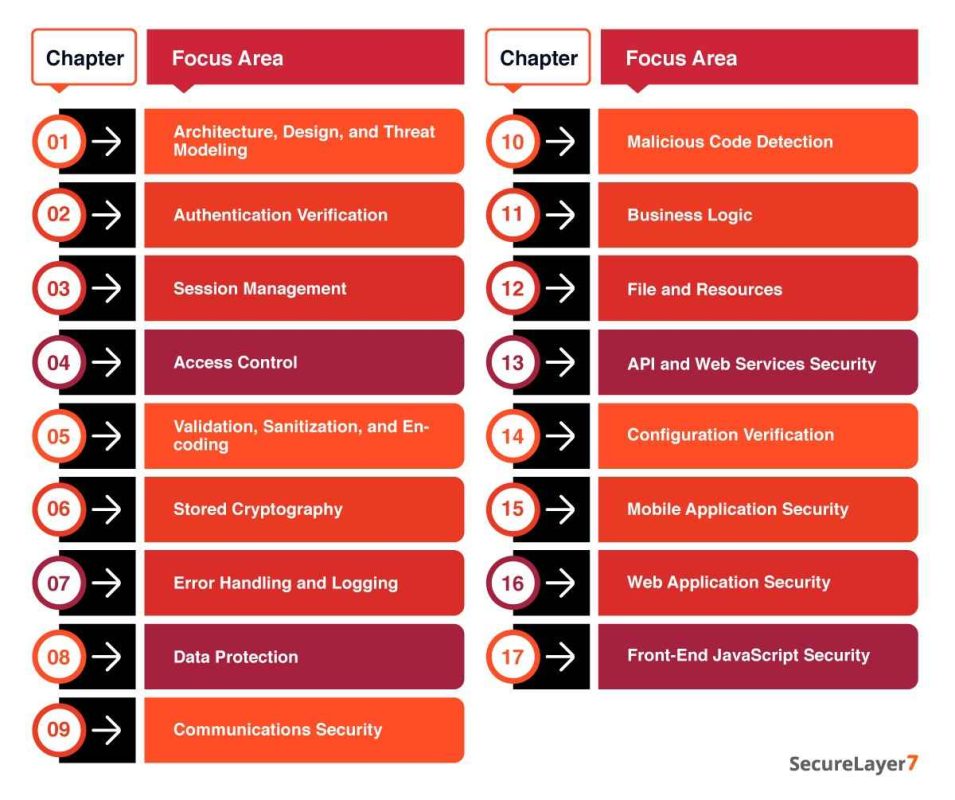
Some chapters focus on authentication, access control, and session management, while others cover areas like cryptography, API security, business logic, secure configuration, and front-end JavaScript security.
Each chapter contains detailed requirements grouped by verification level, making it easier for teams to apply security controls based on the application’s risk level and business needs.
The ASVS Verification Levels
ASVS follows a risk-based structure and recognizes that not all organizations need the same level of security controls. Some industries are inherently more sensitive. ASVS separates security requirements into three verification levels.
Level 1: Baseline Security
Level 1 focuses on defending against common and automated attacks, including the risks in the OWASP Top 10:
This level is appropriate for:
- Low-risk applications
- Internal tools
- Applications that do not process sensitive data
Related Article: OWASP Top 10 Security Risks: A Detailed Guide
Verification can largely be performed through black-box testing and automated scanning without requiring complete access to the source code. For smaller organizations, this creates a realistic entry point into structured application security.
Level 2: Comprehensive Requirements For Most Businesses
ASVS Level 2 is where ASVS becomes highly relevant for commercial applications.
It introduces stronger controls around authentication, access control, secure design, and data handling. Verification also becomes more detailed. Teams typically need access to architecture documentation, code repositories, and implementation details.
This level is best suited for:
- SaaS platforms
- B2B applications
- E-commerce systems
- Applications handling customer or employee data
For most enterprises, ASVS Level 2 should be considered the operational baseline.
Level 3: High-Assurance Security
ASVS Level 3 is intended for environments where compromise could create severe operational, financial, or safety consequences.
Typical examples include:
- Financial transaction systems
- Healthcare applications
- Critical infrastructure platforms
- Defense or government systems
At Level 3, the focus shifts toward building resilience against sophisticated and targeted attacks.
How to Implement OWASP ASVS
The OWASP ASVS framework works best when security is integrated throughout the development lifecycle rather than treated as a final compliance checkpoint. This approach creates better visibility into application risk, improves governance, and reduces the likelihood of expensive security failures in production.
A. Design Phase
During the design stage, teams should review ASVS requirements to identify which controls apply to the application. This includes authentication models, access control structures, encryption requirements, and API protections.
Building these controls early in the development process helps teams avoid costly redesigns later. From a business perspective, early security planning improves delivery predictability. As a result, teams spend less time handling emergency fixes, release delays, and post-deployment remediation.
B. Development Phase
During development, ASVS provides practical guidance for implementing secure coding practices consistently across teams. Developers can use the framework to enforce password security, validate user inputs, sanitize untrusted data, and apply secure data handling controls throughout the application lifecycle.
These practices help reduce common vulnerabilities such as SQL injection and cross-site scripting (XSS).
Embedding security controls during coding also lowers remediation costs. Vulnerabilities fixed during development are far less expensive than issues discovered after deployment or during an incident response exercise.
C. Testing and Verification
Security testing validates whether implemented controls actually work under real-world conditions.
ASVS provides structured verification checklists that teams can use during code reviews, automated testing, manual assessments, and penetration testing activities.
For higher-risk applications, testing may also include architecture analysis, business logic testing, and access control validation.
This gives leadership teams measurable assurance instead of vague security claims. Applications can be evaluated against clearly defined verification standards.
D. Continuous Improvement
As applications evolve, new features, APIs, cloud services, and third-party integrations can introduce additional security risks. Organizations should regularly revisit ASVS requirements to ensure existing controls remain effective.
Continuous reassessment helps teams identify security gaps before they turn into operational problems.
Integrating ASVS checks into CI/CD pipelines, audits, and release processes helps organizations maintain a proactive approach to security while reducing technical debt and long-term compliance pressure.
Final Thoughts
Application security failures rarely happen because organizations lack tools. They happen because security expectations are not clearly defined. The OWASP ASVS framework brings structure to otherwise unstructured security efforts.
It gives developers, security teams, and leadership a shared standard for building and verifying secure applications. More importantly, it pushes security earlier into the development process, where risks are cheaper to fix, easier to manage, and far less likely to become costly production incidents.
Your application may pass reviews, but can it withstand a cyberattack? Let SecureLayer7 put your security controls to the test. Contact us now to learn more.
How SecureLayer7 helps
Frequently Asked Questions (FAQs)
The OWASP Top 10 is primarily an awareness document. It highlights the most common and critical web application risks observed across the industry. On the other hand, ASVS is much broader. It offers detailed security requirements and verification guidance that organizations can operationalize inside development and testing workflows.
For most commercial applications, Level 2 is the practical target. Level 1 is sufficient for low-risk applications with limited exposure. Level 3 should generally be reserved for highly sensitive or mission-critical systems.
Not entirely. Automated tools can validate many technical controls, especially at Level 1. However, higher assurance levels still require manual code review, architectural analysis, and business logic testing.
Continuously. Formal audits may happen annually or before major releases, but individual ASVS controls should ideally be validated throughout development, testing, and deployment cycles.
