
Your attack surface is whatever the internet can find. That’s a reality. To manage that risk effectively, organizations need continuous visibility into every asset exposed to the internet.
If you can’t see something from the outside, you can’t protect it from the inside. External attack surface management (EASM) addresses this issue. It involves constantly identifying, tracking, and analyzing risks across all your internet-facing assets.
In this blog, we’ll look at what ESAM is, why it’s important, and how it fits into today’s tech stack.
What is External Attack Surface Management (EASM)?
External Attack Surface Management (EASM) refers to regularly identifying, monitoring, and protecting all assets exposed to the public internet. These assets can be anything including domains, web apps, shadow APIs, cloud resources, IP addresses, or any other online services that attackers might target.
EASM looks at your organization from the outside, just like a potential attacker would. This helps security teams see what information and systems are visible and accessible from the internet.
Having this visibility is more important than ever as organizations use more cloud services, third-party platforms, remote systems, and web apps. Every new asset that faces the internet can be a point of entry for attackers.
EASM helps organizations spot these risks early, so they can fix forgotten systems, misconfigurations, or unpatched vulnerabilities before attackers find them. This is important for all organizations, not just large companies. Any business with internet-facing systems needs to monitor its external attack surface.
For example, a small business with a customer web app in the cloud might have risks in the app itself, its APIs, cloud storage, databases, and other supporting systems.
Security threats like SQL injection attacks, cross-site scripting (XSS), or poorly configured cloud services could put sensitive data at risk or allow unauthorized access.
Related Article: SQL Injection (OWASP): Types, Exploits, and Prevention
How External Attack Surface Management Works
External Attack Surface Management (EASM) involves regularly identifying, monitoring, and assessing risks to keep pace with an organization’s evolving internet-facing assets.
A. Discovery Through an Attacker’s Lens
The EASM process begins by finding out what is visible to outsiders. It uses the same reconnaissance methods as attackers, scanning public sources like DNS records, WHOIS data, TLS certificates, web apps, exposed APIs, GitHub repositories, and internet-facing infrastructure.
The purpose is to build a complete list of assets accessible from outside, including those that might be forgotten, misconfigured, or set up outside normal security procedures. Most EASM platforms start with a known domain, IP address, or brand name, then look for related assets by analyzing how the infrastructure is connected.
They use methods such as subdomain enumeration, historical DNS analysis, reverse IP lookups, certificate checks, and JavaScript inspection to discover additional assets. Correlation tools then figure out which resources actually belong to the organization.
B. Continuous Monitoring of External Assets
External environments are always changing. New apps launch, and updates sometimes stay longer than planned.
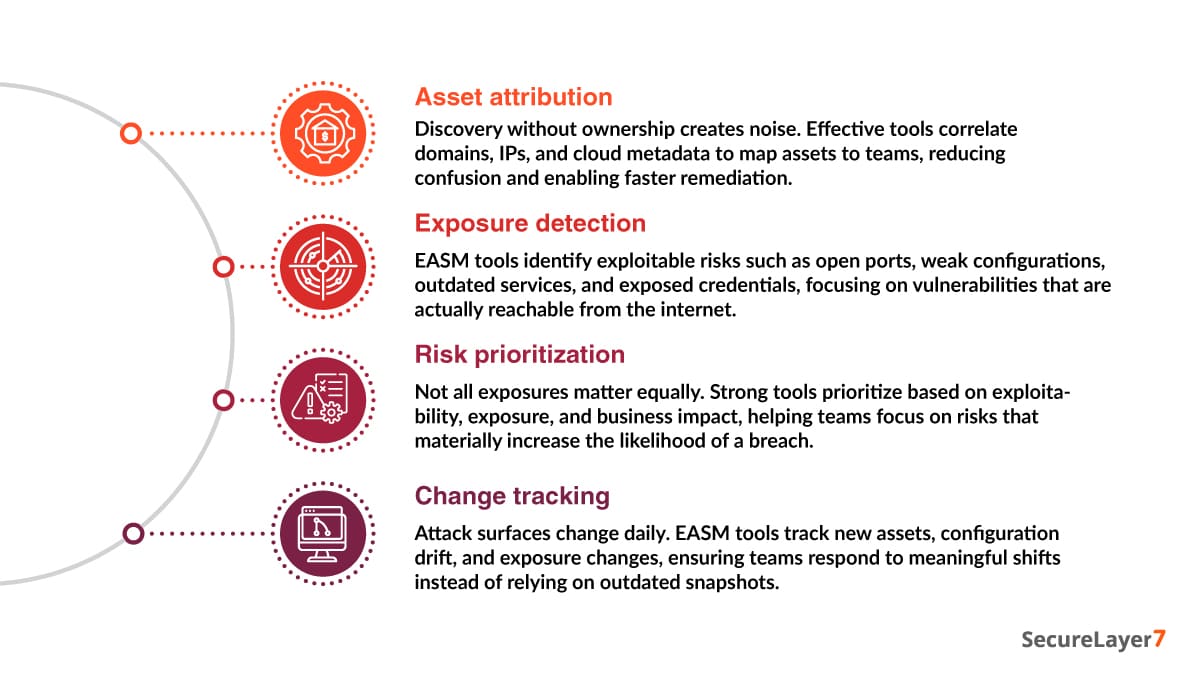
To maintain current visibility, EASM platforms continuously monitor the attack surface for changes. They detect newly exposed services, cross-site scripting issues, login portals, APIs, cloud storage instances, expired certificates, abandoned domains, and other internet-facing resources that may introduce risk.
Related Article: Protecting Web Apps from Cross-site Scripting
Monitoring also extends beyond infrastructure. Platforms analyze web technologies, application frameworks, HTTP headers, JavaScript behavior, and server responses to identify software versions, configuration weaknesses, and technology stacks.
Many solutions also map third-party dependencies and supply chain connections that could increase an organization’s exposure.
C. Risk Assessment and Prioritization
Once assets are found and monitored, EASM checks how secure and important they are to the business. Instead of treating all assets the same, the platform ranks risks based on how easy they are to exploit, how accessible they are, and how much they could affect the business.
Common high-risk findings include:
- Publicly writable cloud storage
- Exposed databases
- Internet-accessible administrative interfaces
- Authentication portals lacking rate limiting.
- Services affected by known critical vulnerabilities
Context plays a critical role in prioritization. An exposed development environment may present a lower risk than an abandoned subdomain that still routes traffic to an unmanaged server. By combining technical exposure data with business context, EASM helps security teams focus on the vulnerabilities most likely to be targeted and exploited.
EASM Challenges
External attack surface management offers visibility into internet-facing assets outside traditional security controls. However, managing and addressing EASM findings can be difficult, particularly for large or complex organizations.
A. Asset Attribution Challenges
Identifying an asset is only the first step; establishing ownership is often more challenging. EASM platforms often find domains, cloud resources, applications, and services connected to the organization but not clearly linked to a specific team or business unit.
Establishing ownership may require analyzing certificates, naming conventions, web content, infrastructure patterns, and other contextual signals.
Without clear ownership, remediation can stall. Security teams may identify risks but struggle to find the appropriate stakeholders to address them.
B. Separating Meaningful Risks from Noise
Not every internet-facing asset poses a security risk. Sometimes, discovery engines incorrectly associate external infrastructure with an organization, leading to false positives.
Shared hosting, vendor-operated services, inactive domains, and test environments can inflate asset inventories and generate unnecessary alerts. Investigating low-priority findings can divert attention from critical risks.
Accurate asset attribution and prioritization require continuous tuning and validation.
C. Scaling Continuous Monitoring
Modern attack surfaces evolve quickly. New cloud resources, applications, APIs, and third-party integrations can emerge within hours. To maintain visibility, EASM platforms must continuously scan, validate, and monitor many external assets. As organizations grow, the volume of assets increases, putting pressure on security teams, budgets, and operations.
Without automation and effective prioritization, monitoring can quickly become unmanageable.
D. Integrating with Existing Security Workflows
Discovery alone does not reduce risk. Findings must be linked to remediation processes to ensure prompt investigation and resolution.
Many organizations struggle to integrate EASM data with vulnerability management platforms, ticketing systems, DevOps pipelines, security operations workflows, and governance programs.
When these connections are missing, identified exposures may remain unresolved despite continuous monitoring. The value of EASM depends on how effectively organizations can turn visibility into action.
E. Managing Exposure Across Vendors and Subsidiaries
Large enterprises often span multiple business units, acquisitions, joint ventures, and third-party providers. As a result, internet-facing assets may be owned, managed, or hosted by various entities.
When exposed assets are found, security teams must identify who is responsible for remediation. Often, ownership is shared or unclear, complicating remediation decisions.
Technology can identify exposures, but governance processes are often needed to establish accountability.
F. Translating Technical Findings into Business Risk
Security teams may understand the risks of an exposed database or public cloud storage, but executives often require a broader business perspective.
To support decision-making, EASM findings should include context such as data sensitivity, business criticality, regulatory requirements, and operational impact. Without this information, exposure data may remain within technical teams and fail to drive business action.ty
Successful EASM programs often require changes in how organizations manage internet-facing assets. Teams may be asked to take ownership of previously unmanaged resources, follow new governance processes, or address previously unknown exposures.
When responsibilities are unclear or security governance is weak, EASM adoption may slow after initial deployment. Without executive support and clear accountability, valuable EASM insights may not lead to meaningful risk reduction.
What EASM Tools Actually Do
EASM tools continuously enumerate assets using DNS data, certificate transparency logs, and scanning techniques, ensuring that new exposures are identified immediately rather than waiting for internal reporting cycles.
How SecureLayer7 Helps Organizations Manage Their External Attack Surface
At SecureLayer7, we help organizations see all their internet-facing assets and lower their risk before attackers can take advantage. Our External Attack Surface Management (EASM) services work around the clock to identify, review, and track your public digital assets.
With SecureLayer7’s EASM, organizations can:
- See their external attack surface and new risks almost in real time.
- Find internet-facing vulnerabilities, misconfigurations, and unknown IT assets before they turn into security problems.
- Review and rank risks by how easily they could be exploited, their impact on your business, and how important the assets are.
- Continuously map vulnerabilities to specific apps, domains, cloud resources, APIs, and servers, and keep track of them so you can fix issues faster.n changes as they occur.
Don’t wait for attackers to discover your exposed assets first. Talk to our experts to identify hidden risks, prioritize remediation, and strengthen your external security posture.
Final Thoughts
External attack surface management is not simply an additional tool. It ensures your organization has an accurate and comprehensive view of its external environment. If your external visibility is incomplete, all subsequent decisions regarding detection, response, and risk management are based on inaccurate information. EASM addresses this gap by providing a complete and accurate external perspective.
Looking to strengthen your security posture? SecureLayer7 helps organizations identify vulnerabilities, reduce risk, and defend against evolving cyber threats. Contact our experts to get started.
Frequently Asked Questions (FAQs)
EASM in cybersecurity refers to the continuous discovery, monitoring, and risk assessment of all internet-facing assets, including unknown, unmanaged, or forgotten systems that attackers can exploit.
EASM identifies unknown external assets first, while vulnerability management scans known systems for weaknesses. Together, they provide complete visibility and risk coverage.
Organizations should prioritize deep assetaa discovery, accurate attribution, strong risk prioritization, and integration with existing workflows to ensure findings lead to measurable exposure reduction.
