
The rising frequency of application attacks has forced security experts to adopt a shift-left security approach. This has enhanced the popularity of the DAST tools, or Dynamic application security testing tools to spot vulnerabilities in real-time. But choosing the best DAST tool can be difficult as all are not the same.
The list given below isn’t a one-size-fits-all solution. Each company has its own security priorities. Some need compliance features, while others care more about easy integration or speed.
Let’s get started!
List of Top DAST Tools: Key Features, Pros And Cons
DAST (Dynamic Application Scanning Tools) has become a go-to tool for security teams because of its powerful capabilities.
All dynamic application security testing scanners are not the same. They are designed to serve different purposes.
Below is a list of the top DAST scanning tools, with an overview of their strengths, pros & cons and factors to consider while choosing a DAST scanner.
1. BugDazz
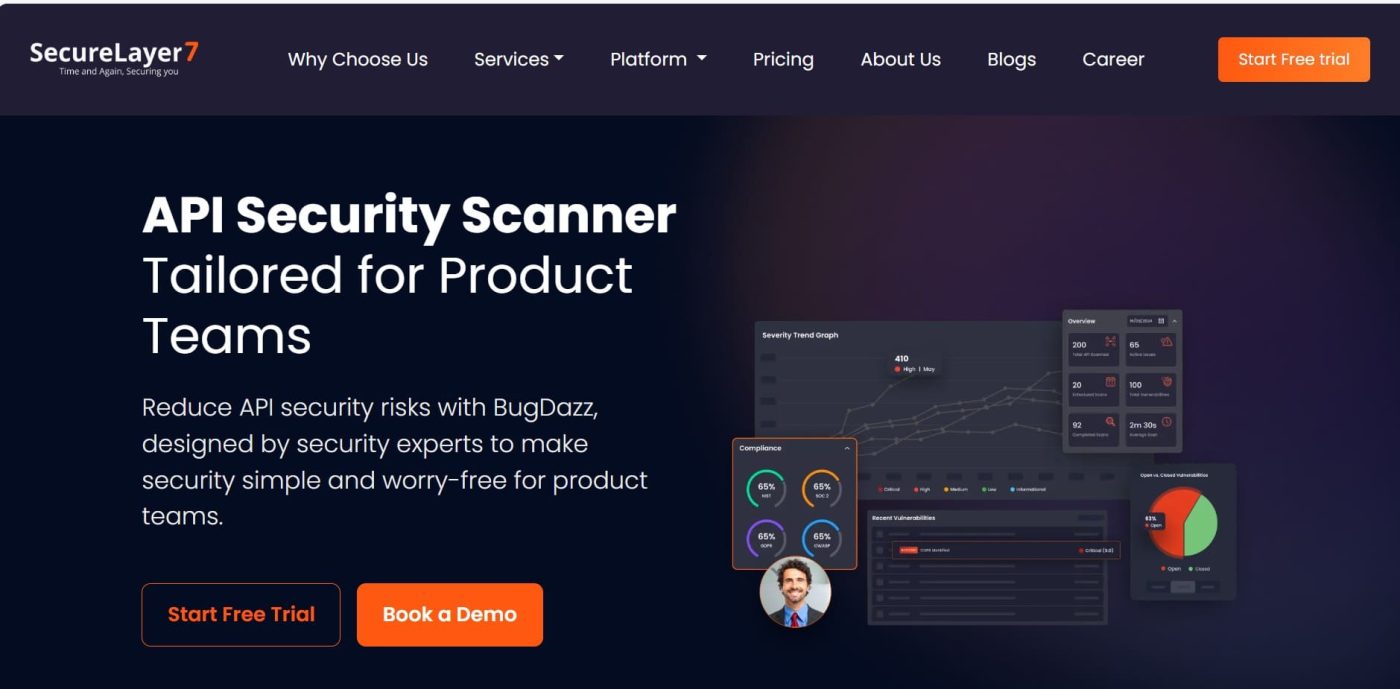
BugDazz API Security Scanner, developed by SecureLayer7, is a modern dynamic DAST-based API security testing platform designed to fill the gaps left by traditional scanners.
It goes beyond OWASP’s standard risks by testing for JWT token weaknesses, session management flaws, poor rate limiting, broken business logic, and insecure OAuth configurations.
With continuous discovery of shadow and outdated applications, role-based access control, customizable testing templates, and contextual vulnerability insights, BugDazz brings enterprise-grade coverage to teams of all sizes. It integrates seamlessly into CI/CD pipelines, produces detailed reports in multiple formats, and provides strategic patch recommendations that accelerate remediation.
Key Features:
- Specialized for REST and SOAP architectures, specifically targeting the OWASP API Top 10 (like BOLA).
- PTaaS Integration
- Powerful shadow API discovery
- A fully self-hosted engine
Pros:
- Intuitive, developer-friendly interface
- Automated deep scanning with actionable reporting
- Smooth integration with Slack, Jira, GitHub, and CI/CD pipelines
- Flexible configuration and customizable templates
- Wide coverage that extends beyond OWASP Top 10
- Free trial available
Cons:
- Limited community support and its still evolving
Best Suitable For:
FinTechs, startups, and agile teams requiring a mix of high-speed automated API scanning and live penetration testing transparency.
2. OWASP ZAP
OWASP ZAP is counted among the most popular free and open-source Dynamic Application Security Testing (DAST) tools. This is actively maintained by a global community of volunteers, it functions as a man-in-the-middle intercepting proxy that sits between your web browser and the target application.
It enables security professionals, developers, and testers to actively capture, inspect, modify, and fuzz web traffic to expose underlying vulnerabilities.
Key Features:
- Automated and manual scanners
- An extensive, built-in add-on marketplace
- Supports native scripting (JavaScript, Python, Zest) to write custom vulnerability testing rules and modify live traffic on the fly.
- A unique interface overlay
Pros:
- 100% free and open-Source
- Massive global community .
- Highly extensible
Cons:
- Steep learning curve
- Resource Intensive .
- High configuration overhead for CI/CD
Best Suitable For:
It is ideal for developers, security testers, and teams seeking a customizable, budget-friendly tool for security testing.
3. Wallarm
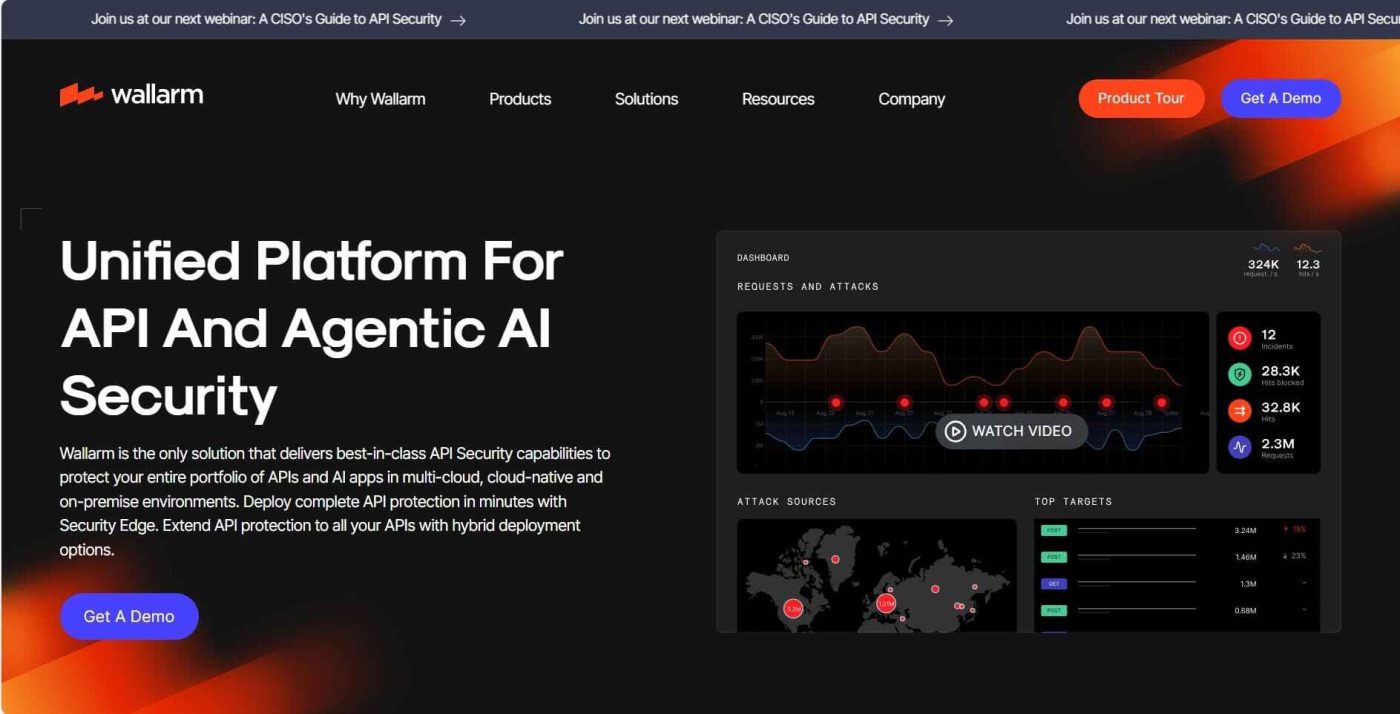
Wallarm DAST Scanner is a unified platform for dynamic testing and runtime protection. It combines automated discovery with real-time threat detection and protection from injection flaws, data leaks, and API abuse.
Wallarm quickly spots and isolates real application security threats from endless harmless activity, ensuring attention goes where it’s needed most. Its NG-WAF gathers attack data, feeding details payload, attack type, and endpoint to Wallarm’s DAST scanner, which then generates targeted tests.
Once the tool confirms a vulnerability, Wallarm creates a remediation ticket, providing a clear guidance for fixes and streamlining response to high-risk incidents.
Wallarm is best suitable for modern, API-driven applications and microservices in cloud-native or hybrid environments.
Key Features:
- Maps your entire attack surface to find hidden, shadow, and zombie APIs.
- Uses AI to block OWASP Top 10 attacks, credential stuffing, and sophisticated API abuse.
- Integrates into CI/CD pipelines to run vulnerability tests based on actual historical traffic.
- Deploys as a sidecar, ingress controller, or gateway plugin across any modern infrastructure.
Pros:
- Real-time detection
- Broad environment support (cloud-native, on-premises, hybrid)
- Strong automation for testing and risk assessment
Cons:
- Setup may require skilled security expertise
Best Suitable For:
Wallarm is best for cloud-native enterprises functioning in fast-paced CI/CD pipelines, Kubernetes and multi-cloud environments. It’s ideal for industries like FinTech needing automated discovery of shadow APIs and real-time threat blocking.
4. Traceable by Harness
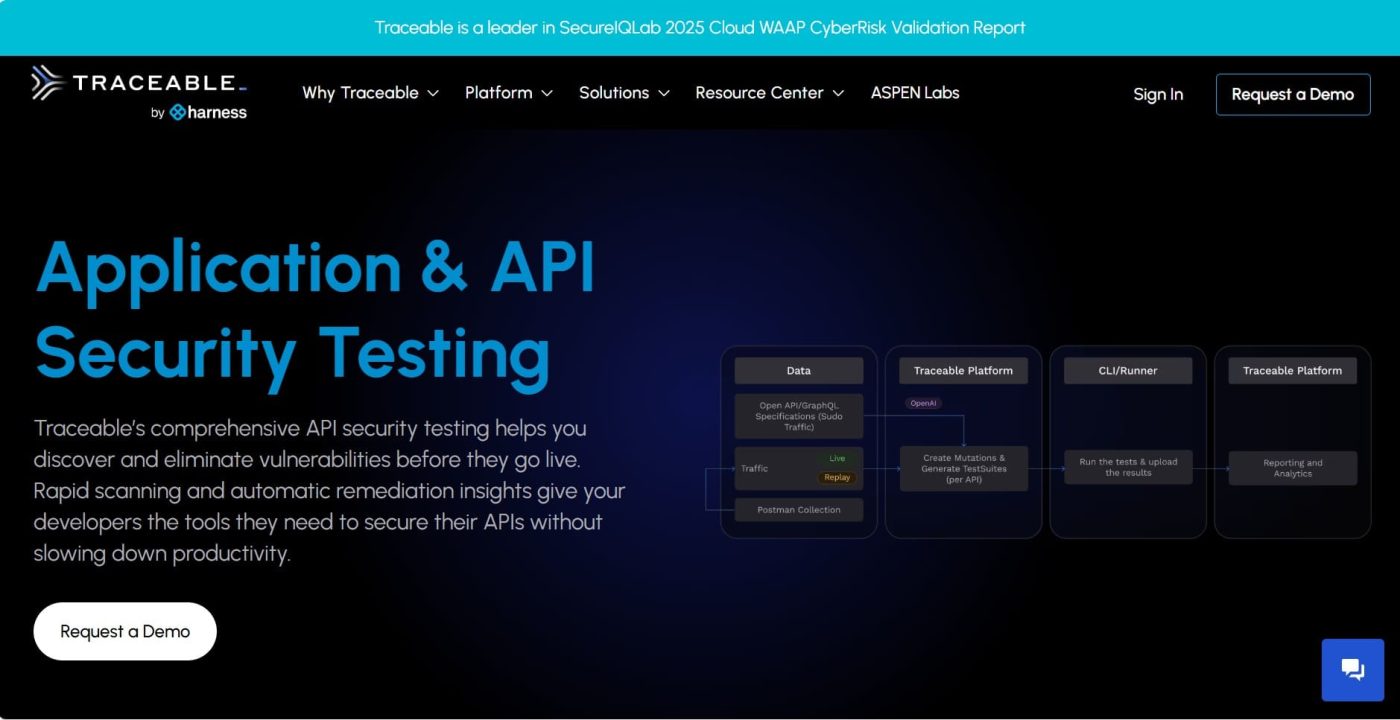
Traceable, now part of Harness, is a DAST tool that uses AI and machine learning to automate discovery, vulnerability detection, and behavioral analysis.
Traceable API DAST by Harness is a DAST scanner, not static or hybrid, it’s a dynamic, black-box API security testing solution
With flexible deployment options, SaaS, on-premises, or multi-cloud.It adapts to diverse environments. It analyzes live traffic for anomalies, making it suitable for complex application landscapes.
Key Features:
- Uses distributed tracing to map internal, external, and shadow APIs across complex microservices.
- Sensitive data tracking
- Contextual security testing logic flaws within CI/CD pipelines
- Behavioral threat protection .
Pros:
- Context-aware scanning with behavioral insights
- Scales easily across hybrid environments
Cons:
- Steep learning curve for new teams
- Can be expensive for SMEs
- Complex deployments
Best Suitable For:
DevOps teams navigate highly complex distributed environments where tracking tracking backend data flow drift is critical.
5. Astra
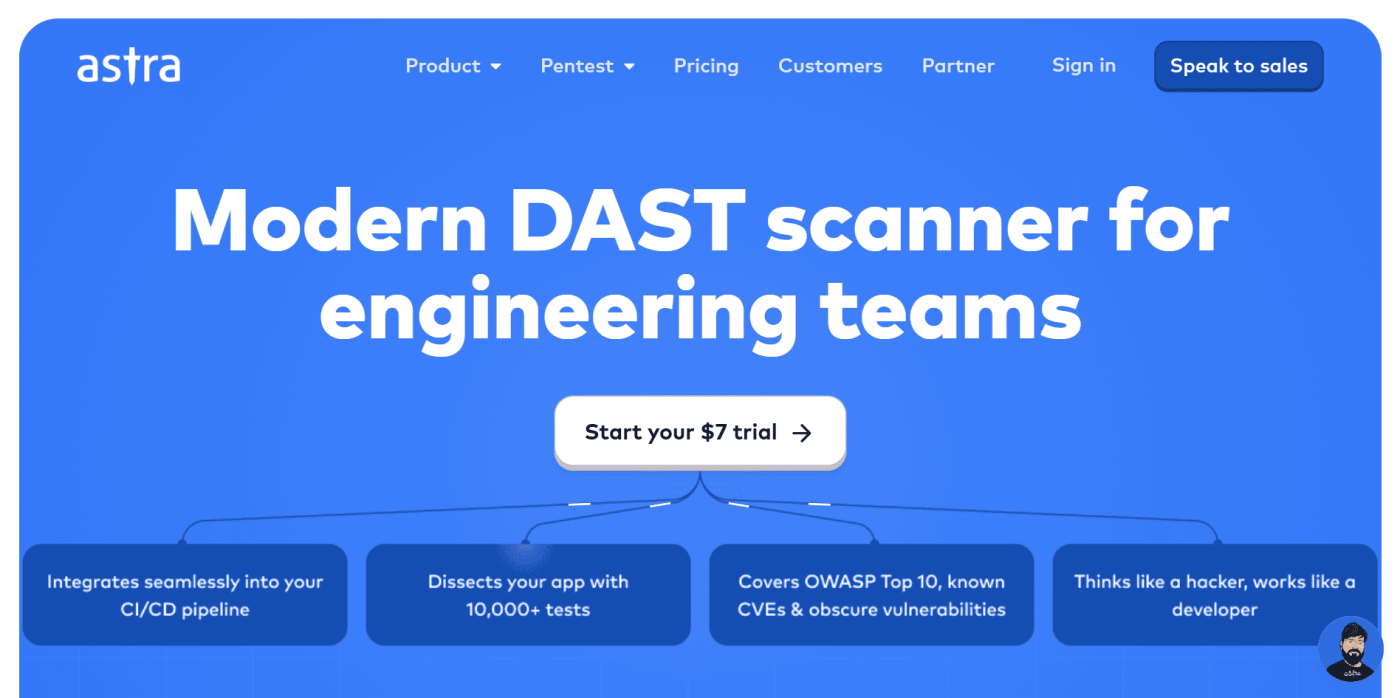
Astra’s DAST scanner automates vulnerability detection across web, mobile, and API assets, including those behind logins, with impressive breadth, over 10,000 AI-powered tests and zero false positives thanks to expert-vetted results.
The dashboard is CXO-friendly, and integration with Slack, Jira, GitHub, and GitLab fits modern DevOps workflows. Compliance reporting (PCI-DSS, HIPAA, SOC2, ISO 27001) and expert remediation support make it a solid choice for SaaS and CI/CD-driven teams.
Key Features:
- Supports complex login flows, including TOTP-based MFA and custom scripts for thorough internal scanning.
- Scanner continuously evolves by integrating real-world vulnerability patterns discovered by expert security engineers.
- Utilizes machine learning to tailor test scenarios and provide contextual remediation advice for developers.
Pros:
- CI/CD, Slack, Jira, GitHub, GitLab integrations
- Compliance reporting for PCI-DSS, HIPAA, SOC2, and ISO 27001.
- Continuous scanning and unlimited test runs.
- Expert manual pentest services available for critical findings.
Cons:
- May miss business logic flaws
Best Suitable For:
Mid-market SaaS businesses that need audit-ready compliance mapping (SOC2/PCI-DSS) paired with on-demand expert validation.
6. Rapid7
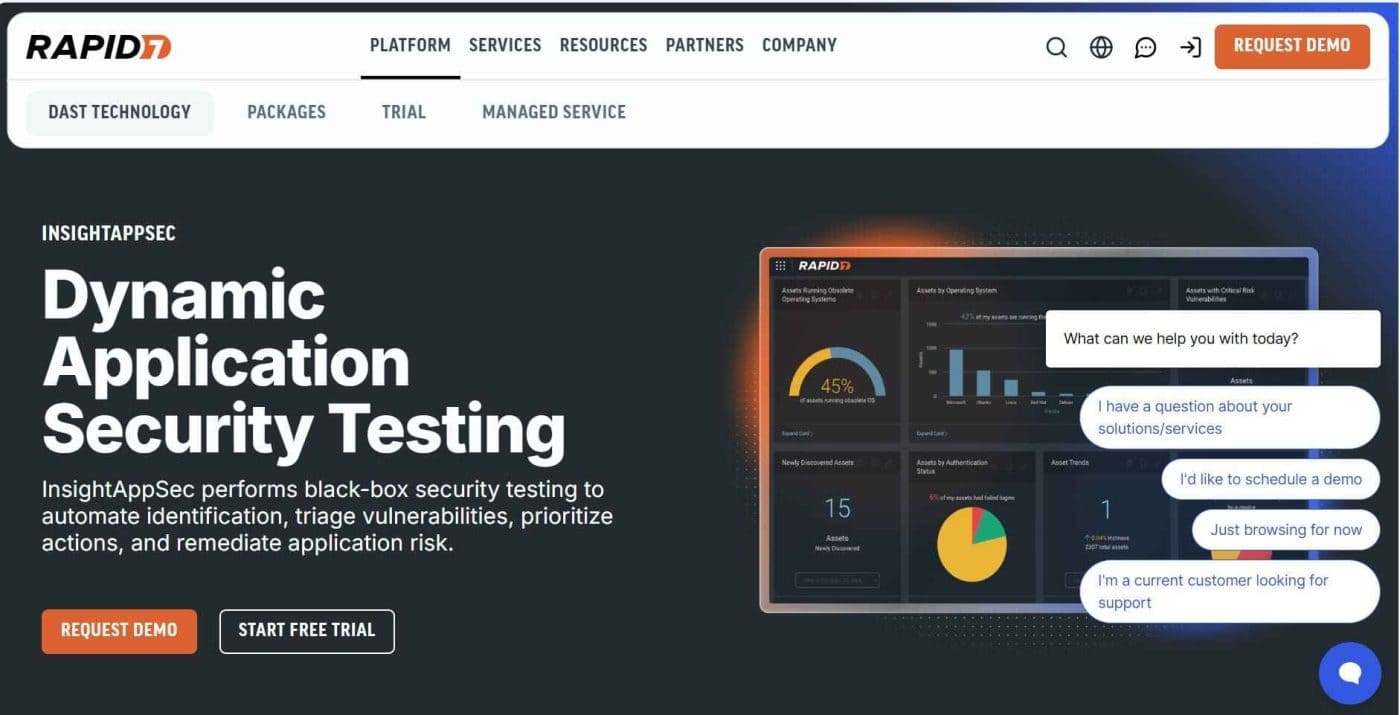
Rapid7 is a DAST tool designed for enterprises needing integrated vulnerability management, incident response, and compliance reporting across cloud, endpoints, and applications. It supports network, web, and cloud scans with integrations like Splunk, AWS, and Microsoft.
The platform offers strong asset discovery, customizable dashboards, and compliance mapping for PCI DSS, HIPAA, and GDPR.
Key Features:
- Modern UI and intuitive workflow
- Attack replay
- Integrates seamlessly with Atlassian JIRA and CI/CD tool
- Hybrid cloud-based scanning engine
Pros:
- Comprehensive coverage across VM, DAST, SIEM, and SOAR
- Customizable dashboards with strong asset discovery
- Compliance-centric reporting for PCI DSS, HIPAA, and GDPR
Cons
- Complex setup and management
- Can be expensive
- Occasional false positives
Best Suitable For:
Organizations already integrated into the Rapid7 Insight ecosystem prioritizing broad multi-asset visibility and unified infrastructure risk metrics.
7. StackHawk
StackHawk is a modern DAST (Dynamic Application Security Testing) tool. It is specifically designed for developers, offering automated scanning of web applications and APIs (including REST, SOAP, GraphQL, and gRPC) directly in CI/CD pipelines.
Unlike traditional DAST solutions aimed at security teams, StackHawk is built to fit into developer workflows, making it easy to catch vulnerabilities like SQL injection, XSS, and broken access controls before code reaches production.
Overall, StackHawk is a leading, developer-friendly DAST and API security solution, built for speed, automation, and collaboration in modern software teams.
StackHawk is best suitable for DevOps teams building modern web applications, microservices, and APIs who want automated, developer-first security testing.
Key Features:
- Support for REST, GraphQL, gRPC, and SOAP
- Automatic attack surface discovery
- Business logic & auth testing
Pros:
- Developer-friendly CI/CD pipelines
- Automates scanning for web and API vulnerabilities
- Supports authenticated scans and custom test scripts
- Simulates real-world attacks with black-box testing
Cons:
- May miss business logic flaws.
- Limited advanced features compared to some other DAST tools.
Best Suitable For:
Its standout feature is providing developers with auto-generated cURL commands, allowing for instant vulnerability reproduction and remediation within their existing daily workflows.
8. PortSwigger Burp Suite
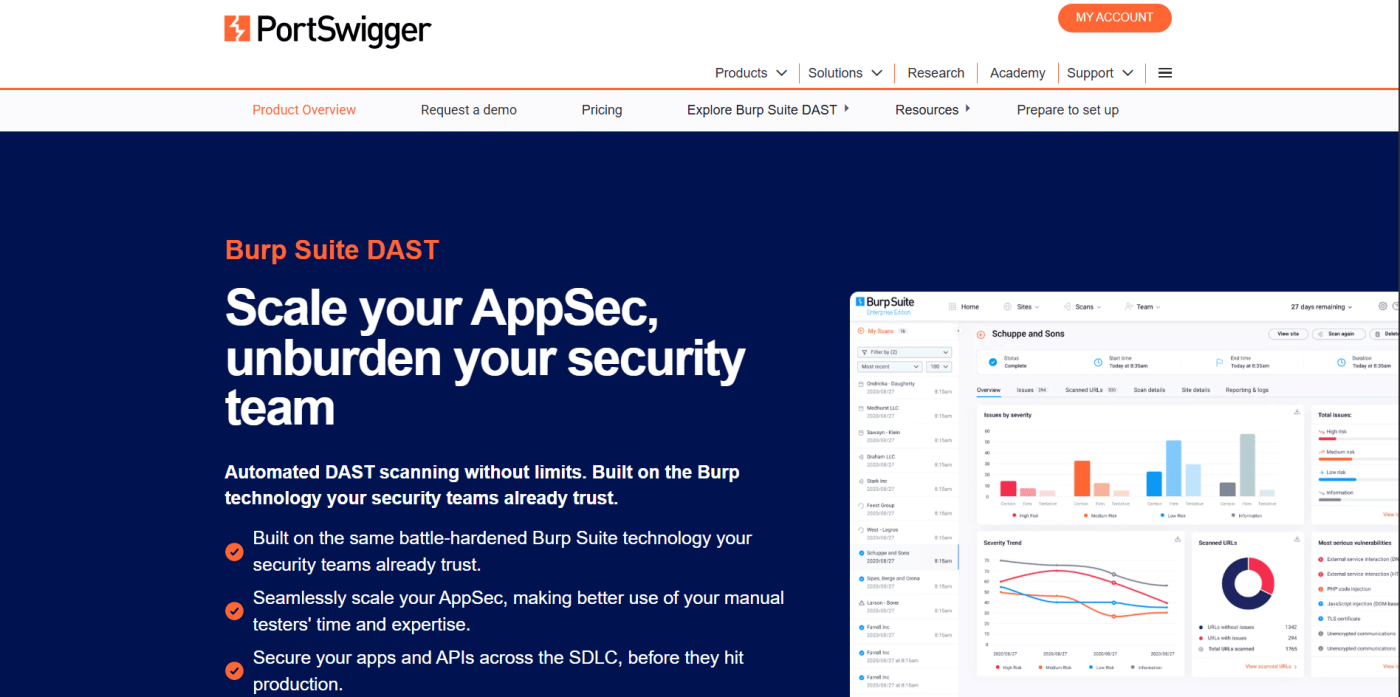
PortSwigger’s Burp Suite is one of the most established DAST scanners worldwide. It offers automated crawling and scanning along with advanced manual testing for complex applications.
With support for OpenAPI, GraphQL, and SOAP, it adapts to diverse environments. Its BApp Store and customizable scan checks (BChecks) make it one of the most extensible DAST platforms for security professionals.
Key Features:
- Intercepting proxy for capturing and modifying real-time HTTP/S traffic between the browser and server
- An automated DAST engine that identifies over 100 vulnerability types.
- Tools for automating customized attacks (fuzzing/brute-forcing) and manually
- Access to hundreds of community-developed plugins
Pros:
- Comprehensive scanning with deep manual testing capabilities
- Highly customizable and extensible via extensions
- Large community and frequent updates
Cons:
- Steep learning curve for beginners
- Expensive for small teams
- Lacks native static analysis (SAST) integration
Best Suitable For:
Burp Suite is the premier choice for penetration testers and bug hunters performing deep, manual security audits. It allows experts to manipulate complex logic and find out nuanced vulnerabilities.
9. Acunetix
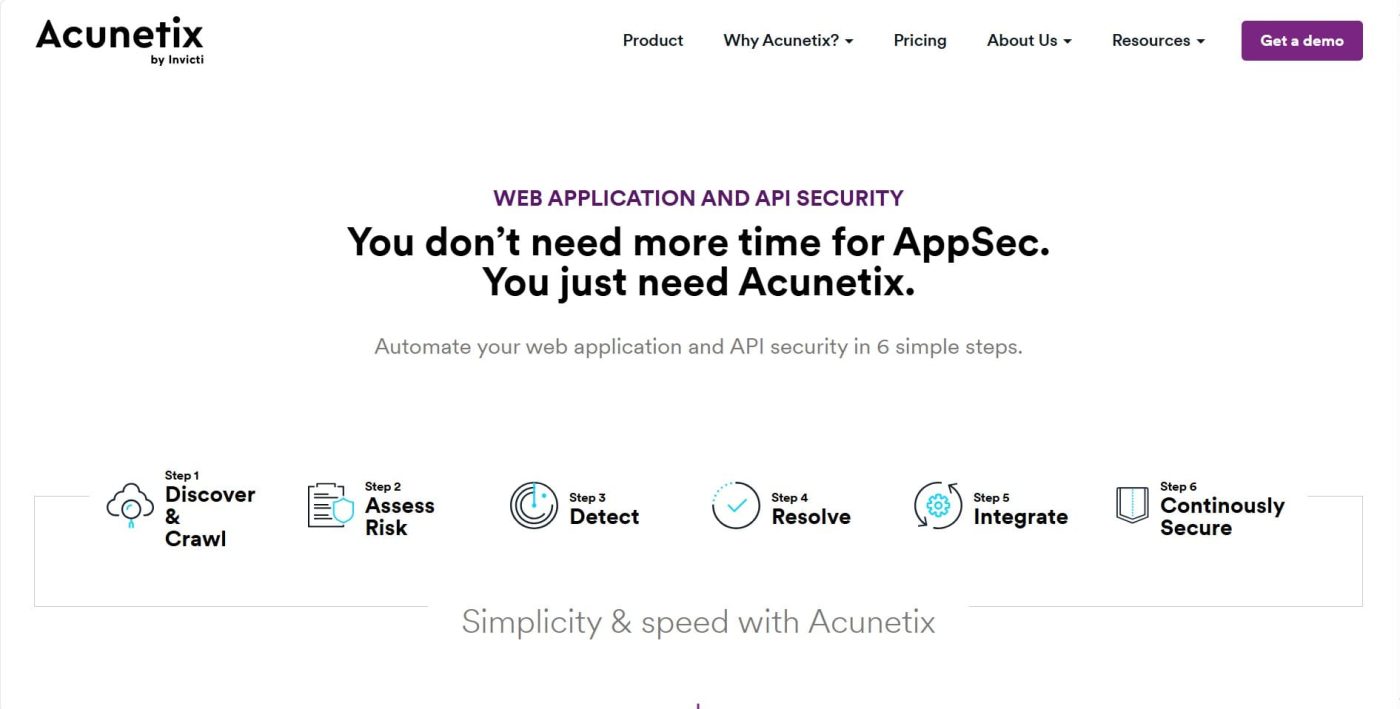
Acunetix is a leading dynamic application security testing (DAST) scanner for Windows and macOS, built for developers and security teams. It seamlessly connects with GitHub, Jira, and Atlassian integrations for CI/CD and DevSecOps workflows. Acunetix scans behind logins, supports compliance (HIPAA, SOC2, NIST, ISO 27001).
Key Features:
- AcuSensor (IAST) for pinpointing the exact line of code for vulnerabilities
- Proof-based scanning for automated validation
- DeepScan crawler for advanced engine for mapping complex JavaScript frameworks
- Integrated network scanning for unified testing to detect infrastructure-level vulnerabilities
Pros:
- Easy to use with a shallow learning curve
- Deep SDLC integration (GitHub, Jira, Atlassian, CI/CD)
- Compliance-ready reporting for major standards
Cons:
- Possible false positives requiring expert review
- Pricing may not suit all budgets
Best Suitable For:
Acunetix is best for organizations with a large number of web portfolios or fast-paced DevOps pipelines. It’s ideal for companies where automated, scalable scanning is required to maintain compliance.
10. Invicti
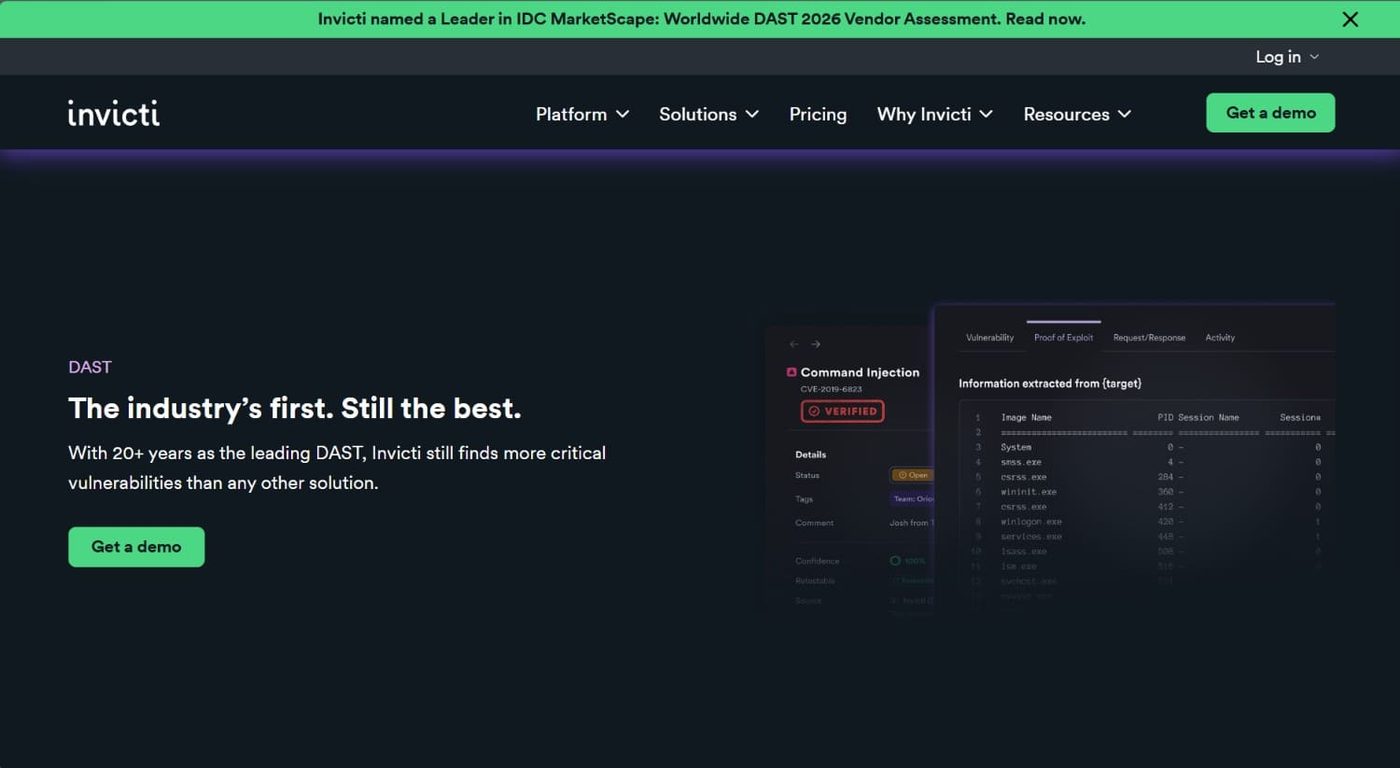
Invicti is a highly scalable, cloud-based enterprise DAST platform built to continuously scan thousands of corporate web assets. It specializes in automated risk management, discovering hidden applications, and securely verifying vulnerabilities across vast global digital attack surfaces.
Key Features:
- Proof-based scanning
- Scans global domains to find hidden or shadow applications automatically.
- Seamlessly navigates complex enterprise logins, including MFA and SSO portals.
- Integrates internal server agents to map runtime vulnerabilities directly to code.
- Syncs with Jira, ServiceNow, and CI/CD tools to automate ticket lifecycles.
Pros:
- Automated validation eliminates time wasted triaging fake security alerts.
- Centralizes concurrent scanning schedules across vast global web portfolios.
- Provides developers with exact exploit payloads and targeted patching guidance.
Cons:
- Cost structure is too expensive for small teams or startups.
- Complex corporate configurations can feel bloated for nimble development workflows.
- Deploying distributed scanners across internal corporate networks requires significant overhead
Best Suitable For:
Large enterprises managing thousands of web targets that require zero-false-positive automation to minimize triage work.
11. Veracode Dynamic Analysis
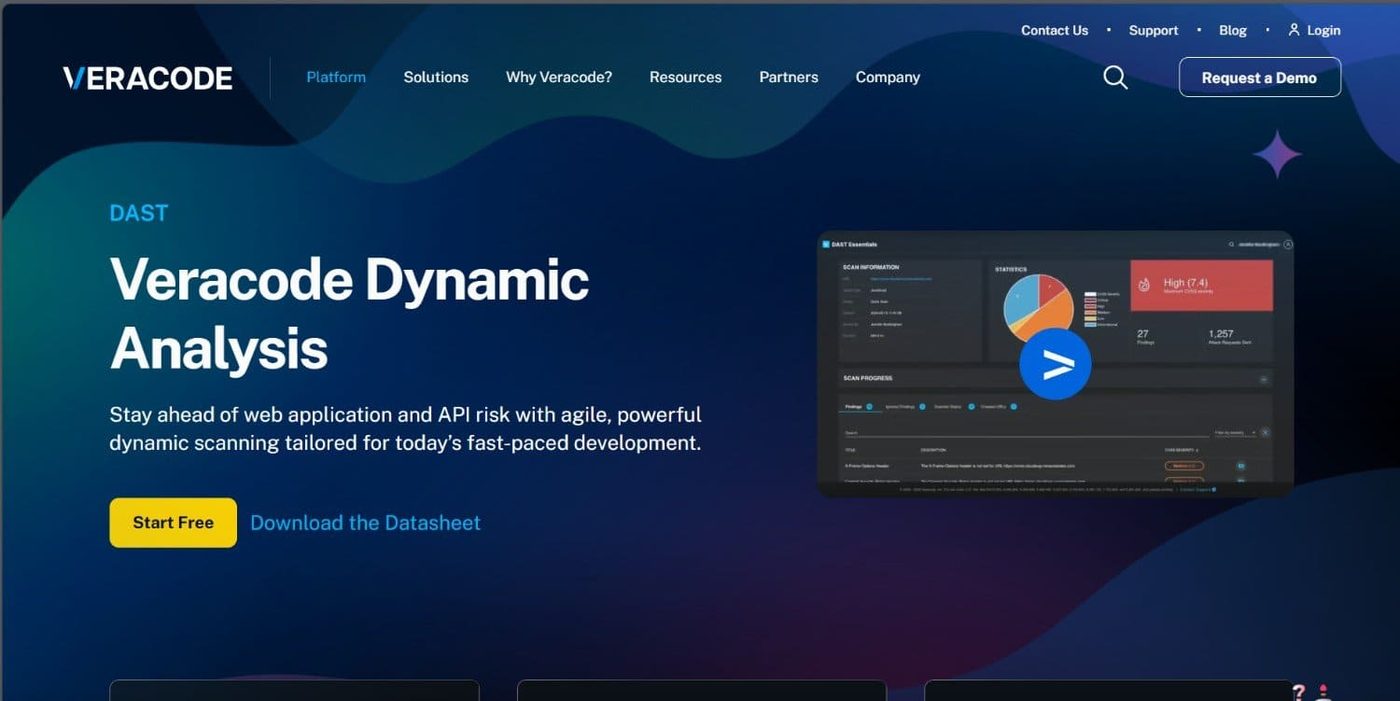
Veracode Dynamic Analysis is a cloud-native, governance-focused DAST platform built to run massive, concurrent application portfolio scans. It unifies runtime analysis with deep static testing metrics to provide corporate security leaders with a single-pane-of-glass overview of organizational risk.
Key Features:
- Unified application profiles .
- Selenium crawler scripting
- External attack surface mapping
- Governance policy enforcer
Pros:
- A fully cloud-managed execution environment handles heavy scan coordination seamlessly without local resources.
- Ideal for global compliance tracing across hundreds of legacy business software systems.
- Maintains an under-five-percent false positive rate through rigorous cloud validation tuning loops.
Cons:
- Scan processing and dashboard correlation can take longer than nimble developer-first pipeline checkers.
Best Suitable For:
Centralized Enterprise AppSec and compliance officers who need to manage global application security posture and audit metrics from a single dashboard.
12. AppCheck DAST
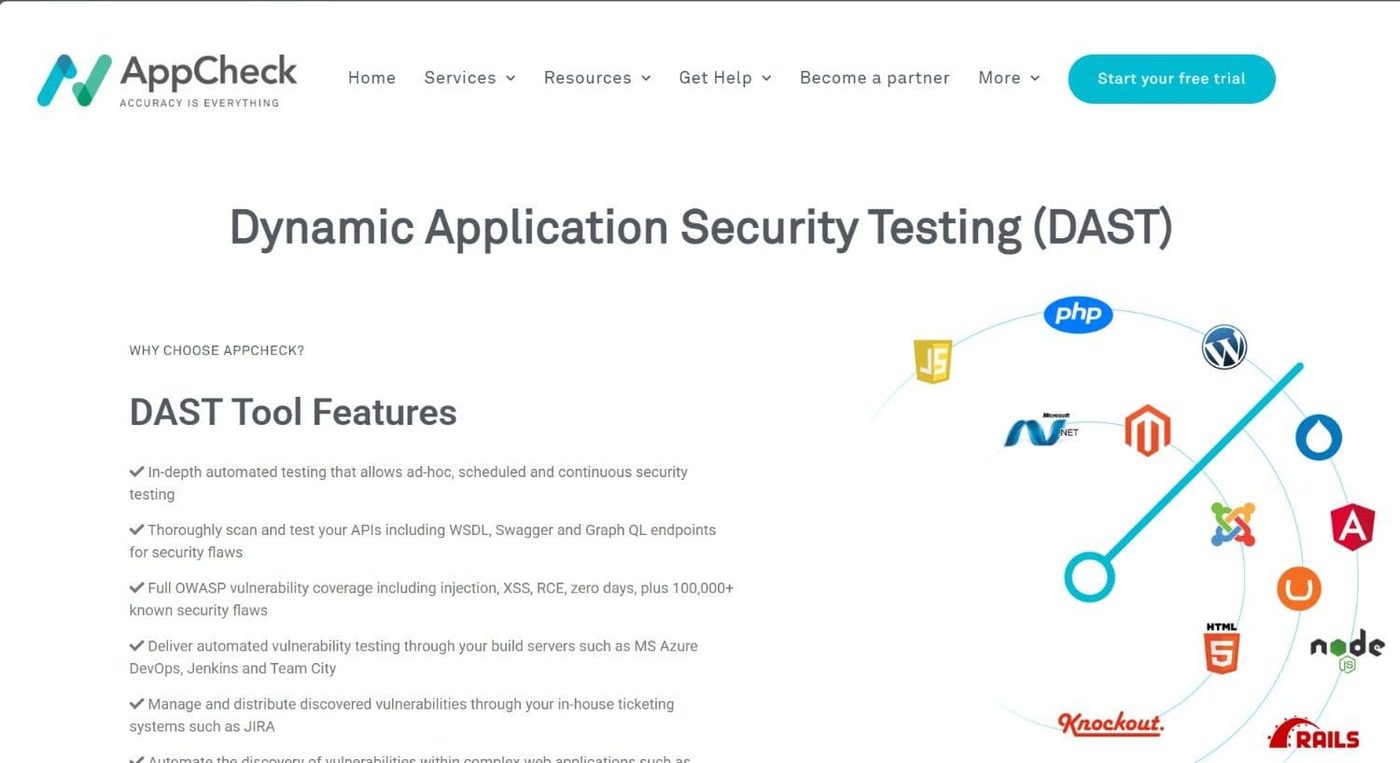
AppCheck is a dedicated automated dynamic scanning platform engineered to deliver penetration-test-quality depth. It specializes in identifying complex configuration mistakes, zero-day flaws, and broken access control structures across web applications and endpoints.
Key Features:
- Simulates deep, multi-stage attacker actions to surface elusive Insecure Direct Object Reference (IDOR) vulnerabilities.
- Monitors dedicated tracking servers to catch complex asynchronous code execution vulnerabilities.
- Uses browser-guided macros to maintain stable sessions past tricky TOTP and MFA challenges.
- Scans surrounding network infrastructure alongside active application endpoints to map overlapping entryways.
Pros:
- Uncovers deeply hidden logical gaps that basic pattern-matching scanners completely miss.
- Highly rated by security professionals for its accessible, expert technical tier-three engineering support.
- Licensing model permits infinite concurrent team users and role-based access configurations.
Cons:
- Console reporting structures can feel rigid when creating hyper-custom executive data analytics.
Best Suitable For:
Mid-to-large enterprises seeking an automated tool that closely replicates the thoroughness of a manual penetration testing engagement.
13. Checkmarx DAST
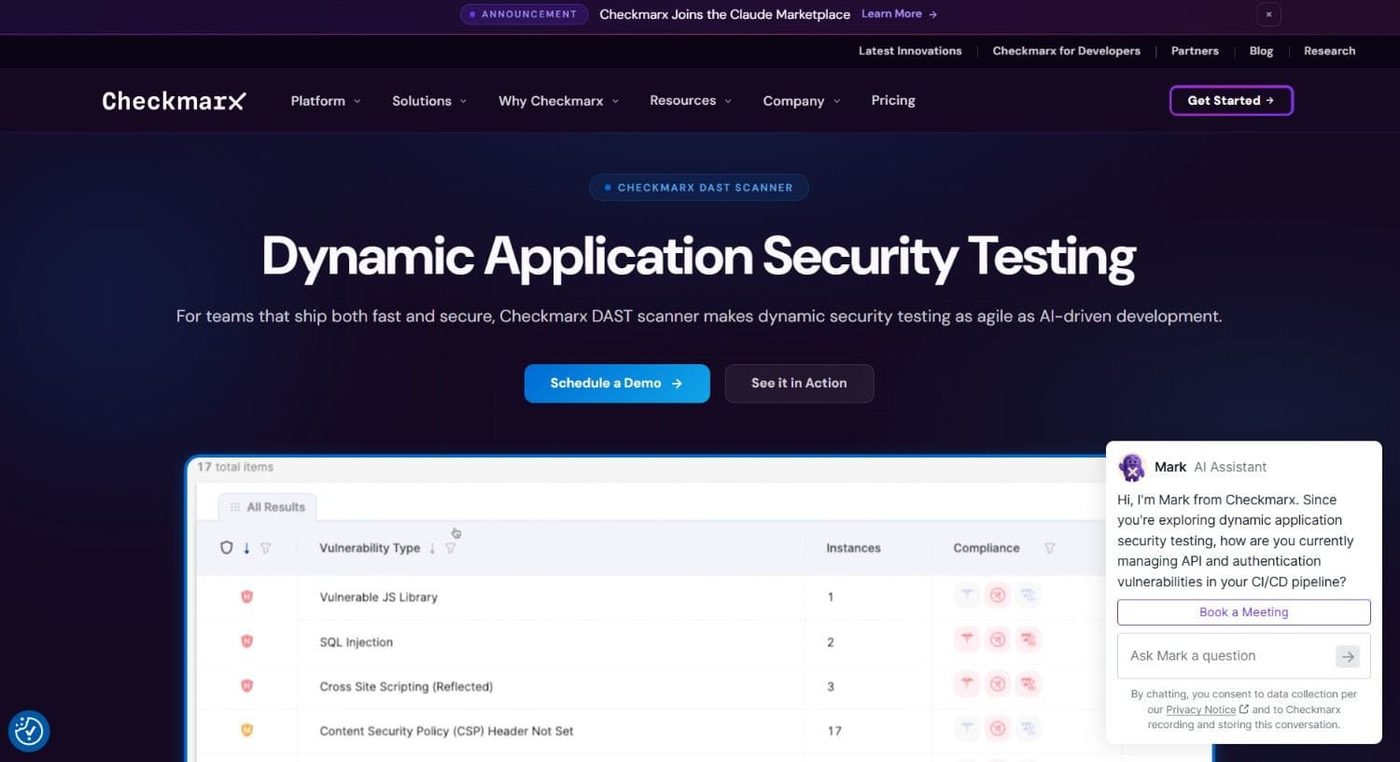
Checkmarx DAST is an enterprise-grade scanning solution functioning natively within the unified Checkmarx One AppSec platform. It correlates runtime test discoveries alongside static signals to help large security operations teams prioritize fixes for exploitable application flaws.
Key Features:
- Matches active runtime DAST findings against static code analysis vulnerabilities to confirm exploitability.
- Securely connects cloud platform engines directly into hidden internal testing environments seamlessly.
- Simplifies multi-factor login parameters using browser-recorded tracking loops and custom validation tools.
- Tailored to scan and validate that automated, AI-generated code snippets behave securely at runtime.
Pros:
- High Signal-to-Noise Ratio
- Removes vendor fragmentation by consolidating DAST, SAST, and API tracking into one suite.
- Can be plugged directly into pipeline commits to verify code logic before production.
Cons:
- Operates with peak efficiency only when purchased alongside the full Checkmarx enterprise ecosystem.
Best Suitable For:
Large security teams seeking to eliminate siloed point-solutions by managing dynamic testing alongside complex static source code engines.
Choosing a DAST Tool: Key Factors to Consider
Choosing the right DAST tool starts with three essentials:
- Scalability: A tool must grow with your applications without slowing down.
- Ease of use: It should also connect seamlessly with your CI/CD pipelines.
- Integration: It should connect with other tools is also critical.
And while automation speeds up testing, manual validation brings the accuracy required for high-stakes environments.
But selection is not just limited to technical capability, It involves other business-related factors. Check for demos and pay attention to whether it mirrors real-world scenarios.
You should look for free trials as it allows your team to see how the tool behaves in daily workflows. During this stage, ask direct questions about scalability, vendor support, update cycles, and coverage breadth.
Next, pricing is a crucial part. Some vendors price per app, others per scan, while enterprise licenses cover everything.
Conclusion
Integrating a DAST tool in the software development lifecycle can make a real difference in the DevSec process. It can spot issues before attackers do, cutting risks and saving time for developers.
Additionally, each of these DASt tools mentioned in this blog differs vastly in terms of use cases, pricing, and features. Additionally, what works for a small startup might not suit a large enterprise. The best way forward is to experiment, compare, and see which tool fits naturally into your workflow. By making a careful choice now, you give your applications a stronger defense and your team more confidence to move fast without compromising on security.
Ignoring hidden API vulnerabilities can be risky. BugDazz helps you secure APIs with continuous scanning and detailed insights. Move beyond generic tools, test with confidence, and protect your applications. Start a Free Trial Now!
How SecureLayer7 helps
Frequently Asked Questions (FAQs)
Yes. A good DAST tool can be seamlessly integrated into a CI/CD pipeline, allowing developers to test for vulnerabilities during the development phase.
By proactively identifying vulnerabilities, DAST tools help reduce the risk of data breaches and protect customer data and other sensitive information. This supports compliance with HIPAA, GDPR, and other regulatory standards.
DAST (Dynamic Application Security Testing) tools test running applications from the outside to identify vulnerabilities attackers could exploit without accessing the source code. In contrast, SAST (Static Application Security Testing) analyzes source code to identify potential vulnerabilities before deployment.
Consider your application’s complexity, compliance requirements, team expertise, and budget. Startups and SMEs often benefit from easy-to-use, cost-effective tools. Evaluate support for your technology stack, API coverage, and reporting capabilities to ensure the tool aligns with your environment and security goals.
