

The enterprise security environment has become increasingly sophisticated and complex, especially after transitioning to cloud environments. Publicly exposed Internet infrastructure has exponentially expanded the potential attack surface, creating numerous entry points, such as insecure API endpoints, misconfigurations, and third-party integrations.
Third-party actors can exploit these obvious ‘blind spot’ problems. Unfortunately, according to the recent ESG research report, only 9% of organizations confirmed they actively monitor the entire attack surface. The report further says that only 29% of organizations actively monitor between 75% and 89% of their attack surface. This means a considerable proportion monitors an even smaller fraction.
The good news is attack surface management can help address these problems, minimizing vulnerabilities.
This blog aims to help CISOs understand all facets of attack surface management and how it can help CISOs plug the weak spots that increase the organization’s attack surface area.
What Is an Attack Surface?
Simply put, an attack surface refers to the total number of potential entry points in IT networks and computer systems that malicious actors can exploit to gain unauthorized access.
To effectively manage an attack surface, it’s crucial to identify and manage various types of assets, including known, unknown, rogue, and third-party vendor assets. Organizations should invest resources in continuously discovering, tracking, and monitoring their assets to detect vulnerabilities and implement security controls to minimize potential attack points.
The different types of assets are shown in the table below:
| Type of Assets | Definition | Examples |
| Known Assets | Known assets are the components that are properly documented, and security teams are fully aware of. | Known assets include the most obvious assets, such as: ServersWorkstationsNetwork devicesApplicationsDatabases Several other IT assets |
| Unknown Assets | This type of IT assets are present in the IT environment, but they are not so well known and documented. | Shadow IT Unauthorized devicesUnapproved applications Unacknowledged IT resources |
| Rogue Assets | As the name implies, these are unauthorized devices or systems present in the environment without appropriate oversight. | Malware Unauthorized devices Unauthorized users |
| Third Party Vendor Risks | Third-party vendors assets are used to deliver services, such as cloud services, software solutions, or several types of outsourced IT solutions. | SaaS applicationsAPIsPublicly exposed public cloud assets |
Note: If third-party vendors fail to follow due diligence or standard security best practices, they can introduce vulnerabilities.
What is Attack Surface Management?
Attack surface management (ASM) is a methodical process that encompasses the continuous discovery of known, unknown, and third-party assets, including inventory, classification, prioritization, and security monitoring of external digital assets that contain, transmit, or process sensitive data.
According to Forrester Research, ASM includes tools or functionalities that continually scan for, discover, and enumerate internet-facing assets, establish the unique fingerprints of discovered assets, and identify exposures on both known and unknown assets.
The ASM approach follows similar methods and tactics used by threat actors. In fact, it is often performed by ‘ethical hackers’ who mimic these actions.
Why Attack Surface Management Matters
Maintaining visibility of internet-facing assets is essential, as these externally exposed systems serve as initial entry points for attackers to infiltrate a network. These assets are enticing targets for adversaries, who excel at locating unknown, externally exposed assets across organizations of all types.
This task has become easier with the increasing size of organizations, which has vastly expanded the attack surface. Here are the key reasons why effective ASM is important:
1. Better Risk Evaluation:
Attack Surface Management (ASM), when integrated with predictive risk analytics, enables better risk evaluation, contextualization, and prioritization of vulnerabilities for remedial action.
2. Enhances Security Posture:
Fortifies an organization’s overall security posture by mitigating external attack vectors effectively.
3. Optimizes Resource Allocation:
With a clear view of the attack surface, CISOs can allocate resources based on priority and risk severity.
4. Minimizes Operational Costs:
Proactively managing the attack surface reduces the likelihood of data breaches, thereby minimizing the chances of financial losses and operational downtimes.
5. Improved Regulatory Compliance:
Proactively managing the attack surface is critical for meeting regulatory compliance across industries such as BFSI and healthcare. ASM helps organizations adhere to compliance requirements like GDPR, HIPAA, PCI DSS, and others, strengthening their security posture.
What Can Attack Surface Management Do for Businesses?
Here are some essential capabilities of Attack Surface Management (ASM):
- Discover and maintain an inventory of all internet-facing and non-internet-facing assets within an organization’s infrastructure.
- Map and visualize the organization’s attack surface, enabling the identification of potential entry points, vulnerabilities, and interconnections.
- Evaluate assets for known vulnerabilities, misconfigurations, and other loopholes through vulnerability scanning, penetration testing, and other security testing methods.
- Integrate with a threat intelligence engine to stay updated on the latest threats, attack vectors, and indicators of compromise (IoCs).
- Help prioritize and remediate the most critical risks, including patching vulnerabilities, implementing access control mechanisms, and decommissioning obsolete assets.
What Are the Key Components of an Attack Surface Management Strategy?
An effective attack surface management (ASM) program involves many components, which include:
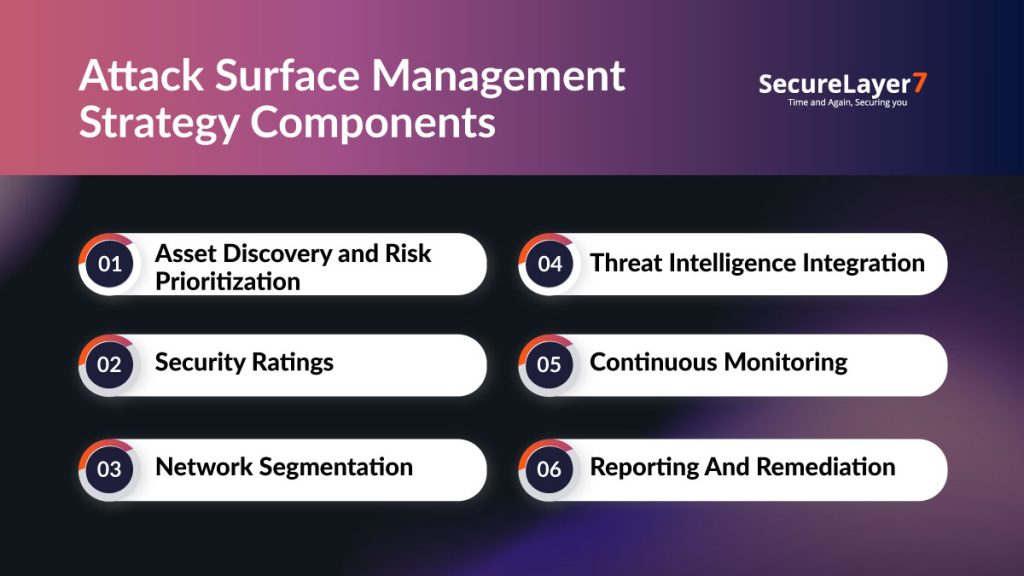
1. Asset Discovery and Risk Prioritization
This involves classifying assets based on their risk profile and suggesting how to implement appropriate controls and remediation policies, considering the priorities of each asset. For example, running scans periodically to detect new servers, workstations, or other connected devices.
2. Security Ratings
Not all security risks are the same. Security ratings provide insight into the severity of various security risks, empowering security teams to manage the attack surface actively.
3. Network Segmentation
Segmenting the network into separate, controlled segments limits the potential spread of cybersecurity threats. This involves adopting a zero-trust security approach, ensuring that even if an attacker intrudes, their lateral movement is restricted, limiting the damage.
4. Threat Intelligence Integration
Integrating threat intelligence into the ASM strategy offers valuable insights into the evolving threat landscape and emerging attack vectors. This enables proactive risk mitigation and ensures adequate security controls against emerging threats.
5. Continuous Monitoring
Continuous monitoring tracks changes across the attack surface, detecting new assets, vulnerabilities, or emerging threats. This enables proactive adjustments to security controls while minimizing exposure to evolving threats.
6. Reporting and Remediation
After identifying risks, appropriate actions are taken to remediate vulnerabilities through patching, reconfiguring settings, or decommissioning insecure assets. Compensating controls and mitigation measures are implemented to reduce the attack surface. These efforts prioritize critical risks, enhancing the organization’s overall cybersecurity posture
What Are Some Best Practices for Attack Surface Management?
Effective attack surface management helps uncover potential vulnerabilities and provides a comprehensive understanding of the security landscape. However, successful attack surface management depends on how well the plan is executed.
McKinsey, in its report on Transforming Cybersecurity, opines:
“The idea that some assets are extraordinary, of critical importance to a company, must be at the heart of an effective strategy to protect against cyber threats. Because in an increasingly digitized world, protecting everything equally is not an option.”
Security teams should adhere to the following best practices:
| Best Practices | Execution Strategy |
| Properly map out the attack surface | Prepare a list of digital assets that are exposed, identify attackers’ likely targets, and determine what protection is needed to plug the gaps. |
| Minimize vulnerabilities | Bring assets offline wherever possible. Strengthen both internal and external-facing assets. |
| Set up robust security practices | Establish strong authentication protocols. Maintain continuous vulnerability scanning and patching. Identify and remove unknown or rogue assets. Implement strong encryption wherever possible. |
| Establish monitoring and testing protocols | Implement continuous penetration testing. |
| Understand compliance requirements | Put policies and procedures in place to meet compliance standards such as HIPAA, PCI DSS, GDPR, and NIST. |
| Hire external ASM experts | Hire security auditors to identify vulnerabilities that would otherwise go unnoticed. |
How SecureLayer7 Can Help
An effective attack surface management strategy includes continuous penetration testing. That’s where you can consider SecureLayer7 for next-generation penetration testing and cybersecurity solutions.
Here are some key reasons to select SecureLayer7 as a reliable ASM partner:
- SecureLayer7 helps customers spot high-risk business vulnerabilities such as authentication, authorization, and logic flaws that may result in data breaches.
- Our PTaaS services include application testing, mobile app penetration testing, thick client penetration testing, source code analysis, smart contract audits, and cloud penetration testing.
- We help businesses address cloud security concerns by securely maintaining their cloud infrastructure. Any cloud-based vulnerabilities in your AWS, Azure, and Kubernetes systems are swiftly detected and quarantined by the SecureLayer7 platform.
- Our comprehensive approach to server hardening limits attacker entry points by preventing unauthorized access through unsecured ports.
- We provide full security services for your IoT ecosystem, including lifecycle management, superficial testing, manual assessments, and securing endpoints to networks in the cloud. When deploying our systems, there will be fewer hindrances to IoT product delivery.
- We are Gartner-reviewed, which speaks to the quality of our services.
Conclusion
In the era of a digitally connected world through cloud and IoT, the attack surface has expanded exponentially, creating new vulnerabilities that challenge CISOs. It is essential to understand that mere visibility into exposed assets cannot prevent an organization from being targeted. Organizations need to build and implement a robust attack surface management strategy that continuously identifies, analyzes, and mitigates vulnerabilities.
Looking for a partner to enhance your ASM strategy? SecureLayer7 experts can help detect blind spots. Get in touch with us to learn more about how we can assist.
Reference:
How SecureLayer7 helps
Frequently Asked Questions
An attack surface is the full set of entry points an attacker can use to reach your systems, including servers, APIs, applications, and exposed cloud assets. Attack surface management is the ongoing process of discovering, classifying, prioritizing, and monitoring those entry points. The first is the target; the second is the practice of controlling it.
Four categories matter: known assets that are documented and tracked, unknown assets like shadow IT and unapproved applications, rogue assets such as malware and unauthorized devices, and third-party vendor assets including SaaS tools and APIs. Unknown and rogue assets cause most blind spots because security teams have no inventory of them. Third-party assets add risk when vendors skip security due diligence.
ASM tools continuously scan for and enumerate internet-facing assets, then fingerprint each one to build an inventory. They identify exposures on both known and unknown assets and feed that data into prioritization for remediation. The approach copies the reconnaissance methods threat actors use, and ethical hackers often run it to mirror real attacker behavior.
Cloud migration and public internet exposure created far more entry points than security teams can track manually, including API endpoints, misconfigurations, and vendor integrations. ESG research found only 9% of organizations monitor their entire attack surface, and just 29% cover between 75% and 89%. The gap comes from unknown and rogue assets that never make it into an inventory.
Yes. Maintaining a current inventory of exposed assets and fixing vulnerabilities supports requirements under GDPR, HIPAA, and PCI DSS. It matters most in regulated sectors like BFSI and healthcare, where unmonitored assets can lead to violations. Continuous monitoring also produces the evidence auditors expect.

