
The rapid adoption of generative AI, AI agents, and AI-powered coding tools is changing how organizations develop applications, automate workflows, and process data. AI systems can generate and execute code, interact with APIs, access files, and perform autonomous actions, creating new security risks when these capabilities are not properly controlled. An AI sandbox provides an isolated environment where AI-generated code and agent activities can run without unrestricted access to production systems, sensitive data, or critical infrastructure.
AI sandboxing helps organizations contain unsafe behavior, restrict permissions, protect data, and monitor AI activity before it can affect enterprise environments. By combining secure execution, environment isolation, least-privilege access, monitoring, and controlled testing, organizations can reduce risks such as malicious code execution, data leakage, prompt injection, unauthorized actions, and vulnerable dependencies.
Growing Adoption of Generative AI and Autonomous Agents
Organizations are increasingly integrating generative AI and autonomous agents into software development, customer support, data analysis, and business automation workflows. These AI-driven systems introduce new operational complexities because they can process large volumes of data, connect with enterprise tools, and operate with varying levels of autonomy.
As organizations expand AI usage across business processes, traditional security controls may not provide sufficient visibility or control over AI behavior. AI sandboxing enables teams to safely test, validate, and monitor AI applications before allowing them to operate within production environments. Similar concerns exist in modern application security, where organizations use techniques such as Application Security Testing to identify vulnerabilities before attackers exploit them.
Security Risks of Running AI-Generated Code, Tools, and External Actions
AI-generated code may contain vulnerabilities or malicious instructions, increasing security risks when AI agents execute it or access external systems.
Key risks include:
- Malicious Code Execution: AI-generated code could perform unauthorized operations or access sensitive resources.
- Data Exposure: An AI agent may unintentionally access or transmit confidential files, credentials, or application data.
- Excessive Permissions: Broad access to operating systems, APIs, or cloud resources can increase the impact of a compromised or misbehaving agent.
- Prompt Injection: Malicious instructions can manipulate an AI agent into performing actions outside its intended purpose. To understand how attackers exploit AI systems through malicious instructions.
For a deeper understanding of this risk, read our related post on prompt injection attacks.
Why an AI Sandbox is Becoming Essential for Secure AI Deployment
An AI sandbox isolates AI-generated code, tools, and agent actions with controlled permissions and limited system access, reducing the impact of unsafe behavior on production and development environments.
An AI sandbox can provide:
- Isolation: Separates AI-generated processes from sensitive systems and workloads.
- Controlled Access: Restricts filesystem, network, API, and system permissions.
- Safe Code Execution: Allows AI agents to test and execute code in an isolated environment.
- Monitoring: Tracks processes, network activity, resource usage, and agent behavior.
What is an AI Sandbox
An AI sandbox is an isolated execution environment designed to safely run AI-generated code, agent actions, tools, and untrusted workloads without giving them unrestricted access to the host system or production infrastructure. It creates a controlled boundary around AI activity, limiting access to files, networks, system resources, credentials, and external services.
AI sandboxing is particularly important for autonomous AI agents that can execute code, interact with APIs, modify files, or perform multi-step tasks. Depending on the required security and performance level, sandbox environments can use technologies such as containers, microVMs, or other isolation mechanisms.
How AI Sandboxing Creates Isolated Environments for AI Models and Agents
AI sandboxing isolates AI execution from sensitive systems by enforcing predefined security controls. It limits what AI models and agents can access, execute, and modify.
An AI sandbox can control:
- Filesystem access: Restricts which files and directories an AI agent can read or modify.
- Network access: Limits connections to approved domains, APIs, or services.
- System permissions: Prevents unauthorized access to operating-system resources.
- Compute resources: Controls CPU, memory, and execution time to prevent resource abuse.
- Credentials and secrets: Prevents unnecessary exposure of API keys, tokens, and sensitive credentials.
- Process execution: Controls which commands, applications, or tools an AI agent can execute.
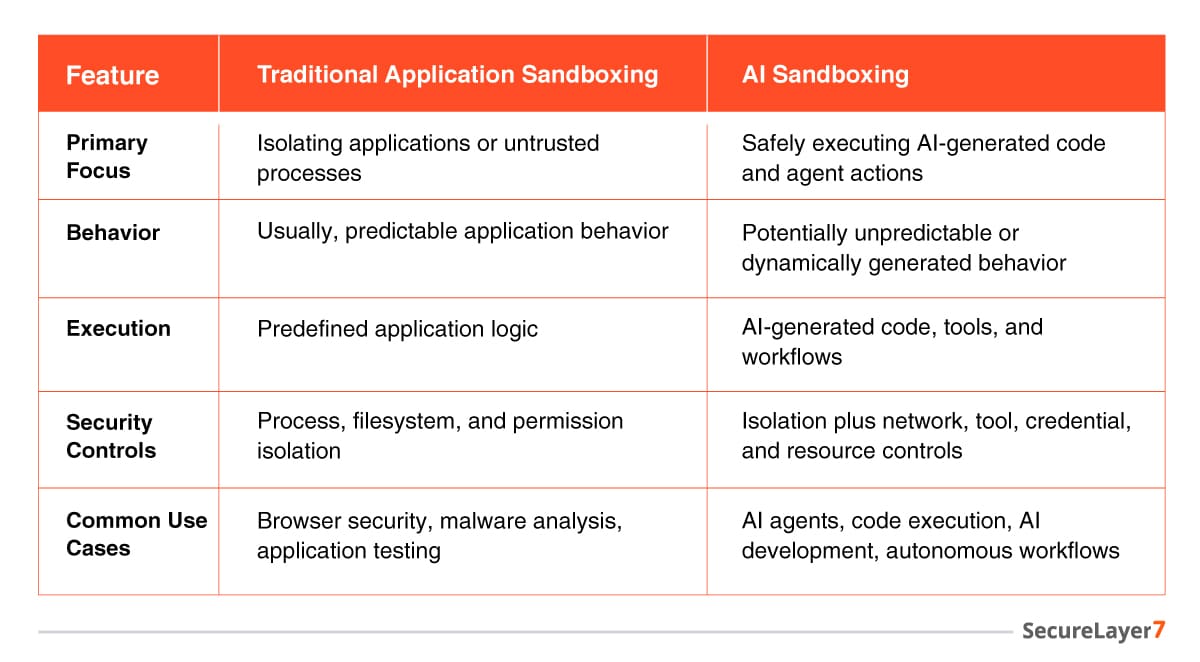
AI Sandboxing vs Traditional Application Sandboxing
Both approaches use isolation to reduce security risks; AI sandboxing is designed around the unique behavior of AI-generated code and autonomous agents.
Role of Sandbox Environments in Testing and Securing AI Systems
AI sandboxes support safer AI adoption by containing agent activity and reducing risks across development and production environments.
- Reduce Approval Fatigue: Sandboxing allows AI agents to operate within controlled boundaries without requiring manual approval for every action.
- Protect Infrastructure and Secrets: Restricting network, credential, and filesystem access helps prevent data leaks and unauthorized system access.
- Enable Safe Testing: Security teams can test AI models against prompt injection, malicious inputs, and other threats without exposing production systems.
Why AI Sandboxing Matters
As generative AI applications evolve into autonomous agents capable of executing code, accessing files, calling APIs, and interacting with external systems, traditional security controls may not be sufficient to contain unexpected behavior.
AI sandboxing provides an isolated environment where AI-generated code and agent actions can be executed with controlled permissions, reducing the potential impact of security incidents. Organizations deploying AI applications should also evaluate their complete AI attack surface to identify potential exposure points.
Increasing Risks From AI-Generated Code and Autonomous Agents
AI systems can generate and execute code dynamically, which introduces risks that are difficult to predict in advance. An AI agent may unintentionally execute unsafe commands, use vulnerable dependencies, access unauthorized resources, or follow malicious instructions introduced through prompt injection.
Common risks include:
- Unsafe code execution: AI-generated code may contain vulnerabilities or unintended commands.
- Prompt injection: Malicious instructions can manipulate an AI agent into performing unauthorized actions.
- Excessive tool access: Agents with broad permissions can interact with sensitive files, APIs, or infrastructure.
- Malicious dependencies: AI-generated applications may introduce vulnerable or untrusted libraries.
Preventing Data Leakage and Unauthorized Actions
AI applications often require access to business data, files, APIs, and other resources. Without proper isolation, an AI agent could unintentionally expose sensitive information or perform actions beyond its intended scope.
AI sandboxing helps reduce these risks through:
- Restricted filesystem access: Limits which files an AI process can access.
- Network controls: Restricts communication with untrusted websites and external services.
- Credential isolation: Prevents unnecessary access to API keys, tokens, and secrets.
- Permission controls: Applies least-privilege access to tools and system resources.
- Execution limits: Controls CPU, memory, processes, and execution time.
Protecting Enterprise Systems from AI-Driven Threats
Enterprise systems are not designed to contain autonomous AI agents that can rapidly execute actions and test attack paths.
- Prevent Lateral Movement: Sandboxes isolate AI agents from internal networks, privileged resources, and host systems, limiting unauthorized access and privilege escalation.
- Contain the Blast Radius: Isolated containers or microVMs keep malicious code, destructive actions, and system failures confined to the sandbox without affecting production systems or critical data.
How an AI Sandbox Works
Deploying autonomous AI agents and coding assistants safely requires moving beyond passive monitoring and implementing robust, active runtime isolation. Unlike traditional software environments that assume code is trusted; an AI sandbox operates on the principle that all AI-generated outputs and tool calls are untrusted by default.
A mature AI sandbox architecture functions through four core, interconnected phases – from runtime isolation to pre-deployment validation.
AI Environment Isolation
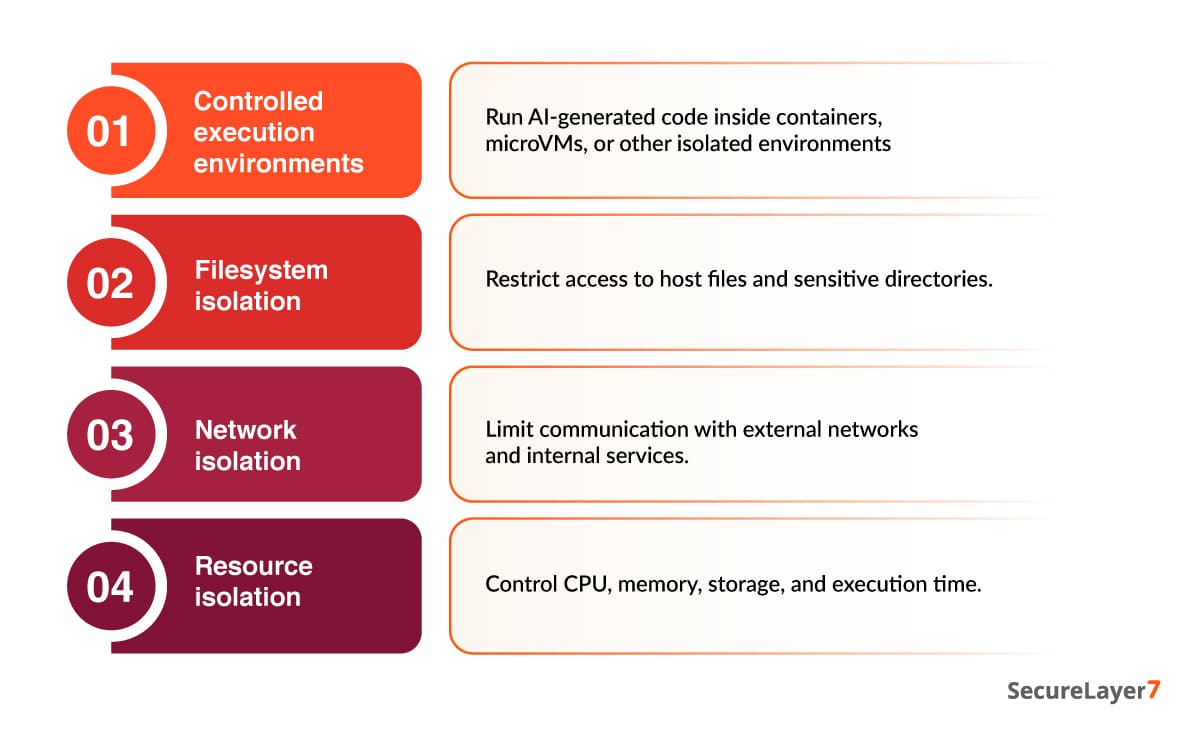
AI sandboxing creates a controlled, isolated environment where AI-generated code and agent actions can run safely. Instead of executing commands directly on developer workstations or production systems, AI operations are contained within a dedicated sandbox.
Key isolation controls include:
Input and Output Monitoring
An AI sandbox should monitor both what the AI receives and what it produces or attempts to execute. This provides security teams with visibility into potentially unsafe behavior.
Monitoring can include:
- Prompt analysis: Identifying potentially malicious or suspicious instructions.
- Data access monitoring: Tracking which files, databases, or resources the AI attempts to access.
- Tool activity: Monitoring API calls, commands, and external tool usage.
- Network activity: Detecting connections to unauthorized or suspicious destinations.
Permission and Access Control
AI agents should not automatically receive unrestricted access to systems or resources. An AI sandbox applies least-privilege principles by granting only the permissions required for a specific task.
Access controls can restrict:
- Files and directories the agent can access.
- Commands and processes it can execute.
- APIs and external services it can call.
- Network destinations it can communicate with.
Testing and Validation
AI sandboxing enables teams to safely test AI responses, code execution, and tool interactions before production deployment. Security teams can strengthen this process through AI application penetration testing to identify vulnerabilities in LLM-powered applications.
Testing can help identify:
- Vulnerabilities in AI-generated code.
- Unsafe or unexpected agent behavior.
- Prompt-injection risks.
- Unauthorized tool or resource access.
Key Features of an Effective AI Sandbox
As organizations increasingly adopt autonomous AI agents, coding assistants, and automated tool-use pipelines, traditional security controls fall short. Securing generative AI workflows requires specialized infrastructure built specifically for probabilistic and non-deterministic software.
An enterprise-grade AI sandbox must incorporate four core features to ensure complete protection, data privacy, and operational velocity.
Secure Execution Environment
Because AI models generate code dynamically in real time, an effective sandbox must treat all AI-generated scripts, terminal commands, and tool calls as untrusted by default.
- Kernel-Level Isolation: Utilizing lightweight microVMs or secure container runtimes to erect hard virtualization boundaries between the AI workload and the host node.
- Ephemeral Compute: Automatically spinning up isolated execution environments in milliseconds to run a specific task and destroying the instance immediately afterward to eliminate persistent footprint risks.
Data Isolation and Protection
AI sandboxes protect sensitive data by isolating agents from enterprise systems and removing unnecessary credentials.
- Strict Boundary Separation: Isolate sandboxes from databases, internal services, and production data.
- Secret Masking: Remove API keys, environment variables, and cloud credentials to prevent unauthorized access or data exfiltration.
Access Control and Policy Enforcement
Even within an isolated environment, an autonomous agent should never be granted unfettered capabilities. Granular governance is vital.
- Principle of Least Privilege: Restricting agent capabilities down to the specific task required – stripping unnecessary outbound internet access, blocking raw socket connections, and preventing dangerous system calls.
- Policy-as-Code Guardrails: Enforcing automated security policies that intercept and block high-risk actions before they execute.
AI Behavior Monitoring
Runtime isolation must be paired with continuous visibility to detect sophisticated attacks like indirect prompt injection or anomalous agent looping.
- Real-Time Telemetry: Actively monitoring prompts, ingested data files, shell commands, and model responses as they happen.
- Threat Detection and Alerting: Instantly flagging suspicious agent behavior – such as attempts to access restricted host directories, scan internal networks, or execute unexpected binary files – allowing security teams to intercept threats before damage occurs.
AI Sandbox Use Cases
As generative artificial intelligence and autonomous AI agents become deeply integrated into software development pipelines, traditional security tools are no longer sufficient. Organizations need practical ways to harness agentic workflows without risking production stability, data privacy, or enterprise security.
Following are three primary use cases where deploying an AI sandbox is critical for secure AI adoption.
Testing AI-Generated Code Securely
AI coding tools can generate scripts and commands that contain bugs or unintended actions. Sandboxing provides a controlled environment to execute and test this code safely.
- Sandboxed Execution: Runs AI-generated code in isolated, disposable environments instead of directly on host systems.
- Blast Radius Containment: Limits the impact of destructive commands, infinite loops, or faulty dependencies to the sandbox.
Evaluating AI Agents Before Production Deployment
AI sandboxes enable teams to safely evaluate autonomous agents before production deployment.
- Behavioral Testing: Simulate malformed inputs, edge cases, and complex workflows in isolated environments.
- Red Teaming: Test agents against prompt injection, malicious payloads, and unauthorized tool calls without exposing production systems.
Protecting Enterprise Data Used by AI Systems
AI sandboxes reduce data exposure by limiting access to sensitive credentials, systems, and external networks. Organizations can improve their overall AI security strategy by addressing risks related to data protection, model behavior, and secure AI deployment.
- Protect Sensitive Secrets: Remove unnecessary API keys, environment variables, and database credentials from the sandbox.
- Prevent Data Exfiltration: Restrict outbound network access to prevent compromised or prompt-injected agents from leaking source code and enterprise data.
Challenges in Implementing AI Sandboxing
Implementing an AI sandbox is essential for safely harnessing generative artificial intelligence and autonomous code agents, but the journey is not without friction. Because AI workflows are probabilistic, fast-paced, and highly dynamic, security and platform engineering teams face unique hurdles when establishing robust isolation infrastructure.
Managing Complex AI Workflows and Dependencies
AI applications often rely on multiple models, libraries, APIs, databases, plugins, and external tools. Sandboxing these interconnected components without disrupting their functionality can introduce operational complexity.
Common challenges include:
- Managing dependencies required by AI-generated code.
- Supporting multiple programming languages and frameworks.
- Controlling access to external APIs and tools.
- Maintaining consistent sandbox environments across development and production.
Balancing Security Controls with AI Usability
Overly restrictive security policies can prevent AI agents from completing legitimate tasks, while excessive permissions can increase security risks. Organizations need to find the right balance between security and usability.
Organizations should:
- Apply permissions based on specific AI tasks.
- Use temporary access where possible.
- Allowlist required tools and services.
- Monitor denied and permitted activities.
Protecting Against Advanced AI Attacks
AI sandboxing must also account for emerging threats targeting AI applications and autonomous agents. Attackers may attempt to manipulate AI systems into bypassing restrictions, accessing sensitive information, or executing unauthorized commands.
Potential threats include:
- Prompt injection: Malicious instructions manipulate an AI agent into violating its intended behavior.
- Tool abuse: Attackers exploit connected tools or APIs to perform unauthorized actions.
- Data exfiltration: Sensitive information is extracted through AI-generated responses or external connections.
Best Practices for AI Sandbox Implementation
To overcome these operational challenges and establish a resilient runtime security posture, organizations should adopt three foundational best practices:
- Define AI Security Policies and Usage Boundaries: Establish explicit, policy-as-code guardrails that dictate what actions an AI agent is permitted to perform. Define clear operational boundaries for file access, shell execution, and external API calls before deploying agents into development pipelines.
- Isolate AI Environments from Critical Systems: Never allow AI agents to share raw compute resources with local host machines or production infrastructure. Enforce kernel-level isolation using lightweight microVMs or secure container runtimes, ensuring that any compromised workload or destructive script is instantly contained within an ephemeral boundary.
- Apply Identity and Access Management Controls: Treat AI agents as non-human identities requiring strict least privilege access. Strip unnecessary cloud credentials, internal API keys, and sensitive environment variables from the sandbox space, ensuring agents only possess the bare-minimum permissions required to complete their designated task.
Future of AI Sandboxing
As autonomous AI agents, multi-step coding assistants, and tool-calling workflows become deeply embedded in software engineering and enterprise operations, the technology protecting these systems is evolving rapidly. Traditional static containers are giving way to intelligent, hardware-enforced, and natively integrated runtime architectures. As organizations adopt AI tools and agent-based systems, securing external integrations becomes critical. Learn more about securing AI integrations through MCP security testing.
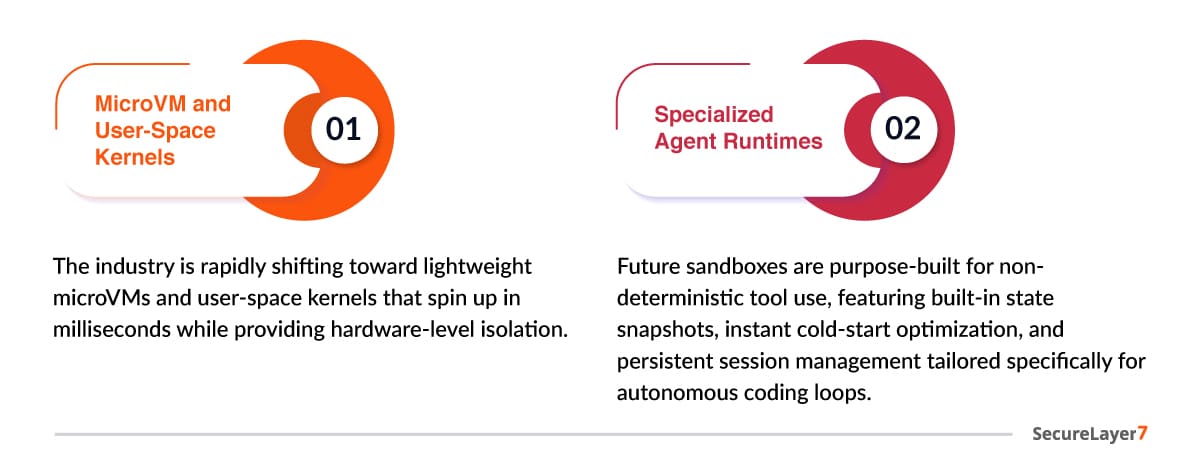
Future of AI sandboxing is defined by three major technological shifts:
AI Agent-Specific Sandboxing Approaches
Standard software containers rely on a shared host kernel, making them vulnerable to sophisticated container breakouts if an autonomous agent is manipulated via prompt injection.
Integration with Cloud Security Platforms
AI sandboxes will no longer operate as isolated local utilities; they are becoming a core layer of enterprise cloud security and observability stacks.
- Unified Governance and DLP: Security platforms are integrating AI execution sandboxes directly with outbound HTTP proxies, data loss prevention (DLP) filters, and domain allowlists to intercept secret exfiltration in real time.
- Kubernetes and Cloud-Native Convergence: Sandboxes are increasingly orchestrated directly inside Kubernetes clusters or serverless cloud infrastructure, allowing agents to test, deploy, and verify changes in ephemeral staging environments with full compliance auditing.
Automated Threat Detection and Response
As threat actors adapt by targeting AI toolchains with indirect prompt injections and automated malware payloads, sandboxes are evolving into active defense systems.
- Behavioral Telemetry and AI Firewalls: Next-generation sandboxes utilize real-time behavioral analysis to monitor agent execution patterns, instantly tripping a “kill switch” if an agent attempts unauthorized network pivoting, lateral movement, or file system tampering.
- Self-Healing Guardrails: Advanced runtime governance tools automatically analyze blocked threat vectors inside the sandbox and adapt security policies on-the-fly, hardening future agent interactions without manual developer intervention.
Conclusion
As generative AI and autonomous agents become more capable, AI sandboxing is essential for secure AI adoption. By isolating workloads, restricting sensitive access, monitoring agent behavior, and controlling code execution, organizations can reduce risks such as prompt injection, malicious code, data leakage, and unauthorized actions.
A resilient AI security strategy combines sandboxing, least-privilege access, security policies, continuous monitoring, and regular security testing to protect enterprise systems and sensitive data. SecureLayer7 helps organizations identify and mitigate AI security risks through proactive security testing and vulnerability assessments.
Secure your AI environment with SecureLayer7 and enable safer, more confident AI adoption.
Frequently Asked Questions (FAQs)
An AI sandbox is an isolated environment that safely runs AI-generated code, agent actions, and untrusted workloads while restricting access to sensitive systems, data, credentials, and networks.
AI sandboxing isolates AI workloads and controls filesystem, network, API, and system access, reducing risks such as data leakage, unauthorized access, malicious code execution, and unsafe AI actions.
Key benefits include secure code execution for safely testing AI-generated code, data protection by restricting access to sensitive information, risk containment to prevent unsafe actions from affecting production, and controlled access through least-privilege permissions.
Traditional sandboxing primarily isolates applications or processes, while AI sandboxing also controls AI-generated code, autonomous actions, tool usage, APIs, data access, and network interactions.
AI agents can execute code, access files, call APIs, and interact with external systems. Sandboxes limit these capabilities through restricted permissions, network and filesystem controls, isolated credentials, resource limits, and continuous monitoring.

