
What Is Data Masking?
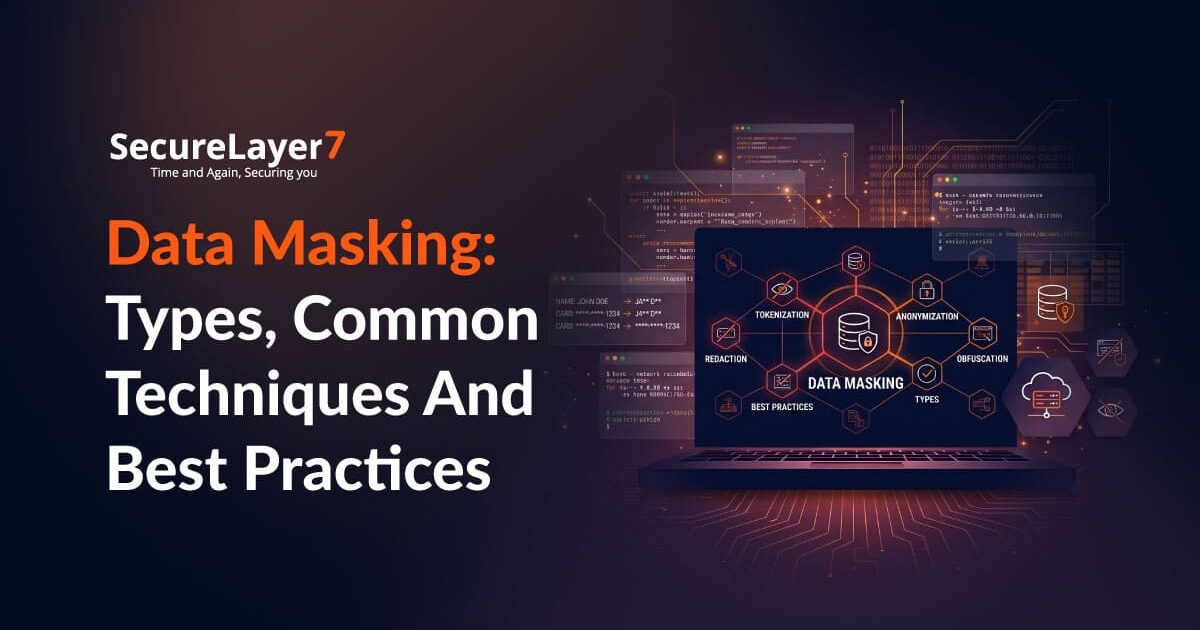
Data masking refers to the process of replacing sensitive information or data with fictional but realistic values while preserving the original format and usability of the data. A masked customer name still looks like a customer name, but it will be different from the original.
For example, a customer’s name might be replaced with a fictional name, while a credit card number could appear as XXXX-XXXX-XXXX-4521. The transformed information retains enough of its original structure to support specific business activities without revealing the complete underlying value.
Think of it like movie money. The cash used in a film looks realistic enough for the camera, but it cannot be spent in a store.
Data masking works on a similar principle. A developer can use a realistic-looking customer record to test an application without necessarily accessing the customer’s actual identity.
However, not all masking methods offer the same level of protection. Some transformations permanently remove identifying information, while others conceal it only during display or preserve a mechanism for recovering the original value.
This distinction matters when organizations decide how to protect information across development, analytics, cloud operations, and third-party environments.
Why Data Masking Matters
Organizations have invested heavily in securing production databases, but sensitive information rarely remains confined to production systems.
A customer database may be copied into testing environments, reporting platforms, backup systems, and applications operated by external vendors. These copies often receive less security attention than the original database.
An attacker who compromises one of these environments may find customer records without encountering the same security controls deployed around production infrastructure.
The Hidden Risk of Data Copies
A single customer database rarely exists in just one location. Copies spread into development environments, testing servers, reporting systems, and third-party platforms. Each copy expands the attack surface and the compliance burden, often without anyone noticing.
Attackers Target Test Environments
Development and testing environments are attractive targets because they frequently contain realistic production data but may not receive equivalent security monitoring.
A compromised testing server can expose customer information even when the main production database remains secure.
The business consequences can include:
- Exposure of customer and employee information.
- Regulatory investigations and potential penalties.
- Incident response and forensic investigation costs.
- Loss of customer confidence.
- Delays to development and product releases.
- Additional contractual and third-party liabilities.
Masking sensitive information before it enters non-production environments reduces the amount of usable personal information available to an attacker.
Types of Data Masking
Different business situations call for different masking approaches. Choosing the wrong one creates friction; choosing the right one is invisible to the teams using the data.
- Static Data Masking
Static masking is the process of creating a copy of the production database and permanently replaces sensitive fields before that copy ever leaves the secure environment. Developers and testers get realistic data without ever touching the real thing.
Choose this if development or QA teams need production-scale datasets on a recurring basis.
It is the standard approach in banking, insurance, healthcare, and ecommerce, where teams need to validate applications and performance without exposing sensitive data.
- Dynamic Data Masking
Dynamic masking hides sensitive information in real time without altering the underlying database. Different users see different versions of the same record depending on role and permissions.
For example, a support agent might see only the last four digits of a card number, while a fraud investigator sees the full value. The record itself never changes; only what each user is shown does.
Choose this if your organization has tiered access needs, where different roles legitimately require different levels of visibility into the same live data.
- On-the-Fly Data Masking
On-the-fly masking protects data while it moves between systems, transforming sensitive fields during migration or synchronization so an unprotected copy is never created mid-transfer.
Choose this option during cloud migrations or platform modernization projects, where large volumes of customer data move between environments and every transfer is a potential point of exposure.
Common Data Masking Techniques
Technique selection depends on how the data is used and whether the original value needs to be recovered.
1. Substitution replaces sensitive values with realistic alternatives from a predefined dataset.
A customer named “John Smith” might become David Wilson, with formatting and character length preserved. Best suited to testing environments, where realism matters more than reversibility.
2. Shuffling rearranges existing values within a dataset rather than generating new ones, swapping names, phone numbers, or addresses between records. This is useful when preserving realistic statistical distributions matters more than preserving the link between an individual and their specific data.
3.Redaction removes part of a sensitive value while leaving enough visible for the business to function, such as showing only the last four digits of a card number. Common in customer service portals and employee-facing tools.
4.Randomization generates entirely new values that still follow the original formatting rules, applied to dates, salaries, or transaction amounts. Useful when the goal is to eliminate any possibility of reconstructing the original value, rather than preserving business relationships within the data.
5.Tokenization replaces sensitive values with tokens that reference the original data stored elsewhere, and unlike most masking techniques, it can be reversed when an authorized process requires it. This is why payment systems rely on it heavily: a transaction may need the real card number back under tightly controlled conditions.
6. Quick reference: testing environments generally call for substitution or shuffling. Analytics and reporting favor randomization. Payment and financial systems that need reversibility should use tokenization.
Data Masking vs Encryption
Data masking and encryption are often discussed together, but they address different security requirements.
Encryption transforms information into ciphertext that can be recovered using the appropriate cryptographic key.
Data masking changes how sensitive information is represented or exposed, allowing applications and users to work with transformed values when the original information is unnecessary.
Consider a company storing customer records in a cloud database.
Encryption protects the stored information against unauthorized access to the underlying storage. However, an application with legitimate database access may still retrieve and display the original customer information.
Masking can limit what particular users or development teams see, even when they have legitimate access to the application or a dataset.
| Parameter | Data masking | Encryption |
| Primary purpose | Reduce exposure of sensitive values | Protect confidentiality through cryptography |
| Data representation | Replaced, concealed, or transformed | Converted into ciphertext |
| Original data recovery | Depends on the masking method | Possible with the appropriate key |
| Common application | Testing, analytics, controlled data access | Data at rest and in transit |
| Key management | Not always required | Essential for cryptographic encryption |
The two approaches complement each other. Encryption protects data against unauthorized disclosure, while masking reduces unnecessary exposure during data use.
Tokenization is another related approach. It replaces sensitive values with tokens and relies on a separately protected mechanism to retrieve the original information.
Organizations should evaluate these technologies according to their data protection requirements rather than treating them as interchangeable solutions.
Data Masking vs. Anonymization vs. Pseudonymization
These terms are often used interchangeably, but they describe different approaches to protecting personal information.
Data masking transforms or conceals sensitive values to reduce exposure. It does not necessarily eliminate the possibility of identifying an individual.
Anonymization transforms data so that individuals can no longer be identified, directly or indirectly, using reasonably available means.
Pseudonymization replaces direct identifiers with alternative values, such as randomly generated identifiers. Additional information may still allow the original individual to be identified.
For example, replacing a customer’s name with a random customer ID is pseudonymization if a separate mapping table can reconnect the ID to the individual.
Removing names alone does not necessarily anonymize a dataset. Age, location, occupation, transaction history, and other attributes can sometimes be combined with external information to identify an individual.
The distinction has regulatory consequences.
Under GDPR, pseudonymized information remains personal data because identification may still be possible. Properly anonymized information falls outside the GDPR’s scope when individuals can no longer be identified.
The European Data Protection Board’s Guidelines 02/2026 on Anonymisation, published for public consultation on July 8, 2026, provide further guidance on assessing whether data can genuinely be considered anonymous. The consultation closed on October 30, 2026.
Organizations should therefore evaluate re-identification risks rather than assuming that removing direct identifiers is sufficient.
Data Masking vs. Synthetic Data
Synthetic data has emerged as an important option for organizations that need realistic datasets without routinely sharing actual customer records.
Traditional data masking starts with existing information and transforms selected values. Synthetic data takes a different approach by generating artificial records that reproduce useful characteristics of an original dataset.
Consider a bank developing a loan processing application.
The development team needs customer profiles containing income levels, credit scores, loan amounts, repayment histories, and transaction patterns.
Instead of copying production records and replacing customer identifiers, the organization can generate synthetic customer profiles with similar statistical characteristics.
This allows developers to test application workflows without directly using actual customer records.
| Parameter | Data masking | Synthetic data |
| Data source | Existing production or source data | Artificially generated data |
| Customer identity | Replaced or concealed | No actual identity intended |
| Data relationships | Can be preserved through consistent transformations | Generated through modelling |
| Primary use | Testing and controlled data access | Testing, analytics, and model development |
| Main concern | Re-identification and exposure of original data | Memorization, disclosure, and statistical accuracy |
Synthetic data is not automatically anonymous or risk-free. A generation model may reproduce information from its training data, especially when unusual records are involved.
Organizations should assess privacy risks, statistical utility, and the possibility of linking synthetic records to real individuals before sharing the resulting datasets.
NIST SP 800-188, De-Identifying Government Datasets: Techniques and Governance, discusses synthetic data alongside other de-identification approaches and recommends evaluating disclosure risks rather than assuming that transformed datasets are safe.
For organizations with complex analytical requirements, synthetic data and conventional masking can also be used together.
Data Masking Best Practices
A successful data masking program requires more than replacing names and account numbers. Organizations must understand their data, preserve the relationships applications depend on, and verify that the transformed information does not introduce new privacy risks.
The following seven steps provide a practical starting point.
1. Discover Sensitive Data Across the Enterprise
Begin by identifying where sensitive information exists.
Look beyond production databases. Include development environments, cloud storage, backups, analytics platforms, reporting systems, and third-party applications.
Data discovery should be continuous because new applications, integrations, and data sources can introduce additional copies.
2. Classify Data According to Sensitivity
Not every field requires the same level of protection.
- Identify personal information, financial records, authentication credentials, confidential business information, and other sensitive attributes.
- Classify these fields according to regulatory obligations, business requirements, and the potential consequences of exposure.
3. Select the Appropriate Masking Approach
- Choose the technique according to how the information will be used.For example, development teams may need static masking, while customer support applications may require dynamic masking.
- Analytics teams may benefit from generalization or synthetic data, depending on their requirements.
Avoid applying one transformation indiscriminately across every dataset.
4. Preserve Referential Integrity
- Masking should not break relationships between connected records.
- Consider an application that links customer IDs with account numbers, transaction records, and support tickets.
If these identifiers are transformed inconsistently, the application may no longer associate the correct records.
Use consistent transformation rules across related datasets and validate application workflows after masking.
5. Test for Re-Identification Risks
- Removing names and phone numbers does not guarantee that individuals cannot be identified.
- Other attributes, including location, age, occupation, and transaction history, may reveal identities when combined with external information.
- Assess whether the transformed dataset can be linked to individuals through available information.
Where appropriate, use formal privacy risk assessments and re-identification testing.
6. Enforce Access Controls and Monitor Usage
- Restrict access to original datasets, token vaults, masking configurations, and unmasked information.
- Apply the principle of least-privileges and review which users, applications, and vendors can access sensitive records.
- Maintain audit logs to identify unauthorized access, policy changes, and unusual data extraction activity.
7. Review Masking Policies Regularly
A masking policy created during a migration may become ineffective as applications, datasets, and business requirements change.
- Review policies periodically and whenever new data sources, third-party integrations, or AI workflows are introduced.
- Validate that masking continues to protect sensitive information without affecting application functionality or business operations.
What Should Organizations Look for in a Data Masking Solution?
Choosing a data masking solution requires evaluating more than the number of masking techniques a product supports.
Security leaders should assess whether the solution fits the organization’s existing infrastructure, data architecture, and governance requirements.
Consider the following criteria:
| Evaluation criteria | Questions to ask |
| Data discovery | Can the solution identify sensitive information across databases and other data sources? |
| Database support | Does it support the organization’s existing database technologies and cloud platforms? |
| Referential integrity | Can it preserve relationships between connected records? |
| Masking flexibility | Does it support static, dynamic, and on-the-fly masking? |
| Re-identification assessment | Can the organization evaluate whether transformed datasets remain identifiable? |
| Automation | Can masking policies run automatically during data provisioning and migration? |
| Access governance | Can access to original records and sensitive configurations be restricted? |
| Auditability | Does it record masking operations, access events, and policy changes? |
| AI compatibility | Can it help protect datasets used in model development and evaluation? |
Organizations should also assess deployment complexity, scalability, operational overhead, and integration with existing security controls.
A solution that masks data effectively but disrupts application workflows can create operational problems. Equally, a solution that preserves application functionality but leaves identifiable information exposed does not meet the underlying security objective.
The evaluation should therefore consider both data protection and business usability.
How Data Masking Supports GDPR
Privacy regulations increasingly emphasize responsible handling of personal information, appropriate security safeguards, and accountability throughout the data lifecycle.
Data masking can support these objectives by reducing unnecessary exposure of personal information.
GDPR Considerations
The General Data Protection Regulation requires organizations to implement appropriate technical and organizational measures to protect personal data.
Data minimization, security of processing, and appropriate safeguards are relevant considerations when organizations provide information to developers, analysts, and third-party service providers.
Masking can help reduce exposure, but it does not automatically make personal information anonymous or remove GDPR obligations. Organizations should evaluate whether transformed records can still be linked to identifiable individuals.
Final Thoughts
The organizations that get breached are rarely the ones that failed to secure production. They are the ones that forgot a test database existed, left a backup unmonitored, or never masked the analytics copy a vendor was given two years ago. Production security gets the budget and attention. Everything downstream of it usually does not.
Looking to strengthen your security posture? SecureLayer7 helps organizations identify vulnerabilities, reduce risk, and defend against evolving cyber threats. Contact our experts to get started.
Frequently Asked Questions (FAQs)
Privacy regulation has shifted toward reducing unnecessary exposure of personal data rather than only responding after a breach occurs. Data masking aligns directly with that direction by limiting where sensitive information exists and who can see it.
It depends on the technique. Substitution, randomization, and properly implemented irreversible masking are generally designed not to recover original values. Tokenization can support recovery through a separately protected mapping mechanism. Encryption is reversible using the appropriate cryptographic key.
Synthetic data can replace masked production data in certain testing, analytics, and AI development scenarios. It generates artificial records rather than transforming existing customer records. However, organizations must evaluate statistical accuracy and potential disclosure risks before using or sharing synthetic datasets.
Data masking can affect data accuracy, break relationships between records, and leave information vulnerable to re-identification if implemented incorrectly. Dynamic masking may also fail to protect underlying records from privileged users. Organizations should combine masking with encryption, access controls, monitoring, and regular privacy assessments.
