
Security testing is not an optional choice for digital-first organizations that operate on modern applications. Frequent product releases, exploding APIs, cloud environments, mobile applications, make the attack surface management very complex. They need to protect the security environment. This raises a practical question: Should you build security testing capabilities in-house or hire an external provider?
The answer isn’t simply about which option costs less. It’s beyond that. The right decision depends on several factors, including testing demand, internal expertise, technology complexity, scalability, independence, data constraints, and total cost of ownership.
When to Build In-house Security Testing
Building an internal security testing team looks attractive in a predictable environment when things are not changing fast. For example, consider a SaaS company that releases new functionality every week.
In this scenario, testers need to continuously test the application’s architecture, APIs, authentication mechanisms, business logic, deployment processes, and other commonly recurring security issues.
This where hiring an external team is not practical as businesses need to keep this knowledge to themselves. .
The logic is therefore not limited to cost. The security testing team should work close to the business and engineering environment, where internal testers can regularly participate in security reviews, understand why systems were designed a certain way, identify recurring weakness patterns, and work in tandem with developers.
Building tends to make more sense when an organization has:
- Strong internal security leadership and governance.
- The ability to recruit and retain experienced testers.
- A need for rapid feedback to engineering teams.
- Highly sensitive environments where external access is difficult.
- Enough demand to keep skilled testers productively engaged.
Pros & Cons of Building Internal Security Testing Team
Building an in-house security testing team allows organizations to have more control over security testing programs. They don’t need to depend on internal testing providers, the organization develops its own testing expertise and knowledge, making it easier to integrate security testing with development and engineering workflows.
Pros:
This helps develop in-depth understanding of the context and system knowledge to identify complex, hidden vulnerabilities missed during brief assessments. continuous, on-demand testing integrated directly into your daily development lifecycle.
Cons:
High ongoing costs for recruiting, retaining, and training premium-salaried security talent; risk of tunnel vision or corporate political pressure that compromises testing objectivity.
In-House TCO
A realistic internal cost model should include:
- Higher compensation
- Recruitment and onboarding
- Training and certifications
- Testing tools and licenses
- Testing labs and infrastructure
- Management and quality assurance
- Leave, backup capacity, and turnover
- Specialist expertise that still needs to be outsourced
When to Hire External Testing Partner
Hiring external testing partners has its own advantages. It suits when testing requirements are periodic, unpredictable, and requires in-depth expertise.
Often the internal security testing team lacks such expertise as their knowledge-base is limited owing to their limited exposure. On the other hand, external partners work with different businesses and their understanding and expertise are more evolved. They understand the unpredictable security scenarios better.
Maintaining every one of those capabilities as permanent employees may not make economic sense. Buying provides access to expertise when it is needed.
Another advantage is hiring an external partner brings fresh perspective in the team that in-house security teams often lack.
An external tester approaching the environment without those assumptions may identify attack paths or business logic weaknesses that internal teams have overlooked.
Buying can be particularly useful when an organization:
- Has limited internal penetration testing expertise.
- Needs specialist skills only occasionally.
- Has a major product launch or migration approaching.
- Requires additional testing capacity for a short period.
- Needs an independent assessment.
- Needs expertise outside its internal team’s core capabilities.
Pros And Cons of Hiring Security Testing
Outsourced security testing or red team assessment company means hiring a third-party vendor or specialized firm to test your networks, apps, and systems.
- Pros:
This is often more cost-effective for periodic testing without paying full-time salaries and tool maintenance; instant access to top-tier experts with diverse skill sets; unbiased, objective third-party perspective.
- Cons:
This is less direct control over the day-to-day testing process; potential communication hurdles or rigid vendor scopes; dependence on vendor availability and service level agreements (SLAs)
TCO (Total Cost of Ownership) of Hiring an Offensive Security Company
One of the biggest mistakes organizations make when comparing Build vs. Buy is comparing one employee’s salary with one vendor’s project fee. Neither number represents the real cost.
For external testing, consider:
- Engagement or retainer fees.
- Procurement and vendor due diligence.
- Internal scoping and coordination.
- Secure access and data handling.
- Scope changes and rush requirements.
- Remediation support.
- Retesting.
- Vendor oversight and knowledge transfer.
This is the more useful way to evaluate the economics of the two models. The reference material similarly recommends including coordination, capacity, turnover, specialist gaps, retesting, and knowledge transfer rather than comparing headline prices alone.
Build vs. Buy: Which Option You Should Choose
Cost is only one part of the decision. Organizations should also consider how each model affects testing quality, operational efficiency, and long-term security capability.
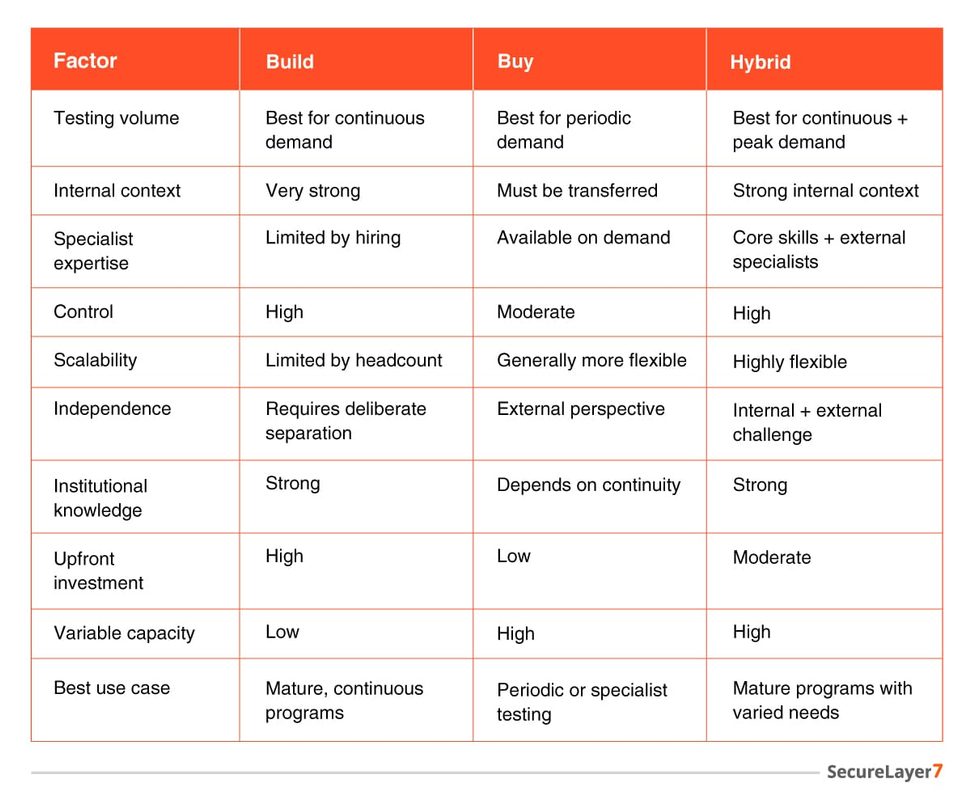
The important point is that none of these factors should be considered in isolation.
A low-cost model that cannot provide the required expertise or testing coverage isn’t actually a lower-cost security strategy.
Why the Hybrid Model Is Often the Practical Answer
The Build-vs-Buy debate can create a false choice.
Many mature organizations don’t need to choose one model exclusively. They can build the capabilities they use continuously and buy the capabilities they need occasionally.
For example, an internal team could own:
- Security testing prioritization.
- Application context and architecture.
- Continuous security validation.
- Developer collaboration.
- Remediation tracking.
- Retesting and closure.
An external partner could provide:
- Advanced penetration testing.
- Specialist assessments.
- Red teaming.
- Independent validation.
- Complex attack-path analysis.
- Surge capacity before launches or major changes.
The result is a model where internal teams retain the context and accountability while external specialists provide depth and additional capacity.
But hybrids aren’t automatically better. It can introduce additional coordination costs, duplicated work, inconsistent severity assessments, and unclear ownership if responsibilities aren’t explicitly defined.
The model works only when scope, accountability, evidence, remediation, and retesting responsibilities are clear.
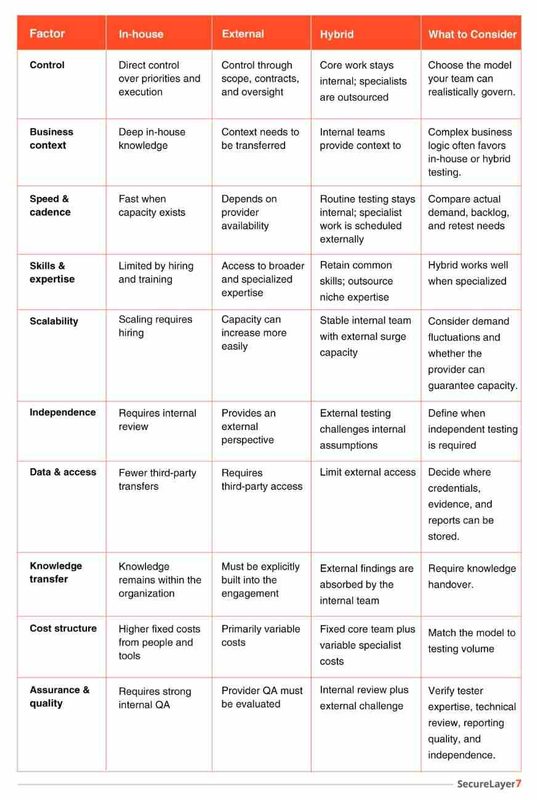
In-House vs. Outsourced vs. Hybrid Security Testing
Final Takeaway
Build-vs-Buy shouldn’t be treated as a simple procurement exercise. Most importantly, don’t optimize for the cheapest testing model. Optimize for the model that can consistently deliver the right coverage, expertise, speed, independence, and quality for your risk profile. A useful rule of thumb is:
- Build the security testing capabilities you need continuously.
- Buy the expertise you need occasionally. Combine both when your environment requires scale, specialization, and internal context.
The best security testing model is ultimately the one that provides the right depth at the right frequency, with clear accountability and sustainable economics.
Looking to strengthen your security posture? SecureLayer7 helps organizations identify vulnerabilities, reduce risk, and defend against evolving cyber threats. Contact our experts to get started.
Frequently Asked Questions ( FAQs)
Start with the people doing the testing. Look at their experience with your type of application, infrastructure, and security issues. It is also worth checking how they handle sensitive data, how they report vulnerabilities, and whether they provide retesting after fixes.
It depends on how often your environment changes. A company releasing new features every few weeks may need testing more often than one with a stable environment. Major application changes, new infrastructure, migrations, and important releases are also good reasons to run another security test.
The work does not end when the report is delivered. Security and engineering teams need to review the findings, fix the issues, and verify that the fixes actually work. Retesting is especially useful for critical vulnerabilities because a fix can sometimes introduce another problem or fail to address the original issue completely.
