
Security needs to be addressed early in the Software Development Life Cycle (SDLC), not only at the end. Shift left security brings security practices into the design and coding stages, helping teams find vulnerabilities sooner, reduce remediation costs, and deliver more secure software.
With DevSecOps and faster CI/CD cycles, shift left security brings development, operations, and security teams into the same process. Integrating security tools and continuous validation helps teams share responsibility for security, improve protection, support compliance, and maintain development speed without reducing software quality.
Understanding Shift Left Security in Modern Software Development
Shift left security is a proactive approach that brings security earlier into the Software Development Life Cycle (SDLC), instead of waiting until testing or deployment. In modern development environments, security is considered during planning, design, and coding, allowing teams to identify and address vulnerabilities before they reach production. This approach reduces the cost and effort involved in fixing security issues later and makes secure development part of the normal workflow.
Why Security Needs to Move Earlier in the SDLC
Traditional development often addressed security during quality assurance or after deployment. This can result in vulnerabilities being discovered late, higher remediation costs, and greater exposure to risk. A broader approach to application security testing can help cover security testing from development through deployment.
- Detects vulnerabilities in code, architecture, and design earlier.
- Reduce security debt and limit rework in later stages.
- Support continuous compliance with regulatory requirements.
- Encourage developers, testers, and security professionals to work together on security from the start.
What is Shift Left Security?
Shift left security is a proactive approach that integrates security earlier in the Software Development Life Cycle (SDLC), rather than addressing it only during testing or after deployment. The goal is to identify and address vulnerabilities as early as possible, reducing remediation costs, improving application resilience, and supporting secure software delivery. By moving security earlier in the process, organizations can include security practices in requirements gathering, design, coding, and testing.
Difference from Traditional Security Approaches
To understand shift left security, it helps to compare it with traditional security approaches.
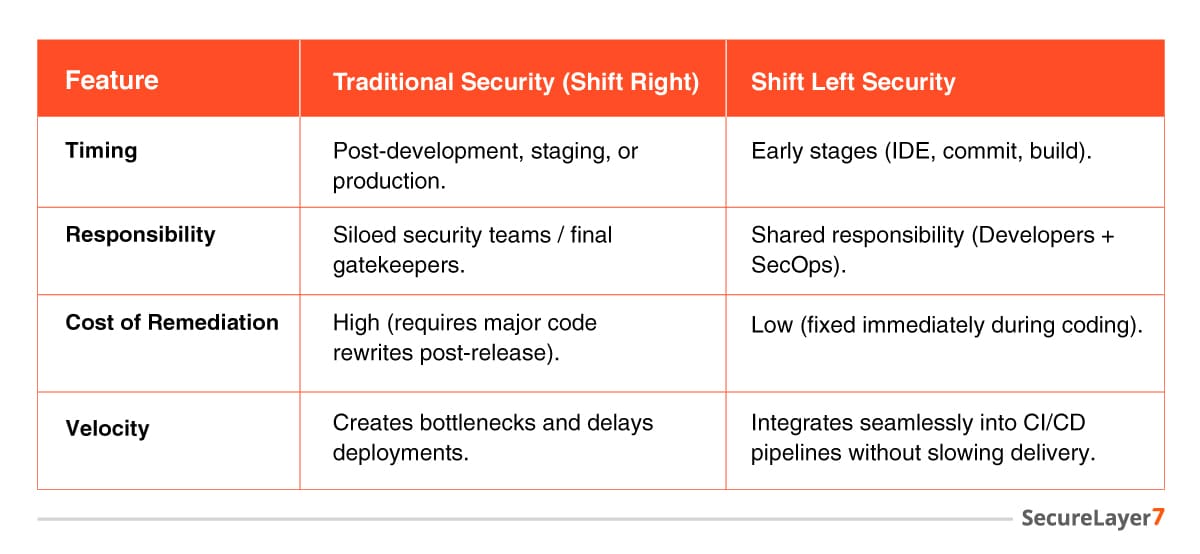
Alignment With Modern DevSecOps Practices
Shift left security is a core principle of DevSecOps, where development, security, and operations work together. By integrating security into CI/CD pipelines and automation tools, teams can implement DevSecOps practices throughout the software development lifecycle.
- Perform continuous security testing during builds and deployments.
- Introduce threat modeling, static code analysis, and dependency scanning earlier in development.
- Make security a shared responsibility instead of leaving it to a separate security team.
Why Shift Left Security Matters
Modern engineering teams release updates, patches, and new features frequently. This pace can make it difficult to identify and fix security issues before software reaches production.
As applications move toward cloud-native architectures and face increasingly complex threats, adding security only at the end of the development pipeline creates delays and leaves less time for remediation. Shift left security brings security checks into earlier stages of development, where issues are generally easier to address.
Accelerated Development Cycles and Frequent Releases
Modern development relies heavily on Agile methodologies and CI/CD pipelines.
- The Bottleneck Problem: Traditional security models often rely on manual reviews near the end of the development cycle. When security testing happens just before production, issues can delay releases and create additional work for development teams.
- The Shift Left Solution: By integrating automated security checks into the CI/CD pipeline, teams can identify and address vulnerabilities as code moves through development.
Expanded Attack Surface and Increasing Cyber Threats
Modern applications often depend on third-party libraries, open-source components, microservices, and Infrastructure as Code (IaC). These dependencies can introduce supply chain risks, making software supply chain security an important part of early security validation.
- Complex Dependencies: A single application can depend on hundreds of open-source packages, each of which can introduce supply chain risks.
- Proactive Defense: Shift left security uses tools such as Software Composition Analysis (SCA) and Static Application Security Testing (SAST) to identify these issues before code reaches staging or production.
Cost Reduction by Fixing Vulnerabilities Early
Finding and fixing security issues earlier in the Software Development Life Cycle (SDLC) can reduce the effort required for remediation.
- During Development: Fixing a vulnerability while code is being written is generally simpler because the developer is already working with the affected code.
- After Deployment: If the same issue is discovered in production or exploited in a breach, remediation can involve emergency patches, incident response, forensic investigations, customer communication, and potential regulatory costs.
Compliance and Regulatory Advantages
Compliance requirements increasingly include secure development and vulnerability management practices.
- Built-In Compliance: Frameworks such as SOC 2, PCI DSS, ISO 27001, and HIPAA require organizations to maintain appropriate security and vulnerability management controls.
- Audit Readiness: Shift left security creates records of security scans, code reviews, and dependency checks throughout development. These records can help organizations demonstrate how security controls are applied during audits.
Shift Left Security in the SDLC
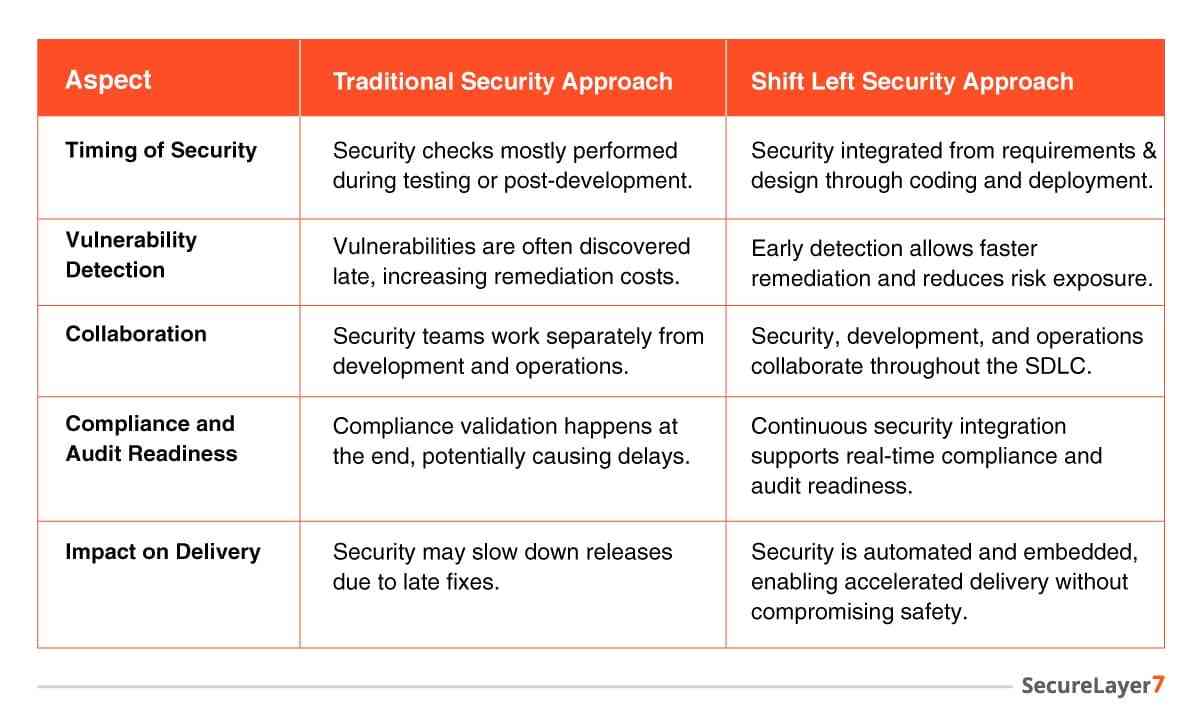
Modern software development requires security to be considered throughout the Software Development Life Cycle (SDLC). Shift left security moves security activities earlier in the process, helping teams identify vulnerabilities, support compliance, and deliver software more securely.
Traditional vs Shift Left Approach
Security Integration at Each SDLC Phase
- Requirements Phase:
- Conduct threat modeling and identify security requirements early.
- Define secure authentication, authorization, and data handling practices.
- Design Phase:
- Apply secure architecture principles.
- Incorporate input validation, encryption standards, and error handling.
- Coding Phase:
- Enforce secure coding practices.
- Use static code analysis (SAST) to detect vulnerabilities during development.
- Testing Phase:
- Implement dynamic application security testing (DAST) and automated vulnerability scans.
- Conduct manual penetration testing for complex or business-critical functionality.
- Deployment Phase:
- Monitor security postures in production with logging, monitoring, and runtime application self-protection (RASP).
- Ensure continuous vulnerability management and patching strategies.
Benefits of Embedding Security into DevOps Pipelines
- Early Vulnerability Detection: Issues can be identified before deployment, reducing potential security risks.
- Faster Remediation: Developers can address issues while the relevant code is still being developed.
- Cost Efficiency: Fixing vulnerabilities earlier generally requires less effort than addressing production issues.
- Continuous Compliance: Automated security checks support ongoing compliance with regulatory and industry requirements.
- Proactive Security Culture: Security becomes a shared responsibility across development, security, and operations teams.
Common Challenges of Shift Left Security
Shift left security provides significant benefits for modern software development, organizations often face challenges when integrating security early in the SDLC.
Understanding these obstacles helps teams implement effective strategies and maintain a strong security posture.
Cultural Resistance Between Teams
The main challenges are aligning development, security, and operations teams. Traditional workflows often treat security as a separate function, which can create friction when developers are required to address security concerns early.
- Developers may perceive security tasks as slowing down delivery.
- Security teams may struggle to communicate risk effectively to non-technical stakeholders.
- Overcoming cultural resistance requires training, clear communication, and leadership support.
Lack of Security Skills in Development Teams
Embedding security early in the SDLC demands that developers understand secure coding practices and vulnerability prevention techniques.
- Limited knowledge of threat modeling and secure design principles.
- Difficulty applying automated security tools correctly.
- Risk of introducing vulnerabilities due to inexperience.
Tooling and Process Integration Issues
Integrating security tools into fast-moving DevOps pipelines can be complex:
- CI/CD pipelines may not support all security tools natively.
- Automation scripts might conflict with development or testing workflows.
- Teams may struggle to maintain consistent configurations across multiple environments.
Security Techniques for Shift Left
Implementing shift left security requires integrating security testing and vulnerability detection tools early in the Software Development Life Cycle (SDLC). Techniques help development teams identify and remediate security issues during coding, testing, and deployment, rather than waiting until post-release.
Static Application Security Testing (SAST)
SAST analyzes application source code, bytecode, or binaries for security vulnerabilities without requiring the application to run. For a detailed comparison of static and dynamic testing, explore SAST vs DAST.
- How It Works: SAST scanners analyze application code against predefined security rules and patterns to identify issues such as SQL injection, cross-site scripting (XSS), and hardcoded credentials.
- When It Operates: SAST can run during development through Integrated Development Environments (IDEs), code commits, and pull requests.
- Key Benefit: It identifies structural code issues early, when remediation is generally faster and simpler.
Software Composition Analysis (SCA)
Modern applications rely heavily on open-source libraries, packages, and third-party components.
- How It Works: SCA tools scan application dependencies to identify known vulnerabilities, including CVEs, and check open-source licenses against organizational requirements.
- When It Operates: SCA can run during dependency management and package installation and continuously within CI/CD build pipelines.
- Key Benefit: It helps identify vulnerable or compromised third-party components before they become part of the final product.
Interactive Application Security Testing (IAST)
IAST combines aspects of SAST and DAST (Dynamic Application Security Testing) by analyzing applications while they are running.
- How It Works: IAST agents operate inside the application runtime environment. As automated tests or functional interactions execute application code, the agent monitors data flow, control flow, and HTTP traffic.
- When It Operates: IAST is commonly used during QA, testing, and pre-production stages while the application is running.
- Key Benefit: It can provide detailed vulnerability findings by analyzing application behavior and linking issues to specific areas of code.
Tools Enabling Shift Left Security
Shifting security to the left requires more than just a change in mindset; it demands a modern, automated toolchain. Because traditional security tools are too slow and bulky for agile development, organizations must adopt lightweight, developer-first solutions that integrate natively into version control systems, IDEs, and CI/CD pipelines.
Following are the four core categories of tools that enable true shift left security.
Code Scanning Tools Integrated in CI/CD
Static and dynamic code scanning tools automatically analyze application code as part of continuous integration/continuous deployment (CI/CD) pipelines:
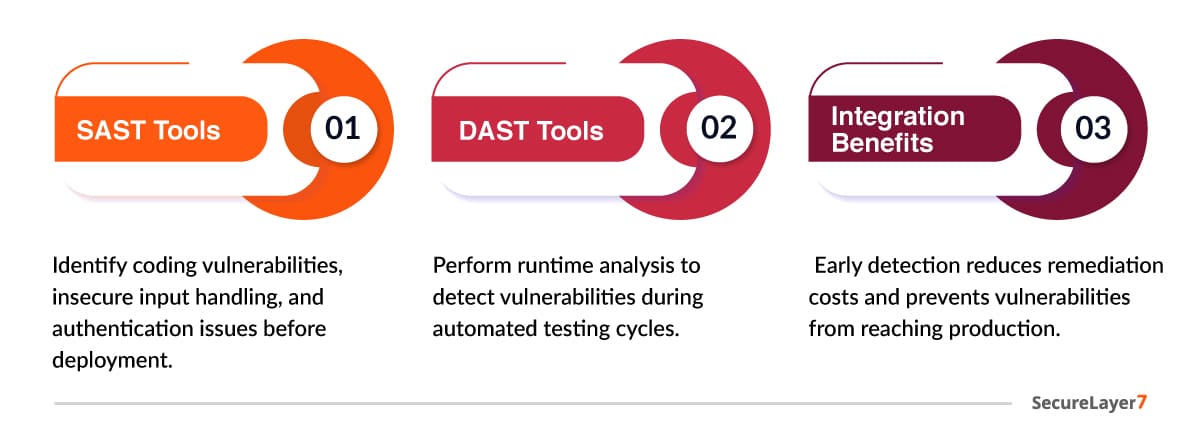
Dependency and Vulnerability Scanners
Modern applications use numerous third-party libraries and frameworks, which can introduce hidden risks. Dependency and vulnerability scanners continuously monitor for:
- Known CVEs in open-source components.
- Misconfigured libraries and insecure defaults.
- License compliance issues.
Security as Code and Policy as Code Solutions
Security policies can be embedded directly into the development process using Security as Code (SaC) and Policy as Code (PaC) frameworks:
- Define security controls, compliance rules, and access policies in code.
- Automatically enforce policies during builds, deployments, and runtime.
- Reduce human error and ensure consistent enforcement across environments.
Automation Frameworks for Security Validation
Automation frameworks enable continuous security validation across code, infrastructure, and pipelines:
- Automatically run tests for vulnerabilities in applications, containers, and cloud resources.
- Provide actionable reports for development and security teams.
- Ensure integration into DevSecOps workflows, reducing manual effort and improving coverage.
Implementation Best Practices
Implementing shift left security effectively requires a combination of proactive planning, automation, developer education, and performance measurement. Organizations that adopt these best practices can detect vulnerabilities earlier, reduce remediation costs, and maintain a stronger security posture throughout the Software Development Life Cycle (SDLC).
Define Security Requirements Upfront
- Establish security goals and requirements during the planning phase.
- Incorporate threat modeling and risk assessments into initial design decisions.
- Ensure security requirements are aligned with compliance standards such as PCI DSS, ISO 27001, and NIST frameworks.
Automate Security Checks in Development Pipelines
- Integrate Static Application Security Testing (SAST) and Dynamic Application Security Testing (DAST) tools into CI/CD pipelines.
- Implement dependency scanning to detect vulnerable third-party components automatically.
- Use automated alerts and dashboards to provide real-time feedback to developers.
Train Developers in Secure Coding
- Educate development teams on secure coding practices, including input validation, authentication, authorization, and secure API usage.
- Provide hands-on security workshops, coding guidelines, and threat simulations.
- Encourage collaboration between developers, security engineers, and DevOps teams to embed security knowledge throughout the SDLC.
Conclusion
Shift left security is an important part of modern software development. Integrating security early in the Software Development Life Cycle (SDLC) helps organizations identify vulnerabilities sooner, reduce remediation effort, and support regulatory compliance. Bringing security into planning, development, testing, and deployment also helps teams address risks before software reaches production.
Effective implementation requires appropriate tools, DevSecOps practices, and collaboration between development and security teams. SecureLayer7 helps organizations develop shift left security strategies through automated testing, threat modeling, and security practices designed to protect applications and critical assets.
Partner with SecureLayer7 to embed security from the start and ensure your software is both fast and secure.
Frequently Asked Questions (FAQs)
Shift left security is the practice of integrating security earlier in the Software Development Life Cycle (SDLC), from planning and design through coding and testing. It helps organizations identify vulnerabilities earlier, reduce remediation costs, and incorporate secure practices throughout development.
Traditional security approaches often perform security testing later in the development lifecycle, when vulnerabilities can be more difficult and costly to fix. Shift left security introduces security activities earlier in the SDLC, enabling earlier vulnerability detection, continuous testing, and collaboration between development, security, and operations teams.
Shift left security uses tools such as Static Application Security Testing (SAST) for source code analysis, Software Composition Analysis (SCA) for identifying vulnerable dependencies, Interactive Application Security Testing (IAST) for analyzing applications during execution, and policy-as-code or security-as-code tools for automating security controls.
Organizations can implement shift left security by integrating SAST, SCA, secrets scanning, container scanning, and Infrastructure as Code security checks into CI/CD workflows. Security checks can run during code commits, builds, and pre-deployment stages, providing developers with timely feedback.

