
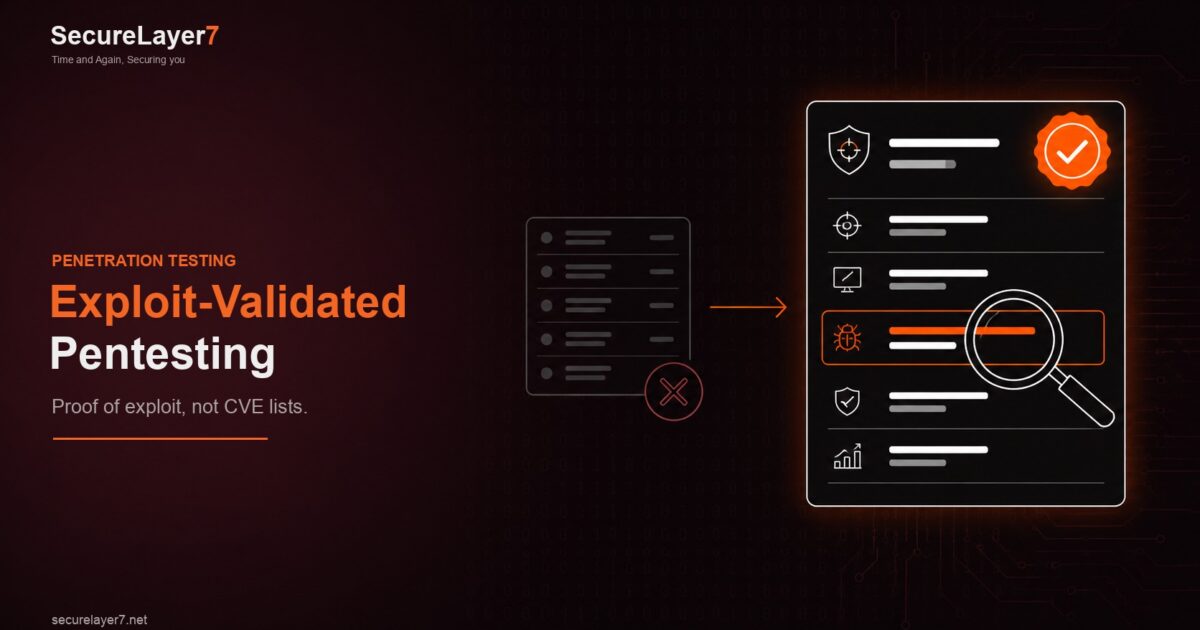
If you have ever received a pentest report that reads like a CVE dump with severity scores and CVSS numbers, you know the frustration. Your engineering team opens it and asks the same question every time: “Is this actually exploitable in our environment, or is this just something that exists somewhere on the internet?” That is a fair question, and the fact that many pentest providers cannot answer it confidently is a real problem.
This post is for security leaders who are done paying for theoretical risk assessments. If you need proof that a vulnerability was actually triggered in your production environment, not just discovered and catalogued, here is what to look for, what to ask, and how to tell the difference between a real exploit-validated engagement and a glorified scan report.
What proof of exploit actually means, and why CVE lists fall short
Proof-of-Exploit (PoE) is documented, reproducible evidence that a specific vulnerability was successfully triggered in a controlled, authorized test. The word reproducible carries all the weight here. It means a skilled attacker, or your own engineer, can follow the documented steps and confirm the finding is real, in your environment, against your actual configuration.
A CVE tells you a weakness exists in a class of software. It does not tell you whether the vulnerable component is reachable in your deployment, whether your WAF or network controls neutralize the vector, or what an attacker could actually do after triggering it. The expectation gap between “this CVE exists” and “this is exploitable in your environment with confirmed access” is where most pentest reports fail security teams.
The practical cost of that gap: your engineers spend hours triaging vulnerabilities that may not be exploitable at all in your stack, while the one critical path that does exist gets buried on page 34 because it does not carry a high CVSS score on paper.
Exploit-validated findings invert that priority order. By confirming exploitability in context, a good pentest provider surfaces the attack paths that actually matter and filters out the theoretical noise.
PoE vs CVEs: the practical difference for remediation
CVEs are references to known weaknesses in software or configurations. They are useful for patch management and vendor tracking. What they are not designed to do is tell you whether your specific deployment of that software, behind your specific controls, in your specific cloud environment, is actually compromisable.
Exploit validation bridges that gap. A verified exploit path shows what access was gained, from what entry point, through what sequence of steps. A finding that reads “authenticated user can escalate to admin via parameter manipulation, confirmed via session token capture showing admin-level API response, screenshot attached” is actionable in a way that “CVE-2024-XXXX: improper access control” simply is not.
The other concrete benefit is false-positive reduction. CVE-only reporting inflates the vulnerability backlog with issues that exist on paper but are not realistically exploitable in the tested environment. When every finding comes with evidence of confirmed exploitation, your remediation queue reflects actual risk, and engineers fix what demonstrably matters first.
What exploit-validated pentest reporting should include
A quality penetration testing report outlines scope, methods used, key findings, and supporting evidence that turns simulated attack results into action. That is the baseline. A genuinely exploit-validated report goes further.
Evidence artifacts per finding. Each high or critical finding should include at minimum a screenshot or short video of successful exploitation, command output or log excerpts showing the exact response, and where applicable the HTTP request and response pair demonstrating the confirmed attack. If a provider cannot show you what this looks like for a sample finding, that is a red flag.
Reproducibility. Engineers need clear, step-by-step reproduction steps to verify the finding independently and to confirm the fix closes the path. Vague descriptions like “SQL injection possible via login form” support neither. A proper PoE entry reads more like a technical incident report: exact endpoint, payload, observed behavior, and what access it granted.
Impact mapping. The report needs to state precisely what an attacker can do from the position gained. “Access to admin panel” is not sufficient. “Authenticated attacker gains admin session, can export the full customer database including PII for approximately 1.2M records, can create new admin users, and can disable audit logging” is the level of impact specificity that drives executive prioritization and engineering urgency.
Rules of engagement transparency. Safe exploitation methodology matters, particularly for production systems. The provider should document what was and was not attempted, where they stopped short of destructive actions, and how controlled the exploitation was. This protects you legally and operationally.
Retest and closure confirmation. A finding is closed when the verified exploit path no longer works, not when a developer closes the ticket. Retesting after remediation should confirm that the specific exploit steps fail on the patched system. That is a different and more valuable assurance than “developer marked as resolved.”
How to scope an exploit-validation engagement
The single biggest reason organizations receive theoretical reports is that they did not define exploitability standards during scoping. Fix that before the contract is signed.
Agree on rules of engagement upfront: which assets are in scope, what exploitation techniques are permitted, what the stop conditions are (for example, “stop before attempting lateral movement beyond the DMZ”), and what the process is if a genuine breach-level finding is discovered mid-engagement. These boundaries protect both parties and set clear expectations for what proof means in your context.
Pick the right test types for your actual attack surface. A web application pentest has different PoE standards than an internal network or Active Directory engagement. For web and API testing, proof often means a confirmed auth bypass, IDOR with demonstrated data access, or RCE with controlled code-execution evidence. For identity and AD testing, proof might be confirmed Kerberoasting with cracked credentials or a full domain-compromise chain. Define what proof looks like per risk category before the engagement starts, and align it with the scope of your penetration testing services.
Require a verified exploit path standard in writing for all high and critical findings. If the provider will not commit to this standard, if they hedge with language like “potential” or “theoretical” for critical-severity issues, that tells you something important about what their report will actually deliver.
Business-logic testing is a category that CVE-only providers frequently skip entirely. Your payment flow, multi-tenancy access controls, and role-permission matrices will not appear in a CVE database. An exploit-validation provider should have a process for testing and documenting business-logic flaws with the same evidence standard applied to technical vulnerabilities.
Vendor evaluation checklist: 12 questions to ask before you sign
Use these during scoping calls and contract review. The answers will separate exploit-validation providers from CVE-list generators quickly.
- What exact artifacts are delivered per finding? Ask to see a sample finding from a past engagement, redacted.
- Do you confirm exploitability in our specific environment, or do you map to CVEs theoretically?
- How do you handle partially or conditionally exploitable findings, and what does the evidence section look like?
- What is your process for reducing false positives and validating attack paths before the report is delivered?
- What is your retest approach after we remediate: do you re-execute the exploit steps, or just review the ticket?
- How do findings integrate into our workflows? Do you support Jira, Slack, and CI/CD pipeline delivery natively?
- What is your evidence format standard: PDF, machine-readable export, portal access?
- How do you handle safety in production environments, and what is the emergency stop process?
- Does every finding include a chain-of-impact narrative from attacker entry point to confirmed business impact?
- How frequently are findings delivered during the engagement: batched at the end, or continuously as discovered?
- How do you approach business-logic testing for application-specific risk?
- What are the testers’ qualifications, and what methodology standard governs the engagement?
CREST accreditation gives buyers a way to identify providers whose processes, standards, and methodologies have passed an external assessment. It is not a guarantee of quality, but it is a useful baseline signal when evaluating providers.
SecureLayer7, for context, is CREST-accredited, with engagements governed by documented exploit-validation standards across web, API, cloud, identity, and internal environments. The point is not accreditation as a checkbox, it is that the methodology behind each engagement is externally assessed and consistently applied. For adversary-emulation depth, the same evidence standard runs through our red team assessment.
Why continuous testing matters: exploitability changes faster than annual pentests
Your attack surface from 12 months ago is not your attack surface today. New API endpoints ship weekly. Cloud resources get provisioned and misconfigured in the same sprint. Identity changes, new service accounts, SAML integrations, and OAuth flows introduce access paths that did not exist during your last annual engagement.
A point-in-time pentest produces a snapshot of exploitability that starts aging the moment the report is delivered. That is not a criticism of traditional pentesting as a practice, it is a structural limitation of the engagement model when applied to environments that change continuously.
This is where the Continuous Threat Exposure Management (CTEM) approach becomes relevant as a buyer concept: a structured, ongoing method for identifying, validating, prioritizing, and remediating security exposures rather than treating security testing as a periodic event. The shift from annual test to continuous validation is not just a frequency change, it is a change in what security testing is expected to produce.
Exploit validation is the mechanism that makes continuous testing meaningful. Continuous scanning without exploit confirmation produces a continuously growing list of theoretical vulnerabilities. Continuous exploit validation produces a continuously current picture of what is actually compromisable in your production environment.
SecureLayer7’s penetration testing as a service is built for exactly this environment: deploy-by-deploy API testing, continuous external attack-surface discovery, and scheduled engagement cycles that align with release cadences rather than fiscal-year calendars.
Compliance and evidence: what auditors actually need
SOC 2, PCI DSS, ISO/IEC 27001, and HIPAA do not just want you to test. They want evidence that your controls work under adversarial conditions. Penetration testing provides tangible evidence of how security controls perform under adversarial conditions, which is exactly what auditors and insurers are evaluating.
A CVE list does not answer the auditor’s real question: “Did you test whether an attacker can bypass your access controls, and do you have evidence of the outcome?” A PoE-based report does. It shows scope, methods, confirmed findings with exploitation evidence, and remediation validation. That is a defensible evidence package.
Cyber insurance underwriters are increasingly asking the same questions. A report that says “we found 47 medium-severity vulnerabilities” carries much less weight than a report that says “we attempted to exploit the 12 highest-risk attack paths in your environment, confirmed 3 were exploitable with documented evidence, and confirmed closure via retest for all 3.”
SecureLayer7’s reporting is explicitly aligned to compliance program requirements for SOC 2 Type II, PCI DSS, HIPAA, ISO/IEC 27001, GDPR, and NIST CSF. The evidence format is designed to support both internal security stakeholders and external audit and insurance reviewers, not just the engineering team that needs to fix things.
Ready to see what exploit-validated findings actually look like?
If you are evaluating pentest providers and the deliverable question keeps coming up, “what proof do we get?”, the answer should not require a leap of faith. Request a sample PoE report format or evidence-artifact examples before you commit to an engagement.
SecureLayer7 offers a short scoping call to define exploit-validation standards, discuss your environment’s specific testing needs, and align on what proof means for your security, engineering, and compliance stakeholders. If a provider cannot show you what their evidence looks like before you sign, that is your answer. Talk to our team to get started.
Proof-of-Exploit is documented, reproducible evidence that a specific vulnerability was successfully triggered in a controlled, authorized test, rather than just discovered and catalogued. A PoE entry typically includes the exploited weakness, the step-by-step attack chain, artifacts such as screenshots or request and response captures, the access or data obtained, and the real-world impact.
A CVE list tells you that a class of weakness exists in some software. Proof of exploit tells you whether that weakness is actually exploitable in your specific environment, behind your specific controls, and what an attacker could do after triggering it. One is theoretical exposure, the other is confirmed, contextual risk.
It is a technical narrative that documents the entry point, the specific technique used, the observed system response confirming successful exploitation, and exactly what access or impact was confirmed. It is reproducible by your engineering team and reviewable by your auditors.
Yes. Retesting re-executes the original exploit steps against the patched system to confirm the specific path is closed. A developer closing a ticket is not a retest. SecureLayer7 confirms the exploit fails before a finding is marked closed.
Rules of engagement are defined before the engagement starts. Techniques are selected to confirm exploitability without causing downtime or data loss, and where destructive confirmation is not appropriate for production, alternative evidence methods are used. Emergency stop procedures are agreed upon in advance.
Yes. Findings integrate directly into Jira, Slack, and CI/CD workflows so your engineering team gets actionable tickets with attached evidence, rather than a PDF that lives in a shared drive and never gets triaged.
