
Runtime Application Self-Protection (RASP) is a vital security technology designed to protect modern applications in real-time. Unlike traditional tools like firewalls and WAFs, which focus on perimeter security, RASP operates within the application itself. It continuously monitors the application during runtime, detecting and blocking threats as they happen, ensuring vulnerabilities are mitigated before exploitation.
RASP provides accurate defense against advanced attacks, such as SQL injection and XSS, without compromising performance. As cyber threats become more sophisticated, RASP has become a critical component of modern cybersecurity strategies.
Rise of Application-Layer Attacks and Runtime Exploitation
As cyberattacks become increasingly sophisticated, application-layer attacks have emerged as a significant threat to organizations of all sizes. Traditional network security tools, such as firewalls and intrusion detection systems, are often inadequate when it comes to defending against these attacks. Attackers have shifted their focus to exploiting vulnerabilities within the application layer, targeting the very heart of an organization’s digital infrastructure.
Limitations of Perimeter-Based Security (WAF, Firewalls)
Web Application Firewalls (WAFs) and firewalls have traditionally served as the first line of defense against external threats, but they are increasingly ineffective in protecting against modern, sophisticated cyberattacks targeting applications directly.
- Evolving Attack Surface: The shift to cloud computing, APIs, and microservices, the traditional network perimeter is no longer a reliable defense.
- Limitations of WAFs: WAFs monitor incoming HTTP and HTTPS requests using predefined signatures and rules. They may fail to detect advanced application-layer attacks, particularly when rules are misconfigured or attackers use techniques designed to bypass perimeter filters. Learn more about the capabilities and limitations of a Web Application Firewall.
- Firewall Gaps: Traditional firewalls focus on network-level protection but cannot analyze application behavior. They are unable to detect runtime exploits or attacks that bypass network defenses, such as credential stuffing and API exploitation.
Need for Real-Time, In-Application Protection
The rise in frequency and complexity of cyberattacks, real-time, in-application protection has become essential. Perimeter-based defenses, such as firewalls and WAFs, are no longer sufficient to safeguard modern applications.
Key Reasons Real-Time Protection is Vital:
- Real-Time Threat Detection: Modern attacks often unfold in stages, requiring immediate detection and response to prevent escalation.
- Protection Against Runtime Exploits: Real-time protection monitors application behavior during execution, stopping runtime exploits before attackers gain control.
- Adaptive Security: Unlike traditional tools, real-time systems can adapt to new threats and identify abnormal behaviors, providing more accurate protection.
What is Runtime Application Self-Protection (RASP)?
As cyber threats evolve, traditional security measures are no longer enough. Runtime Application Self-Protection (RASP) offers real-time protection by integrating directly into an application’s runtime environment. It continuously monitors and analyzes application behavior, detecting and blocking threats from within, without relying on external tools. By acting inside the application, RASP can defend against attacks that traditional perimeter-based security often misses. RASP complements application penetration testing by providing continuous runtime protection after vulnerabilities have been identified and remediated during security assessments.
How RASP Works Inside Applications at Runtime
Runtime Application Self-Protection (RASP) is embedded within the application at runtime, providing continuous, real-time protection. Unlike traditional tools, RASP operates internally, offering contextual security based on the application’s behavior.
Following are RASP works:
- Monitoring: RASP continuously monitors the application’s behavior and incoming requests, detecting any deviations from normal operation that could signal an attack.
- Threat Detection: It identifies suspicious activity, such as SQL injections, cross-site scripting (XSS), and buffer overflow attacks, in real time.
- Threat Prevention: Upon detecting a threat, RASP can immediately block or mitigate the attack, preventing further damage and ensuring the application’s integrity.
Key Characteristics of RASP
RASP offers several distinct characteristics that make it an essential tool for modern application security. These features help organizations safeguard their applications from advanced threats and ensure they remain secure in dynamic environments.
1. Embedded Security Controls
RASP is not an external appliance; it is part of the application’s DNA. Because the security controls are embedded, they travel wherever the application goes. Whether your app is running on a local server, a virtual machine, or a serverless function in the cloud, the protection remains consistent and always-on.
2. Real-Time Threat Detection
Traditional scanners find vulnerabilities in code before it runs. RASP finds threats while they are happening. By monitoring memory, system calls, and data flows in real-time, RASP can detect sophisticated Zero-Day attacks that haven’t even been assigned a CVE yet.
3. Context-Aware Protection
This is the Superpower of RASP. Because it lives inside the app, it has full context. A firewall might block a request because it looks like an attack (leading to a false positive).
- RASP knows if that request actually reaches a vulnerable function. If the request is harmlessly handled by the code, RASP stays silent. This context-awareness results in near-zero false positives, significantly reducing the burden on your SOC team.
Difference Between Detection and Prevention
RASP combines detection, prevention, and response in real-time, unlike traditional tools that focus on just one aspect.
- Detection:
- Traditional Tools: IDS and vulnerability scanners detect threats based on known patterns but do not provide real-time context.
- RASP: Actively monitors application behavior, detecting specific attacks (like SQL injection or XSS) in real time and providing contextual insights into the attack.
- Prevention:
- Traditional Tools: Firewalls and WAFs block harmful traffic based on predefined rules but only provide perimeter defense.
- RASP: Prevents attacks at the application level, blocking malicious behaviors or requests before they can exploit vulnerabilities, even stopping zero-day attacks.
How RASP Works
Runtime Application Self-Protection (RASP) is a powerful cybersecurity solution that operates directly within the application to detect, monitor, and block threats in real-time. By embedding security controls inside the application’s runtime environment, RASP ensures comprehensive protection from within, rather than relying solely on external security tools like firewalls or Web Application Firewalls (WAFs).
Following are the RASP integrates into your application, monitors its behavior, and effectively blocks malicious activity in real time.
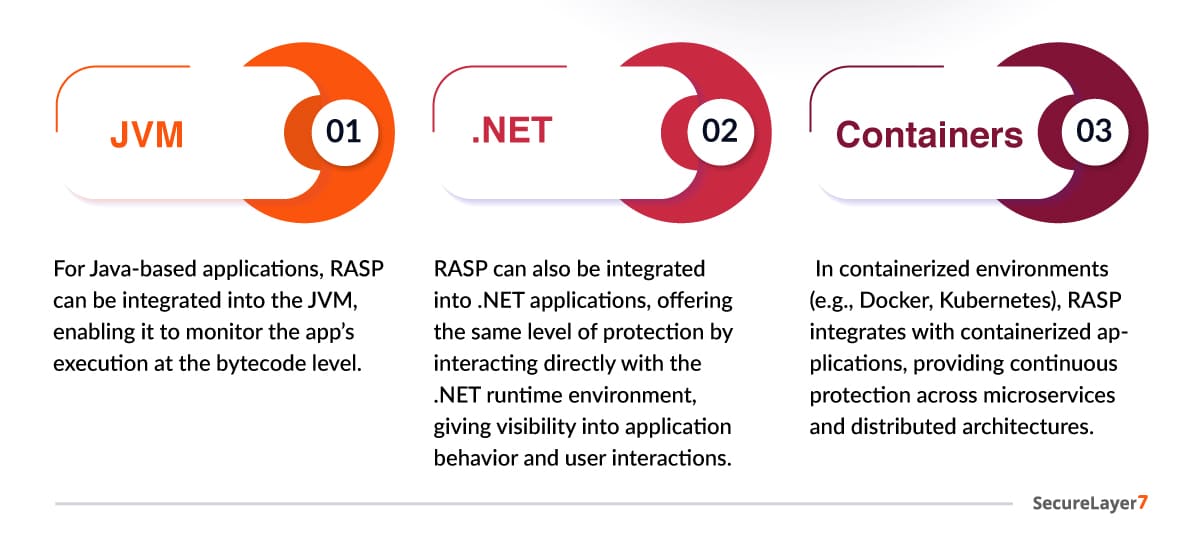
Integration Within Application Runtime (JVM, .NET, Containers)
RASP operates by integrating directly into the application runtime environment, such as Java Virtual Machine (JVM), .NET applications, or containers. This deep integration allows RASP to continuously monitor and protect the application during its execution, without requiring significant changes to the application’s architecture.
Monitoring Application Behavior and User Inputs
RASP continuously monitors application behavior and user inputs in real time to identify malicious activity.
- Behavioral Monitoring: Tracks application actions, including data flows and function calls, flagging any deviations as potential threats.
- User Input Analysis: Detects suspicious or invalid inputs, such as SQL commands or unexpected fields, indicating a potential attack.
- Context-Aware Detection: Unlike traditional tools, RASP understands the application’s context, providing more accurate threat detection.
Blocking Malicious Activity in Real Time
RASP instantly blocks malicious activity as it occurs, unlike traditional systems that detect threats after the fact.
- Real-Time Blocking: Stops attacks like SQL injection and XSS immediately upon detection.
- Protection Without Interrupting Users: Blocks attacks seamlessly without disrupting user experience or functionality.
- Automated Response: Integrates with security controls like IAM and SIEM systems for quick, efficient threat mitigation.
RASP Testing Explained
As organizations face increasing threats from sophisticated application-layer attacks, Runtime Application Self-Protection (RASP) has emerged as a critical tool in securing applications during their execution. RASP testing is a modern approach to security that continuously monitors and protects applications in real time.
How RASP Validates Security During Runtime
RASP testing involves embedding security controls directly into the application during its runtime. This enables the system to continuously monitor and protect the application it is running, providing real-time protection against a range of threats.
- Behavioral Analysis: RASP monitors the behavior of the application, including how it interacts with data, users, and external systems.
- Immediate Mitigation: When RASP detects malicious activity, it can block or mitigate the threat immediately, preventing it from escalating and causing damage.
- Context-Aware Protection: Unlike traditional security tools, RASP has a deep understanding of the application’s context, meaning it can differentiate between normal behavior and an attack, thus reducing false positives and increasing accuracy.
Differences Between RASP Testing and Traditional Testing
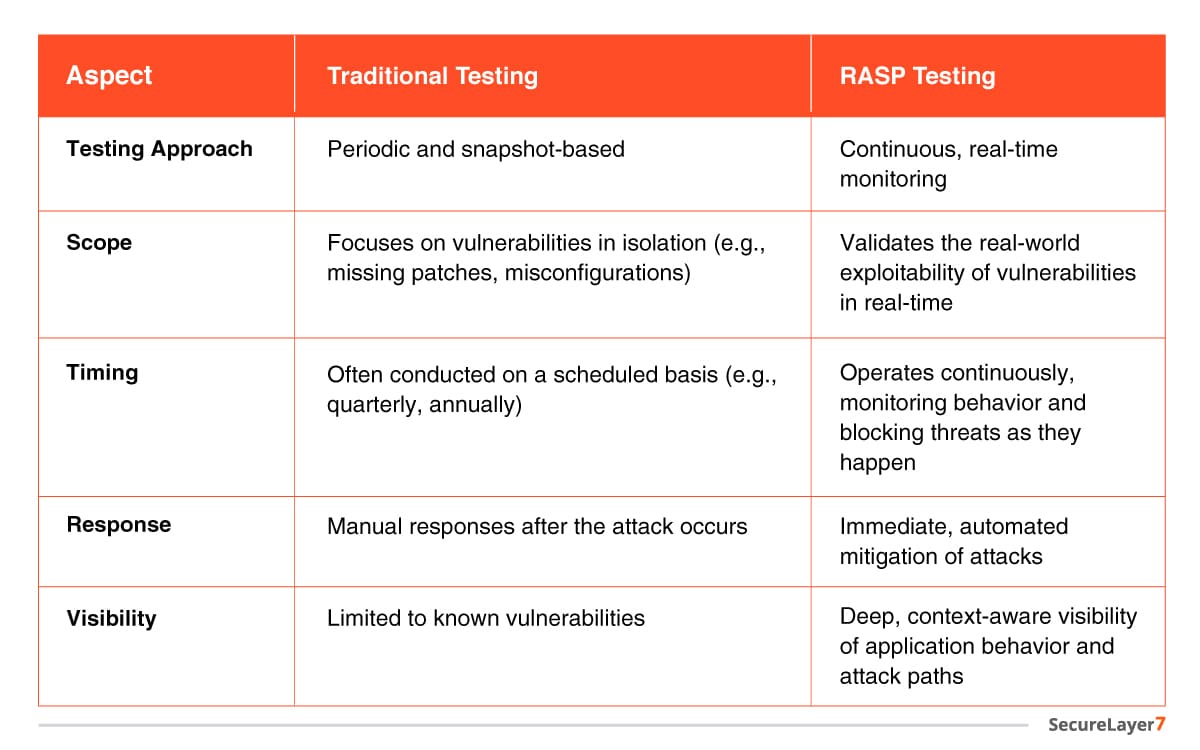
Traditional security testing methods, such as vulnerability scanning and penetration testing, are often limited in their scope and effectiveness in detecting runtime threats.
Following are the breakdown of the differences between RASP testing and traditional testing:
Role of RASP in Secure SDLC
The secure software development lifecycle (SDLC) emphasizes integrating security practices throughout the development process. RASP plays a vital role in securing applications at runtime, but it also contributes to the SDLC in the following ways:
- Early Threat Detection: By integrating RASP testing during the development and testing stages, security teams can detect vulnerabilities as they are being developed.
- Real-Time Feedback for Developers: RASP provides real-time feedback to developers, alerting them to vulnerabilities or suspicious behaviors during runtime.
- Integration with CI/CD: RASP can be integrated into the Continuous Integration/Continuous Deployment (CI/CD) pipeline, providing automated security validation throughout the entire development process.
Types of Attacks Prevented by RASP
Runtime Application Self-Protection (RASP) is a dynamic and powerful security technology that provides real-time protection for applications. By integrating directly into the application’s runtime environment, RASP can detect and prevent a wide range of common and advanced application-layer attacks.
Following are the most significant types of attacks that RASP can effectively prevent, ensuring your applications remain secure even in the face of modern threats.
SQL Injection
Traditional firewalls try to block SQLi by looking for keywords like UNION or SELECT in a URL. RASP takes a more precise approach by monitoring the Database Driver.
- How RASP Prevents It: RASP intercepts the database query at the sink the moment the application is about to send it to the database.
- The 2026 Advantage: RASP prevents Blind SQLi and Second-Order SQLi that often bypass perimeter filters because it validates the query’s final structure, not just the incoming string.
Cross-Site Scripting (XSS)
XSS remains a top threat as attackers try to hijack user sessions or deface front-end interfaces. RASP acts as a contextual filter for all data being rendered to the browser.
- How RASP Prevents It: RASP monitors the Data-in-Use. When an application is about to output data to an HTML page, RASP checks if that data contains executable scripts. Understanding the different types of cross-site scripting attacks helps development teams implement stronger validation, sanitisation, and output-encoding controls.
- The 2026 Advantage: It effectively stops Stored XSS, where a malicious script was previously saved in a database and is only triggered when a user views a specific page.
Command Injection
Command injection is one of the most dangerous exploits, as it allows an attacker to execute operating system commands (like rm -rf or whoami) directly on your server.
- How RASP Prevents It: RASP hooks into the system-level APIs that execute external processes (like Runtime.exec() in Java or os.system() in Python). If a user-provided string attempts to append a command (e.g., filename.jpg; cat `/`etc/passwd).
- The 2026 Advantage: RASP provides a Safety Net for legacy applications that were never designed to handle untrusted input safely at the OS level.
Path Traversal
Path traversal (or Directory Traversal) allows an attacker to move outside the intended web folder to access sensitive system files like configuration files, logs, or credentials
- How RASP Prevents It: RASP monitors all File I/O operations. It knows which directories the application is authorized to access.
- The 2026 Advantage: It stops attackers from exploiting vulnerabilities like RegPwn (CVE-2026-24291) where registry or system path manipulation is a core part of the exploit chain.
RASP vs WAF: Key Differences
As modern cybersecurity challenges evolve, organizations must utilize effective security tools to protect their applications from sophisticated attacks. Two key technologies often discussed in this context are Web Application Firewalls (WAF) and Runtime Application Self-Protection (RASP). Both are critical to application security, they differ significantly in terms of deployment, visibility, accuracy, and use cases.
Deployment Approach
The most visible difference lies in where these tools sit in relation to your code.
- WAF (The Perimeter Guard): A WAF is an external layer. It usually sits at the network edge as a reverse proxy, a Cloud CDN, or a load balancer plugin. It inspects traffic before it reaches the application server.
- RASP (The Immune System): RASP is deployed inside the application. It is integrated into the runtime (JVM, .NET, Node.js) via an agent or an SDK. It travels with the application, whether it’s running on-premise, in a virtual machine, or as a serverless function. Because WAF controls can sometimes be bypassed, organisations should also perform penetration testing for applications and APIs behind a firewall or WAF to identify security gaps that perimeter controls may overlook.
Visibility
Because of their locations, these two tools see very different things.
- WAF (Limited Request Visibility): A WAF sees raw HTTP/HTTPS requests. It looks for patterns in URLs, headers, and body content.
- RASP (Full Application Context): RASP has X-Ray Vision. It sees the data-in-use. It monitors function calls, memory changes, and system-level requests.
Accuracy
The intelligence of each tool dictates how often it interrupts legitimate business operations.
- WAF (Higher False Positives): WAFs rely on signatures and regex patterns. If a legitimate user types something that looks like an attack, the WAF may block it.
- RASP (Context-Aware Decisions): RASP makes decisions based on effect, not just appearance. It only blocks a request if it sees it actually attempting to perform a malicious action.
Runtime Application Self-Protection RASP Tools
Runtime Application Self-Protection (RASP) is becoming a must-have for modern application security, offering real-time protection from runtime threats that traditional security tools can’t detect. But with a growing number of RASP tools and platforms available, it’s crucial to understand what to look for when evaluating these solutions.
Overview of RASP Tools and Platforms
Runtime Application Self-Protection (RASP) is an in-application security solution that provides real-time protection by monitoring and defending applications during runtime. Unlike traditional security tools, RASP operates within the application, detecting and mitigating threats such as SQL injection and XSS as they happen, offering deeper and more immediate protection.
RASP tools are essential for modern security strategies, especially in cloud-native and containerized environments. These solutions integrate seamlessly into DevSecOps workflows, providing continuous, context-aware protection and enabling organizations to identify and resolve vulnerabilities during the development and deployment processes.
Key Features to Evaluate
When evaluating a RASP solution during a Proof of Concept (PoC), focus on these four key features:
A. Real-Time Protection & Accuracy
- Evaluation: Does the tool accurately distinguish between harmless input and malicious payloads, ensuring minimal false positives to avoid overwhelming your SOC.
B. CI/CD Integration
- Evaluation: Does the RASP tool integrate with CI/CD pipelines like Jenkins, GitLab, or GitHub Actions, enabling seamless feedback to developers without slowing down deployment.
C. Cloud-Native Compatibility
- Evaluation: Can the RASP tool handle cloud-native environments like Kubernetes, AWS Lambda, and Fargate, supporting auto-scaling without losing telemetry.
D. Performance Impact
- Evaluation: How much latency does the RASP solution add? Ideally, latency should be under 5ms to avoid performance issues, especially in high-traffic environments.
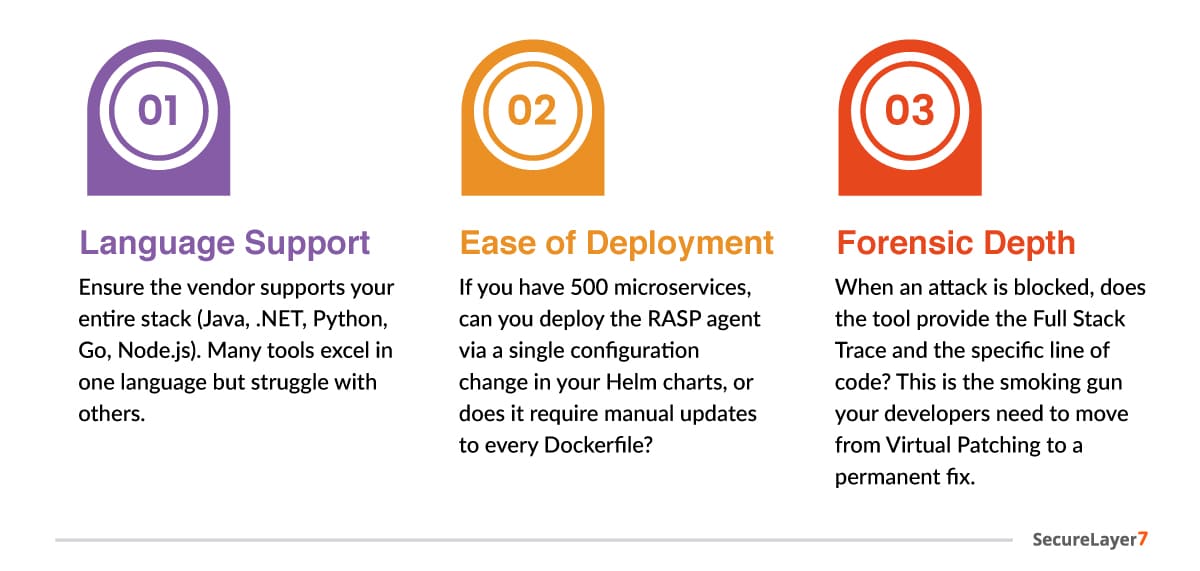
Considerations for Selecting RASP Solutions
Before signing a contract, consider these operational realities:
Benefits of Implementing RASP
Runtime Application Self-Protection (RASP) is a game-changing security technology that provides continuous, in-application protection. By integrating directly into the application’s runtime environment, RASP helps detect and block threats in real time.
Following are the key benefits of implementing RASP as part of your security strategy.
Real-Time Protection Against Active Attacks
Unlike traditional security tools that operate passively, RASP offers real-time protection by continuously monitoring the application during runtime.
- Instant Threat Detection: RASP analyzes the behavior of the application and can identify suspicious activities such as SQL injection, cross-site scripting (XSS), and buffer overflows as they occur.
- Immediate Blocking: A threat is detected, RASP can block malicious actions instantly, stopping attackers from exploiting vulnerabilities and mitigating the risk of data breaches or system compromises.
Reduced False Positives
Traditional security tools, such as vulnerability scanners and Web Application Firewalls (WAFs), often suffer from false positives due to their rule-based nature.
- Context-Aware Detection: RASP is integrated within the application itself; it has a deeper understanding of normal application behavior and can make more accurate security decisions.
- Minimized Alerts: By distinguishing between legitimate requests and real threats, RASP reduces false alarms, allowing security teams to focus on actual issues and improving overall operational efficiency.
Faster Incident Response
RASP significantly accelerates incident response times by offering immediate detection and mitigation.
- Automated Response: Upon detecting an attack, RASP can automatically block the threat without waiting for manual intervention, allowing security teams to respond faster.
- Real-Time Feedback: Security teams receive instant feedback about the attack, helping them understand the nature of the threat and make informed decisions quickly.
Challenges and Best Practices
Runtime Application Self-Protection (RASP) provides essential real-time protection for applications; its implementation comes with challenges.
Following are the challenges and share best practices for maximizing the effectiveness of RASP in your security strategy.
Core Challenges
- Performance Impact: Instrumentation can add 2ms–5ms of latency per request. High-traffic or memory-constrained environments require careful tuning to avoid Out-of-Memory (OOM) errors.
- Deployment Complexity: Managing a polyglot stack (Java, .NET, Go, Python) often requires different agents or SDKs.
- Compatibility: Some RASP tools may conflict with existing APM (Application Performance Monitoring) agents or legacy bytecode obfuscators.
Best Practices for Success
- Integrate with DevSecOps: Treat RASP as Security as Code. Use Helm charts or Terraform to automate injection, ensuring every new service is born secure.
- Phase-In Approach: Start in Log-Only mode for 2+ weeks to establish a behavioral baseline.
- Validate Security Controls: RASP should complement rather than replace application security testing. Regular SAST and DAST testing helps teams identify vulnerabilities during development and validate application behaviour during runtime.
- Defense-in-Depth: Use a WAF to filter high-volume noise (DDoS, bots) at the edge, allowing RASP to focus its CPU cycles on sophisticated, code-level exploits like SQLi or RCE.
- Continuous Tuning: Regularly correlate RASP telemetry with SAST/DAST findings. If a scanner finds a bug, use RASP to provide Virtual Patching until a permanent code fix is deployed.
Conclusion
Runtime Application Self-Protection (RASP) provides real-time, in-application protection against evolving threats by continuously monitoring and blocking attacks during runtime. Unlike perimeter tools, RASP offers context-aware defense, ensuring faster incident response and stronger security when combined with tools like WAFs and SIEM systems.
For organizations seeking to strengthen their security posture, SecureLayer7 offers cutting-edge RASP solutions designed to seamlessly integrate with existing systems, providing real-time protection and continuous security monitoring.
Protect your applications with SecureLayer7’s RASP and stay ahead of evolving threats.
Frequently Asked Questions (FAQs)
RASP is a security solution integrated directly within an application to monitor and block attacks in real time. It provides context-aware protection by detecting and stopping threats like SQL injections and XSS during application runtime.
RASP monitors the application’s behavior during runtime, detecting malicious activity such as SQL injection or runtime exploits. It blocks threats instantly and provides continuous protection without external intervention.
RASP testing evaluates how effectively RASP tools protect applications from attacks during runtime. It involves simulating attacks, checking for real-time detection, and ensuring minimal performance impact.
• WAF: External security layer that filters incoming traffic to block web attacks before reaching the application. • RASP: Internal security tool that monitors the application’s runtime and blocks threats in real time.

