
As cyber threats grow increasingly sophisticated, traditional penetration testing alone is no longer enough to secure complex IT environments. AI-assisted penetration testing (AI-supported pentesting) combines artificial intelligence, machine learning, and automation with human expertise to detect vulnerabilities faster, simulate realistic attack scenarios, and prioritize remediation more effectively.
Organizations can analyze large datasets from networks, applications, cloud systems, and APIs, uncover subtle vulnerabilities, and reduce false positives. A comprehensive overview of AI-assisted penetration testing, including its benefits, methodologies, key tools, and real-world use cases, helping security teams proactively strengthen defenses, improve compliance, and maintain a robust cybersecurity posture.
Why AI-Assisted Penetration Testing is Transforming Cybersecurity
The landscape of cybersecurity is evolving rapidly, and traditional penetration testing alone can no longer keep pace with sophisticated threats. AI-assisted penetration testing is revolutionizing the field by enhancing speed, scale, and accuracy:
- Speed: AI algorithms automate repetitive testing tasks, allowing security teams to identify vulnerabilities in hours rather than weeks.
- Scale: AI-driven tools can assess large, complex networks, multiple applications, and cloud infrastructures simultaneously.
- Accuracy: Machine learning models detect subtle patterns and anomalies that human testers might overlook, reducing false positives and uncovering hidden vulnerabilities.
AI-Assisted vs AI-Supported Penetration Testing
Both approaches integrate AI into cybersecurity workflows:
- AI-Assisted Penetration Testing: AI acts as a supporting layer for human experts, automating tasks like reconnaissance, data analysis, and preliminary exploitation checks. Security professionals remain responsible for final validation and critical decision-making.
- AI-Supported Penetration Testing: AI operates with higher autonomy, capable of simulating attacks and generating reports with minimal human intervention. This approach is ideal for organizations seeking faster, continuous testing across multiple environments.
What is AI‑Assisted Penetration Testing?
AI-assisted penetration testing (also referred to as AI-supported pentesting) is a modern cybersecurity approach that combines artificial intelligence with human expertise to proactively detect vulnerabilities, simulate real-world attacks, and prioritize remediation efforts.
By leveraging machine learning, intelligent automation, and predictive analytics, AI-assisted pentesting enables organizations to identify hidden weaknesses faster and more accurately than traditional methods. Organizations increasingly combine AI-driven automation with Application Penetration Testing to identify exploitable vulnerabilities earlier and strengthen their overall security posture.
How AI Works With Traditional Pentesting Workflows
AI functions as a supportive layer alongside human testers:
- Automates repetitive tasks: Such as reconnaissance, data collection, and preliminary vulnerability scanning.
- Analyzes large datasets: AI algorithms can process vast amounts of information from networks, applications, and cloud environments.
- Prioritizes findings: Machine learning models assess risk severity and highlight critical vulnerabilities for human validation.
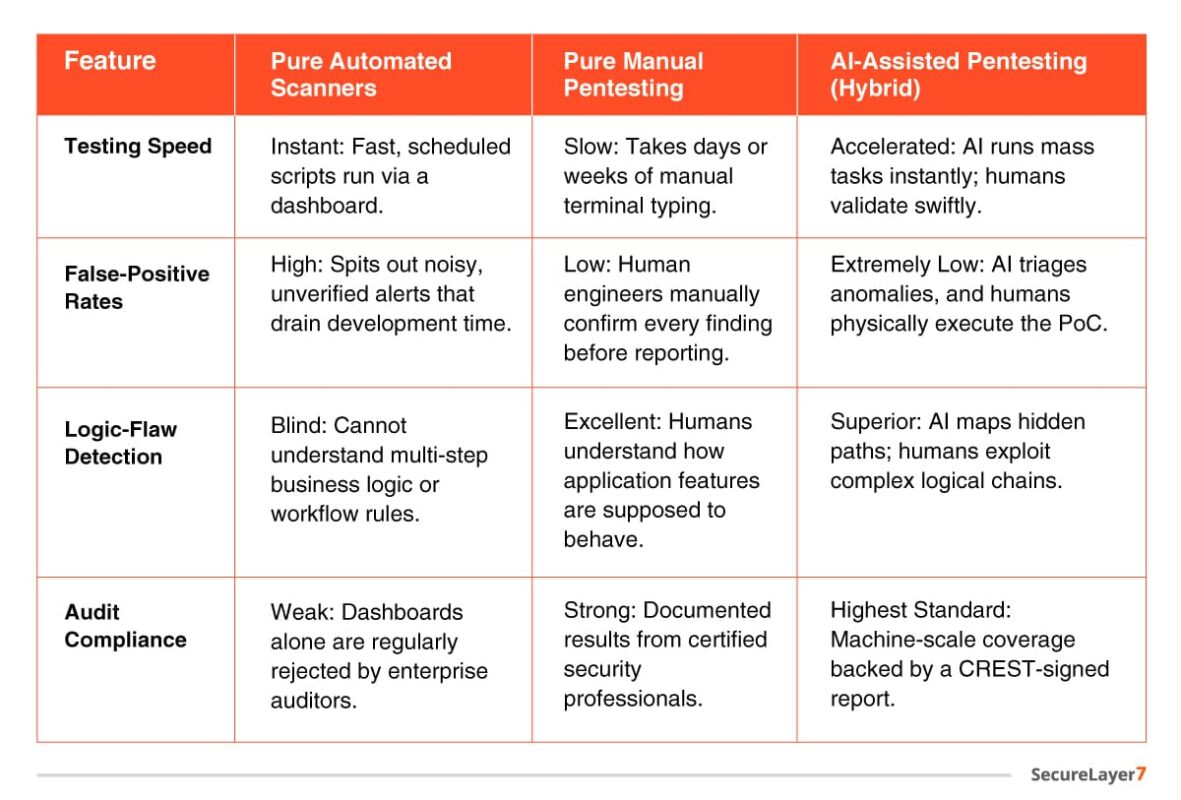
What Makes it Different from Manual or Automated Testing Alone?
Understanding the difference between these testing models is critical for teams trying to achieve both depth and speed in their security strategy.
Examples of AI Enhancements
AI enhances penetration testing in several ways:
- Pattern Recognition: Detects subtle security flaws or suspicious behaviors that may be missed by humans.
- Anomaly Detection: Identifies unusual activity or configurations that indicate potential vulnerabilities.
- Automation: Handles repetitive, large-scale tasks such as scanning, reporting, and correlating vulnerability data across multiple systems.
AI‑Assisted vs Traditional Penetration Testing
Penetration testing is essential for identifying vulnerabilities and securing critical systems, but the approach has evolved significantly with AI integration. Traditional penetration testing relies entirely on human expertise, while AI-assisted penetration testing combines human insight with artificial intelligence to enhance speed, accuracy, and scalability.
Organizations evaluating different testing approaches should also understand the differences between Manual and Autonomous Penetration Testing, particularly when balancing automation with expert validation.
Human-Only vs AI-Assisted Approaches
- Human-Only: Manual penetration tests are creative but time-intensive. Testers spend a large portion of their effort on data gathering, scripting, and reporting, which limits coverage and scalability.
- AI-Assisted: AI handles multi-step reconnaissance, pattern matching, and data triage at machine speed, reducing administrative overhead from days to hours. This allows human experts to focus on high-value tasks like business-logic exploits and complex attack chains.
False Positives and Cognitive Analysis Support
Traditional automated vulnerability scanners generate massive, unfiltered spreadsheets full of unexploitable flags. Humans are then forced to spend days manually validating each alert to filter out the noise.
AI-assisted workflows fundamentally change this through cognitive analysis support:
- Contextual Analysis: Rather than just searching for static, rigid rules, AI models analyze application behaviors and parameter inputs contextually to flag anomalies that matter.
- Automated Differential Testing: AI tools can simulate multi-user flows in parallel to isolate potential Insecure Direct Object Reference (IDOR) pathways before human hands touch the keyboard.
- Intelligent Prioritization: AI engines cluster similar findings, correlate disparate log anomalies, and automatically drop low-risk noise. This provides developers with cleaner data and actionable, validated priority lists.
Scalability and Repeatability with AI Support
AI enables scalable and repeatable testing. As security environments become increasingly dynamic, many organizations are adopting Autonomous Pentesting to continuously validate attack paths and reduce the gaps left by periodic assessments.
- Conduct frequent assessments without additional human resources
- Integrate continuous penetration testing into DevSecOps pipelines
- Maintain consistent quality and coverage across multiple applications, systems, and environments.
How AI‑Assisted Penetration Testing Works
AI-assisted penetration testing integrates artificial intelligence into traditional pentesting workflows to identify vulnerabilities faster, more accurately, and at scale. By combining machine learning, automation, and human expertise, AI-assisted testing provides actionable insights that enhance overall cybersecurity.
Data Collection and Preprocessing
AI-supported pentesting starts with extensive information gathering:
- Mass Ingestion: The AI ingests unstructured data from endpoints, GitHub repos, TLS certificates, WHOIS records, and DNS configurations.
- Normalization & Noise Filtering: Machine learning cleans and organizes chaotic scan data, removes duplicates, and maps assets into a unified graph.
- Contextual Tagging: NLP classifies targets like login portals, admin dashboards, and unauthenticated APIs for focused testing.
Machine Learning Models in Vulnerability Detection
Traditional scanners miss vulnerabilities if they don’t match exact signatures, but AI-powered models overcome this limitation.
- Supervised Learning: Trained on millions of historical vulnerabilities, models can detect complex bug variants like path traversal or deserialization flaws even in obfuscated code.
- Unsupervised Anomaly Detection: AI establishes normal user behavior and flags deviations, identifying issues such as IDOR or unexpected API responses.
- Deep Code Semantics: LLMs analyze code and API patterns contextually, uncovering hidden flaws in custom application logic beyond simple keyword matching.
Intelligent Attack Path Prediction
AI-assisted tools can simulate potential attack paths, predicting how an attacker might exploit multiple vulnerabilities in combination. This helps security teams:
- Understand the most critical risk chains
- Prioritize remediation based on real-world threat scenarios
- Reduce the likelihood of overlooking complex, multi-step exploits
Automated Report Generation
Documentation is often the slowest part of penetration testing, requiring days to turn raw logs, HTTP requests, and proof-of-concept exploits into structured reports. AI-supported platforms automate this process:
- Log-to-Markdown Translation: Converts terminal histories and request/response captures into readable, structured markdown instantly.
- Contextual Remediation Advice: Generates tailored, secure code snippets for developers based on the specific language and framework of the target application.
- Executive Summary Tuning: Uses AI to translate technical findings into high-level business impact language for C-level executives and auditors.
Key Components of AI‑Assisted Penetration Testing
AI-assisted penetration testing leverages advanced technologies to enhance traditional cybersecurity assessments. By integrating artificial intelligence, machine learning, and automation, organizations can identify vulnerabilities faster, predict attack paths, and prioritize remediation efforts more effectively.
Following are the key components that make AI-assisted pentesting a modern, high-impact security solution:
Threat Modeling with AI Insights
Before a single packet is sent across a network, security teams must understand what they are protecting and who might attack it. Traditional threat modeling involves manual whiteboard sessions that quickly become outdated as developers update application code.
AI-assisted threat modeling continuously ingests your live architecture diagrams, API schemas, and code repository structures. Modern offensive security is increasingly powered by intelligent automation. AI Agents for Offensive Security demonstrate how AI-driven reconnaissance, attack simulation, and vulnerability validation are transforming penetration testing workflows.
AI-Enhanced Vulnerability Scanning
Machine learning algorithms improve the efficiency and accuracy of vulnerability scans by:
- Detecting hidden or subtle weaknesses in applications, networks, and cloud environments.
- Prioritizing vulnerabilities based on severity, exploitability, and business impact.
- Reducing false positives and ensuring that remediation efforts focus on critical threats.
Behavioral Anomaly Detection
AI models monitor systems, networks, and user behavior to detect anomalous activities that may indicate security breaches:
- Unusual login patterns or access requests.
- Suspicious file modifications or data exfiltration.
- Irregular network traffic or API usage.
AI‑Assisted Penetration Testing Guide
Organizations need modern penetration testing approaches that go beyond traditional methods. AI-assisted penetration testing (also known as AI-supported pentesting) combines the intelligence of AI with human expertise to identify vulnerabilities, simulate attacks, and prioritize remediation efficiently.
Following a structured step-by-step process, businesses can enhance their cybersecurity posture, reduce risk exposure, and ensure compliance.
Scope Definition and Asset Identification
Before deploying any test payloads, it’s critical to define strict boundaries to ensure AI-driven pentesting remains safe and effective:
- Identify Critical Assets: Input primary domains, cloud IP ranges, or repository links into the asset discovery engine.
- Map Threat Surfaces: AI enumerates external attack surfaces, uncovering forgotten subdomains, shadow APIs, unlinked repositories, and exposed cloud buckets.
- Define Constraints: Security professionals mark high-value assets and enforce automated boundaries to keep testing legal and non-disruptive.
Data Aggregation and Baseline Profiling
AI-supported pentesting first models the normal state of your environment:
- Collect Logs and Metrics: Ingest structured and unstructured data across APIs, system configs, TLS certificates, and HTTP traffic.
- Establish Normal Behavior: Machine learning maps typical user flows, input patterns, and response times to create a behavioral baseline.
- Isolate Deviations: Early anomalies – like undocumented API parameters or unusual authentication responses are flagged for deeper inspection.
AI-Enhanced Scanning and Enumeration
AI transitions to active probing with intelligent, context-aware scanning:
- Contextual Fuzzing: AI tailors attack inputs based on application frameworks and business logic, simulating realistic exploratory behavior.
- Detects Obfuscated Vulnerabilities: The scanner identifies complex flaws like hidden path traversals, multi-step authorization bypasses, and advanced SQL injection variants.
- Triage and Deduplicate Findings: AI algorithms correlate results from multiple scanners, reduce false positives, and generate a prioritized, accurate hit list for further exploitation.
Intelligent Exploitation & Attack Simulation
This phase elevates scanning into true penetration testing, with AI emulating human adversaries:
- Simulate Attack Chains: AI uses graph neural networks to link minor vulnerabilities into complex exploit paths, predicting potential full-scale breaches.
- Safe Exploit Validation: Non-destructive AI-generated payloads test if vulnerabilities are actually exploitable.
- Human-AI Collaboration: When attack paths require creative reasoning, ethical hackers leverage AI insights to manually validate high-risk business-logic exploits and capture proofs-of-concept.
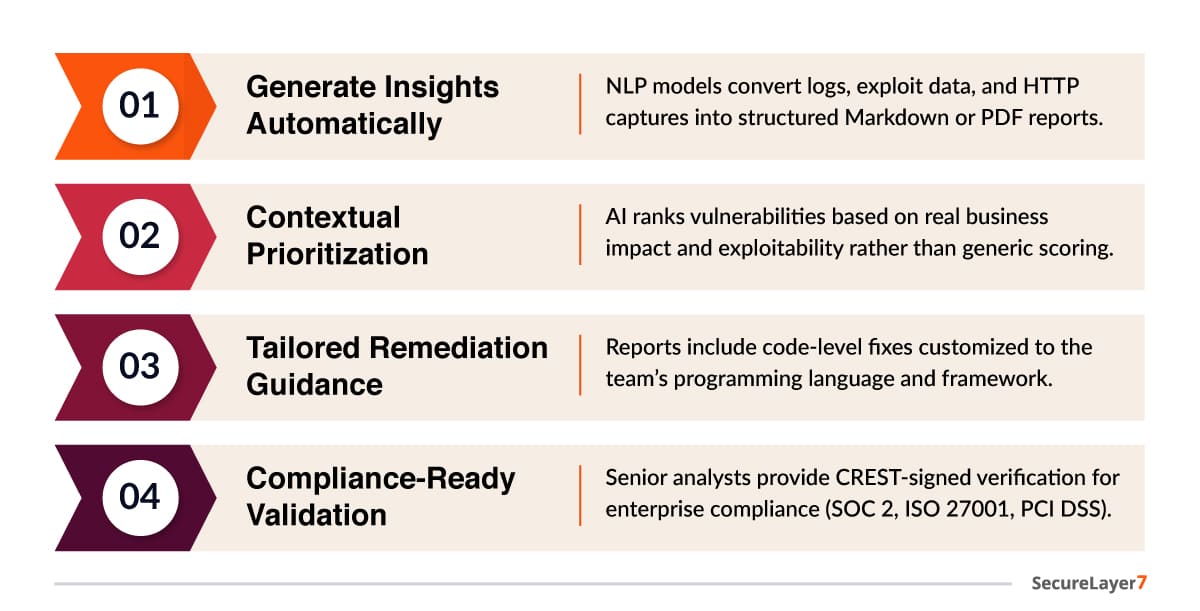
AI-Driven Analysis & Reporting
The final phase eliminates manual report drafting by automating data compilation for faster, actionable insights:
Benefits of AI‑Assisted Penetration Testing
As cyber threats become more sophisticated, traditional penetration testing can struggle to keep up. AI-assisted penetration testing (also referred to as AI-supported pentesting) leverages artificial intelligence, machine learning, and automation to enhance traditional testing workflows.
Integrating AI into pentesting delivers faster, more accurate, and actionable insights, helping organizations strengthen their security posture and reduce risk exposure.
Enhanced Vulnerability Detection and Accuracy
Significant advantages of AI-assisted penetration testing are its ability to enhance detection accuracy:
- Machine learning algorithms analyze vast datasets including network traffic, system logs, application code, and user behavior to identify subtle vulnerabilities.
- AI detects complex misconfigurations, hidden threats, and anomalous patterns that human testers or traditional automated tools might miss.
- Improved accuracy reduces false positives, ensuring that remediation efforts focus on genuine, high-risk vulnerabilities.
Faster Testing Cycles and Reduced Manual Effort
AI-assisted tools automate many repetitive penetration testing tasks:
- Automated reconnaissance, scanning, and initial analysis reduces the burden on human testers.
- AI streamlines data aggregation, correlation, and risk scoring, which normally takes days or weeks manually.
- Organizations can perform more frequent and faster assessments, keeping up with continuous development cycles and new releases.
Prioritization of Critical Vulnerabilities
AI-supported pentesting platforms do more than detect vulnerabilities – they prioritize them based on risk and potential impact:
- Vulnerabilities are scored using AI-driven risk matrices, anomaly detection, and predictive analytics.
- High-severity vulnerabilities affecting business-critical systems or sensitive data are flagged for immediate remediation.
- Prioritization improves resource allocation, allowing teams to address the most critical threats first, reducing organizational risk.
Tools & Technologies for AI‑Assisted Penetration Testing
The rise of AI-assisted penetration testing has transformed how organizations detect, prioritize, and remediate cybersecurity threats. Leveraging the right tools and technologies is essential for maximizing the efficiency, accuracy, and impact of AI-powered security assessments. From AI-supported platforms to machine learning frameworks, these technologies enable security teams to proactively identify vulnerabilities and strengthen organizational defenses.
Overview of AI-Supported Penetration Testing Platforms
Several enterprise-grade platforms provide AI-enhanced penetration testing capabilities:
- Burp Suite Enterprise with AI Modules: Combines automated scanning with AI-driven prioritization of vulnerabilities, enabling faster, more accurate pentesting.
- OWASP ZAP with AI Plugins: Open-source tool that integrates AI-assisted scanning and anomaly detection to improve threat identification.
- Acunetix with AI Support: Provides AI-enhanced web application vulnerability detection and automated reporting with risk scoring for critical findings.
Machine Learning Frameworks for Security
AI-assisted pentesting relies on machine learning frameworks to analyze patterns, detect anomalies, machine learning has become a key component of modern offensive security. Explore how AI and ML in Offensive Security are enabling faster vulnerability discovery and more effective threat simulations.
- TensorFlow and PyTorch: Used to train models for behavioral analysis, anomaly detection, and predictive risk scoring.
- Scikit-learn and XGBoost: Applied for classification and prioritization of vulnerabilities based on likelihood and business impact.
- Custom ML pipelines: Enable integration with proprietary security datasets to refine detection models and reduce false positives.
Intelligent Scanning Engines and Exploitation Modules
Modern AI-supported scanning engines combine automation with intelligent decision-making:
- Vulnerability Enumeration Engines: AI detects complex and multi-layered vulnerabilities in web apps, APIs, and cloud environments.
- Intelligent Exploitation Modules: Simulate realistic attack chains, combining multiple vulnerabilities to assess practical risk impact.
- Adaptive Testing: AI dynamically adjusts scanning paths based on findings, prioritizing high-risk areas and minimizing resource waste.
Integration with SIEM, SOAR, and DevSecOps Pipelines
AI-assisted penetration testing becomes even more powerful when integrated with security operations and development workflows:
- SIEM Integration: Real-time correlation of pentest results with security events to enhance threat detection and monitoring.
- SOAR Platforms: Automates remediation and response workflows based on AI-identified vulnerabilities.
- DevSecOps Pipelines: Embeds AI-assisted testing into CI/CD pipelines, enabling continuous vulnerability scanning during development and deployment.
Real‑World Use Cases
AI-assisted penetration testing (also referred to as AI-supported pentesting) is no longer a theoretical concept – it is actively transforming cybersecurity across industries. By combining machine learning, intelligent automation, and human expertise, organizations can uncover hidden vulnerabilities, simulate realistic attacks, and strengthen their security posture.
Following use cases demonstrate how AI-assisted pentesting delivers tangible, measurable benefits in complex IT environments.
Uncovering Hidden Weaknesses
AI algorithms can detect subtle, complex vulnerabilities that traditional or manual penetration testing might miss:
- Pattern Recognition: Identifies anomalous configurations, unusual user behavior, or hidden misconfigurations across networks and applications.
- Anomaly Detection: Detects inconsistencies in data flows, system responses, or authentication patterns that may indicate exploitable weaknesses.
- Automation of Repetitive Checks: Frees human testers to focus on validating critical vulnerabilities, improving overall coverage and accuracy.
AI-Supported Vulnerability Detection in Complex Systems
In complex systems, such as multi-cloud environments, hybrid networks, or microservices architectures, AI-supported tools excel at:
- Mapping interconnected assets and dependencies to highlight high-risk attack paths
- Detecting vulnerabilities in cloud storage, containerized applications, and third-party integrations
- Prioritizing findings based on business impact, exploitability, and regulatory compliance
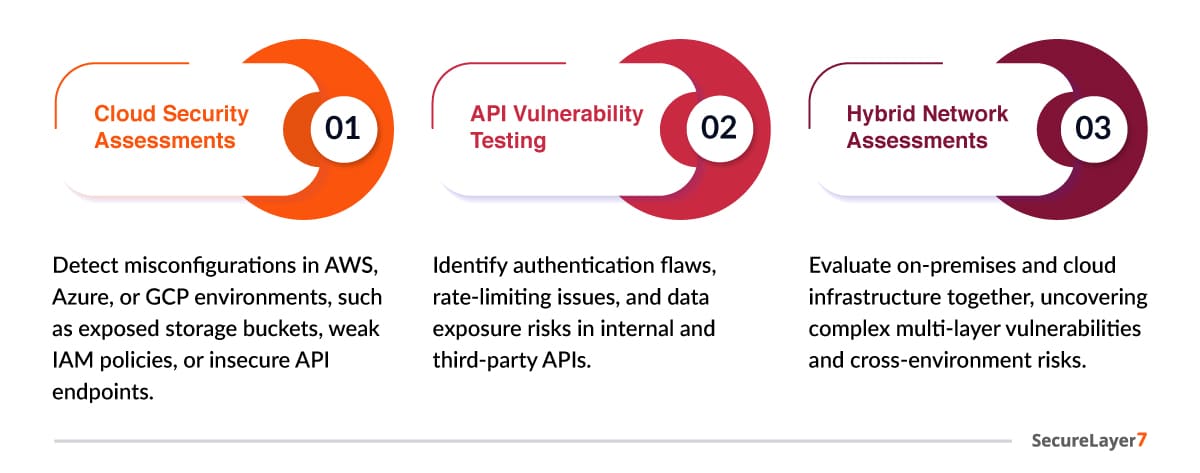
Case Scenarios: Cloud Security Assessments, APIs, and Hybrid Networks
Real-world scenarios where AI-assisted pentesting proves invaluable include, organizations deploying LLM-powered applications should also consider AI App Pentesting, which focuses on AI-specific risks such as prompt injection, insecure output handling, RAG poisoning, and orchestration flaws.
Measurable Improvements in Security Posture
Organizations leveraging AI-assisted penetration testing report significant improvements in security metrics, including:
- Faster vulnerability identification and remediation cycles
- Reduced risk exposure for critical systems and data
- Lower incidence of false positives and wasted remediation effort
- Enhanced compliance with standards such as PCI DSS, ISO 27001, and NIST frameworks
Best Practices for Implementing AI‑Assisted Penetration Testing
AI-assisted penetration testing (also referred to as AI-supported pentesting) delivers faster, more accurate, and scalable vulnerability detection. To maximize its effectiveness, organizations must follow best practices that blend AI intelligence with human expertise and operational workflows.
Implementing these practices ensures comprehensive security coverage, reduces false positives, and strengthens overall cybersecurity posture.
Blend Human Expertise with AI Insights
AI can automate repetitive tasks and analyze vast amounts of data, but human expertise remains essential for:
- Interpreting AI-generated results and validating findings.
- Making contextual decisions on risk prioritization and remediation.
- Simulating complex, real-world attack scenarios that AI alone cannot fully predict.
Regularly Update Models and Data Sources
AI-assisted pentesting relies on machine learning models and threat intelligence feeds. To maintain accuracy:
- Continuously update AI models with new vulnerabilities, attack patterns, and system configurations.
- Refresh data sources to include emerging threats, CVE updates, and organizational environment changes.
- Validate model predictions to minimize false positives and negatives.
Combine with Manual Verification and Contextual Judgment
Even the most advanced AI cannot replace human judgment entirely:
- Conduct manual verification of AI-identified vulnerabilities.
- Evaluate findings in the context of business impact, regulatory compliance, and operational priorities.
- Use human expertise to design remediation strategies for complex or multi-step attack paths.
Conclusion
AI-assisted penetration testing merges artificial intelligence, machine learning, and automation with human expertise to deliver faster vulnerability detection, precise risk prioritization, and scalable security coverage across applications, networks, and cloud environments. Compared to traditional testing, it reduces false positives, uncovers hidden vulnerabilities, and enables predictive threat analysis for a comprehensive security posture.
SecureLayer7 offers cutting-edge AI-assisted penetration testing services, helping businesses integrate AI intelligence into their security workflows. With our expertise, organizations can detect vulnerabilities faster, simulate realistic attacks, and prioritize remediation effectively, ensuring a robust and proactive cybersecurity posture.
Protect your organization before attackers do – Partner with SecureLayer7 for AI-assisted penetration testing and future-ready security.
Frequently Asked Questions (FAQs)
AI-assisted pentesting combines AI with human expertise to identify vulnerabilities, simulate attacks, and prioritize remediation, providing faster and more accurate threat detection than traditional methods.
Unlike manual testing, AI-assisted pentesting automates reconnaissance, analyzes large datasets, and prioritizes risks using AI models while still relying on human judgment for validation and complex scenarios.
Popular tools include Burp Suite Enterprise (AI modules), OWASP ZAP (AI plugins), Acunetix with AI support, and cloud/container platforms like Trivy, Wiz, and Orca Security.
No. AI augments human expertise, handling repetitive tasks and analysis, while humans focus on validation, strategic decisions, and sophisticated attack simulations.
Potential risks include model errors, over-reliance on automation, integration challenges, and data privacy concerns. Mitigation involves human oversight, regular model updates, and structured workflow integration.

