
Misconfigured cloud resources, excessive permissions, unsecured storage buckets, and compliance gaps remain some of the leading causes of cloud security incidents. Even a minor configuration error can expose sensitive data, disrupt operations, and result in significant financial and reputational damage.
Cloud Security Posture Management (CSPM) fills this gap by providing continuous visibility, monitoring, and automated remediation to keep cloud configurations secure and compliant. CSPM identifies risks such as overly permissive IAM roles, exposed storage buckets, misconfigured security groups, and compliance gaps across AWS, Azure, and Google Cloud.
What Cloud Security Posture Management (CSPM) Means in Simple Terms
Cloud Security Posture Management (CSPM) is a solution that continuously checks your cloud environment to ensure everything is configured securely. It helps identify common mistakes – like exposed storage buckets, overly permissive IAM roles, or unencrypted databases – that could leave your cloud vulnerable to attacks.
CSPM acts like an automated security guard for your cloud. It monitors your resources across AWS, Azure, and Google Cloud, compares configurations against best practices, and often fixes critical issues automatically.
For a broader view of cloud exploitation techniques, check SecureLayer7’s Cloud Security Trends & Exploits
Why CSPM is Essential as Cloud Adoption Grows
As cloud environments become larger and more complex, maintaining consistent security becomes increasingly difficult. Organizations often operate across multiple cloud providers, manage thousands of cloud resources, and support distributed teams, creating a broader attack surface and increasing the risk of security misconfigurations.
CSPM is essential because it provides continuous, automated oversight in an environment where manual checks simply cannot keep up. It ensures that every cloud resource is configured securely, detects policy violations instantly, and enforces best practices across all accounts and cloud providers.
Rising Risks Due to Misconfigurations and Lack of Visibility
Misconfigurations are now one of the biggest drivers of cloud security breaches. Even small mistakes – like a public storage bucket, an open port, or an overly permissive IAM role – can expose sensitive data without anyone noticing. Because cloud environments change quickly and resources are created constantly, these issues can accumulate fast and remain hidden.
The problem becomes worse when organizations lack visibility across their cloud accounts. Shadow resources, unmanaged identities, and inconsistent configurations create blind spots that attackers can easily exploit. Without centralized monitoring and continuous oversight, these misconfigurations grow into serious risks, making strong posture management critical for cloud security.
CSPM secures cloud configurations, organizations should also understand Data Security Posture Management (DSPM) to continuously discover, classify, and protect sensitive data stored across cloud environments. Without centralized monitoring and continuous oversight, these misconfigurations grow into serious risks, making strong posture management critical for cloud security.
What is CSPM?
Cloud Security Posture Management (CSPM) is a security approach that continuously monitors cloud environments to ensure they are configured correctly and securely. It identifies misconfigurations, policy violations, and security gaps such as public storage buckets, weak access controls, and unencrypted data – that could lead to breaches.
CSPM helps organizations maintain a strong and compliant cloud security posture by providing visibility, real-time alerts, and automated remediation. It works across multi-cloud platforms like AWS, Azure, and Google Cloud to prevent mistakes and ensure every resource follows best practices and organizational policies.
Types of cloud security weaknesses are often uncovered during cloud penetration testing, which helps validate how misconfigurations can be exploited by attackers
Read more: What Is Cloud Penetration Testing? A Complete Guide.
Meaning of CSPM in Cloud Security
Cloud Security Posture Management (CSPM) refers to the tools and processes used to ensure that a cloud environment is configured securely at all times. CSPM helps organizations detect misconfigurations, enforce security best practices, and maintain compliance across all their cloud accounts and services.
CSPM acts as a continuous security audit for the cloud – automatically checking whether resources are set up correctly, identifying risks, and alerting teams before issues turn into breaches. It ensures that the overall security posture of the cloud remains strong, consistent, and aligned with organizational and regulatory standards.
How CSPM Monitors Cloud Resources and Configurations
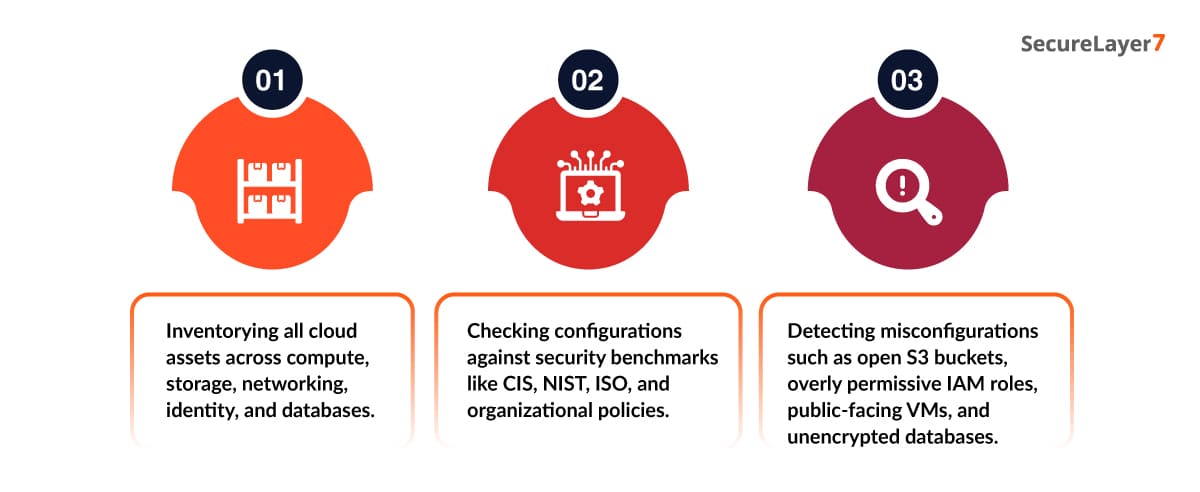
CSPM tools continuously scan your cloud infrastructure for risks by:
How CSPM Supports Multi-Cloud Environments (AWS, Azure, GCP)
Cloud Security Posture Management (CSPM) simplifies multi-cloud security by providing a centralized view of security risks, configurations, and compliance status across all cloud environments. Instead of managing security separately for each platform, security teams can monitor and enforce consistent security policies from a single dashboard.
CSPM solves this by:
- Providing a unified dashboard to monitor security risks across all cloud providers.
- Normalizing policies and controls, so the same security standards apply everywhere.
- Ensuring consistent visibility across mixed environments – public cloud, private cloud, or hybrid cloud.
How Cloud Security Posture Management Works
CSPM works by continuously scanning your cloud environment to detect misconfigurations, security risks, and compliance violations. It compares your cloud settings against security best practices and alerts you when something is unsafe.
By providing real-time visibility, automated monitoring, and optional auto-remediation, CSPM ensures your cloud configurations stay secure and compliant as your environment grows and changes.
Continuous Cloud Visibility
CSPM starts by giving you full visibility across all your cloud accounts.
It identifies:
- Every asset you have, including VMs, databases, storage buckets, containers, and serverless functions
- How each asset is configured
- Which assets present risk because of incorrect settings or exposure
Misconfiguration Detection
Misconfigurations are the number one cause of cloud breaches. Even a small mistake, like an open storage bucket, can expose sensitive data.
CSPM continuously scans your cloud to detect unsafe configurations such as:
- Network rules that allow unrestricted inbound or outbound traffic
- Overly permissive IAM roles and access policies
- Storage buckets or databases left publicly accessible
- APIs, ports, and services exposed to the internet
Automated Remediation
Once CSPM identifies a misconfiguration, it can help you fix it.
Depending on the tool, CSPM offers:
- Automatic remediation, where it applies the correct setting instantly
- Guided remediation, where it shows you the exact steps to fix the issue
- Policy-based enforcement, where safe configurations are applied continuously
Common Cloud Security Risks CSPM Helps Prevent
Cloud environments offer scalability and flexibility, but they also introduce security risks that can expose sensitive data and critical business assets. Many cloud breaches result from misconfigurations and security oversights rather than vulnerabilities in the cloud platforms themselves.
Some of the most common cloud security risks CSPM helps prevent include:
- Publicly Exposed Storage Resources: Detects unsecured storage buckets, databases, and file repositories that could expose sensitive information to unauthorized users.
- Excessive Permissions and IAM Misconfigurations: Identifies overly permissive user accounts, roles, and service permissions that violate the principle of least privilege and increase the risk of unauthorized access.
- Unencrypted Data: Discovers cloud resources that lack proper encryption for data at rest or in transit, helping organizations protect sensitive information.
- Misconfigured Network Security Settings: Detects open ports, insecure firewall rules, unrestricted security groups, and other network configurations that can expand the attack surface.
- Compliance Violations: Continuously monitors cloud environments for deviations from regulatory requirements and industry standards such as PCI DSS, HIPAA, ISO 27001, SOC 2, and GDPR.
Publicly Exposed Storage Buckets or Databases
The leading causes of cloud data breaches is accidentally exposing storage buckets, files, or databases to the public internet. A single misconfigured policy can make sensitive information accessible to anyone.
CSPM helps prevent this by:
- Continuously scanning for publicly exposed storage services
- Detecting misconfigured permissions or anonymous access
- Enforcing secure access controls and encryption
Over-Permissive IAM Roles and Unmanaged Identities
Cloud identities – users, roles, and service accounts – often accumulate more privileges than necessary. This creates multiple entry points for attackers.
CSPM addresses identity-related risks by:
- Identifying overly broad IAM permissions
- Detecting unused or abandoned accounts
- Highlighting privilege escalation risks
- Enforcing least-privilege access policies
Unencrypted Sensitive Data
Unencrypted data is highly vulnerable; it is stored in databases or moving between applications and services.
CSPM continuously monitors encryption settings to ensure:
- All storage resources and databases are encrypted at rest
- Traffic between cloud components uses secure protocols like TLS/SSL
- Encryption keys follow security best practices
Misconfigured Firewalls and Open Ports
Firewalls, security groups, and network rules define the boundaries of your cloud environment. A single open port or overly permissive rule can expose workloads to unauthorized traffic.
CSPM prevents network vulnerabilities by:
- Identifying open or unnecessary inbound ports
- Detecting security groups that allow wide-range access
- Flagging non-compliant firewall rules
- Recommending secure configuration fixes
Key Features of CSPM Security Solutions
CSPM solutions give organizations continuous visibility and real-time monitoring across their cloud environments. As cloud usage grows, CSPM helps quickly detect and fix misconfigurations, reducing the risk of breaches caused by unsafe settings or overlooked resources.
CSPM also improves governance by identifying identity and access risks, simplifying compliance reporting, and enforcing security policies automatically.
Following are the essential features that make CSPM a critical component of modern cloud security strategies.
Security Posture Monitoring Across Multi-Cloud Environments
Organizations today use multiple cloud platforms such as AWS, Azure, and Google Cloud. Each provider has different services, settings, and security controls, which makes consistent monitoring challenging.
CSPM solutions simplify this by offering:
- A single unified dashboard for all cloud environments
- Continuous monitoring of configurations, resources, and workloads
- Cross-cloud visibility that eliminates blind spots
Real-Time Alerts for Misconfigurations
Cloud misconfigurations – like open ports, unencrypted storage, or public-facing databases – are among the biggest causes of breaches.
CSPM tools provide:
- Instant detection of risky configuration changes
- Real-time alerts to security teams
- Automated or guided remediation steps
Identity and Access Risk Detection
Excessive privileges, abandoned accounts, and misconfigured IAM roles are common weaknesses in cloud security. CSPM solutions strengthen identity governance by:
- Analyzing permissions for users, roles, and service accounts
- Detecting identity risks such as privilege escalation
- Identifying unused or overly permissive IAM policies
- Highlighting non-compliant identity configurations
Compliance Dashboards and Audit Reporting
CSPM solutions simplify compliance management by automatically mapping configurations to industry standards. A strong posture relies on enforcing accurate configurations.
- CIS Benchmarks
- NIST
- ISO 27001
- GDPR
- HIPAA
- SOC 2
Benefits of Cloud Security Posture Management
CSPM delivers essential protection in today’s fast-changing cloud environments. As organizations scale across multiple cloud platforms, CSPM provides the visibility, automation, and control needed to reduce risks and maintain secure configurations at all times.
Beyond security, CSPM strengthens overall cloud governance and operational efficiency. It supports faster remediation through automation, simplifies audit preparation, and reduces costs by catching issues early – before they turn into high-impact incidents.
Following are the key benefits CSPM delivers.
Stronger Cloud Visibility and Reduced Blind Spots
In cloud security is understanding what resources exist, where they are deployed, and how they are configured. Without full visibility, critical assets can go unnoticed and unprotected.
CSPM eliminates these blind spots by:
- Automatically discovering all cloud resources across accounts and regions
- Providing a unified view of workloads, identities, and configurations
- Highlighting unmanaged, misconfigured, or shadow resources
Reduced Risk of Breaches Caused by Misconfigurations
Misconfigurations are the number one cause of cloud data breaches. Something as simple as an open storage bucket or an overly permissive IAM role can expose sensitive data.
CSPM prevents these issues by:
- Continuously scanning infrastructure for risky settings
- Flagging violations such as public access, unencrypted databases, or exposed ports
- Enforcing best practices before deployment
Faster Remediation Through Automation
Responding to cloud vulnerabilities manually is time-consuming and prone to human error. CSPM speeds up the response process through:
- Automated fixes for common misconfigurations
- Auto-remediation workflows aligned with security policies
- Real-time alerts to notify teams of critical issues
Simplified Compliance and Audit Readiness
An organization must follow CIS benchmarks, NIST standards, PCI-DSS, HIPAA, GDPR, or internal governance policies; CSPM helps maintain compliance across cloud environments.
Key compliance benefits include:
- Automated compliance checks across all cloud resources
- Easy-to-understand dashboards showing compliance status
- Audit-ready reports with detailed findings and remediation steps
CSPM vs Other Cloud Security Tools
Cloud Security Posture Management (CSPM) plays a crucial role in securing cloud environments, but it is only one part of a larger cloud security ecosystem. As organizations adopt multiple security solutions, it becomes important to understand how CSPM differs from other tools and how they complement each other.
CSPM focuses on preventing misconfigurations and strengthening overall cloud posture, tools like CWPP and CIEM address different layers of cloud security, such as workload protection and identity governance.
CSPM vs CWPP
Cloud Security Posture Management (CSPM) and Cloud Workload Protection Platforms (CWPP) serve different purposes in cloud security. Understanding the difference helps organizations build a more complete and layered cloud security strategy.
Posture Protection vs Workload-Level Protection
CSPM (Cloud Security Posture Management)
- Ensures that cloud configurations follow security best practices
- Prevents risks caused by misconfigurations, open ports, excessive permissions, or insecure settings
- Monitors cloud accounts, storage, networking, identity, and compliance
CWPP (Cloud Workload Protection Platform)
- Protects individual workloads such as VMs, containers, Kubernetes clusters, and serverless functions
- Focuses on runtime protection, threat detection, malware defense, and workload vulnerabilities
- Monitors workload behavior, system calls, and insider threats
CSPM vs CIEM
Cloud Security Posture Management (CSPM) and Cloud Infrastructure Entitlement Management (CIEM) address two different but closely related areas of cloud security. They provide a more complete approach to preventing both configuration-based and identity-driven security breaches.
Configuration Monitoring vs Identity/Permission Governance
CSPM (Cloud Security Posture Management)
- Monitors cloud resources and their configurations
- Detects misconfigurations like public S3 buckets, open security groups, or unencrypted data
CIEM (Cloud Infrastructure Entitlement Management)
- Manages identities and permissions across cloud accounts
- Detects excessive, unused, or risky IAM permissions
- Helps enforce least-privilege access
Best Practices for Implementing CSPM Cloud Security
Implementing Cloud Security Posture Management (CSPM) effectively requires more than just turning on a tool – it involves adopting the right processes and practices to ensure continuous security. As cloud environments grow and change rapidly, organizations must take a structured approach to monitoring, remediation, and governance.
By integrating all cloud accounts, enabling automation, enforcing least-privilege access, and regularly reviewing risks, businesses can get the full value of CSPM. Following are the key best practices for successfully implementing CSPM in any cloud environment.
Integrate All Cloud Accounts into One CSPM Platform
Cloud resources are often spread across multiple accounts, regions, and providers. Without complete integration, CSPM cannot provide full visibility or detect hidden risks.
To maximize visibility:
- Connect all AWS, Azure, and GCP accounts to a single CSPM dashboard
- Include production, staging, and development environments
- Add any shadow or legacy accounts that may contain unmanaged resources
Enable Automated Remediation for Critical Risks
Manual remediation is slow and increases the window of exposure. Enabling automation ensures high-risk misconfigurations are fixed instantly.
Best practices for automation:
- Auto-remediate critical issues such as public storage buckets, exposed ports, or unencrypted data
- Use predefined policies aligned with CIS, NIST, and organizational standards
- Enable alerts and logs to track every automated action
Enforce Least-Privilege IAM Policies
Identity misconfigurations are one of the most common cloud security risks. CSPM should work alongside IAM governance to ensure secure access.
Recommended steps:
- Remove unused permissions and roles.
- Detect overly permissive identities.
- Allow only the minimum permissions needed per user or service.
Real-World CSPM Use Cases
Cloud Security Posture Management (CSPM) delivers practical, real-world value by helping organizations catch the kinds of misconfigurations and oversights that often lead to cloud breaches. From detecting public storage buckets to correcting excessive permissions, CSPM continuously identifies risks that can easily go unnoticed in fast-moving cloud environments.
These use cases show how CSPM strengthens security across development, testing, and production – ensuring teams maintain a consistent, compliant, and secure cloud posture at all times. Following are some real-world scenarios where CSPM delivers immediate and measurable value.
Preventing Data Exposure Due to an Open S3 Bucket or Azure Blob
Cloud security failures occur when a storage bucket is accidentally configured for public access. This can expose sensitive customer records, financial data, or internal documents to the entire internet.
Detecting Overly Broad IAM Roles Before Attackers Exploit Them
Identity-related risks are among the biggest threats in cloud environments. An IAM role with excessive permissions – such as broad administrative access – can allow attackers to escalate privileges, steal data, or disable security protections.
- Identifies IAM roles with unnecessary or dangerous permissions
- Highlights unused identities that could be compromised
- Detects privilege escalation pathways
- Enforces least-privilege access policies
Catching Configuration Drift in Fast-Moving DevOps Teams
Developers and engineers frequently update cloud resources. With so many rapid changes, configurations can drift away from established security baselines without anyone noticing.
- Monitors all resources continuously for deviations from approved configurations
- Flags unauthorized or risky changes as soon as they occur
- Automatically reverts or remediates non-compliant settings
- Integrates with CI/CD pipelines to enforce secure deployment standards
Conclusion
CSPM is essential for any cloud-driven organization because it reduces misconfigurations, strengthens cloud posture, and ensures continuous compliance across rapidly expanding environments. By providing real-time visibility and automated remediation, CSPM helps teams prevent the security issues that most commonly lead to cloud breaches.
To build a stronger cloud security strategy, organizations need expert guidance and the right protections in place. Securelayer7 can help you implement effective CSPM practices, eliminate misconfigurations, and secure your cloud environments with confidence.
Contact Securelayer7 today to get started.
Frequently Asked Questions (FAQs)
Cloud Security Posture Management (CSPM) is a security approach that continuously monitors your cloud environments for misconfigurations, risks, and policy violations. It helps you fix these issues before attackers exploit them.
You need CSPM because cloud environments change fast, and a single misconfiguration can expose sensitive data. CSPM gives you visibility, alerts you to unsafe settings, and helps you correct them quickly.
CSPM tools scan your cloud resources, compare them against best practices and compliance standards, and detect risky configurations. They also offer guided or automated remediation to help you fix the problems.
CSPM protects you from publicly exposed storage buckets, weak IAM roles, open ports, unencrypted data, shadow resources, and configuration drift. These issues are common entry points for attackers.
CSPM improves visibility, reduces misconfigurations, automates remediation, strengthens compliance, lowers security costs, and helps you maintain a safer cloud environment. These benefits make cloud security easier and more proactive.

