
Data security posture management (DSPM) helps organizations find and assess the exposure of sensitive data across cloud environments. DSPM provides security teams with visibility to quickly address data gaps, meet compliance requirements, and prevent future problems.
SANS Institute’s latest study shows a major paradigm shift. DSPM is no longer viewed as a standalone feature; rather, it authorizes organizations to treat data as a critical asset.
In this blog, we’ll explain what DSPM is, why it matters, how it works, DSPM tools, and DSPM best practices for organizations.
Why DSPM Matters
Traditional security tools focus on perimeter defense. By monitoring user behavior, APIs, and endpoints, such as laptops and servers, these technologies efficiently block unauthorized access. However, the shift to cloud computing has fundamentally changed the IT landscape.
The rapid growth of cloud-native development, hybrid environments, and ad-hoc AI projects has created significant visibility gaps. Organizations are not only losing data to sophisticated hackers but also losing track of where their data resides.
This challenge is known as the crisis of shadow data, in which organizations lose visibility into untracked or unmanaged data storage and processing resources.
When DevOps teams create temporary data stores for testing or data scientists duplicate large datasets to train machine learning models, security teams commonly lack visibility. Even a minor error in these untracked backups can expose millions of sensitive records.
Related Article: DevSecOps for beginners
The consequences are real. According to the IBM Cost of a Data Breach Report 2025, depending exclusively on perimeter security is no longer adequate to protect against modern threats. If you do not know your data exists, you cannot protect it. This is why Data Security Posture Management is now essential.
Key Benefits of DSPM
Implementing the DSPM framework closes the visibility gap in modern cloud infrastructure. It’s more than an extra dashboard. The benefits include the following:
1. Instant Visibility: Manual inventory can’t handle today’s complicated environments. DSPM maps your full data footprint across multicloud, hybrid, and SaaS in real time.
It finds hidden, orphaned, or unmanaged data stores and exposes weak data paths before attackers do.
2. Automated Remediation:DSPM automates detection and fixes misconfigurations, excess access, and outdated sharing policies.By eliminating human error, you get continuous monitoring that prevents minor oversights from ballooning into massive data breaches.
3. Continuous, Audit-Ready Compliance: Policies like GDPR, CCPA, and HIPAA require nonstop vigilance. DSPM continuously audits your data for compliance.
This helps avoid the panic of prep-week before an audit, eliminate the risk of heavy fines, and build immediate trust with enterprise partners.
4. Reduced Operational Noise:DSPM categorizes and prioritizes risks based on actual data sensitivity, allowing your engineers to focus on real threats.It slashes manual workloads, maximizes your team’s efficiency, and prevents the compounding costs of incident response, downtime, and regulatory penalties.
How DSPM Works: The Four Key Pillars
Most DSPM platforms connect directly to your cloud environments via APIs instead of requiring software installation on every server. Through automation, a DSPM platform continuously executes a four-step lifecycle across your ecosystem. Each step builds on the previous to guarantee comprehensive coverage.
1. Continuous Data Discovery
After locating data, DSPM analyzes and tags it for sensitivity and business context, addressing three key questions:
- Does this data contain personally identifiable information (PII, such as names or ID numbers), proprietary information, or sensitive information?
- Does this data need to comply with laws or industry standards such as the Health Insurance Portability and Accountability Act (HIPAA), Payment Card Industry Data Security Standard (PCI DSS), General Data Protection Regulation (GDPR), or California Consumer Privacy Act (CCPA)?
- How is this data processed, where does it travel, and who within your organization requires access to it?
2. Intelligent Data Classification
Once data is found, DSPM analyzes and tags it based on sensitivity and business context. It answers three critical questions:
- Does the file contain PII (Personally Identifiable Information), intellectual property, or trade secrets?
- Does this specific dataset fall under compliance mandates like HIPAA, PCI DSS, GDPR, or CCPA?
- How is this data being processed, where is it moving, and who actually needs access to it?
3. Risk Assessment & Prioritization
DSPM cross-references data sensitivity with system vulnerabilities to map attack paths and focuses on three main risks:
- Misconfigurations in cloud settings, such as leaving storage accessible to anyone on the internet, pose significant security risks by allowing unauthorized access to or exfiltration of sensitive data, potentially resulting in data breaches, loss of intellectual property, and violations of confidentiality agreements.
- Forgetting to enable encryption exposes sensitive data to unauthorized access during storage or transmission, significantly increasing the chance of data breaches and compromising data confidentiality.
- Failing to apply the latest security fixes leaves systems vulnerable to known exploits, thereby increasing the likelihood of unauthorized access or data breaches.
Related Article: An Exploration of Cloud Security Trends and Exploitations
4. Automated Remediation & Prevention
This completes the process by shifting focus from identifying to actively managing security threats. After prioritizing risks, DSPM transitions from detection to defense by triggering automated workflows to revoke permissions, isolate exposed storage, and remediate misconfigurations in real time.
This proactive approach is significant because it reduces the window of vulnerability, minimizing potential damage from data breaches. It also enforces guardrails and continuous monitoring to prevent public data exposure.
DSPM vs CSPM: Key Differences
DSPM and CSPM (Cloud Security Posture Management) are often discussed together because both strengthen cloud security. However, they address different risks.
On the other hand, CSPM focuses on securing cloud infrastructure and configurations, such as identifying open storage buckets or misconfigured permissions.
In contrast, DSPM focuses on discovering, monitoring, and protecting sensitive data. For example, by locating unencrypted personally identifiable information stored across multiple cloud services. Understanding where each fits helps organizations build a more complete cloud security strategy.
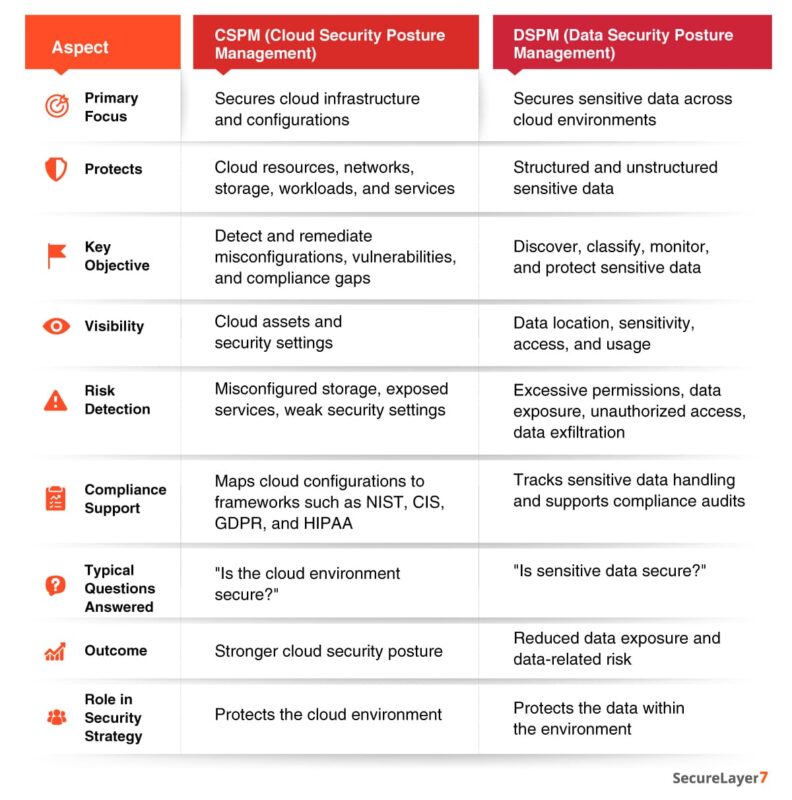
In short, CSPM protects the cloud, while DSPM protects the data inside it. Together, they provide end-to-end cloud security.
Data Security Posture Management Tools
DSPM tools help organizations find, understand, and protect sensitive data across cloud environments. While capabilities vary by vendor, most DSPM solutions include the following:
- Data Loss Prevention (DLP): DLP capabilities monitor how data moves across systems and users. They help prevent unauthorized sharing, accidental exposure, and data leaks before they become security incidents.
- Encryption: DSPM solutions support encryption to protect sensitive information both at rest and in-transit. This ensures that even if data is intercepted or accessed without permission, it remains unreadable.
Related Article: Securing Sensitive Data in Transit
- Identity and Access Management (IAM): IAM capabilities help organizations control who can access sensitive data. They manage user identities, authentication, and permissions to reduce the risk of unauthorized access.
Related Article: Minimizing Privileges for IAM Users: A Key to Cloud Security
- Data Masking and Anonymization: Data masking replaces sensitive information with fictional or scrambled values while preserving the original format. This allows teams to use data for testing, analytics, or development without exposing real information.
- Security Information and Event Management (SIEM): Many DSPM platforms integrate with SIEM tools to collect and analyze security events. This helps security teams detect suspicious activity, investigate incidents, and support compliance efforts.
- Data Classification: DSPM solutions automatically discover and classify sensitive data based on its type, sensitivity, and business value. This gives organizations better visibility into where critical data resides and how it should be protected.
DSPM Best Practices
A DSPM tool is only as effective as the processes built around it. To get meaningful results, organizations need clear visibility into their data, strong access controls, and continuous monitoring. Here are five best practices that help reduce data security risks and improve overall data governance.
1. Discover and Classify Sensitive Data: Start by identifying where sensitive information is stored across cloud environments, databases, applications, and file repositories. Classifying data based on sensitivity helps security teams focus on the assets that matter most, whether that is customer records, financial information, source code, or intellectual property.
2. Limit Access Using the Principle of Least Privilege: Not every employee, application, or service needs access to sensitive data. Grant users only the permissions required to perform their jobs and review those permissions regularly. Restricting unnecessary access reduces the risk of insider threats, account compromise, and accidental exposure.
3. Continuously Monitor Data Risks and Compliance: Cloud environments change constantly. Regular monitoring helps identify security gaps, risky configurations, and compliance issues before they become larger problems. It also helps organizations meet requirements under regulations such as GDPR, HIPAA, PCI DSS, and CCPA.
4. Prioritize Risks and Remediate Quickly: Not every security issue carries the same level of risk. Focus first on exposures involving highly sensitive data, excessive permissions, publicly accessible storage, or compliance violations. Risk-based prioritization allows security teams to address the most critical issues before attackers can exploit them.
5. Define Clear Data Security Policies: Technology alone cannot protect sensitive information. Organizations need documented policies covering data access, storage, sharing, retention, and disposal. Clear guidelines help employees handle data correctly, support compliance efforts, and reduce the likelihood of human error that could lead to a security incident.
How to Implement DSPM
Deploying a DSPM solution is not just about installing a tool. It requires a structured approach that helps organizations gain visibility into sensitive data, understand risks, and apply the right security controls.
A. Start with Data Discovery: The first step is identifying where sensitive data exists across cloud, hybrid, and on-premises environments. Without a clear inventory of your data, it is difficult to assess risk or enforce security policies effectively.
B. Establish Policies and Risk Priorities: Work with security, cloud, compliance, and data teams to define how sensitive data should be classified, accessed, and protected. These policies should reflect both business needs and regulatory requirements.
C. Deploy in Stages: Begin with the environments that contain the most sensitive or business-critical data. A phased rollout allows teams to validate configurations, address security gaps, and fine-tune policies before expanding deployment across the organization.
When implemented methodically, DSPM becomes part of everyday security operations, helping organizations reduce data exposure, strengthen compliance, and maintain better control over sensitive information.
Final Thoughts
A right DSPM solution depends on an organization’s environment, security goals, and compliance requirements. Cloud-native organizations often prefer platforms that combine DSPM with broader cloud security capabilities, while others may choose standalone solutions. The key is selecting a tool that fits the organization’s data landscape and regulatory obligations.
Ignoring data management can pose a huge security risk. Contact us now to learn how our experts can help deal with the challenges.
Frequently Asked Questions (FAQs)
DSPM and SSPM (SaaS Security Posture Management) address different parts of the security landscape. DSPM focuses on protecting sensitive data by identifying where it resides, who can access it, and whether it is adequately secured. SSPM, on the other hand, focuses on the security posture of SaaS applications, helping organizations detect misconfigurations, excessive permissions, weak security settings, and other risks within platforms such as Microsoft 365, Salesforce, and Google Workspace.
Organizations use DSPM tools to gain better control over sensitive data across cloud environments.
Common use cases include discovering unknown or forgotten data stores, identifying overexposed data, enforcing least-privilege access, supporting compliance initiatives, reducing data breach risk, and improving visibility into how data is used across applications, users, and AI-driven workflows.
