


![OWASP API Top 10 Risks: Best Practices For Prevention [Updated]](https://blog.securelayer7.net/wp-content/uploads/2026/01/owasp-top-10-api-risks-1.jpg)
APIs power modern applications, connecting systems and enabling new features. But every API is also a potential entry point for attackers.
OWASP’s API Security Top 10 list identifies the most critical vulnerabilities threatening APIs today. It’s updated regularly to reflect what attackers are actually exploiting in the wild.
Below, we have elaborated each vulnerability with real-world examples and practical mitigation tips.
What Are OWASP API Top 10 Risks?
OWASP tracks the top 10 most dangerous API vulnerabilities. The first list came out in 2019 and then updated in 2023. This list reflects the trend of what attackers are actively trying to exploit.
The goal is to help security teams prioritize their security efforts accordingly. For example, the 2023 update added a new threat: Unrestricted Access to Sensitive Business Flows (API6:2023). Unlike traditional web security frameworks, the OWASP API Security Top 10 targets API-specific risks. It’s a guide for securing APIs.
OWASP API Security Top 10 Threats:
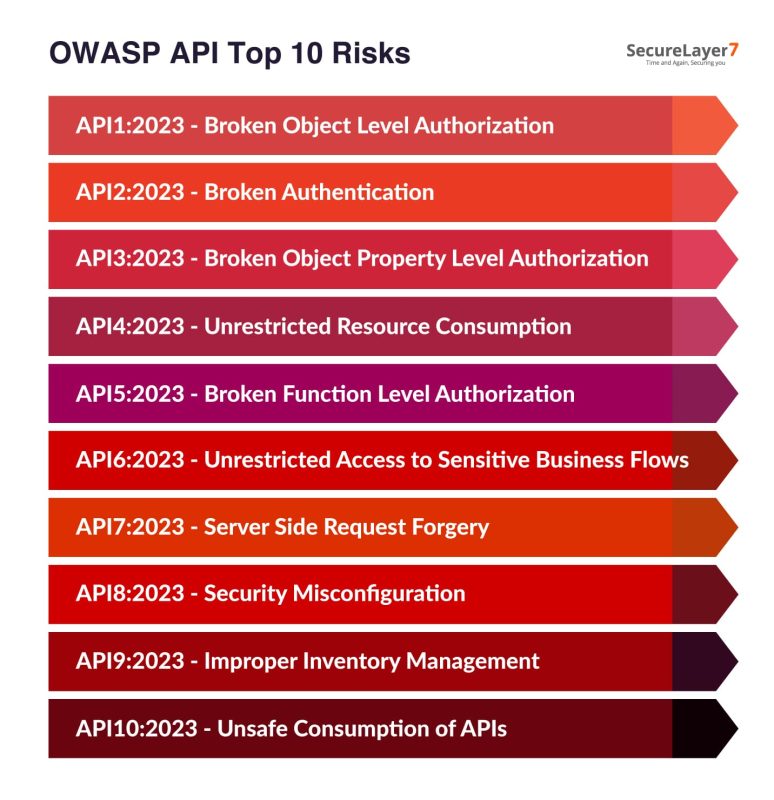
The OWASP API Security Top 10 identifies the most critical vulnerabilities threatening APIs today. Here’s a breakdown of each risk and how to defend against it:
API1:2023: Broken Object Level Authorization
Broken Object Level Authorization (BOLA) occurs when APIs fail to verify whether users should access specific objects. Attackers exploit this vulnerability by manipulating object IDs to view, modify, or delete data they shouldn’t touch.
BOLA risks are common and easy to exploit, which makes them dangerous. The vulnerability is hard to catch during development because it stems from logic flaws. This means traditional security tools will likely miss it.
For example, in 2021, a BOLA flaw in Peloton’s API let users access anyone’s account data by simply changing object IDs. This exposed sensitive data like names, email addresses, and workout statistics.
Learn more about Broken Object Level Authorization (BOLA) in API Security
API2:2023:Broken Authentication
Broken authentication is created when APIs have flawed, misconfigured, or poorly implemented authentication systems. Attackers can exploit these weaknesses to hijack accounts.
Broken authentication can be exploited easily. When successful, attackers gain full account control, making the business impact severe.
The root causes of this vulnerability include weak password policies, lack of brute-force protection, and missing multi-factor authentication (MFA).
You can defend against broken authentication by implementing a strong password framework, secure protocols like OAuth 2.0 and OpenID Connect, and MFA. APIs also need rate limiting to block brute-force attacks and must store and transmit authentication tokens securely.
For example, in 2018, a broken authentication flaw in the US Postal Service API exposed 60 million users’ data. Any authenticated user could inquire account details without proper authorization checks.
Know More About Broken Authentication API Risks and How You Can Prevent It
API3:2023: Broken Object Property Level Authorization
Broken Object Property Level Authorization occurs when APIs fail to enforce access controls on individual object properties. Attackers can exploit this to read or modify sensitive attributes they shouldn’t access.
To defend against BOPLA-related security risks, security teams require fine-grained access controls that validate permissions for each property. Additionally, they should avoid using client binding functions like “to_json() and to_string()” into code variables, internal objects, or object properties.
For example, an ecommerce platform lets sellers manage stores through an API. Due to this vulnerability, the API doesn’t restrict access to specific properties within store objects. A malicious seller could tamper with competitors’ payment settings or view other sellers’ order histories, compromising data integrity and eroding platform trust.
Know More About API Broken Object Property Level Authorization
API4:2023: Unrestricted Resource Consumption
APIs expose resources programmatically, but this also poses security risk. Unrestricted Resource Consumption vulnerabilities allow attackers to overwhelm systems with a large number of requests. This may trigger denial-of-service attacks, exhausting memory, CPU, and storage.
Attackers can launch these attacks from local machines or cloud resources. The vulnerability is relatively easy to exploit and it can spike infrastructure costs significantly for organizations. Rate limiting, request throttling, and resource quotas can help in tackling consumption per user or IP address.
For example, in March 2023, Poland’s online tax filing system suffered a massive DDoS attack that blocked user access. Attackers overwhelmed the platform by exploiting its lack of resource controls, leaving citizens unable to file taxes during a critical period.
Know More About Unrestricted Resource Consumption
API5:2023: Broken Function Level Authorization
Broken Function Level Authorization occurs when APIs fail to properly restrict access to specific functions or endpoints. Even with authentication in place, attackers can exploit missing permission checks to perform unauthorized actions or access sensitive data they shouldn’t reach.
For example, an API allows users to update their profiles but doesn’t verify permissions properly. An attacker changes the user ID in the request and edits another user’s profile without authorization.
The 2018 Cambridge Analytica scandal showed the real-world impact. A quiz app exploited Facebook API’s authorization flaws to collect data from 87 million users without their consent, which was then used for political targeting.
You can prevent this by implementing role-based access control (RBAC). Verify that users have permission to execute specific functions—not just that they’re authenticated.
Understand Broken Function Level Authorization (BFLA)
API6:2023: Unrestricted Access to Sensitive Business Flows
Unrestricted access to sensitive business flows arise from not viewing the full picture of how APIs work together to support business processes. Attackers spend time mapping out how all the moving parts of the system, endpoints, the connections, and data flows from one point to another.
Once they understand the system, they start looking for gaps. Even if security measures are in place, they figure out ways to bypass them.They keep testing boundaries until they find a weak spot.
You can combine strong access controls, data encryption, and least-privilege principles to defend against API6 security risks . Using logging and monitoring can also help catch suspicious patterns early.
For example, scalpers use bots to exploit ticketing platform APIs, instantly purchasing thousands of tickets for high-demand events.
Know More About Unrestricted Access to Sensitive Business Flows
API7:2023: Server-Side Request Forgery (SSRF)
Server-Side Request Forgery (SSRF) occurs when attackers manipulate an API server to send requests to unintended destinations. They trick the server into accessing internal systems, external sites, or other APIs, potentially exposing sensitive data or enabling unauthorized actions.
You can prevent attacks related to SSRF by implementing strict validation of user-supplied URLs, allowlisting trusted domains, and blocking requests to internal IP ranges. Also, disable unnecessary protocols and implement network segmentation to limit APIs access.
For example, in 2020, a researcher found an SSRF flaw in Shopify Exchange’s screenshot feature. By manipulating the URL parameter, attackers gained unauthorized access to internal containers within Shopify’s infrastructure.
Learn More About Server-Side Request Forgery (SSRF)
API 8:2023: Security Misconfiguration
Security Misconfiguration refers to vulnerabilities across the entire API stack ranging from the network to the application level. These include unpatched systems, default credentials, unnecessary services, exposed configuration files, or overly permissive settings. Attackers use automated tools to find and exploit these weaknesses.
Security misconfigurations can expose sensitive data or grant unauthorized access. Because misconfigurations are common and exploits are publicly available, they’re attractive targets for attackers.
You can prevent this through regular security audits, automated configuration scanning, timely patching, and disabling unused features.
For example, NASA’s JIRA dashboard was exposed due to weak access controls, leaking employees’ personal data and confidential project information.
The misconfiguration made internal project management tools publicly accessible, a reminder that even sophisticated organizations can fall victim to basic configuration errors.
Learn More About API Security Misconfigurations
API 9:2023: Improper Inventory Management
Improper inventory control vulnerabilities refer to a scenario when an organization fails to keep its API inventory up-to-date and accurate. This results in the lack of oversight of APIs endpoints,versions, and other assets.
Such risks can be mitigated by establishing a structured and well-organized API inventory list. It includes an all-inclusive list of all the APIs, versions, endpoints, and dependencies associated with documentation. Security teams must keep this inventory current and accurate by conducting regular reviews and updates.
For example, a company struggles owing to the lack of inventory control of its APIs.The lack of a centralized repository and poor API inventory management makes it difficult for security teams to detect and patch vulnerabilities at the same time.
API 10:2023: Unsafe Consumption of APIs
Unsafe API consumption happens when applications fail to check or validate the request receiving from APIs. This can create security problems, such as injection attacks, data leaks, or unauthorized access. To address the issue, developers should verify any input received from users.
Learn About the Risks Associated With Unsafe Consumption of APIs
For example, if an app uses an API but doesn’t validate the data it receives, hackers could insert harmful scripts into the API responses. When the app runs these scripts, it can lead to attacks that compromise user data.
How to Secure Your APIs: Best Practices
Keeping your API safe is critical to ensure safety of digital assets. Here are some tips to improve your API security:
Input Level:
Use Proper HTTP Methods and Status Codes
- Apply the correct HTTP method for each operation: GET (read), POST (create), PUT/PATCH (update), DELETE (remove records).
- Respond with “405 Method Not Allowed” if an unsupported method is requested for a resource.
Enforce Content Negotiation and Validation
- Validate the Accept header and only allow supported response formats (e.g., application/json, application/xml). Respond with 406 Not Acceptable if the request is not matched.
- Check the Content-Type of incoming requests and accept only allowed formats (e.g., application/json, multipart/form-data, application/x-www-form-urlencoded).
Sanitize and Validate User Input
- Validate and sanitize all user inputs without fail to prevent typical vulnerabilities such as XSS, SQL Injection, and Remote Code Execution.
- Implement allowlists for expected input formats rather than relying solely on blocklists, which attackers can bypass.
Protect Sensitive Data
- Never include sensitive data (such as credentials, passwords, tokens, or API keys) in the URL. Instead, use the Authorization header to transmit authentication information securely.
- Implement secure session management and ensure tokens expire after appropriate timeframes.
Employ Strong Data Encryption
- Rely only on server-side encryption for storing and transmitting sensitive data.
- Enforce TLS 1.2 or higher for all API communications and disable outdated protocols like SSL and TLS 1.0/1.1..
Processing:
Ensure Endpoint Authentication
- Ensure each API endpoint is protected by proper authentication to prevent unauthorized access and broken authentication risks.
- Require authentication not just for “main” endpoints, but also for auxiliary and internal APIs, including password reset and admin endpoints.
Use Resource Paths That Don’t Expose User IDs
- Avoid exposing “user-owned” resource identifiers in URLs. Instead, use endpoints like /me/orders for personal resource access rather than /user/654321/orders.
- This helps reduce the risk of information leakage and user enumeration attacks.
Prefer UUIDs Over Auto-Incremented IDs
- Do not use auto-incrementing IDs, as they are predictable and may be exploited for enumeration.
- Use UUIDs for resource identification.
Harden XML and Other Parsers Against Entity Attacks
- Disable entity parsing when processing XML to prevent XML External Entity (XXE) attacks.
- Disable entity expansion on XML, YAML, or other data formats supporting references to avoid exponential “billion laughs”/XML bomb attacks.
Use a CDN for File Uploads
- Route file uploads through a reliable Content Delivery Network (CDN) to reduce direct load on your API servers and protect against DDoS attacks and other threats.
Offload Heavy Workloads via Background Processing
- For large data processing or long-running jobs, use workers and queues to move tasks out of the HTTP request lifecycle, improving response times and reducing the risk of HTTP blocking.
- Respond quickly with a pending or accepted status, and process in background.
Turn Off Debug Mode in Production
- Always ensure that debug mode is disabled in production deployments to prevent the accidental exposure of stack traces, environment variables, or sensitive configuration details.
- Implement proper error handling that logs detailed errors internally while returning generic error messages to API consumers.
CI & CD:
- Audit your design and implementation with comprehensive unit and integration test coverage.
- Use a formal code review process—never allow self-approval of your own changes.
- Continuously perform automated security tests, both static and dynamic, on your codebase.
- Regularly check your software and OS dependencies for known vulnerabilities.
Conclusion
APIs power modern day applications allowing companies to deliver services seamlessly to meet customer expectations. Therefore, it’s important to keep in mind the security issues associated with them.
Ignoring API security can be dangerous. If you are looking to protect your assets, SecureLayer7 can help improve your security posture by timely discovery and remediation. Get in touch with us to learn more about how we can help.
Frequently Asked Questions (FAQs)
The OWASP API Top 10 focuses on API-specific risks such as object-level authorization, excessive data exposure, and business logic abuse, which traditional web security models often overlook.
Authorization flaws like BOLA and BFLA are most exploited, as APIs often expose predictable object identifiers and insufficient permission checks, allowing attackers to access or manipulate data at scale.
Automated tools help identify technical flaws, but many API risks involve business logic and authorization context, which require manual testing, threat modeling, and human understanding of workflows.