


Cyber threats such as ransomware, phishing, and data breaches continue to evolve, exposing organizations to financial, operational, and reputational risks. A single vulnerability – like an unpatched server or weak access control – can disrupt business operations and lead to severe regulatory and compliance consequences.
Information Security Risk Management (ISRM) offers a structured, proactive approach to identifying, assessing, and mitigating these risks before they escalate. It transforms cybersecurity from a reactive defense into a strategic function that safeguards critical assets, ensures regulatory compliance, and strengthens overall resilience.
Importance of ISRM in the evolving cybersecurity landscape
The cybersecurity landscape is evolving at an unprecedented pace, driven by new attack vectors emerging from cloud computing, remote work environments, AI-driven threats, and complex supply chain ecosystems. Traditional perimeter-based defenses are no longer enough to protect sensitive data in this interconnected digital era.
Information Security Risk Management (ISRM) has become indispensable in this context, enabling organizations to adopt a proactive, risk-based approach to cybersecurity. It facilitates continuous monitoring of digital assets, anticipates vulnerabilities before they escalate into incidents, and ensures adherence to compliance standards such as GDPR, HIPAA, and ISO 27001.
Real-World Example: Why ISRM Matters
In 2023, a leading healthcare provider experienced a significant data breach due to an unpatched server – an oversight that exposed thousands of patient records and resulted in heavy regulatory penalties. The failure wasn’t caused by a lack of cybersecurity tools but by the absence of a structured risk management framework.
A proactive Information Security Risk Management (ISRM) approach would have incorporated regular vulnerability assessments, timely patch management, and risk prioritization – measures that could have prevented the breach entirely. This incident underscores how ISRM forms the foundation of a resilient cybersecurity strategy, ensuring that potential risks are systematically identified, evaluated, and mitigated before they escalate into costly and reputation-damaging incidents.
Quick Preview of What Readers Will Learn (Frameworks, Benefits, Best Practices)
Gain a comprehensive understanding of how Information Security Risk Management (ISRM) strengthens cybersecurity posture and supports long-term business resilience.
- Frameworks and Standards: Explore globally recognized ISRM frameworks such as ISO/IEC 27005, NIST SP 800-30, and the FAIR model, and understand how each guides risk identification, assessment, and mitigation.
- Core Benefits: Discover how ISRM safeguards business continuity, ensures regulatory compliance, and enhances decision-making by transforming cybersecurity from a reactive function into a proactive, strategic discipline.
- Best Practices: Learn practical steps to implement ISRM effectively – from establishing policies and governance to leveraging automation, analytics, and AI-driven insights for predictive risk management.
What Is Information Security Risk Management?
Information Security Risk Management (ISRM) is the structured process of identifying, assessing, and mitigating risks that could compromise an organization’s data, systems, or digital infrastructure. It ensures that security efforts are aligned with business objectives by evaluating potential threats – such as cyberattacks, human errors, or system failures – and determining their likelihood and impact. Rather than reacting to incidents,
Definition and Scope of ISRM
The primary goal of ISRM is to ensure that risks are managed in alignment with business objectives – not merely to eliminate them, but to reduce them to an acceptable level. It involves continuous assessment, policy enforcement, and adaptation to new threats as the organization’s technology landscape evolves.
The scope of ISRM extends beyond IT systems. It covers:
- Confidentiality: Protecting sensitive data from unauthorized access.
- Integrity: Ensuring data accuracy and reliability.
- Availability: Guaranteeing that systems and data remain accessible to authorized users when needed.
Difference Between Information Security and Cybersecurity
Although the terms information security and cybersecurity are often used interchangeably, they differ in focus and scope:
| Aspect | Information Security | Cybersecurity |
| Scope | Protects all forms of information (digital and physical) | Focuses mainly on protecting digital data and networks |
| Objective | Ensures confidentiality, integrity, and availability of information | Prevents unauthorized digital access, attacks, and breaches |
| Examples | Securing paper records, implementing access control policies, and employee training | Deploying firewalls, intrusion detection systems, and malware defenses |
| Coverage | Broader – includes data governance, risk policies, and physical security | Narrower – focuses on technical controls and network protection |
Components of ISRM: People, Process, and Technology
A strong ISRM framework rests on three foundational pillars – people, process, and technology. Each plays a critical role in minimizing security risks and ensuring organizational resilience.
- People: Employees are often the first line of defense – and sometimes the weakest link. ISRM emphasizes user awareness, training, and role-based access control.
- Process: Well-defined policies and procedures form the backbone of ISRM. This includes risk assessment workflows, incident response plans, change management, and compliance monitoring.
- Technology: Tools and systems enable the automation and enforcement of security controls. This covers encryption, intrusion detection, vulnerability scanning, access management, and continuous monitoring solutions.
Why Information Security Risk Management Matters
Information Security Risk Management (ISRM) helps organizations stay ahead by identifying vulnerabilities, assessing their impact, and implementing proactive controls. A strong ISRM framework protects business continuity, ensures regulatory compliance, and safeguards reputation.
Real-World Examples of Data Breaches Caused by Weak Risk Management
Organizations across industries have learned the hard way that weak or non-existent risk management can lead to catastrophic consequences.
- Equifax Breach (2017): A missed security patch in an open-source web application led to one of the largest breaches in history, exposing the personal data of over 147 million users.
- Target Breach (2013): Attackers infiltrated Target’s network through a third-party HVAC vendor with poor access controls. This led to the theft of over 40 million credit and debit card numbers.
How ISRM Protects Business Continuity, Compliance, and Reputation
A well-implemented ISRM framework safeguards the core pillars of an organization’s success: operational continuity, compliance, and reputation.
- Business Continuity: ISRM identifies critical business assets and defines recovery strategies, ensuring minimal disruption in the event of a cyberattack or system failure.
- Regulatory Compliance: With tightening regulations such as GDPR, HIPAA, and ISO 27001, ISRM ensures that risk management practices are aligned with compliance requirements.
- Reputation: Reputation is everything. A single data breach can severely damage customer confidence and brand loyalty. ISRM strengthens incident response and communication protocols, demonstrating transparency and reliability – essential traits for long-term brand reputation.
The Financial and Operational Impact of Unmanaged Security Risks
Failing to manage information security risks can result in substantial financial and operational losses that go far beyond the immediate aftermath of a breach.
- Financial Losses: According to IBM’s Cost of a Data Breach Report 2024, the average cost of a data breach rose to USD 4.88 million globally. These expenses include detection, containment, regulatory fines, and reputational damage.
- Operational Disruption: Cyber incidents can halt production lines, delay service delivery, and interrupt critical business processes. Recovery time can range from days to months, depending on the scale of the breach – leading to lost productivity and customer dissatisfaction.
- Strategic Consequences: Beyond immediate financial damage, unmanaged security risks can erode investor confidence, impact stock prices, and reduce company valuation during mergers or acquisitions.
The Core Stages of Infosec Risk Assessment
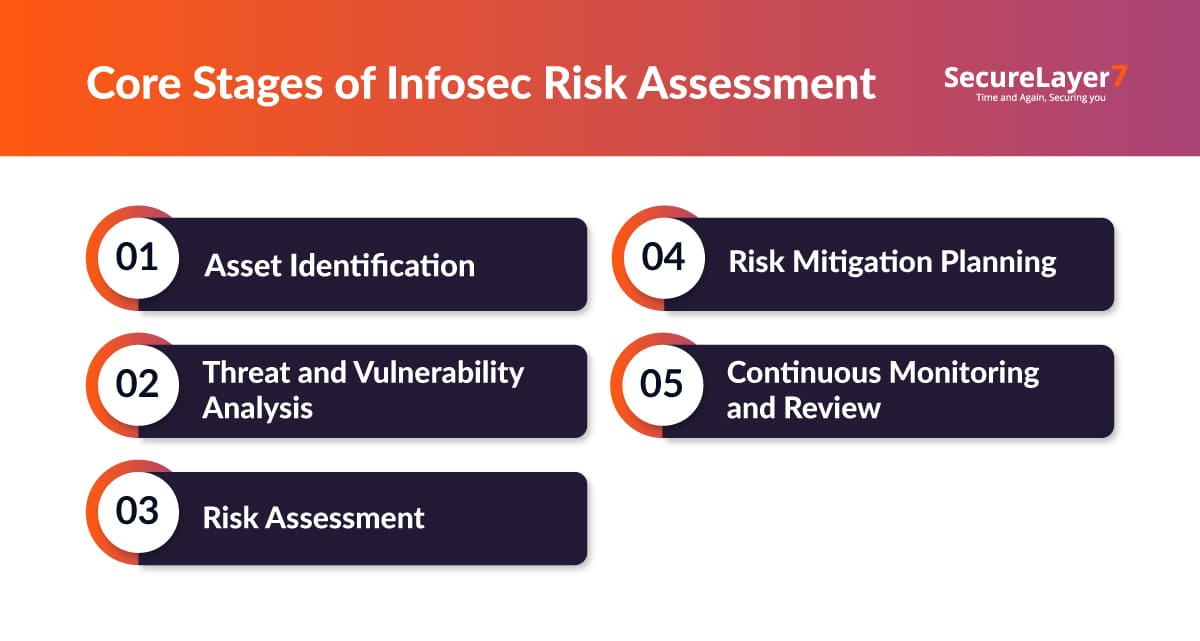
A well-structured Information Security Risk Management (ISRM) process begins with a thorough infosec risk assessment. This assessment helps organizations identify, evaluate, and mitigate risks that threaten the confidentiality, integrity, and availability of information assets. It’s not a one-time activity but an ongoing cycle that adapts to evolving threats and technologies.
Asset Identification – Determining Critical Information Assets
The first step in any risk assessment is to identify what needs protection. Organizations must create a comprehensive inventory of all information assets.
For a deeper understanding of how asset visibility impacts risk posture, explore What is a Network Security Assessment?
- Data (customer records, intellectual property, financial details)
- Hardware and software systems
- Cloud services and databases
- Business processes dependent on digital systems
Threat and Vulnerability Analysis – Mapping Potential Security Threats
Once assets are identified, the next step is to understand what could endanger them. To understand how vulnerabilities are scored and prioritized across industries, read our in-depth guide on the Common Vulnerability Scoring System (CVSS).
- Threats refer to any event or actor (internal or external) that could exploit a weakness – such as cybercriminals, insider misuse, or system failures.
- Vulnerabilities are the weaknesses or gaps in controls that could be exploited by threats – like outdated software, misconfigured servers, or weak passwords.
Risk Assessment – Measuring Risk Likelihood and Impact
After identifying vulnerabilities and threats, organizations must quantify the level of risk associated with each. This involves analyzing two key factors:
- Likelihood: How probable it is that a threat will exploit a vulnerability.
- Impact: The potential damage to confidentiality, integrity, and availability if the event occurs.
Risk Mitigation Planning – Implementing Controls and Safeguards
Once risks are assessed, organizations must decide how to respond. The goal isn’t always to eliminate risks – rather, it’s to reduce them to acceptable levels. Following are four main mitigation strategies:
- Avoid: Eliminate the source of the risk (e.g., discontinue an insecure system).
- Reduce: Apply security controls such as encryption, MFA, firewalls, or employee training.
- Transfer: Shift responsibility to third parties (e.g., cybersecurity insurance, outsourcing).
- Accept: Acknowledge and monitor low-impact risks that fall within tolerance levels.
Examples of Risk Mitigation Controls:
- Technical controls: Patch management, network segmentation, intrusion detection systems (IDS).
- Administrative controls: Security policies, change management, and incident response planning.
- Physical controls: Secure access points, CCTV, and restricted facility zones.
Continuous Monitoring and Review – Tracking evolving threats
Cyber threats evolve daily, which makes continuous monitoring a critical final stage of the risk assessment lifecycle. Once mitigation controls are in place, organizations must verify their ongoing effectiveness.
Continuous monitoring involves:
- Regular vulnerability scans and security audits to identify new exposures.
- Security Information and Event Management (SIEM) systems to detect anomalies in real time.
- Periodic policy reviews to ensure alignment with updated regulations or business processes.
- Incident post-mortems and lessons learned to refine the overall ISRM framework.
Common Frameworks and Standards in ISRM
To implement Information Security Risk Management (ISRM) effectively, organizations often rely on established frameworks and international standards. These frameworks provide structured methodologies for identifying, analyzing, and mitigating risks. While each has a unique approach, they all aim to help businesses strengthen security posture, ensure compliance, and make informed decisions.
Below are three of the most widely recognized and trusted ISRM frameworks.
ISO/IEC 27005 – Information Security Risk Management Standard
ISO/IEC 27005 is part of the globally recognized ISO/IEC 27000 family of standards for information security management. It provides detailed guidance on establishing a systematic approach to risk management in alignment with ISO 27001, which defines requirements for an Information Security Management System (ISMS).
Key Highlights:
- Emphasizes a continuous improvement cycle.
- Focuses on protecting the confidentiality, integrity, and availability of information assets.
- Defines a flexible process adaptable to different organizational sizes and industries.
- Encourages documentation, accountability, and ongoing monitoring of risk treatment actions.
NIST SP 800-30 – Guide for Conducting Risk Assessments
Developed by the National Institute of Standards and Technology (NIST), Special Publication 800-30 offers a comprehensive methodology for assessing and managing information security risks. It’s widely adopted by both government and private sectors, especially in the U.S.
Key Highlights:
- A step-by-step risk assessment process: prepare, conduct, communicate results, and maintain.
- Provides detailed methods for evaluating threat sources, vulnerabilities, likelihood, and impact.
- Supports both qualitative and quantitative risk assessments.
- Integrates with other NIST publications, such as SP 800-37 (Risk Management Framework) and SP 800-53 (Security Controls).
FAIR Model – Quantitative Risk Assessment Approach
The FAIR (Factor Analysis of Information Risk) model provides a quantitative framework for analyzing and measuring information security risks in financial terms. Unlike qualitative methods that rely on subjective scales, FAIR translates risk into monetary values, making it especially useful for executive decision-making.
Key Highlights:
- Measures risk using probability and financial impact metrics.
- Enables organizations to compare risks based on potential financial loss.
- Supports informed budgeting and prioritization of security initiatives.
- Complements rather than replaces traditional frameworks like ISO 27005 or NIST 800-30.
Comparison Table: Framework vs. Key Benefit vs. Use Case
| Framework | Key Benefit | Typical Use Case |
| ISO/IEC 27005 | Provides a structured, globally recognized process aligned with ISO 27001. | Ideal for organizations seeking ISO certification or building a formal ISMS. |
| NIST SP 800-30 | Offers detailed, step-by-step risk assessment guidance and integrates with broader NIST controls. | Commonly used by U.S. federal agencies and enterprises adopting the NIST RMF. |
| FAIR Model | Quantifies risks in financial terms, helping justify cybersecurity investments. | Suited for executives and risk analysts seeking data-driven, financial-based risk decisions. |
Building an Effective Information Security Risk Management Program
Developing a successful Information Security Risk Management (ISRM) program requires more than just frameworks and compliance checklists. It demands a cohesive strategy that aligns people, processes, and technology to identify, assess, and mitigate security risks continuously. A mature ISRM program integrates seamlessly with business objectives, ensuring that security becomes a business enabler rather than a constraint.
Following are the essential components and best practices for building a sustainable and effective ISRM program.
Steps to Establish a Structured ISRM Policy
A well-defined ISRM policy provides the foundation for consistent, organization-wide risk management practices. Establishing such a policy involves the following key steps:
- Define the Purpose and Scope: Clearly outline the objectives of ISRM – what assets it covers, which departments are responsible, and how risks are categorized and prioritized.
- Develop a Governance Structure: Assign roles and responsibilities. Typically, this includes the Chief Information Security Officer (CISO), Risk Management Committee, and departmental security leads.
- Identify and Classify Assets: Create an inventory of critical data, systems, applications, and third-party services, classifying them by sensitivity and business impact.
- Establish a Risk Assessment Framework: Adopt standardized methodologies (like ISO 27005, NIST 800-30, or FAIR) to identify threats, vulnerabilities, and corresponding mitigation strategies.
- Implement Risk Treatment and Reporting: Define how identified risks will be managed – through mitigation, transfer, acceptance, or avoidance – and set up reporting channels for risk visibility.
- Ensure Policy Review and Updates: Schedule periodic reviews to ensure the policy remains aligned with evolving business goals, technology changes, and regulatory updates.
Role of Leadership, Governance, and Employee Awareness
Leadership commitment and governance are crucial to making ISRM successful. Without executive sponsorship, even the most sophisticated risk tools or frameworks may fail to deliver long-term value.
- Leadership’s Role: Executives and board members must set the tone from the top by defining risk tolerance levels, allocating budgets, and ensuring alignment with enterprise strategy.
- Governance Mechanisms: Establish governance through Information Security Steering Committees or Risk Councils that review ongoing risk assessments, approve mitigation plans, and oversee compliance efforts.
- Employee Awareness: Human error remains a leading cause of breaches. Regular security awareness training – covering phishing, password hygiene, and incident reporting – turns employees into a first line of defense.
Integration with Enterprise Risk Management (ERM)
To achieve full organizational resilience, ISRM should not function in isolation. Instead, it should integrate seamlessly with Enterprise Risk Management (ERM) – the overarching framework that addresses strategic, operational, financial, and compliance risks.
Benefits of Integration:
- Holistic View of Risk: Aligns cybersecurity risks with broader business objectives.
- Improved Decision-Making: Helps executives understand how information security risks influence financial and reputational outcomes.
- Resource Optimization: Prevents duplicate efforts between IT and corporate risk teams, ensuring a unified response to potential threats.
- Compliance Synergy: Facilitates consistency across regulatory frameworks like SOX, GDPR, and HIPAA.
Use of Automation and Analytics Tools in ISRM
As threat landscapes grow in complexity, manual risk management processes are no longer sufficient. Automation and analytics play a key role in enhancing efficiency, accuracy, and scalability within ISRM programs.
Key Advantages of Automation and Analytics:
- Real-Time Risk Detection: Tools like Security Information and Event Management (SIEM) and Extended Detection and Response (XDR) platforms detect and alert on anomalies instantly.
- Automated Risk Scoring: AI-driven platforms can assess vulnerabilities, assign severity scores, and recommend mitigation steps automatically.
- Centralized Dashboards: Analytics-driven dashboards provide visual insights into risk trends, compliance metrics, and remediation status across departments.
- Predictive Insights: Machine learning models can forecast potential threats based on historical data and global threat intelligence feeds.
Challenges and Best Practices in Infosec Risk Assessment
Even with mature frameworks and advanced tools, organizations often face several challenges when implementing information security risk assessments. Understanding these obstacles and knowing how to overcome them – is key to maintaining an effective and resilient Information Security Risk Management (ISRM) program.
Challenges:
Despite its importance, implementing effective Information Security Risk Management (ISRM) comes with several challenges:
- Data Silos and Incomplete Asset Visibility: Many organizations struggle to maintain a centralized view of all digital assets, making it difficult to identify and assess risks accurately.
- Rapidly Changing Threat Landscape: New vulnerabilities and attack techniques emerge daily, making it hard for traditional risk assessment methods to stay current.
- Resource Constraints: Limited budgets, tools, or skilled personnel often hinder the ability to perform continuous monitoring and timely risk mitigation.
Best Practices:
To overcome common challenges and strengthen your Information Security Risk Management (ISRM) program, organizations should follow these proven best practices:
- Regular Audits and Vulnerability Scans: Conduct periodic security audits and automated vulnerability scans to identify and address weaknesses before they can be exploited.
- Use of Real-Time Threat Intelligence: Integrate live threat intelligence feeds and analytics tools to stay updated on emerging risks and evolving attack patterns.
- Collaboration Between IT, Compliance, and Business Teams: Foster cross-functional cooperation to align security goals with business objectives, ensuring risks are prioritized based on overall organizational impact.
How Modern Tools Simplify Risk Management
Managing information security risks manually can be time-consuming, error-prone, and reactive. Modern automation platforms and analytics tools now empower organizations to perform continuous, data-driven risk management that scales with business growth.
Solutions like Rapid7, SecurityScorecard, Tenable, and Qualys have transformed how teams detect, assess, and mitigate risks in real time. Below is an overview of how these tools streamline key aspects of the Information Security Risk Management (ISRM) process.
Overview of How Automation Platforms Assist with Risk Management
Modern automation platforms such as Rapid7, SecurityScorecard, Tenable, and Qualys simplify and accelerate the Information Security Risk Management (ISRM) process. They provide real-time visibility, actionable insights, and automated workflows that help security teams detect, assess, and mitigate threats more efficiently.
Continuous Monitoring
Continuous monitoring is the cornerstone of modern ISRM. Instead of conducting risk assessments once or twice a year, automated tools enable real-time tracking of vulnerabilities, configuration changes, and suspicious behavior across all assets.
- Rapid7 InsightVM and Tenable.io scan networks, endpoints, and cloud environments continuously, alerting teams whenever new threats or misconfigurations appear.
- SecurityScorecard provides external monitoring of an organization’s digital footprint, highlighting weaknesses like exposed ports or outdated certificates.
Risk Scoring and Reporting
Automation tools simplify complex security data into actionable risk scores. They analyze vulnerabilities, assign severity ratings, and calculate the overall risk posture based on exploitability and asset criticality.
- Rapid7 uses context-based risk scoring to highlight which vulnerabilities pose the greatest business threat.
- SecurityScorecard assigns a letter grade (A-F) across categories like network security, DNS health, and endpoint security, making it easy for executives to understand the organization’s risk exposure at a glance.
Compliance alignment (GDPR, HIPAA, ISO 27001)
Staying compliant with regulatory frameworks such as GDPR, HIPAA, and ISO 27001 is a critical part of ISRM. Modern tools integrate compliance management directly into their platforms, helping organizations map risks to required controls. For more understanding ISO alignment, check out ISO 27001 Implementation Checklist.
- Qualys Cloud Platform and Rapid7 InsightIDR offer built-in policy templates that align with multiple regulatory frameworks, ensuring that each detected vulnerability is linked to a specific compliance requirement.
- Automated compliance dashboards display audit readiness in real time and provide downloadable evidence reports for auditors.
- These solutions also track remediation progress and send alerts for non-compliant assets.
The Role of AI and Machine Learning in Predictive Risk Management
Artificial Intelligence (AI) and Machine Learning (ML) have introduced a predictive dimension to ISRM. Instead of responding after an incident, AI/ML systems analyze patterns across massive datasets to forecast and prevent security events.
- Anomaly Detection: ML algorithms learn normal network and user behavior, flagging deviations that could indicate insider threats or compromised accounts.
- Exploit Prediction: AI models evaluate vulnerability data and predict which ones are most likely to be exploited based on historical threat patterns.
- Automated Response: Integrated SOAR (Security Orchestration, Automation, and Response) solutions can isolate infected systems or block malicious IPs automatically.
- Contextual Analysis: AI correlates alerts from diverse sources – endpoints, firewalls, and cloud logs – to provide a unified view of the organization’s security health.
Conclusion
As cyber threats grow more advanced and unpredictable, maintaining continuous information security risk management is vital for every organization. A proactive ISRM approach not only reduces vulnerabilities and regulatory risks but also ensures uninterrupted operations and customer confidence. By integrating structured frameworks, automation, and AI-driven insights, businesses can transform cybersecurity from a reactive function into a strategic enabler of growth and resilience.
SecureLayer7 helps organizations achieve this transformation through comprehensive risk assessments, penetration testing, and continuous monitoring solutions tailored to your environment. With our expertise, you can build a smarter, stronger, and compliance-ready defense against emerging threats.
Partner with SecureLayer7 to elevate your risk management framework and stay one step ahead of cyber threats.
Frequently Asked Questions (FAQs)
The primary goal of Information Security Risk Management (ISRM) is to identify, evaluate, and reduce risks that could compromise the confidentiality, integrity, or availability of an organization’s information assets. It ensures that security measures align with business objectives, helping organizations maintain operational continuity and regulatory compliance while minimizing potential financial and reputational damage.
An Infosec Risk Assessment should be performed at least once a year or whenever there are significant changes in the IT environment – such as system upgrades, new software deployments, mergers, or regulatory updates. Continuous monitoring and periodic reassessments ensure that emerging threats and vulnerabilities are promptly addressed.
• A Vulnerability Assessment focuses on identifying and cataloging system weaknesses – such as unpatched software, misconfigurations, or insecure network ports.
• A Risk Assessment, on the other hand, goes a step further by evaluating how likely these vulnerabilities are to be exploited and the potential impact on the organization.
The most widely recognized frameworks for Information Security Risk Management include:
• ISO/IEC 27005: Offers a structured, globally accepted approach aligned with ISO 27001.
• NIST SP 800-30: Provides detailed guidance for conducting risk assessments and managing security controls.
• FAIR Model: Uses quantitative methods to express risk in financial terms for better business decision-making.
Automation tools like Rapid7, SecurityScorecard, and Qualys streamline the ISRM process by providing continuous monitoring, automated risk scoring, and compliance tracking. They help detect vulnerabilities faster, generate real-time reports, and align security controls with frameworks such as GDPR, HIPAA, and ISO 27001.