
Penetration testing is a critical component of modern cybersecurity, helping organizations identify and address vulnerabilities before attackers can exploit them. Manual penetration testing relies on the expertise, intuition, and creativity of skilled security professionals to simulate real-world attacks, autonomous penetration testing leverages advanced tools and automation to continuously scan and test systems for weaknesses without human intervention.
Understanding the key differences between these approaches is essential for choosing the right strategy based on your organization’s environment, resources, and security objectives. Manual testing offers deep, context-driven insights for complex or customized systems, Autonomous testing provides speed, scalability, and consistent coverage, particularly suited for standard or rapidly evolving infrastructures.
Penetration Testing in Modern Cybersecurity
Penetration testing, often called pen testing, is a simulated cyberattack on an organization’s systems designed to identify vulnerabilities before malicious actors can exploit them. In today’s rapidly evolving digital landscape, pen testing is critical for safeguarding sensitive data, protecting critical infrastructure, and ensuring regulatory compliance.
Organizations use penetration testing to proactively assess security controls, measure resilience against real-world attacks, and prioritize remediation efforts. By revealing potential attack paths and demonstrating the impact of vulnerabilities, pen testing helps security teams implement targeted defenses and strengthen their overall cybersecurity posture.
To understand the fundamentals of penetration testing and how it works in real-world scenarios, refer to the Steps in penetration testing process.
Understanding Manual vs Autonomous Testing
Manual and autonomous penetration testing serve distinct purposes, and confusing the two can lead to security gaps and unrealistic expectations. Manual testing provides deep, context-aware analysis driven by human expertise, while autonomous testing delivers speed, scale, and continuous visibility.
A clear distinction between these approaches enables better decisions around cost, prioritization, and remediation. Autonomous testing helps surface widespread and emerging issues quickly, while manual testing validates exploitability and business impact for critical systems.
Set Expectations: Different Purposes, Not Competitors
Manual and autonomous penetration testing are often compared as competing approaches, but they are designed to serve different purposes. Autonomous testing focuses on speed, scale, and continuous coverage, helping teams quickly identify exposure across large and changing environments. Manual testing, in contrast, delivers depth, creativity, and context, uncovering complex attack paths and assessing real business impact.
Setting the right expectations is critical. Autonomous testing is not meant to replace skilled human testers, and manual testing is not built for continuous, large-scale validation. When understood as complementary rather than competitive, both approaches work together to provide faster detection, deeper insight, and a more effective overall security posture.
What is Manual Penetration Testing?
Manual penetration testing is a human-driven security assessment where skilled security professionals actively attempt to identify and exploit vulnerabilities within a defined scope. Instead of relying on predefined scans or automated logic, testers use experience, intuition, and real-world attacker techniques to evaluate how systems, applications, and workflows can be compromised.
Manual penetration testing emphasizes real-world attack behavior by actively attempting exploitation rather than relying on theoretical findings. It uncovers complex logic flaws, evaluates how weaknesses can be combined, and helps assess the actual impact on systems and business operations.
Human-Driven Nature
Human-driven nature allows manual penetration testing to adapt in real time, think creatively, and explore non-obvious attack paths. Testers can understand context, interpret system behavior, and assess business impact – capabilities that are difficult to replicate through automated or autonomous tools alone.
Core Strengths: Creativity, Intuition, Context-Aware Testing
Manual penetration testing stands out for its ability to apply creativity, intuition, and context-aware analysis. Human testers can think like real attackers, experimenting with unconventional techniques and chaining vulnerabilities in ways that automated systems often miss. This creative approach is especially effective for uncovering complex flaws that do not follow predictable patterns.
Intuition and contextual understanding further strengthen manual testing. Experienced testers can interpret subtle system behaviors, understand business logic, and adjust their approach based on real-time findings.
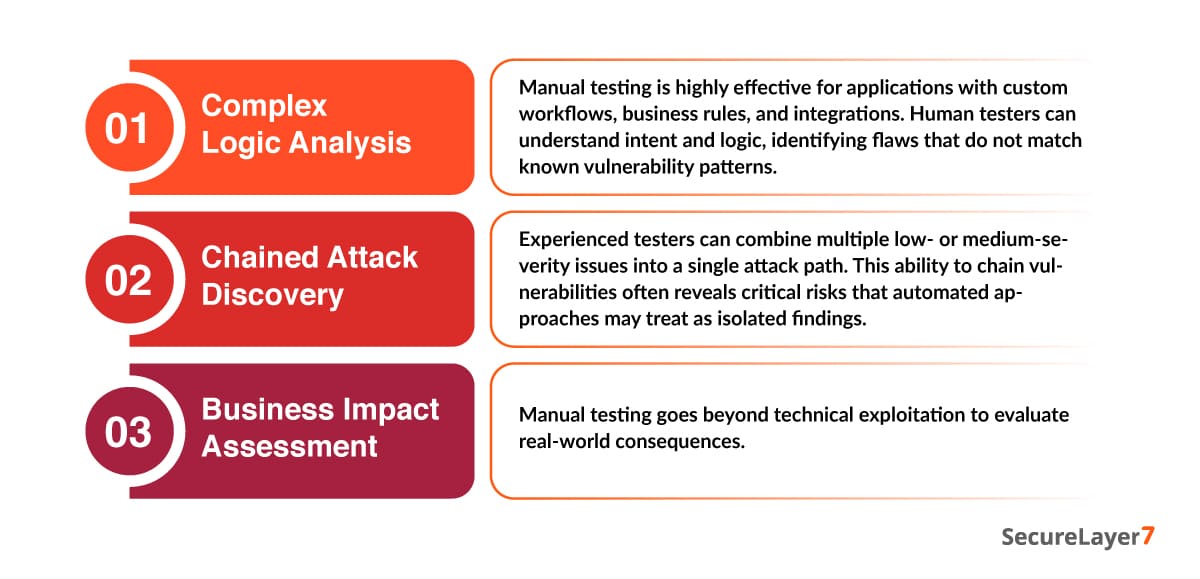
Manual Testing: Complex Logic, Chained Attacks, Business Impact Assessment
What is Autonomous Penetration Testing?
Autonomous penetration testing is an advanced approach to security testing where intelligent systems independently discover, validate, and explore vulnerabilities across an organization’s digital environment. Unlike traditional tools that rely only on predefined checks, autonomous penetration testing is designed to simulate real attacker behavior, dynamically adapting its actions based on what it uncovers during execution.
The primary objective is not just to identify vulnerabilities, but to understand real-world risk – how an attacker could exploit weaknesses, move through systems, and potentially impact critical assets. This outcome-driven approach makes autonomous penetration testing especially relevant for modern, fast-changing infrastructures.
High-Level Definition of Autonomous Penetration Testing
Autonomous penetration testing is a security testing approach in which intelligent systems independently identify, validate, and explore vulnerabilities across an organization’s environment with minimal human involvement.
At a high level, autonomous penetration testing focuses on achieving security outcomes – such as identifying exploitable attack paths or validating access – Operating within approved scopes and controls. This makes it well suited for fast, large-scale, and continuously changing environments where frequent testing is required.
Automated vs Autonomous Penetration Testing: A Clear Distinction
Automated and autonomous penetration testing are often confused, but they differ significantly in purpose and capability. Automated penetration testing relies on predefined rules, scripts, and signatures to scan for known vulnerabilities. Tools execute specific checks, generate findings, and stop once the programmed tasks are completed, without adapting their behavior based on results.
Autonomous penetration testing goes beyond automation by being adaptive and outcome-driven. Instead of following a fixed checklist, autonomous systems analyze results in real time and decide the next steps – such as attempting alternative attack paths, validating exploitability, or progressing deeper within the environment.
Key Strengths: Speed, Scalability, and Continuous Coverage
Autonomous penetration testing delivers speed, scalability, and continuous visibility, making it well suited for today’s rapidly changing IT environments where manual efforts alone cannot keep pace.
- Speed: Autonomous penetration testing enables rapid security assessments by automatically discovering and validating vulnerabilities in a short time frame.
- Scalability: Autonomous testing can assess hundreds or thousands of assets simultaneously, including applications, cloud resources, and network components. This makes it well suited for large, distributed.
- Continuous Coverage: Unlike periodic testing, autonomous penetration testing supports frequent or continuous execution.
Use Cases for Autonomous Penetration Testing
Autonomous penetration testing is best suited for scenarios where speed, scale, and consistency are essential. Common use cases include:
- Rapid Security Assessments: Ideal for quick evaluations during development cycles or before releases, providing fast feedback without delaying delivery timelines.
- Large and Distributed Environments: Effective for organizations with extensive cloud, hybrid, or multi-account infrastructures where manual testing alone is not practical.
- Frequent Testing Requirements: Well, suited for environments with regular configuration changes, updates, or deployments that require repeated validation.
- Baseline Security Validation: Useful for maintaining an ongoing view of an organization’s security posture between manual penetration tests.
Key Differences Between Manual and Autonomous Penetration Testing
Manual and autonomous penetration testing differ in how they assess risk and the value they provide. Autonomous testing emphasizes speed, scale, and continuous coverage, while manual testing relies on human expertise to deliver deeper analysis and contextual insight. Understanding these differences is key to applying each approach effectively.
Execution Model: Autonomous Systems vs Human Expertise
Autonomous and manual penetration testing differ fundamentally in how testing is executed. Autonomous systems operate independently within a defined scope, using intelligent logic to discover vulnerabilities, evaluate results, and determine next steps without human involvement during execution.
Human expertise drives manual penetration testing. Skilled security professionals actively guide the testing process, making real-time decisions based on context, experience, and intuition. Human testers can adapt strategies, explore unconventional attack paths, and interpret findings through a business lens – capabilities that remain difficult for autonomous systems to fully replicate.
Speed and Flexibility vs Depth and Creativity
Autonomous penetration testing excels in speed and flexibility, allowing organizations to assess environments quickly and adapt to frequent changes. It can test multiple assets in parallel, adjust to configuration updates, and provide rapid feedback, making it well suited for fast-moving development and cloud-based environments.
Manual penetration testing, in contrast, focuses on depth and creativity. Human testers can think beyond standard attack patterns, explore complex logic flaws, and creatively chain vulnerabilities to uncover deeper risks. This depth of analysis is especially valuable for critical systems where understanding real-world impact matters more than speed alone.
Rule-Based Outcomes vs Adaptive Thinking
Autonomous penetration testing operates with rule-based outcomes, where intelligent systems follow predefined goals, constraints, and logic to identify and validate security issues. While these systems can adapt within their programmed boundaries, their decisions are ultimately guided by established rules and objectives to ensure consistency and control.
Manual penetration testing relies on adaptive thinking driven by human experience and intuition. Testers can recognize subtle anomalies, change tactics on the fly, and pursue unconventional attack paths that fall outside predefined rules.
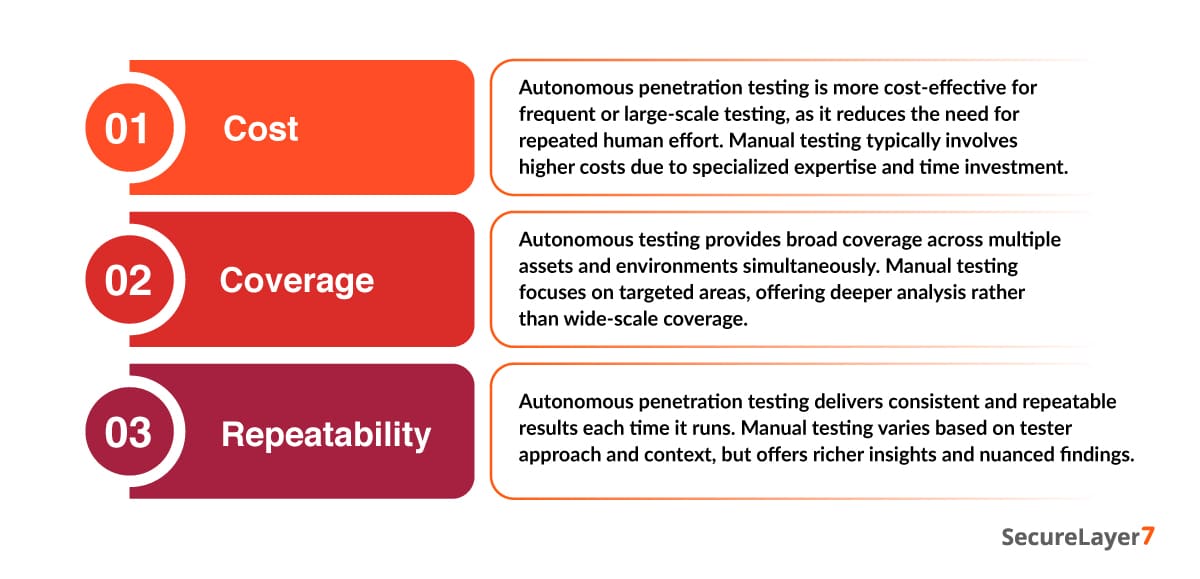
Cost, Coverage, and Repeatability Considerations
When to Choose Manual vs Autonomous Penetration Testing
Manual penetration testing is best suited for critical systems, complex workflows, and scenarios that require deep analysis and human judgment. Autonomous penetration testing complements this by providing continuous, large-scale, and fast assessments. Using both together delivers balanced coverage and deeper security insight.
When Manual Penetration Testing is the Better Choice
Manual penetration testing is the preferred option when depth, context, and human judgment are critical. It is especially valuable for high-impact assets and environments with complex logic or custom workflows.
Manual testing is typically chosen for:
- Critical systems and sensitive data where business impact must be fully understood
- Complex applications with custom logic, integrations, or workflows
- Scenarios requiring creative attack chaining and non-obvious exploitation paths
- Regulatory or compliance-driven assessments that demand expert validation
When Autonomous Penetration Testing Makes Sense
Autonomous penetration testing is best suited for scenarios that require continuous, large-scale, and fast feedback. It is particularly effective in environments where infrastructure changes frequently and security teams need rapid visibility into new risks.
Organizations often choose autonomous testing when they need:
- Continuous security validation across cloud, hybrid, or multi-environment setups
- Large-scale coverage where manual testing would be time-consuming or resource-intensive
- Fast feedback loops to support DevOps and CI/CD pipelines
- Regular assessments to maintain a baseline security posture
How to Decide: Practical Guidance
Deciding between autonomous and manual penetration testing starts with understanding your security environment, system complexity, and testing frequency. Autonomous testing is a practical choice for maintaining continuous visibility across large or rapidly changing environments.
The most effective approach is not choosing one over the other, but using both strategically. Autonomous testing provides ongoing baseline coverage and early detection, while manual testing is applied selectively for validation and deeper analysis.
How Manual and Autonomous Pen Testing Work Together
Manual and autonomous penetration testing address different aspects of security. Autonomous testing provides speed, scale, and continuous coverage, Manual testing delivers depth, creativity, and contextual insight through human expertise.
They create a balanced approach – autonomous testing establishes baseline visibility, and manual testing validates findings and uncovers complex attack paths for stronger security outcomes.
Why This is Not an Either-Or Decision
Autonomous and manual penetration testing address different aspects of security, which is why this is not an either-or decision. Autonomous testing delivers speed, scale, and continuous coverage, helping teams quickly identify exposure across changing environments.
Relying on only one approach can leave gaps – autonomous testing may miss nuanced logic flaws, while manual testing alone cannot offer continuous, large-scale validation. When used together, they complement each other by combining broad visibility with deep analysis, resulting in a more effective and resilient penetration testing strategy.
Using Autonomous Testing for Speed and Baseline Coverage
Autonomous penetration testing delivers speed and baseline coverage across an organization’s environment by rapidly scanning and validating security exposures in applications, networks, and cloud assets.
By running frequently or continuously, autonomous testing establishes a consistent security baseline. It ensures that new vulnerabilities introduced through configuration changes, deployments, or updates are detected in a timely manner, helping organizations maintain ongoing visibility and reduce blind spots between manual assessments.
Using Manual Testing for Validation, Depth, and Advanced Attack Paths
Manual penetration testing brings essential human insight beyond automated tools, helping organizations understand how vulnerabilities behave in real-world attack scenarios.
- Validation: Manual testing confirms whether identified vulnerabilities are truly exploitable. By actively attempting exploitation, testers reduce false positives.
- Depth: Human-led testing allows deeper analysis of application logic, custom workflows, authentication flows, and integrations.
- Advanced Attack Paths: Manual penetration testing excels at uncovering multi-step and chained attack paths.
Building a Balanced, Modern Penetration Testing Strategy
A modern penetration testing strategy combines autonomous and manual testing to deliver continuous visibility and deep, attacker-level insight, creating stronger and more resilient security.
- Continuous Baseline Coverage: Autonomous penetration testing provides fast, scalable, and repeatable assessments across environments. It establishes an ongoing security baseline.
- Targeted Deep-Dive Testing: Manual penetration testing complements this baseline by focusing on critical assets, complex workflows, and high-risk applications. Human testers validate findings, explore logic flaws.
- Risk-Driven Prioritization: By combining both approaches, organizations can prioritize remediation based on real-world impact.
Conclusion
Manual and autonomous penetration testing serve distinct but complementary purposes in modern cybersecurity programs. Autonomous testing brings the speed, scale, and continuous coverage needed to keep pace with rapidly changing environments, while manual testing delivers the depth, creativity, and human insight required to uncover complex attack paths and assess real business impact.
The future of effective penetration testing lies in combining both approaches intelligently – using autonomous testing for ongoing visibility and baseline assurance, and manual testing for validation, deep analysis, and high-risk scenarios. At SecureLayer7, we help organizations design penetration testing strategies that balance automation with expert-driven insight.
Visit SecureLayer7 to learn more, connect with our security experts today.
How SecureLayer7 helps
Frequently Asked Questions (FAQs)
Automated penetration testing follows predefined rules and scripts to identify known vulnerabilities and stops once the scan is complete. Autonomous penetration testing is adaptive and outcome-driven, adjusting its actions based on findings to simulate real attacker behavior within defined boundaries.
Autonomous penetration testing is ideal for continuous, large-scale, and fast assessments in dynamic environments. Manual penetration testing is better suited for critical systems, complex workflows, and scenarios requiring deep analysis and human judgment.
Autonomous penetration testing is gaining adoption due to its speed, scalability, and ability to provide continuous security coverage. It helps organizations keep pace with frequent changes in cloud and DevOps-driven environments.
Manual penetration testing delivers creativity, intuition, and contextual understanding. It excels at uncovering complex logic flaws, chaining vulnerabilities, and assessing real-world business impact that automated approaches may miss.
Yes. Using both together provides the most effective results – autonomous testing offers continuous baseline coverage, while manual testing validates findings and explores advanced attack paths for deeper security insight.

