
The rapid growth of cloud environments, APIs, and GenAI applications has created attack surfaces that traditional security testing methods struggle to assess at scale. AI-powered penetration testing helps organizations overcome these challenges by making security testing faster, more scalable, and more efficient.
However, picking the right provider can be difficult, especially with so many vendors now offering AI-driven solutions.
To help simplify your search, we’ve compiled a list of the top 10 AI pentesting companies. It can be a good starting point for the companies looking for a reliable partner.
How We Chose the Companies Featured in This List
We evaluated how each vendor combines AI and human expertise, their specialization in AI security threats, the extent of autonomous testing, and the ability to analyze entire attack chains.
We also considered how well each integrates with engineering workflows and adheres to established security standards.
We primarily selected three types of companies:
- Hybrid AI pentesting providers that use AI to quickly identify issues, which are then validated by experts.
- AI security specialists who protect AI applications, models, and agents from risks such as prompt injection and RAG poisoning.
- Autonomous security platforms that use agents to continuously assess applications, cloud environments, APIs, and other attack surfaces.
Beyond these major criteria, we also considered the following factors:
- Integrate seamlessly with the modern engineering stack: JIRA and GitHub.
- Actively follow MITRE ATLAS or the OWASP LLM Top 10 security risks.
In addition, this list represents a curated selection based on specific criteria. Many other specialized AI pentesting companies offer outstanding services but are not included due to the focused scope of this guide.
Top 10 AI Penetration Testing Companies 2026
Below is a curated list of 10 prominent companies that offer AI-powered penetration testing, blending expert human oversight with advanced AI-driven automation.
1. SecureLayer7
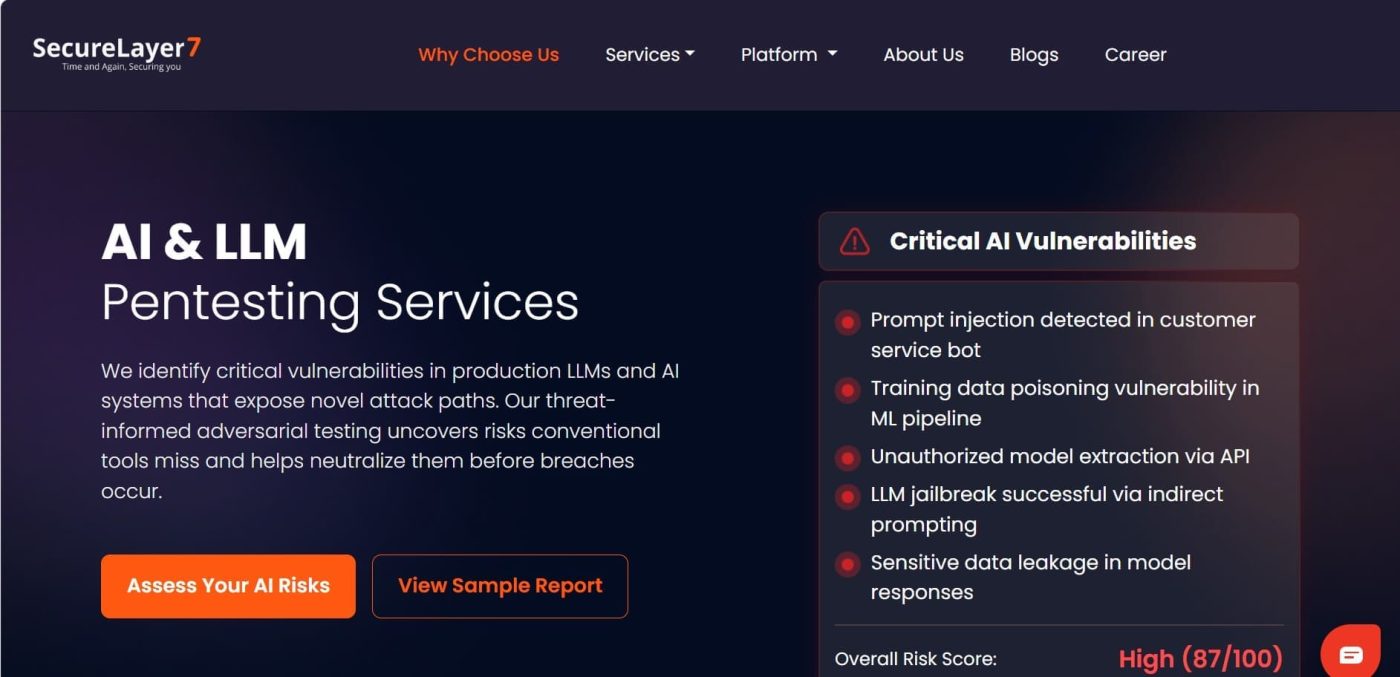
SecureLayer7 is a leading provider of AI and LLM penetration testing services, with established operations in India and North America. We deliver high-fidelity security testing and specialized AI risk mitigation.
We protect against the direct prompt injection, output-handling abuse, RAG-store poisoning, model data exfiltration, and OWASP Top 10 LLM risks.
To counter these evolving threats, our approach combines AI-driven automation with expert offensive security. We identify exploitable vulnerabilities and simulate real-world attack paths across APIs, cloud environments, and modern applications.
Key features:
- Integrates AI and human expertise
- A single autonomous app pentest
- Robust BugDazz PTaaS platform
- Crest-aligned report
- Customized testing and reporting ensures compliance with SOC 2, ISO 27001, PCI DSS, and HIPAA
Why choose SecureLayer7:
Choose SecureLayer7 for certified, expert human testers and tailored, audit-ready compliance reports across API, cloud, and AI deployments. It is ideal for product and engineering teams seeking transparent, platform-driven penetration testing. Our solution is suitable for mid- to large-sized enterprises seeking a cost-effective option.
2. Horizon3.ai
Horizon3.ai is an autonomous security solution built on the NodeZero platform. NodeZero uses a Cyber Terrain Map to link misconfigurations, compromised credentials, and vulnerabilities into realistic attack paths.
The platform delivers expert-led AI offensive capabilities, ensuring comprehensive security across internal, external, cloud, and Kubernetes environments.
Key features:
- Comprehensive AI-driven penetration testing services
- AI solutions tailored to address diverse threat scenarios
- Utilizes open-source intelligence (OSINT) to simulate targeted attacks
- Enables teams to prioritize critical security issues
Why choose Horizon3:
Choose Horizon3 if you require visibility into your infrastructure from an attacker’s perspective.
3. Pentera
Pentera is an automated security validation platform that incorporates threat simulation to continuously assess and validate an organization’s security posture. It enables you to prioritize critical security gaps, streamline remediation workflows, and demonstrate measurable risk mitigation.
Pentera provides continuous exposure management by combining internal and external penetration testing with cloud security validation. Its AI-driven features let security teams manage complex offensive operations through natural language commands.
Key features:
- Automated security validation
- Unified dashboard
- A natural language interface
- Validates security control for compliance
Why Choose Pentera:
Select Pentera if you manage a large global enterprise and require continuous, large-scale offensive testing across your entire attack surface.
4. BreachLock
BreachLock is a leading offensive security testing provider offering pentesting-as-a-service (PTaaS) that integrates AI automation with human expertise. The company delivers AI scans and specialized assessments for large language models (LLMs) and AI assets. By automating manual reporting, BreachLock allows security professionals to concentrate on identifying and addressing complex, high-impact vulnerabilities.
Key features:
- Consolidates all data into a unified dashboard
- Tests vulnerabilities in live production environments
- Supports testing of complex business logic
- Provides compliance-driven manual assessments
Why choose BreachLock:
Choose BreachLock if your security team is overwhelmed by alerts and requires clear, evidence-based validation of vulnerabilities in your live production environment.
5. Cobalt
Cobalt combines human pentesters with AI. Its “Cobalt Core” platform handles the actual testing, while AI takes care of different phases of recon, attack surface mapping, and quick validation of findings. It also tests LLM-based apps for adversarial risks. It fits into DevSecOps workflows.
Key features:
- Automated reconnaissance to map attack surfaces
- Adversarial LLM testing for simulating advanced attacks
- Targeted testing for LLM vulnerabilities
- AI-powered writing assistants
Why choose Cobalt:
- It is ideal for agile security teams looking for fast pentesting cycles.
6. NetSPI
NetSPI is a reputed enterprise penetration testing provider specializing in application, cloud, and infrastructure security. By integrating AI security assessments into its established testing portfolio, NetSPI offers a structured, scalable approach to securing modern digital ecosystems.
It offers LLM web application testing services and LLM benchmarking and jailbreaking services.
Key features:
- Combines manual and NetSpi platform capabilities
- Strong at testing AI features along with cloud and application infrastructure
- Structured enterprise reporting
- Provides continuous and traditional LLM assessments
- Built for large-scale architectures
Why choose NetSPI:
- Enterprises operating on complex, multi-system architectures
- Security teams looking for standardized reporting and centralized risk management dashboards
7. Software Secured
Software Secured has positioned itself as a leading AI penetration testing company. It has a clear focus on product-driven AI systems, including AI features, Agents, chatbots, and MCP Servers.
It conducts manual, hacker-led testing across the full AI stack: the model, data retrieval, connected tools, agents, and AI-written code. It prioritizes testing complex decision paths and model behaviors over simple endpoints.
Key features:
- Identifies prompt injection (direct/indirect), RAG poisoning, and agent-based privilege escalation
- Full-time certified specialists perform tests
- Methodology maps to OWASP LLM Top 10 , Mitre AI ATLAS Matrix, Google SAIF Risks
Why choose Software Secured:
- SaaS and product-led companies
- Engineering teams that require technical, high-fidelity validation
8. Escape (Escape.tech)
Escape is an AI penetration testing platform designed to help security teams move beyond annual or quarterly assessments. It continuously tests applications, APIs, and cloud assets for real-world attack paths, providing clear evidence of how vulnerabilities can be exploited and how they should be fixed.
The platform also turns previously discovered vulnerabilities into repeatable tests, helping teams catch recurring issues before release.
Key features:
- Continuous AI-powered penetration testing
- Multi-agent AI penetration testing
- Multi-step attack path validation
- Evidence-backed vulnerability verification
- Automated security regression testing
Why choose Escape:
Escape is best suited for organizations that rely heavily on APIs and need deeper visibility into logic-based vulnerabilities. It is ideal for high-growth SaaS and teams managing complex API ecosystems.
9. XBOW
XBOW earned recognition for its advanced exploitation capabilities and speed in assessing complex enterprise attack surfaces. XBOW is an automated, AI-driven penetration testing platform that simulates expert human hackers to provide continuous offensive security.
It uses a coordinated fleet of AI agents to plan, execute, and validate real-world attack chains at machine speed, reducing reliance on manual penetration testing.
Key features:
- Verified proofs-of-concept (PoC) validated by a dedicated agent
- Integrates seamlessly with Microsoft Sentinel and Security Copilot
- Orchestrates thousands of independent AI agents
- Deploys advanced AI for adaptive exploration
- Delivers reproducible exploit evidence for every alert
- Automates the full pentesting lifecycle
Why choose XBOW:
- Ideal for engineering-heavy organizations
- Security teams prioritizing audit-ready reports for SOC 2, ISO 42001, and the EU AI Act
10. Novee
Novee is a recognized leader in AI-powered security services. Its attacker-trained AI reasoning model, developed by experts in offensive cyber operations, uses proprietary technology to simulate real-world adversary behavior.
Key features:
- AI-trained model capable of starting grey-box and black-box testing
- Simulates advanced persistent attacks
Why choose Novee:
Designed for organizations with fast-moving CI/CD pipelines and AI-first enterprises deploying LLM-powered applications or autonomous agents.
Final Thoughts
Choosing the right AI pentesting provider is about more than automation. For high-risk environments, compliance requirements, and complex applications, human expertise is critical for identifying vulnerabilities that tools alone may overlook. Look for providers that follow recognized frameworks such as OWASP and can assess emerging AI-specific threats.
SecureLayer7 combines AI-powered automation with expert-led testing to deliver comprehensive security assessments at scale. Talk to our experts now to learn how we can help.
Frequently Asked Questions (FAQs)
Standard scanners detect known bugs. AI pentesting uses human-like reasoning to link exploits together. It goes further by automatically confirming threats, so your team focuses only on real, high-risk issues instead of chasing false alarms.
Not completely. Continuous security checks help you stay ready for audits all year, but most standards still need regular reviews by people. Combining both methods is the best way to meet auditor requirements and real security needs.
A trustworthy vendor should match their findings to MITRE ATLAS or the OWASP Top 10 for LLMs. Make sure the platform shows a clear reasoning path, so your team can see how each simulated attack works.
It swaps lengthy reports for clear, useful information. Top tools offer scripts you can run again, automatic code fixes, and direct links to JIRA or GitHub, so engineers can fix problems as quickly as they deploy code.